2.976 Ergebnisse
Best.-Nr. feb43256Used. For more details please contact me unknown
2002Best.-Nr. Q-1567316263Barnes & Noble 2002-01-01. Hardcover. New. New. In shrink wrap. Looks like an interesting title! Barnes & Noble hardcover
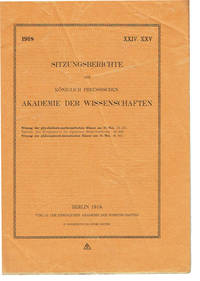
1918Best.-Nr. 5721KBerlin: Verlag der Königlichen Akademie der Wissenschaften in commission at Georg Reimer Reichsdruckerei 30th May 1918. Near Fine. Imperial 8vo 26 5: 19 cm. 11 pages numbered 448-459. Letterpress on machine paper in original publisher’s brochure on orange-coloured stock with black title printing. First journal issue in the original printed wrappers of Einstein's paper about the energy of a gravitational field. – Contents: ""Einstein in this present paper answers criticisms of his conservation law in general relativity and the pseudotensor used to express it first expressed in »Hamiltonsche Prinzip und allgemeine Relativitatstheorie« 1916. He argues that an integral form of the law is appropriate and shows that the integral of a closed system's total energy is invariant and conserved and can be measured only far from the source. The pseudotensor played the key role in his analysis of gravitational waves."" Einstein Encyclopaedia – Condition: Some pages crease due to handling and reading otherwise fine uncut and therefore unread copy. – Reference: Boni N.: A bibliographical checklist and index to the published writings of Albert Einstein 109; The Collected Papers of Albert Einstein. Volume 7 9; Shields M. C.: Bibliography der Schriften Einsteins. In: Schilpp P. A.: Albert Einstein als Philosoph und Naturforscher 118; Weil E.: Albert Einstein. A bibliography of his scientific papers 1901-1930 99; Calaprice A.: An Einstein Encyclopaedia p. 300. Verlag der Königlichen Akademie der Wissenschaften (in commission at Georg Reimer [Reichsdruckerei]) unknown
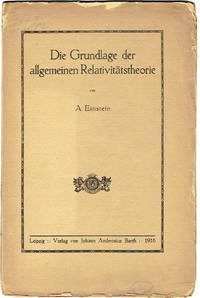
1619Best.-Nr. 5711KLeipzig: Johann Ambrosius Barth Omnitypie-Ges. Nachfl. L. Zechnall Stuttgart; Metzger & Wittig Leipzig Wrappers 1916 but c. 1919. Near Fine. 8vo. 16: 24 3 cm. 64 pages. Letterpress on machine paper in original publisher’s wrappers on cream stock with black title printing on covers and spine incorporating publisher's emblem and ornamental framing on front cover as well as publisher's advertisements on rear cover. Particularly rare early anastatic reprint of the first separate edition of Einstein's first and most important synopsis of his general theory of relativity. – Edition Contents: „In mid-January 1916 Einstein had still expressed doubts about his ability to write such a paper calling his writings ""correct but quite indigestible"" ""zwar richtig aber reichlich unverdaulich."" Einstein to H. A. Lorentz 17 January 1916“. But a „few months after the final papers had appeared 4 papers of Nov. and Dec. 1915 where he finally had completed the theory of general relativity as a logical structure note WoP Einstein was ready to spend some time writing a review paper in which the whole theory was presented and explained in a consistent and accessible way . It gives an excellent overview of the theory.“ cf. Einstein Papers. For present synopsis Einstein also made substantial additions published here for the first time. „Einstein’s paper of March 1916 concludes with a brief section on the three new predictions: the red shift the bending of light and the precession of the perihelion of Mercury. In the final paragraph of that section is recorded the single major experimental confirmation which at that time could be claimed for the theory: the Mercury anomaly. In 1916 next to nothing was known about the red shift; the bending of light was first observed in 1919.“ cf. Paise – The paper was first printed on May 11th 1916 in the special interest journal »Annalen der Physik« series 4 vol. XLIX issue no. 7 pp. 769-822 and probably simultaneously as separate printing in book form by the Leipzig editor Barth titled »Sonderdruck« enlarged with an introduction by Einstein and a table of content. Edited in this way and therefore more accessible for a broader audience of interested lay people the Barth book edition of Einstein's probably most important achievement in the history of science became popular and was reprinted several times until 1929. According to Weil present first reprint from 1919 is of better printing quality than others and is bound in the original paper wrappers of the 1916 edition with an updated publisher's ads list of 5 available titles appearing between 1911 and 1918. – Condition: Former faults and tears at margins of front and rear cover skilfully restored front cover with shelf wear paper time-stained otherwise clean copy. – Rarity: Scarce in trade. RHB ABPC 1973ff. and JBP/JAP/APO record 4 copies of this particular reprint in the original wrappers and comparable condition at auction 2016 2014 former copy of Karl Malmkvist 2006 2004. – Reference: Boni N.: A bibliographical checklist and index to the published writings of Albert Einstein 78 for the journals issue 78.1 for the separate edition; Carter/Muir Bücher die die Welt verändern 725; Norman 696 for the journal issue; Shields M. C.: Bibliography der Schriften Einsteins. In: Schilpp P. A.: Albert Einstein als Philosoph und Naturforscher 84 for the separate edition 86 for the journal issue; The Collected Papers of Albert Einstein. Volume 6 30 cit. p. XIX and p. 238 fn 1; Weil E.: Albert Einstein. A bibliography of his scientific papers 1901-1930 80a; Pais A.: Subtle is the Lord. The Science and Life of Albert Einstein 2005 ed. p. 273; Sauer T. „Albert Einstein review paper on general relativity theory“. In: Grattan-Guinness I. et al. ed.: Landmark Writings in Western Mathematics 2015 pp. 802-22. Johann Ambrosius Barth (Omnitypie-Ges., Nachfl. L. Zechnall, Stuttgart; Metzger & Wittig, Leipzig [Wrappers]) unknown
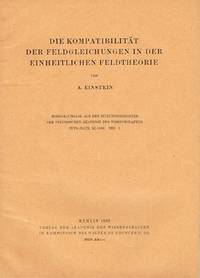
1930Best.-Nr. 5741KBerlin: Verlag der Akademie der Wissenschaften in commission at Georg Reimer Reichsdruckerei 6th February 1930. Near Fine. Imperial 8vo 25 4: 18 2 cm. 8 pages. Letterpress on machine paper in original publisher’s brochure on orange stock with black title printing. First offprint in the original wrappers and new pagination of this late paper by Einstein about the Unified Field Theory - Condition: Mint. - Reference: Boni-Russ-L. 195; Schilpp-Shields 239; Weil 169 quotes the pagination of the first separate printing p. 18-23. Verlag der Akademie der Wissenschaften (in commission at Georg Reimer [Reichsdruckerei]) unknown
1941Best.-Nr. 2142520/12/1941. Brigitte Kaufmann was born in Germany but when the Nazis came to power in 1933 she fled to Paris. In France Kaufmann worked as an actress under the name of Brigitte Châtel and translated documents. She met her future husband Alfred Alexander-Katz in Paris and they married in 1939; the following day her husband was taken to an internment camp. He was given the choice of being interned in a labor camp or joining the Foreign Legion and chose the latter. Alexander was then sent to Clermont in Vichy France and the family relocated there. Dr. Walter Rudlin was a social science professor at Sarah Lawrence College in New York and actively involved in anti-fascist activities. He was the author of “The Growth of Fascism in Great Britain”. In September 1942 he left his position and joined the U.S. Board of Economic Welfare whose chair was Vice President Henry Wallace. His wife Eryl was interested in bringing Jews in Europe out of harm’s way and she knew the Alexander-Katz family. So Eryl sought to get Brigitte and her family safely out of Europe to Mexico and sought Einstein’s help. On March 12 1941 Einstein responded noting that Brigitte is his relative. “Thank you very much for your letter of March 11th. I am very gratified indeed to learn that our mutual friends Fred and Brigitte Alexander-Katz have some prospect to receive a visa into Mexico. I am certainly willing to vouch for their reliability and integrity both personal and political. I have known Mrs. Brigitte Alexander-Katz - whose family is related to mine - since she was a little girl. Her husband a very able engineer will certainly be useful to any country which receives him. If you will send me the address of the proper Mexican authority I shall gladly send any letter of recommendation desired.” This was a warm letter indeed expressing true concern and friendship for the Alexander-Katz family. On April 3 1941 Einstein again wrote Rudlin noting “Enclosed I am sending you the requested letters in the hope that they may be successful.” But there were delays and no visa so Rudlin wrote Einstein seven months later asking him to take the matter up with the Mexican government. Typed letter signed on his blind-embossed letterhead Princeton December 20 1941 to Mrs. Eryl Rudlin saying that he expects the visa to be granted but does not feel he ought to approach the Mexican government directly. “The Mexican authorities know that I am interested in the case of the Alexander-Katz family; they have kept me informed about the whole development of the matter. I have no doubt that admission to Mexico will be granted as it has been granted to hundreds of people in the same situation. I can give Mr. Alexander-Katz a recommendation but it is out of the question that I ask the Minister of Education to send him an official invitation. I have already done what could be done without intrusion.” Despite what he writes here to calm Mrs. Rudlin Einstein might have exerted some gentle pressure on Mexico by contacting the Mexican ambassador to the U.S. Gilberto Bosques; or the Alexander-Katz visas may have already being granted at that moment. The Einstein Archives is silent on this subject. But soon after Einstein soon wrote this letter in 1942 a telegram to the young Alexander-Katz family arrived stating that Einstein and Rudolph Uhlman a lawyer in New York had secured visas through Ambassador Bosques for them to escape to Veracruz Mexico aboard the ship San Thomé. In Mexico Brigitte she became a noted author actress director and translator. She became the first woman in Mexico to produce and direct television programs. Speaking five languages she also worked as a translator for UNESCO and Amnesty International. Her daughter Susana and granddaughter Sophie also became actors. unknown
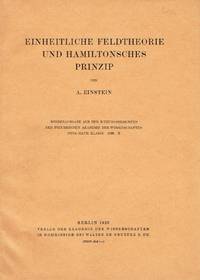
1929Best.-Nr. 5740KBerlin: Verlag der Akademie der Wissenschaften in commission at Georg Reimer Reichsdruckerei 23th April 1929. Near Fine. Imperial 8vo 25 4: 18 2 cm. 6 pages. Letterpress on machine paper in original publisher’s brochure on orange stock with black title printing. First offprint in the original wrappers and new pagination of this late paper by Einstein about Hamilton's principle of stationery applied for the Unified Field Theory. - Content: Einstein already had succesfully used Hamiltion's achievements in the field of classical mechanics for his General Theory of Relativity in 1926. - Condition: Mint. - Reference: Schilpp-Shields 227; Weil 166 quotes the pagination of the first separate printing p. 156-159. Verlag der Akademie der Wissenschaften (in commission at Georg Reimer [Reichsdruckerei]) unknown
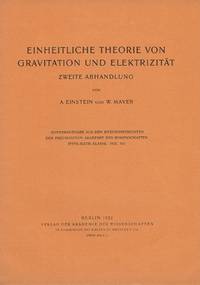
1931Best.-Nr. 5745KBerlin: Verlag der Akademie der Wissenschaften in commission at Georg Reimer Reichsdruckerei 2nd December 1931; 30th April 1932. Near Fine. Imperial 8vo 25 4: 18 2 cm. 19 1 pages; 12 pages numbered 235-245 1. Letterpress on machine paper in original publisher’s brochures on salmon-coloured and orange stock with black title printing. First offprints in the original wrappers and new pagination of this important two-part paper by Einstein formulating new developments towards Unified Field Theories. - Content: Einstein made several attempts at a five-dimensional unified field theory including this two-part collaboration with Austrian mathematician Walther Mayer nicknamed „Einstein's calculator“ ""in which a new unified field theory was proposed one based on a four-dimensional space-time continuum with a five-dimensional tangent space attached at each point"" Pais Subtle is the Lord p. 492. - Condition: Very well preserved. - Reference: Boni-Russ-L. 207; Printing and the Mind of Man 416 „Principal Work“; Schilpp-Shields 251 and 261; Weil 182 and 185 quotes the paginations of the first separate printings p. 541-557 and 130-137. Verlag der Akademie der Wissenschaften (in commission at Georg Reimer [Reichsdruckerei]) unknown
Best.-Nr. 315800The Easton Press. Hardcover. Fine. Typical Easton binding. All four books have unused bookplates laid in. Trivial gilt nicks. A Fine copy. The Easton Press hardcover
1947Best.-Nr. 316757Emergency Committee of Atomic Scientists 1947. Paper Back. Very Good. Letterhead of Emergency Committee of Atomic Scientists on two sheets soliciting contributions to the Committee. Dated August 6 1947 the second anniversary of the Hiroshima bombing. An original typed letter with a facsimile Einstein signature in blue ink. Emergency Committee of Atomic Scientists unknown
Best.-Nr. 2091502133539294Iwanamishoten N.A. Soft Cover. Fine. Number of books: 1 Iwanamishoten paperback
Best.-Nr. A9781258115357Paperback / softback. New. paperback
Best.-Nr. B9781258115357Paperback / softback. New. paperback
1988Best.-Nr. Q-0517345803Random House Value Publishing 1988-12-12. Hardcover. New. New. In shrink wrap. Looks like an interesting title! Random House Value Publishing hardcover
1988Best.-Nr. DADAX05173458031988-12-12. Avenel 1981 ed. hardcover. New. xx. Buy with confidence. Excellent Customer Service & Return policy. hardcover
1997Best.-Nr. ZB3938491997-2000. volumes 4; 6-7. 1997-2000. partly bound library markings textually clean & tight PRICE IS FOR THE LOT. - If you are reading this this item is actually physically in our stock and ready for shipment once ordered. We are not bookjackers. Buyer is responsible for any additional duties taxes or fees required by recipient's country. unknown
Best.-Nr. B9781013402906Hardback. New. hardcover
1949Best.-Nr. 160919012Philosophical Library 1949. Hardcover. very good/Good - considerable wear. Hardcover very good condition typical reader wear. Gift inscription inside front cover DJ very good but considerable wear. Philosophical Library hardcover
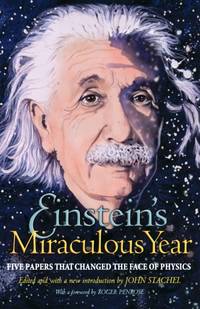
Best.-Nr. ria9780691122281_inpPaperback. New. New Book; Fast Shipping from UK; Not signed; Not First Edition; In twelve months after the year 1905 Einstein shattered many scientific beliefs with five papers that established him as the world's leading physicist. This book brings those papers including the papers that founded special relativity: paperback
1998Best.-Nr. 1-0691059381Princeton Univ Dept of Art & 1998. Hardcover. New. illustrated edition. 198 pages. 8.75x6.00x0.75 inches. Princeton Univ Dept of Art & hardcover
2004Best.-Nr. Q-0807615323George Braziller Inc 2004-05-17. Paperback. New. In shrink wrap. Looks like an interesting title! George Braziller Inc paperback
Best.-Nr. Juanpebooks045562WE ship worldwide. Brand new 100%guarentee unknown
Best.-Nr. 184029/9/54. The fullest summation we have seen by Einstein comparing relativity to Newtonian concepts of space and time Immanuel Kant took both Euclidean geometry and the Newtonian laws of motion to be synthetic a priori principles which from Kant’s point of view function as necessary presuppositions for applying our fundamental concepts of space time matter and motion to our sensible experience of the natural world meaning they are fixed necessary conditions. This idea rested on the absolute nature of space and time the work of Newton and the relationship between geometry and physics. In 1905 while a young patent clerk and physicist in Bern Switzerland Albert Einstein obtained his doctorate and published a paper that explained his newly developed Special Theory of Relativity. This unlocked many mysteries of the universe and introduced the world to ""e=mc2"" equating mass and the speed of light with energy. It established that time and space are not fixed and in fact change to maintain a constant speed of light regardless of the relative motions of sources and observers. Just 10 years later in 1915 Einstein published his General Theory of Relativity which described the universe as a four-dimensional continuum with time added as the fourth dimension where gravitational effects are explained by the warping of space-time. In this theory Einstein incorporated gravity as a geometric property of space-time. The impact of Einstein's work between 1905 and 1915 challenged many principles of physics that had been accepted for centuries. In 1921 he won the Nobel Prize for his work. Time Magazine named him the Person of the Century for the 20th century for his discoveries in relativity and space-time. Einstein is the most important scientist since Isaac Newton and probably the most famous in history. Space and time were considered relativistic more subjective and not the fixed a priori notions that had long permeated the mathematical and scientific worlds. Max Fischler was a California scientist who was interested in the implications of this distinction: were space and time now to be studied together in this context only or were the nature of space and the nature of time different In special relativity what appears simultaneous to one person might not to another - they are relative. You cannot separate space and time; they occur subjectively and semi-dependently but are not tied to the content of that space. With General Relativity space-time remains but matter warps it. It's a field like the sheet of a trampoline but reacts to matter. One needs all four dimensions of space-time and without them the others don't exist. You need matter for space. On September 5 1954 he wrote to Einstein: "".Can anything in your theory of Relativity be said to throw new light on the nature of space and time themselves Or must we rest satisfied with the purely new logical treatment of these conceptions In other words does the new view of space and time as space-time carry any new meaning ontologically beyond the purely mathematical and logical relationship between the two. Or to put it differently: When Minkowski in his famous words said 'Space by itself and time by itself must not sink into the mere shadows and only a kind of union of the two can preserve an independent existence' did he not attach some new real meaning to the 'spacetime' which the old independent notions of space and time could not convey If so in what does this new meaning consist."" Four days later Einstein replied in this letter: Typed letter signed in German on his personal blind embossed letterhead Princeton September 9 1954 to Max Fishler. ""The expression cited in the second paragraph only signifies the wish for logical clarity in the formal expressions. De facto the justification for concepts lies in their ability to comprehend the empirically given. ""In classical mechanics space and time were completed existences which had to be presupposed as real a priori in order to give meaning to the laws of motion. It was a reality in the same sense as the reality of matter; even governing the latter. In this sense Kant was entirely wrong. ""The case was the same as regards the Special Theory of Relativity only that an objective separation of space and time was abandoned in the sense that there could no longer be any objective simultaneity. Here too the four dimensional space is a reality independently of the physical content of space. ""Regarding the General Theory of Relativity however this is principally different. What we call ""space"" is here only an extension of a Field dimensionality hence no longer independent of the content of space. It is real in the same sense as matter but has no real existence independently of matter. When the field is taken away there does not remain any space but just nothing.” Letters of Einstein directly relating to relativity are increasingly uncommon and this is one of the finest such letters we have had. unknown
1950Best.-Nr. 50104New York: Philosophical Library 1950. First Edition. Hardcover with Dust Jacket. Rare VG First Edition. DJ is in VG condition and has the original $3.00 price. In an acetate. Moderate foxing through the book but unmarked with VG binding. . Philosophical Library hardcover
Best.-Nr. 67-01046Philosophical Library. Hardcover. Very Good. Very good condition with dust jacket. Few tears. Philosophical Library hardcover