1 909 résultats
1979réf. 78271Interlibrium 1979-01-01. Hardcover. Like New. As new cream colored hardcover #172 of limited edition no jacket as issued. Please email for photos. Interlibrium hardcover
1949réf. 31509Evanston Ill: Library of Living Philosophers 1949 Book Date 1949. 1st Edition. No Binding. Clamshell As New/No Jacket. 1st Edition. No Binding. First Edition Clamshell Case. Albert Einstein. ALBERT EINSTEIN: PHILOSOPHER-SCIENTIST. Edited by Paul Arthur Schilpp. Evanston Ill.: Library of Living Philosophers 1949. First Trade Edition. Superb Custom Fitted Modern Collector's Clamshell Not A Book HAND-CRAFTED by our conservation team each case features a gilt stamped spine title piece & signature cut on the upper cover both on maroon leather. The clamshell case is finished in fine black cloth & black Nuba®. Nuba® is a fine supple & durable covering with a neutral ph that has the feel of velvety soft Italian Nubuck® leather. An excellent Collector's Custom Case for this uncommon Einstein. Other Einstein Cases are readily available. TBCL Web Site photo/link available for OVER 100 generally in-stock titles. Book definitely NOT included. Custom Craft available. Library of Living Philosophers, [1949, Book Date] unknown
1979réf. 309856PRINCETON: PRINCETON UNIVERSITY PRESS. Fine with no dust jacket. 1979. Poster. Promotional POSTER. 17 1/2" X 22 1/2" Fine on a single printed sheet. Splendid illustrated portrait of Einstein on tan-colored paper set against the heading- "The Albert Einstein Centennial 1879-1979." Suitable for framing. . PRINCETON UNIVERSITY PRESS. unknown
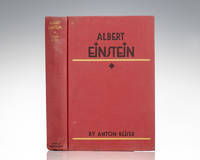
1930réf. 144683New York: Albert & Charles Boni 1930. First edition early printing of this Einstein biography written by Rudolf Kayser a German literary historian and husband to Albert Einstein's stepdaughter Ilse under the pseudonym Anton Reiser. Octavo original cloth frontispiece of Einstein. In near fine condition. Albert Einstein developed the general theory of relativity one of the two pillars of modern physics alongside quantum mechanics. Einstein's work is also known for its influence on the philosophy of science. Einstein is best known in popular culture for his mass–energy equivalence formula E = mc2 which has been dubbed "the world's most famous equation". He received the 1921 Nobel Prize in Physics for his "services to theoretical physics" in particular his discovery of the law of the photoelectric effect a pivotal step in the evolution of quantum theory David Bodanis. Albert & Charles Boni hardcover
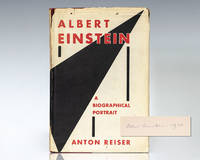
1930réf. 138499New York: Albert & Charles Boni 1930. First edition of this Einstein biography written by Rudolf Kayser a German literary historian and husband to Albert Einstein's stepdaughter Ilse under the pseudonym Anton Reiser. Octavo original cloth frontispiece of Einstein. Signed and dated by Einstein in the year of publication on the front free endpaper "Albert Einstein 1930." Near fine in a very good dust jacket. Rare signed and in the original dust jacket. Albert Einstein developed the general theory of relativity one of the two pillars of modern physics alongside quantum mechanics. Einstein's work is also known for its influence on the philosophy of science. Einstein is best known in popular culture for his mass–energy equivalence formula E = mc2 which has been dubbed "the world's most famous equation". He received the 1921 Nobel Prize in Physics for his "services to theoretical physics" in particular his discovery of the law of the photoelectric effect a pivotal step in the evolution of quantum theory David Bodanis. Albert & Charles Boni hardcover
1930réf. 110352New York: Albert & Charles Boni 1930. First edition of this Einstein biography written by Rudolf Kayser a German literary historian and husband to Albert Einstein's stepdaughter Ilse under the pseudonym Anton Reiser. Octavo original cloth frontispiece of Einstein. Signed and dated by Einstein on the front free endpaper in the year of publication "Albert Einstein New York 1930." In near fine condition. Housed in a custom half morocco clamshell box. Albert Einstein developed the general theory of relativity one of the two pillars of modern physics alongside quantum mechanics. Einstein's work is also known for its influence on the philosophy of science. Einstein is best known in popular culture for his mass–energy equivalence formula E = mc2 which has been dubbed "the world's most famous equation". He received the 1921 Nobel Prize in Physics for his "services to theoretical physics" in particular his discovery of the law of the photoelectric effect a pivotal step in the evolution of quantum theory David Bodanis. Albert & Charles Boni hardcover
réf. ria9780313273636_inpHardcover. New. New Book; Fast Shipping from UK; Not signed; Not First Edition; N/A hardcover
réf. 637393386ABC-Clio Incorporated . Hardback. New. pp. 340 ABC-Clio, Incorporated hardcover
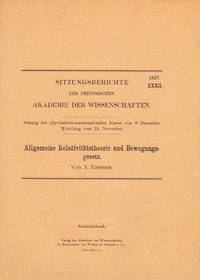
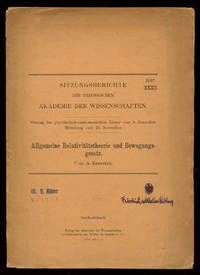
1927réf. 5736KBerlin: Verlag der Akademie der Wissenschaften in commission at Georg Reimer Reichsdruckerei 24th February 1927; 14th February 1928. Near Fine. Imperial 8vo 25 4: 18 2 cm. 12 pages numbered 2-13; 12 pages numbered 235-245 1. Letterpress on machine paper in original publisher’s brochures on orange stock with black title printing. First offprints in the original wrappers of two of Einstein's papers about the interrelations of the General Theory of Relativity and the Law of Motion the 2nd paper conducted with his assistant Jakob Grommer. - Condition: Mint. - Reference: Boni-Russ-L. 171; Schilpp-Shields 212; Weil 155 and 160. Verlag der Akademie der Wissenschaften (in commission at Georg Reimer [Reichsdruckerei]) unknown
1927réf. 1663Berlin: Verlag der Akademie der Wiss 1927. 1st Edition. FIRST EDITION OFFPRINT ISSUE IN ORIGINAL PAPER WRAPS VERY GOOD CONDITION. "Einstein and Grommer's work treats the particle as a singularity in the field and attemptss to obtain the equations of motion by imposing conditions on the exterior field in the neighborhood of the singularity" Stachel Einstein from 'B' to'Z' pp. 507. Weil 155. In 1927 Einstein's research "concentrated on a new approach to the problem of the motion of particles in a general field theory" Mehra The Golden Age of Theoretical Physics 997. He presented his work conducted with Jakob Grommer in this report. Einstein and Grommer here show that 'in the case of a pure gravitational field the mechanical behavior of singularities can be derived' a result which in Einstein's opinion 'opened the possibility to obtain on the basis of the field equations a theory of matter characterized as discontinuities in space' ibid 997; Einstein and Grommer 1927. "After Einstein had tried for years to obtain a theory of material particles in a generalized field theory by describing these objects with the help of continuous functions Einstein and Grommer now proposed 'to consider elementary particles as singular points or singular world lines respectively' motivated by the observation 'that both the equations of the pure gravitational field and the equations augmented by Maxwell's electromagnetic field possess simple spherically-symmetric solutions which contain a singularity' ibid. Finally they arrived at the result: In the approximation of the gravitational field obtained by solving linearized equations the equation of motion for a singularity is completely determined - at least in the case of equilibrium - and corresponds to the law of a geodetic line" ibid. CONDITION & DETAILS: Berlin: Verlag der Akademie der Wiss. Pp. 2-13. Offprint in original wraps. 10 x 7.25 inches; 250 x 181mm. Toning at the edges & bearing the ownership stamp of "Friedrich Wilhelm Ritter" W. F. Ritter 1839-1929. Ritter had a large library. Very good condition. Verlag der Akademie der Wiss paperback
1927réf. 433031927. Offprint from Sitzungsberichte der preussischen Akademie der Wissenschaften 1927. 235-245pp. 255 x 183 mm. Original printed wrappers. Fine. On the problem of motion in general relativity theory; a follow-up to his and Grommer's paper of the same title published earlier in 1927. Weil Albert Einstein Bibliography 160. unknown
1927réf. 374151927. Offprint from S. preuss. Akad. Wiss. Weil 155. unknown
réf. E04E-02027McGraw-Hill Osborne Media. Used - Very Good. Very Good condition. Sorry CD missing. A copy that may have a few cosmetic defects. May also contain light spine creasing or a few markings such as an owner’s name short gifter’s inscription or light stamp. McGraw-Hill Osborne Media unknown
réf. 0078822394.Gpaperback. Good. Access codes and supplements are not guaranteed with used items. May be an ex-library book. paperback
réf. 0078824028.Gpaperback. Good. Access codes and supplements are not guaranteed with used items. May be an ex-library book. paperback
réf. 1298941474.Ghardcover. Good. Access codes and supplements are not guaranteed with used items. May be an ex-library book. hardcover
réf. 101957027X.Ghardcover. Good. Access codes and supplements are not guaranteed with used items. May be an ex-library book. hardcover
réf. 0265215838.Ghardcover. Good. Access codes and supplements are not guaranteed with used items. May be an ex-library book. hardcover
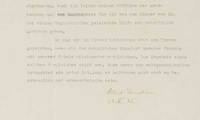
1935réf. 1383623/05/1935. He prophesizes however that the road ahead for the Jews will be “arduous and very painful” The Institute for Advanced Study in Princeton New Jersey was founded in 1930 by educator Abraham Flexner with funding from department store magnate Louis Bamberger. Flexner first recruited noted mathematicians from Princeton University to join the Institute then broadened its scope by including established scholars in economics politics and humanistic studies. In 1932 Flexner offered Einstein a faculty position at the Institute. Einstein’s decision was effected by historical events as in January 1933 Adolf Hitler became Chancellor of Germany. Soon after Einstein made the decision to resign from his Berlin position give up his German citizenship and accept the position in Princeton. The ocean liner Westmoreland which carried Einstein at age 54 to what would become his new home country arrived in New York Harbor on October 17 1933. <img class=""alignnone size-full wp-image-24695"" src=""https://cdn.raabcollection.com/wp-content/uploads/20231204145639/einsteinsig.gif"" alt="""" width=""1920"" height=""1080"" /> Einstein found the Institute and life in the United States congenial so in April 1934 just six months after his arrival Einstein announced that he was staying in Princeton indefinitely and assuming a permanent full-time status at the Institute. He would remain in the United States the rest of his life. Meanwhile he was very much a celebrity and was invited to the White House to meet with the Roosevelts. He politely declined saying he did not want to call attention to himself a position that German Jews had become accustomed to adopting during the rise of Naziism. However the First Lady Eleanor Roosevelt intervened writing Einstein directly requesting his presence. So Einstein and his wife Elsa arrived at the White House on January 24 1934 had dinner and spent the night. President Roosevelt was able to converse with them in passable German. Among other things they discussed Roosevelt’s marine prints and Einstein’s love for sailing. On learning that the Einsteins had decided to stay in the United States Roosevelt suggested that the Einsteins should accept the offer of some Congressmen to have a special bill passed on their behalf that he would sign granting them citizenship so that they would not have to endure the five year waiting period. The Einsteins declined the President’s generous suggestion saying they wanted to be treated like any other applicant for American citizenship. Because the Einsteins had not been sure of their ultimate destination and declared themselves as visitors instead of immigrants when they arrived in October 1933 this meant that they would need to leave the U.S. and return again to declare intention to seek citizenship. The United Jewish Appeal UJA planned a fund-raising dinner in Einstein’s honor for May 28 1935. This was exactly the time the Einsteins had set aside to leave the country to perfect their citizenship so he was forced to decline the invitation. He did however provide them with a statement that was received by the UJA on May 25 the very day the Einsteins stepped onboard the Queen Mary to travel to British-owned Bermuda for a few days to satisfy the formalities. The royal governor was there to greet them when they arrived in Hamilton and he recommended the island’s two best hotels. Einstein found them stuffy and pretentious. As they walked through town he saw a modest guest cottage and that is where they ended up. <img class=""alignnone wp-image-32085 size-post-window"" src=""https://cdn.raabcollection.com/wp-content/uploads/20240908143641/Einstein-May-23-1935-1-1600x968.jpg"" alt="""" width=""1600"" height=""968"" /> Typed statement signed in German Princeton May 23 1935 time stamped as received on May 25 to be read at the UJA dinner and issued to the press accordingly. It takes the moral high ground but warns of great dangers ahead. ”Unfortunately because of non-deferrable obligations I can only express in writing my recognition and gratitude for the assistance provided to the many unfortunate people by the dinner on the 28th of May. We can gain consolation in this critical time if we compare the moral standard of our friends and our enemies with each other. The result of such a comparison shows us that our way for world history can be considered the better one even if at times it is arduous and very painful.” Our research indicates that this important statement is unpublished as the dinner was postponed and it was never released to the press. But even this moving and forceful statement was not enough for the event organizers. Learning that Einstein could not attend they postponed the dinner. Instead the $50-a-plate dinner for the benefit of the UJA arranged by that organization and the Council of Jewish Organizations was held in New York City on June 26 with Einstein in attendance. About 1000 people attended the banquet at which Einstein spoke. In his speech Einstein returned to the same theme of morality as in the above statement saying that the ""moral disintegration and intensified national egoism"" of the times requires all Jews to strengthen their ranks to preserve Jewry. Of foremost importance he said was the upbuilding of the settlement in Palestine. On June 28 the UJA announced it was using the proceeds from the dinner to aid German refugees in New York City by allocating funds to local agencies equipped to care for the refugees. Einstein reentered the U.S. from Bermuda on June 3 1935. On January 15 1936 the Einsteins submitted their declaration of intention to become citizens of the United States. <img class=""alignnone wp-image-25018 size-post-window"" src=""https://cdn.raabcollection.com/wp-content/uploads/20231204144051/Folder-site-11-1600x1327.jpg"" alt="""" width=""1600"" height=""1327"" /> unknown
1961réf. 714603PN. New. 1961. Soft Cover. Date is original print. This is a reprint edition. . PN paperback
réf. 0994006918.Gpaperback. Good. Access codes and supplements are not guaranteed with used items. May be an ex-library book. paperback
1921réf. 302276Leipzig Felix Meiner 1921. 1921. First edition. 8vo. Foreword by Raymund Schmidt. Articles by Oskar Kraus Friedrich Lepsius Paul F. Lincke Joseph Petzoldt. Text pages numbered 334-500. Original stiff green wrappers printed in black. Very good. Cover title: Zur Relativitatstheorie. Kraus' article entitled: "Fiktion und Hypothese in der Einsteinschen Relativitatstheorie.". 1st Edition. Soft cover. Very Good/No Jacket. Leipzig, Felix Meiner, 1921. paperback
1929réf. ZB727262Leipzig : J.A. Barth 1929. 5. Folge 5th Series. Volumes 1 through 43 1929-1943 ALL PUBLISHED; all bound ex library else text clean & bindings tight. - If you are reading this this item is actually physically in our stock and ready for shipment once ordered. We are not bookjackers. Buyer is responsible for any additional duties taxes or fees required by recipient's country. Photos available upon request. Leipzig : J.A. Barth unknown
2005réf. b0979Chamberlain Bros. 2005. X310 pages. New Hardcover with sealed CD. New DJ. 8.5"x5.8"x1.0". be35 Chamberlain Bros. hardcover
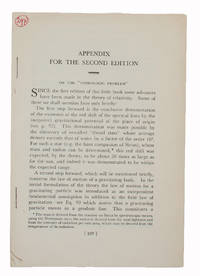
1950réf. 465431950. 8vo. Original proof-copy of the latest stage presumably final proof in the same format as the printed version and with no corrections printed on rectos and versos. Stapled twice in left margin. A few marginal creases. A proof- number to upper left corner in red ink 297. Pp. 109-148 tipped-in errata slip at p. 147. Very rare original proof-copy of the two highly important appendices for Einstein's "The Meaning of Relativity" third edition 1950 the second appendix being one of the most important pieces Einstein ever wrote namely the appendix "in which he described his most recent work on unification" Pais and the work which was hailed by The New York Times under the heading "New Einstein theory gives a master key to the universe". The first appendix which appeared for the second edition of the work remained unchanged throughout the history of "the Meaning of Relativity" and was written because "Since the first edition of this little book some advances have been made in the theory of relativity. . The first step forward is the conclusive demonstration of the existence of the red shift of the spectral lines by the negative gravitational potential of the place of origin" . A second step forward which will be mentioned briefly concerns the law of motion of a gravitating body." . A third step forward concerning the so-called "cosmologic problem" wiil be considered here in detail." pp. 109-10. The present 40 pages constitute the final proof-copy of the entire appendices I and II to the Generalized Theory of Gravitation exactly as they appeared in the third edition Princeton in 1950. Einstein's "The Meaning of Relativity" was originally published in 1922 on the basis of his "Vier Vorlesungen ueber Relativitetstheorie" given at Princeton in 1921. A second edition with an appendix appendix I appeared in 1945 several issues and editions of this appeared also and in 1949 the third edition with the seminal Appendix II printed for the first time appears also appeared in 1950 in Princeton. In 1950 a revised edition of the third edition appears having Appendix II slightly revised and in 1953 the heavily revised fourth edition appears. THIS IS THE PROOF-COPY OF APPENDICES I AND II FOR THE "THIRD EDITION INCLUDING THE GENERALIZED THEORY OF GRAVITATION" PRINCETON 1950. The main focus of the work throughout all these editions of the work since 1949 is Appendix II which deals with Einstein's main interest the generalization of the Gravitation Theory which was to unite the general theory of relativity with electromagnetism recovering an approximation for quantum theory and presenting us with a theory to explain the universe as a unified entity the ultimate goal for the greatest physicist that ever lived. "This was Einstein's ultimate response to the mechanical-electromagnetic crisis in physical theory he had first talked about in the opening of his 1905 light quantum-paper." Nandor in D.S.B. p. 330. It was indeed Einstein's aim to provide an explanation of the universe through his unified field theory although he was well aware that his sort of field theory might not exist. However even the establishing of the non-existence of it could bring us closer to an explanation than we had ever been before. There is no topic of greater importance to Einstein than his theory of unification. "In 1949 Einstein wrote a new appendix for the third edition of his "The Meaning of Relativity" in which he described his most recent work on unification. It was none of his doing that a page of his manuscript appeared on the front page of "The New York Times" under the heading "New Einstein theory gives a master key to the universe". He refused to see reporters and asked Helen Dukas to relay this message to them: "Come back and see me in twenty years"." Pais p. 350. unknown