EinsteinMareMagnum

2.978 Ergebnisse
1987Einstein La teoria della relatività. , Universale tascabile Newton 1987, Piatti e dorso segnati dal tempo. Tagli bruniti. Prima di copertina leggermente scollata. Interno brunito, complessivamente in buono stato. Buono (Good) . 111
1961in cofanetto
1922Brossura editoriale, buona copia. Ritrato di Einstein in antiporta. Prima edizione. Sc. U.
1951(Firenze, IGM, 1951) stralcio con copertina posticcia muta, pp. 779/782. - !! ATTENZIONE !!: Con il termine estratto (o stralcio) intendiamo riferirci ad un fascicolo contenente un articolo di rivista, sia che esso sia stato stampato a parte utilizzando la stessa composizione sia che provenga direttamente da una rivista. Le pagine sono indicate come "da/a", ad esempio: 229/231 significa che il testo è composto da tre pagine. Quando la rivista di provenienza non viene indicata é perchè ci è sconosciuta. - !! ATTENTION !!: : NOT A BOOK : “estratto” or “stralcio” means simply a few pages, original nonetheless, printed in a magazine. Pages are indicated as in "from” “to", for example: 229/231 means the text comprises three pages (229, 230 and 231). If the magazine that contained the pages is not mentioned, it is because it is unknown to us.
1961(Il mosaico del pensiero). 16°, pp.207 (1), t. cart. edit., astuccio edit. (Lineamenti della teoria della relatività e pensiero filosofico; Il principio di relatività nella meccanica classica;Relatività particolare; Cenno sulle geometrie non euclidee; Teoria della relatività generale e sintesi successive; Nuove vedute geometriche di Weyl e Eddington; Interpretazioni unitarie dei fenomeni naturali).
1998Best.-Nr. I-660-456Agora 1998. Paperback. Very Good. Ammareal gives back up to 15% of this item's net price to charity organizations. Agora paperback
1998Best.-Nr. BN672171Agora 1998. 1998. Softcover. La theorie de la relativite restreinte et generale La theorie de la relativite restreinte et generale Albert Einstein Agora paperback
Best.-Nr. 65642Gauthier-Villars Paris 1956 In-8 23 cm 179pp couverture avec dos restaure etat moyen Ats30 traduit de l'allemand par Maurice Solovine unknown
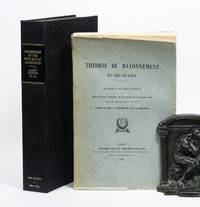
1912Best.-Nr. 2508Paris: Gauthier-Villars 1912. First edition. Original wrappers custom box. Very Good. RARE FIRST EDITION IN ORIGINAL WRAPPERS OF THE REPORTS FROM THE HISTORIC FIRST SOLVAY CONFERENCE "THE FIRST INTERNATIONAL CONFERENCE IN PHYSICS EVER ORGANIZED" AND A CRITICAL MOMENT IN THE BIRTH OF QUANTUM PHYSICS. In the short time that followed Planck's hypothesis of the universal constant that would bear his name the greatest minds in physics were largely at a loss about how to deal with the bizarre theoretical results that followed let alone the experimental results which confirmed them!. Much of the focus at the time was on black-body radiation including work by Planck himself as well as Lorentz Rayleigh and Jeans. However shortly before the first Solvay conference a young Einstein had also started investigating the related question of materials' specific heat. Kuhn. "The purpose of the first Solvay Conference was thus two-fold: first there was the need to examine whether classical theories molecular-kinetic theory and electrodynamics could in some undiscovered ways provide an explanation of the problem of black-body radiation and of the specific heat of polyatomic substances at low temperatures; secondly to consider phenomena in which the theory of quanta could be successfully used." Mehra. Underlying these questions was the more fundamental mystery of how to interpret the existence of the Planck constant. There were two camps both of which were represented at the conference. Planck's took the constant to indicate some fundamental constraint on the radiative processes of emission and absorption. For example "Sommerfeld introduced a version of the quantum hypothesis which he considered to be compatible with classical electrodynamics. He postulated that in 'every purely molecular process' a quantized quantity of action is exchanged." Staumann. Einstein's camp on the other hand took the quantum of action to represent the physicality of a perhaps pseudo-corpuscular theory of energy exchange - his photons of light. Although the debates that followed the lectures included in the proceedings did not rise to the famous heated exchange that Einstein would have with Bohr at the 1927 Solvay conference we do see some of the young Einstein's hotheadedness as he opens the debate following Planck's plenary lecture: "What I find strange about the way Mr. Planck applies Boltzmann's equation is that he introduces a state probability W without giving this quantity a physical definition. If one proceeds in such a way then to begin with Boltzmann's equation does not have a physical meaning." As translated by Straumann. It would take another 14 years for quantum mechanics to be fully formalized but the first Solvay conference represents a pivotal point in quantum history: "During 1911 the situation changed quickly. Articles that applied the quantum to other topics then outnumbered those on blackbody radiation for the first time and some were backed by impressive experimental evidence. In part because of that evidence physicists like Planck and Lorentz who had previously taken the constant h to be characteristic only of the radiation problem began to consider additional areas in which others had earlier staked quantum claims." Kuhn. Albert Einstein and the Solvay Conference: Among the most renown scientists of the day - including Ernest Rutherford Marie Curie and Max Planck - Einstein made quite an impression. At age 32 he was the second youngest participant in the conference. The youngest was British physicist Frederick Lindemann later to become scientific adviser to Winston Churchill. Although "Einstein had already published so many masterpieces none had actually been put to the test and his theories were looked on rather as tours de force than as definitive additions to knowledge. But his pre-eminence among the twelve greatest theoretical physicists of the day was clear to any unprejudiced observer." Frederick Lindemann quoted in Brian. References: Headline quote from the Solvay Institute website. Kuhn T. 1978 Black Body Theory and the Quantum Discontinuity 1894-1912. University of Chicago Press. Mehra J. 1975 The Solvay Conferences on Physics: Aspects of the Development of Physics Since 1911. Straumann N. 2011. On the first Solvay Congress in 1911. The European Physical Journal H 363 379-399. Denis Brian Einstein: A Life p.82. Paris: Gauthier-Villars 1912. Octavo original wrappers; custom box. Splits to top and bottom joint of upper wrapper two creases to front wrapper. Text in fine condition largely unopened. FIRST PRINTINGS IN ORIGINAL WRAPPERS ARE EXTREMELY SCARCE. Gauthier-Villars unknown
1912Best.-Nr. 2508Paris: Gauthier-Villars 1912. First edition. Original wrappers custom box. Very Good. RARE FIRST EDITION IN ORIGINAL WRAPPERS OF THE REPORTS FROM THE HISTORIC FIRST SOLVAY CONFERENCE "THE FIRST INTERNATIONAL CONFERENCE IN PHYSICS EVER ORGANIZED" AND A CRITICAL MOMENT IN THE BIRTH OF QUANTUM PHYSICS. In the short time that followed Planck's hypothesis of the universal constant that would bear his name the greatest minds in physics were largely at a loss about how to deal with the bizarre theoretical results that followed let alone the experimental results which confirmed them!. Much of the focus at the time was on black-body radiation including work by Planck himself as well as Lorentz Rayleigh and Jeans. However shortly before the first Solvay conference a young Einstein had also started investigating the related question of materials' specific heat. Kuhn. "The purpose of the first Solvay Conference was thus two-fold: first there was the need to examine whether classical theories molecular-kinetic theory and electrodynamics could in some undiscovered ways provide an explanation of the problem of black-body radiation and of the specific heat of polyatomic substances at low temperatures; secondly to consider phenomena in which the theory of quanta could be successfully used." Mehra. Underlying these questions was the more fundamental mystery of how to interpret the existence of the Planck constant. There were two camps both of which were represented at the conference. Planck's took the constant to indicate some fundamental constraint on the radiative processes of emission and absorption. For example "Sommerfeld introduced a version of the quantum hypothesis which he considered to be compatible with classical electrodynamics. He postulated that in 'every purely molecular process' a quantized quantity of action is exchanged." Staumann. Einstein's camp on the other hand took the quantum of action to represent the physicality of a perhaps pseudo-corpuscular theory of energy exchange - his photons of light. Although the debates that followed the lectures included in the proceedings did not rise to the famous heated exchange that Einstein would have with Bohr at the 1927 Solvay conference we do see some of the young Einstein's hotheadedness as he opens the debate following Planck's plenary lecture: "What I find strange about the way Mr. Planck applies Boltzmann's equation is that he introduces a state probability W without giving this quantity a physical definition. If one proceeds in such a way then to begin with Boltzmann's equation does not have a physical meaning." As translated by Straumann. It would take another 14 years for quantum mechanics to be fully formalized but the first Solvay conference represents a pivotal point in quantum history: "During 1911 the situation changed quickly. Articles that applied the quantum to other topics then outnumbered those on blackbody radiation for the first time and some were backed by impressive experimental evidence. In part because of that evidence physicists like Planck and Lorentz who had previously taken the constant h to be characteristic only of the radiation problem began to consider additional areas in which others had earlier staked quantum claims." Kuhn. Albert Einstein and the Solvay Conference: Among the most renown scientists of the day - including Ernest Rutherford Marie Curie and Max Planck - Einstein made quite an impression. At age 32 he was the second youngest participant in the conference. The youngest was British physicist Frederick Lindemann later to become scientific adviser to Winston Churchill. Although "Einstein had already published so many masterpieces none had actually been put to the test and his theories were looked on rather as tours de force than as definitive additions to knowledge. But his pre-eminence among the twelve greatest theoretical physicists of the day was clear to any unprejudiced observer." Frederick Lindemann quoted in Brian. References: Headline quote from the Solvay Institute website. Kuhn T. 1978 Black Body Theory and the Quantum Discontinuity 1894-1912. University of Chicago Press. Mehra J. 1975 The Solvay Conferences on Physics: Aspects of the Development of Physics Since 1911. Straumann N. 2011. On the first Solvay Congress in 1911. The European Physical Journal H 363 379-399. Denis Brian Einstein: A Life p.82. Paris: Gauthier-Villars 1912. Octavo original wrappers; custom box. Splits to top and bottom joint of upper wrapper two creases to front wrapper. Text in fine condition largely unopened. FIRST PRINTINGS IN ORIGINAL WRAPPERS ARE EXTREMELY SCARCE. Gauthier-Villars unknown books
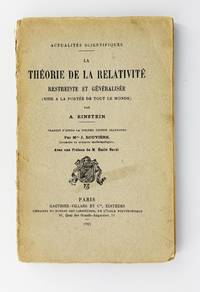
1921Best.-Nr. 009633Paris: Gauthier-Villars 1921 12mo 19 cm XXII 120 pp. Printed wrappers wrappers slightly stained and frayed; small portions of paper missing from the spine; paper toned inside. Early French edition of Einstein's celebrated popular exposition of the theory of relativity intended to make the fundamental ideas of both the special and the general theory accessible to non-specialists. With a preface by the renowned mathematician Émile Borel who emphasizes the scientific importance of Einstein's work and its profound implications for modern physics. Einstein's text explains the essential concepts of space time motion gravitation and the structure of space-time in clear largely non-technical language presenting the empirical and conceptual foundations of relativity to a broad readership. The French translation was prepared by Maurice Solovine one of Einstein's close early collaborators and an important mediator of his ideas to the French-speaking public. Boni-Russ-Laurence 91.B. Gauthier-Villars paperback
1922viii + 86pp, "Traduit d'après la 3e édition revue et augmentée par le p. H. Dopp S.J.", 24cm., brochure originale, manque aux pages 39-43 (petit trou au papier avec perte de quelques lettres, mais le texte est lisible), W98283
2015brossura A sessant'anni dalla sua morte Einstein è per la scienza quello che Maradona è per il calcio, Marilyn Monroe per il cinema e i Beatles per la musica. Mentre però tutti sanno che Einstein è un genio, ben poche persone sanno spiegare perché. Lo scopo di questo libro è narrare, in maniera allegra e divertente, le più importanti scoperte di Einstein, non solo quindi la teoria della relatività ma anche la dimostrazione dell'esistenza degli atomi o della natura quantistica della luce. Contrariamente a quello che si pensa, capire le idee di Einstein non richiede profonde conoscenze di fisica, ma solo la sua stessa fantasia nell'immaginare esperimenti con treni, orologi e raggi di luce e il suo stesso coraggio nella sfida alle idee convenzionali di spazio e tempo.
1985Mm 145x215 Volume nella sua brossura originale, 308 pagine. Copia eccellente, spedizione in 24 ore dalla conferma dell'ordine.
1984In 8, cm. 21,5 x 14,5, pp. 308 + (2), brossura editoriale illustrata. A cura di Fabrizio Battistelli, Carlo Berardini, Gianluca Devoto. Prefazione di Giuseppe Chiarante. esemplare in ottime condizioni
1990Bologna, 1990, 8vo stralcio con copertina posticcia muta, pp. 223/252 (testo in italiano e in inglese) . - !! ATTENZIONE !!: Con il termine estratto (o stralcio) intendiamo riferirci ad un fascicolo contenente un articolo, completo in se, sia che esso sia stato stampato a parte utilizzando la stessa composizione sia che provenga direttamente da una rivista. Le pagine sono indicate come "da/a", ad esempio: 229/231 significa che il testo è composto da tre pagine. Quando la rivista di provenienza non viene indicata é perché ci è sconosciuta. - !! ATTENTION !!: : NOT A BOOK : “extract” or “excerpt” means simply a few pages, original nonetheless, printed in a magazine. Pages are indicated as in "from” “to", for example: 229/231 means the text comprises three pages (229, 230 and 231). If the magazine that contained the pages is not mentioned, it is because it is unknown to us.
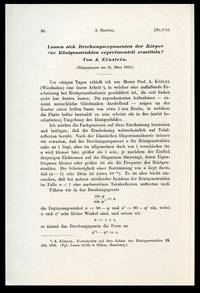
Best.-Nr. 1061Braunschweig: Druck und Vieweg. 1st Edition. FIRST EDITION FULL VOLUME OF THE PAPER IN WHICH EINSTEIN PROVIDES THE FIRST DESCRIPTION OF THE NATURE OF THE REFRACTIVE INDEX FOR X-RAYS here clearly demonstrating that phase contrast effects are significant. "Inspired by the presence of fringes at the edges of objects in early X-ray images and by considerations of optical dispersion theory Einstein suggested in 1918 that the real part of the index of refraction for X-rays in matter is slightly less than unity. This was confirmed in 1924 by Larsson et al. in measurements of wavelength-dependent refraction of X-rays by a prism" Hornberger Quantitative Amplitude 1. "A century later most x-ray microscopy and nearly all medical imaging remains based on absorption contrast even though phase contrast offers orders of magnitude improvements in contrast and reduced radiation exposure at multi-keV x-ray energies"ResearchGate November 2015. Weil 104. Note that we offer this paper separately in its original printed wraps. ALSO INCLUDED: Einstein's reply to Gehrcke's paper "Über den Äther" also present in this volume pp. 165-169. ALSO INCLUDED: Papers by E. Goldstein A. Landé Max Born and J. Petzoldt. CONDITION & DETAILS: Braunschweig: Druck und Vieweg. Full volume. Complete. 4to 9.25 x 6.25 inches; 225 x 150mm. Ex-libris with armorial bookplate on the front pastedown. Bound in brown cloth rubbed at the edges; the cloth has torn at the spine and has been re-glued. Clean throughout. Good . Druck und Vieweg paperback
1979Best.-Nr. ABE-11566986004ÉP-TROIS POÈTES ET LA LIBERTÉ/GIONO-LA RÉVOLUTION AFGHANE À L'ÉPREUVE DE L'ISLAM-LE CENTENAIRE D'EINSTEIN DANS LA PRESSE-M MONTALDO A RAMASSÉ 243 SACS D'ARCHIVES BANCAIRES SUR LE TROTTOIR
1979Best.-Nr. ABE-1571088270650LES PORTUGAIS EN FRANCE, 6P-COLLOQUES: EINSTEIN ET L'ANGE-BRETAGNE PLOGOFF: ASTERIX CONTRE EDF, 1P-CINEMA: TROIS CHAINES EN QUETE DE PRODUCTEURS, PAR HENRY CHAPIER-CREATION: L'ORDINATEUR A MUSIQUE, PAR PIERRE BOULEZ, DEMI PAGE, DESSIN D'AVOINE-UNE NOUVELLE INEDITE: UNE FUREUR DE WALLON, PAR CONRAD DETREZ-1 DECHIRURE SANS MANQUE P15/16 (10 CM)
1954Best.-Nr. 82611954 P., Plon, 1954, in 12 broché, 254 pages ; 7 gravures hors-texte et un fac similé dans le texte.
1991Best.-Nr. 68429Hermann, coll. "Savoir Cultures" 1991 1 vol. broché in-8, broché, couv. illustrée, 222 pp., portrait-frontispice. Préface de Bertrand Russell. Importants plis au plat inférieur de couverture. Sinon en bon état.
1991Best.-Nr. 68429Hermann, coll. "Savoir Cultures" 1991 1 vol. broché in-8, broché, couv. illustrée, 222 pp., portrait-frontispice. Préface de Bertrand Russell. Importants plis au plat inférieur de couverture. Sinon en bon état.
Best.-Nr. 106196Paris, Hermann, éditeurs des sciences et des arts 1991, 210x150mm, frontispice, 222pages, broché. Bel exemplaire.
Best.-Nr. AUB-1519
Best.-Nr. 1963P., Club du livre, 1957, un volume in 8 relié en pleine toile éditeur, 1 portrait d'EINSTEIN, 245pp.