Einstein, Albert, and Leopold InfeldBiblio.com
2 534 résultats
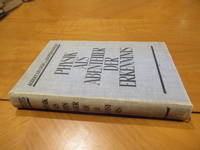
1938réf. 031895Leiden: A. W. Sijthoff's Uitgeversmaatschappij N. V. 1938. First Edition 1st Printing. Light Blue Cloth. Very Good/No Jacket. 9 7/8" Tall. Drawings. 222 Pp. True First Edition Of "The Evolution Of Physics" Issued Just Prior To The English Translation. Blue Cloth Printed In Black. Clean Unmarked. Covers With Slight Sunning To Spine Points Of Fraying At Two Front Tips Hinges Tight 1 1/2" Diameter Ring Mark At Left Fore Edge Of Rear Cover; Light Foxing Spots To Fore Edges Of Page Block But Pages Themselves Clean And Bright Without Spotting. A. W. Sijthoff's Uitgeversmaatschappij N. V. hardcover
1938réf. 009528Leiden: A. W. Sijthoff's Uitgeversmaatschappij N. V. 1938. First Edition 1st Printing. Light Blue Cloth. Near Fine/Very Good Dust Jacket. 9 7/8" Tall. Drawings. Viii 222 Pp. Light Blue Cloth Stamped In Dark Blue. True First Edition Of "The Evolution Of Physics" Issued Just Prior To The English Translation. A Clean Unmarked Copy With Signs Of Removal Of A Single Bookplate On The Front Endpaper No Other Marks. Dust Jacket With Some Wear And Browning Also With A 1 3/8" X 1 5/8" V-Chip At Top Of Rear Panel Adjacent To The Spine Very Small Chips At Tips With A 1" X 1/8" Loss Along Top Of Front Flap Fold And A 1/2" Closed Tear At Top Of Rear Panel With A Few Small Chips And Very Short Closed Tears. A Nice Copy In The Nearly Complete And Scarce Jacket. A. W. Sijthoff's Uitgeversmaatschappij N. V. hardcover
1994réf. 72747Heidelberg/Berlin, Spektrum Akademischer Verlag, 1994. Eine Einführung in die spezielle Relativitätstheorie 495 S. (24,5 cm) illustrierter Pappband / gebundene Ausgabe
1938réf. 42901Paris Freien Deutschen Hochschule 1938. Orig. printed wrappers. In. "Zeitschrift für Freie deutsche Forschung" Vol. I no. 1:pp. 5-19 a. no. 2 pp. 1-14. Whole issues present: "Nummer" 1 u. 2. pp. 1-168 a. pp. 1-144. The German version from the same year in which the paper was printed in "Franklin Institute Journal" vol. 221 1936. - Weyl. 197. unknown
1938réf. 165146Paris 1938. paperback. Pp. 5-19 IN: Zeitschrift fur Freie Deutsche Forschung. Jahrgang 1 Nummer 1. Herausgegeben von der Freien Deutschen Hochschule in Paris. 168p. printed wrappers. Paris Juli 1938. First number of this scarce short-lived exile publication featuring German & Austrian writers and scholars. Fine. unknown
1938réf. 165146Paris 1938. paperback. Pp. 5-19 IN: Zeitschrift fur Freie Deutsche Forschung. Jahrgang 1 Nummer 1. Herausgegeben von der Freien Deutschen Hochschule in Paris. 168p. printed wrappers. Paris Juli 1938. First number of this scarce short-lived exile publication featuring German & Austrian writers and scholars. Fine. unknown books
réf. BN168894WEKA MEDIA. Physik unterrichten: Der Mensch und Physiker Albert Einstein m. CD-ROM Physik unterrichten: Der Mensch und Physiker Albert Einstein m. CD-ROM Physik unterrichten: Der Mensch und Physiker Albert Einstein m. CD-ROM WEKA MEDIA unknown
réf. a90181Leipzig 1909 Hirzel. first edition. One full year of this semi-monthly German publication bound in one hardcover volume. Articles by many of the great names in physics and mathematics including Ladenburg Planck Hilbert Hahn Meitner Ramsey Zeeman Zamboni Zorn Thomson Curie Born Poincare and many more luminaries. Of special interest are H. Minkowski's "Raum und Zeit" p. 104-111 where time is posed as a fourth dimesion in a space-time representation of reality and 3 articles by Albert Einstein including his seminal paper where light is treated as both a wave and a particle. Hardcovers. Lg.4to. 1040p. XXVI photo plates complete text illustrations. Cover tips and backstrip dark brown leather with black boards. Institute name stamp on front blank and blindstamp on titlepage - no other ownership marks no pocket no spine numbers. Binding very secure; hinges not cracked in or out. Text clean. VG plus lightwear on cover spine edges and extreme tips. . hardcover
réf. a107840Leipzig 1913 Hirzel. 4to. 2 Hardcover volumes. Brown and yellow marbled boards with green cloth spine and tips. In German 560p. with 20 plates.and pp. 561-1312 with 36 plates. In addition to the important Einstein article "Zum Gegenwartigen stande des Gravitationsproblems" the volume contains important articles by other scientists including Max Born and Courant "Zur Theorie des Eotvosschen Gesetzes"; V F Hess "Uber den Ursprung der Durchdringenden Strahlung"; Otto Hahn and Lise Meitner "Radioaktinium und Aktinium" etc. Many important articles in history of science especially of physics. Light board edge wear. No owner marks. Pictures available on request. Near Fine. Two volumes. . hardcover
réf. a94363Leipzig 1916 first edition. Hirzel. Hardcover 4to. xiii 626p. Includes Einstein's Obituary for Ernst Mach on p. 101-104 Many significant scientific articles by Max Born Angstrom Sommerfeld Seeliger Freundlich others. Dark brown cloth with gilt spine lettering; brown papercoverd boards. VG. no owner marks. text clean and binding secure. light wear. . hardcover
réf. a91657Leipzig 1913 Hirzel. first edition. Physikalische Zeitschrift . Issues for Januar to Dezember bound in one hardcover 4to. Articles by many of the great names in physics and mathematics xxxi 1312p. 56 plates; text illustrations. In addition to the important Einstein article "Zum Gegenwartigen stande des Gravitationsproblems" the volume contains important articles by other scientists including Max Born and Courant "Zur Theorie des Eotvosschen Gesetzes"; V F Hess "Uber den Ursprung der Durchdringenden Strahlung"; Otto Hahn and Lise Meitner "Radioaktinium und Aktinium" etcBlack cloth. Ex-university library but no spine numbers. VG just light cover wear. Very heavy volume - may require extra postage. . hardcover
réf. a90182Leipzig 1908 Hirzel. first edition. Physikalische Zeitschrift. One full year of this semi-monthly German publication bound in one hardcover volume. Articles by many of the great names in physics and mathematics xix 928p. text illustrations 8 plates. "Eine neue Elektrostatische Methode zur Messung kleier Elektricitatsmengen" by Albert Einstein is on pp. 216-217; "Atomzerfall und Serienspektren "; Hahn and Meitner "Ueber Absorption der B-Strahlen" Planck "Theorie Dispersion" Lord Kelvin Helmoltz more. Cover tips and backstrip dark brown leather with black boards. Institute name stamp on front blank and blind stamp on titlepage but no other ownership marks no pocket no spine numbers. Binding very secure; hinges not cracked in or out. Text clean. VG plus light wear on cover spine edges and extreme tips. . hardcover
réf. a91421Leipzig 1908. Hirzel . first edition. Hardcover. large 4to. paginated pp. XIX 1-416 Plates. Einstein article "Eine neue elektrostatische Methode zur Messung kleiner Elektrizitatsmengen" on p. 216-217 3/4 black cloth with black marbled boards. Very light old library marking with a few circular stamps in text and one small white label on top corner front board. No spine numbers. Mounted printed white paper spine label. VG light wear text Fine. . hardcover
réf. a94365Leipzig 1900 to 1913 first edition. Hirzel. 16 volumes. Vol 2 3 4 5 6 7 8 9 lacks volume 10 11 part I and II 12 pts I and II 13 pts I and II and 14 parts I and II. Matching bindings - Attractive dark green cloth on spine and tips with gilt spine trim and yellow orange and tan marbled boards. No owner marks. Text Fine clean and bright. No hinges cracked; no foxing no tears no chips no soiling. VG plus. Great looking set. Includes major work by Einstein Born Angstrom Hess Hahn Meitner Max Planck and many more. Impressive collection of 16 volumes of landmarks in modern physics - definitely would enhance any office or library. . hardcover
1908réf. 3660aLeipzig, Hirzel, 1908. 4 Tafeln, 928 S., Original-Halblederband. Zustand 2, Rücken u. Kanten berieben.
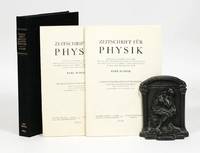
1924réf. 2905Berlin: Julius Springer 1924. First edition. original wrappers. Very Good. FIRST EDITION IN ORIGINAL WRAPPERS of the presentation of "Bose-Einstein statistics." “In 1924 Bose found a way to derive Planck’s equation for black body radiation using a statistical approach based entirely on the idea that light is made up of tiny particles photons. This echoed the statistical mechanics approach of Ludwig Boltzmann to the behaviour of gases but using a different statistical rule; it derives black body radiation entirely in quantum terms without using the idea of electromagnetic radiation at all. Bose wrote a paper about his discovery and sent it to Albert Einstein who immediately saw its significance translated it into German and arranged for its publication in the prestigious Zeitschrift für Physik. Einstein developed the idea to apply to other kinds of particle not just to a ‘gas’ of photons which is why this approach is usually referred to as ‘Bose-Einstein statistics’. Paul Dirac coined the name ‘bosons’ for particles which obey Bose-Einstein statistics" Gribbin Q is for Quantum. Particle Physics: One Hundred Years of Discoveries: “Discovery of new statistical counting rules for light quanta and a new derivation of Planck’s radiation law. Known as Bose-Einstein quantum statistics for particles with integer spins.” WITH a follow-up paper by Bose: "Wärmegleichgewicht im Strahlungsfeld bei Anwesenheit von Materie": "Bose's first paper in 'Zeitschrift für Physik' was followed by another that was also translated by Einstein and published during 1924. In it Bose provided a general statistical treatment of emission and absorption processes for electromagnetic radiation in equilibrium with matter. This paper was accompanied by a note by Einstein expressing serious doubts about the method. In January 1925 Bose wrote to Einstein from Paris that he was working on a paper he felt would remove these doubts. But it seems never to have been completed" DSB. Plancks Gesetz und Lichtquantenhypothese. IN: Zeitschrift für Physik Vol 26 No. 3 August 1924 pp. 178-81. Berlin: Julius Springer 1924. “Wärmegleichgewicht” Vol 27 No. 5/6 September 1924 pp. 384-93. Octavo original wrappers. “Planks Gesetz” with small closed tear at rear wrapper edge; otherwise fine condition; “Wärmegleichgewicht” with small chip to base of front wrapper. SCARCE in original wrappers. Julius Springer unknown
1924réf. 2905Berlin: Julius Springer 1924. First edition. original wrappers. Very Good. FIRST EDITION IN ORIGINAL WRAPPERS of the presentation of "Bose-Einstein statistics." “In 1924 Bose found a way to derive Planck’s equation for black body radiation using a statistical approach based entirely on the idea that light is made up of tiny particles photons. This echoed the statistical mechanics approach of Ludwig Boltzmann to the behaviour of gases but using a different statistical rule; it derives black body radiation entirely in quantum terms without using the idea of electromagnetic radiation at all. Bose wrote a paper about his discovery and sent it to Albert Einstein who immediately saw its significance translated it into German and arranged for its publication in the prestigious Zeitschrift für Physik. Einstein developed the idea to apply to other kinds of particle not just to a ‘gas’ of photons which is why this approach is usually referred to as ‘Bose-Einstein statistics’. Paul Dirac coined the name ‘bosons’ for particles which obey Bose-Einstein statistics" Gribbin Q is for Quantum. Particle Physics: One Hundred Years of Discoveries: “Discovery of new statistical counting rules for light quanta and a new derivation of Planck’s radiation law. Known as Bose-Einstein quantum statistics for particles with integer spins.” WITH a follow-up paper by Bose: "Wärmegleichgewicht im Strahlungsfeld bei Anwesenheit von Materie": "Bose's first paper in 'Zeitschrift für Physik' was followed by another that was also translated by Einstein and published during 1924. In it Bose provided a general statistical treatment of emission and absorption processes for electromagnetic radiation in equilibrium with matter. This paper was accompanied by a note by Einstein expressing serious doubts about the method. In January 1925 Bose wrote to Einstein from Paris that he was working on a paper he felt would remove these doubts. But it seems never to have been completed" DSB. Plancks Gesetz und Lichtquantenhypothese. IN: Zeitschrift für Physik Vol 26 No. 3 August 1924 pp. 178-81. Berlin: Julius Springer 1924. “Wärmegleichgewicht” Vol 27 No. 5/6 September 1924 pp. 384-93. Octavo original wrappers. “Planks Gesetz” with small closed tear at rear wrapper edge; otherwise fine condition; “Wärmegleichgewicht” with small chip to base of front wrapper. SCARCE in original wrappers. Julius Springer unknown books
2004réf. 24035Huntsville Texas U.S.A.: Office of Intl Criminal Justice 2004. Trade paperback in fine condition. Soft cover. Fine. Huntsville, Texas, U.S.A.: Office of Intl Criminal Justice Paperback
réf. 80964Berlin Deutsche Verlagsgesellschaft für Politik und Geschichte 1922. Gr.8° 201 S. Brosch. Handschriftl. Rückentitel Rücken gebräunt etw. fleckig u. am Kopf läd. Einband etw. wellig Schmutztitel im Gelenk angerissen 1 Bl. m. Riss 5 cm Papier gebräunt- Dt. Erstausgabe. 010 Berlin, Deutsche Verlagsgesellschaft für Politik und Geschichte, 1922 unknown
réf. GF15174Dessin original à l'encre de chine sur calque signé - format 13,5 x 10,5 cm -
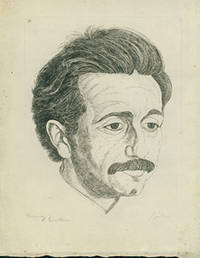
réf. 51-1799Berlin: Circa 1917. Etching on Old Japanese Paper. 30 x 23 cm. on sheet size 40 x 32 cm.Light foxing and folds in the margins.Signed in pencil by Büttner lower right and by Einstein lower left. Indistinct pencil annotations above Einstein’s’ signature.Provenance: A Berkeley academic family.Porträt von Albert Einstein. Radierung auf Bütten. Rechts unten von Erich Büttner links unten von Albert Einstein signiert.At the beginning of the years Einstein suffers from various illnesses among other things from a liver disease and a stomach ulcer. His cousin Elsa takes care of him. It will last several years until he recovers completely. He writes a work on cosmology with the cosmologic term which shall guarantee a limited universe. He will refer to this cosmologic term later as his “biggest idiocy”. He takes over the management of the Kaiser Wilhelm Institute for Physics on October 1. Berlin: Circa 1917. unknown
1948réf. 2327Princeton NJ: np 1948. framed. Fine. ONE OF THE MOST CELEBRATED IMAGES OF EINSTEIN SIGNED BY MASTER PHOTOGRAPHER YOUSUF KARSH. On February 11 1948 Yousuf Karsh perhaps the most accomplished portrait photographer of his generation visited The Institute for Advanced Study in Princeton to fulfill a dream of his: to photograph Albert Einstein. As he later explained: "Among the tasks that life as a photographer had set me a portrait of Albert Einstein had always seemed a 'must' - not only because this greatest refugee of our century has been accounted by all the world as the most outstanding scientist since Newton but because his face in all its rough grandeur invited and challenged the camera." Karsh: Beyond the Camera David Travis ed. "At Princeton's Institute for Advanced Study I found Einstein a simple kindly almost childlike man too great for any of the postures of eminence. One did not have to understand his science to feel the power of his mind or the force of his personality" official Karsh website. "Awed before this unique intellect I yet ventured to ask Einstein his views on human immortality. He mused for a moment and then replied 'What I believe of immortality There are two kinds. The first lives in the imagination of people and is thus an illusion. There is a relative immortality which may conserve the memory of an individual for some generations. But there is only one true immortality on a cosmic scale ant that is the immortality of the cosmos itself. There is no other.' "He spoke of these ultimate mysteries as calmly as he might a student's question about mathematics - with such an air of quiet confidence indeed that I found his answer profoundly disturbing to one who held other views. Knowing him to be an accomplished violinist I turned the conversation and asked if there were any connection between music and mathematics. 'In art he said 'and in the higher ranges of science there is a feeling of harmony which underlies all endeavour. There is no true greatness in art or science without that sense of harmony. He who lacks it can never be more than a great technician in either field.' "Was he optimistic about the future harmony of mankind itself He appeared to ponder deeply and remarked in graver tones: 'Optimistic No. But if mankind fails to find a harmonious solution than there will be disaster on a dimension beyond anyone's imagination.' To what source should we look for the hope of the world's future 'To ourselves' said Einstein. He spoke sadly yet serenely as one who had looked into the universe far past mankind's small affairs. In this humor my camera caught him. the portrait of a man who had traveled beyond hope or despair." Yousuf Karsh Regarding Heroes. Opening quote from: Colin Naylor ed. Contemporary Photographers. Silver print. Photo taken Princeton 1948. Printed later. Signed by Karsh in full beneath the image on photographer's mount. With Karsh's original calling "card" - a 4x10 inch cardboard slip - included. Image: 8x9 inches. Framed to an overall size of 12x15 inches. Fine condition. np unknown
1948réf. 2327Princeton NJ: np 1948. framed. Fine. ONE OF THE MOST CELEBRATED IMAGES OF EINSTEIN SIGNED BY MASTER PHOTOGRAPHER YOUSUF KARSH. On February 11 1948 Yousuf Karsh perhaps the most accomplished portrait photographer of his generation visited The Institute for Advanced Study in Princeton to fulfill a dream of his: to photograph Albert Einstein. As he later explained: "Among the tasks that life as a photographer had set me a portrait of Albert Einstein had always seemed a 'must' - not only because this greatest refugee of our century has been accounted by all the world as the most outstanding scientist since Newton but because his face in all its rough grandeur invited and challenged the camera." Karsh: Beyond the Camera David Travis ed. "At Princeton's Institute for Advanced Study I found Einstein a simple kindly almost childlike man too great for any of the postures of eminence. One did not have to understand his science to feel the power of his mind or the force of his personality" official Karsh website. "Awed before this unique intellect I yet ventured to ask Einstein his views on human immortality. He mused for a moment and then replied 'What I believe of immortality There are two kinds. The first lives in the imagination of people and is thus an illusion. There is a relative immortality which may conserve the memory of an individual for some generations. But there is only one true immortality on a cosmic scale ant that is the immortality of the cosmos itself. There is no other.' "He spoke of these ultimate mysteries as calmly as he might a student's question about mathematics - with such an air of quiet confidence indeed that I found his answer profoundly disturbing to one who held other views. Knowing him to be an accomplished violinist I turned the conversation and asked if there were any connection between music and mathematics. 'In art he said 'and in the higher ranges of science there is a feeling of harmony which underlies all endeavour. There is no true greatness in art or science without that sense of harmony. He who lacks it can never be more than a great technician in either field.' "Was he optimistic about the future harmony of mankind itself He appeared to ponder deeply and remarked in graver tones: 'Optimistic No. But if mankind fails to find a harmonious solution than there will be disaster on a dimension beyond anyone's imagination.' To what source should we look for the hope of the world's future 'To ourselves' said Einstein. He spoke sadly yet serenely as one who had looked into the universe far past mankind's small affairs. In this humor my camera caught him. the portrait of a man who had traveled beyond hope or despair." Yousuf Karsh Regarding Heroes. Opening quote from: Colin Naylor ed. Contemporary Photographers. Silver print. Photo taken Princeton 1948. Printed later. Signed by Karsh in full beneath the image on photographer's mount. With Karsh's original calling "card" - a 4x10 inch cardboard slip - included. Image: 8x9 inches. Framed to an overall size of 12x15 inches. Fine condition. np unknown books
réf. 32479unknown books
réf. 29458Paris, Doin, 1922, in 12 broché, 244 pages ; couverture légèrement fanée