Albert EinsteinBiblio.com
2.986 Ergebnisse
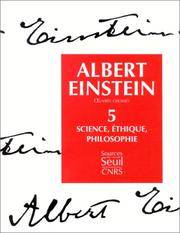
Best.-Nr. BN327717Seuil CNRS Editions. Oeuvres choisies tome 5 : Science éthique philosophie Oeuvres choisies tome 5 : Science éthique philosophie Albert Einstein Seuil CNRS Editions unknown
Best.-Nr. DYD11RT
Best.-Nr. LW51Relié sous jaquette bon état.Tranches piquées .Contenu propre . 1989.270 pages .PHOTOS SUR DEMANDE
1989Best.-Nr. 46024Seuil / CNRS Jaquette en très bon état Couverture rigide toile Paris 1989
1989Best.-Nr. 120415Seuil, CNRS, coll. « Sources Du Savoir » 1989 In-8 reliure éd. sous jaquette 22,1 cm sur 17,8. 345697 pages. Jaquette en très bon état. Très bon état d’occasion.
1907Best.-Nr. 25711Weinheim: Offprint from: Zeitschrift für Elektrochemie. Nr. 6. 1907 February. First Edition Offprint Issue from Volume 13 number 6. Single sheet approximately 10" x 8" pp 41-42 pp. A very fine example of this rare issue a very minor and unobtrusive stain to an upper corner. SCARCE OFFPRINT ISSUE OF AN IMPORTANT EINSTEIN PAPER OF STATISTICAL MECHANICS and a continuation of his remarkable 1905 and 1906 publications on Brownian Motion which not only led to the proof of the existence of the atom but also worked to determine the size of atoms and how many atoms there are in a mole or the molecular weight in grams of a gas. This paper also contains a note on the technical meaning of "average velocity. Offprint from: Zeitschrift für Elektrochemie. Nr. 6. unknown
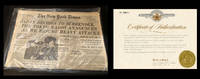
1945Best.-Nr. 1437New York: The New York Times 1945. 1st Edition. First edition of the August 14th 1945 issue of the New York Times complete with "Certificate of Authentication" by the Historic Newspaper Archives. The certificate is #379910; it is signed and includes the seal of the archive. Einstein's article appears in Calaprice's Einstein Almanac No. 244. The certificate will accompany the paper. Most assume that Einstein received the Nobel Prize for his theory of relativity and his famous equation E=mc2. However it was for neither. In 1921 Einstein won the Nobel Prize for discovering the photoelectric effect in 1905. This principle states that when sunlight shines on a metal it emits electrons from the surface of the material. The energy from sunlight photons then transfers to the atoms' electrons and knocks them loose. This discovery was so significant that it has influenced the development of many types of technology from electron microscopes to modern solar cells as we know them today. ALSO INCLUDED: An article by Lewis headlined: "Atoms Not Occult Einstein Declares; Physicist Explains Nuclear and Solar Energy but Refuses to Discuss Use in Bomb" ALSO INCLUDED: New York Time's announces Japan's surrender in 3 line large headline "Japan Decides To Surrender The Tokyo Radio Announces As We Resume Heavy Attacks". CONDITION: Historic Newspaper Archives see above has placed the issue in archival plastic and then into an Archive snap close bag. see photo By any measure this complete issue appears in very good condition. The New York Times unknown
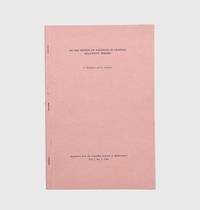
1949Best.-Nr. 180348Ottowa: Canadian Mathematical Society 1949. Their final collaboration First edition offprint issue. Einstein and Infeld demonstrate that "field equations alone suffice as a basis for solving the problem of motion in general relativistic theory since the Einstein equations not only determine how particles must respond to gravitational forces but also contain the information necessary to describe those forces" Calaprice p. 323. Octavo pp. 34. Original orange wrappers wire-stitched as issued front cover lettered in black. Front wrapper lightly marked: a near-fine copy. Boni 259; Weil 223. Alice Calaprice An Einstein Encyclopedia 2015. unknown
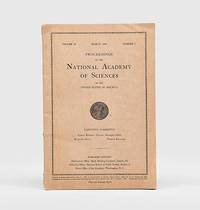
1932Best.-Nr. 180272Easton Pennsylvania: Mack Printing Company 1932. Einstein revises his "biggest blunder" First edition journal issue of the paper in which Einstein rejected his 1917 cosmological constant and acknowledged the expansion of the universe. Drawing on Hubble's law Einstein and de Sitter proposed that the constant should be set equal to zero thereby offering a new model of the universe. "In 1917 Einstein had shown how to construct a universe that was static by introducing a 'cosmological constant' into his equations. This matched well with the idea current before Hubble's 1924 measurement of the distances to the nebulae of a small and static 'universe' that was confined to the stars of the Milky Way galaxy. Einstein's idea of a static universe suspended between gravity pulling inward and the cosmological constant making the universe expand was ruled out by Hubble's data" Kirshner pp. 9-12. In Einstein and de Sitter's revised model "the galaxies receded forever but the recession rate declines to zero as time approaches infinity. Some sources indicate that this is the first attempt to describe our universe rather than a mathematical abstraction of universes possible under general relativity. Shortly after Einstein formally renounced his cosmological constant and according to George Gamow called it 'the biggest blunder of my life'" Wenner. Einstein and de Sitter 1872-1934 were close collaborators in the 1920s at Leiden where de Sitter was chair of astronomy and Einstein was a visiting professor. De Sitter is also known for the concepts of De Sitter space and the De Sitter universe. Large octavo. Original brown wrappers covers printed in black. Short closed tears to spine a little loss to ends corners gently creased: a very good copy. Boni 214; Weil 184; Wenner p. 256. Robert P. Kirshner "Hubble's Diagram and Cosmic Expansion" Proceedings of the National Academy of Sciences of the United States of America vol. 101 no. 1 December 2003. unknown
2003Best.-Nr. Q-076241698XRunning Press Adult 2003-12-24. paperback. New. New. In shrink wrap. Looks like an interesting title! Running Press Adult paperback
2012Best.-Nr. Q-0486602052Dover Publications 2012-05-17. Paperback. New. New. In shrink wrap. Looks like an interesting title! Dover Publications paperback
1955In 16 (18x11) Brossura; pp. 171; firma sull'ultima pagina, segni del tempo, per il resto buono
Best.-Nr. 67548A.G. Berlin: Ernst Wasmuth N.D. Hardcover. Very Good boards. Boards slightly bowed. Wear to spine ends. Text is in German. No date.; 4to - over 9¾" - 12" tall. Ernst Wasmuth hardcover
Best.-Nr. RO60011666Ernst Wasmuth A.G. Berlin. sans date. In-8. Broché. Bon état, Couv. convenable, Dos satisfaisant, Quelques rousseurs. 48 pages. Reproductions noir et blanc hors texte.. . . . Classification Dewey : 430-Langues germaniques. Allemand
2007UTET 2007 XI-297 PP. FONDO DI MAGAZZINO: LIEVI SEGNI DEL TEMPO, VOLUME PERFETTO E INTONSO. La meccanica celeste ha sempre accompagnato lo sviluppo della civiltà sul nostro pianeta. Dalle prime osservazioni astronomiche degli antichi Caldei, attraverso i lavori di Henri Poincaré la meccanica celeste è tornata in prima linea. Infatti, i recenti progressi tecnologici nel campo dell'astronomia osservativa hanno notevolmente aumentato il numero di oggetti celesti scoperti dall'uomo: migliaia di asteroidi, centinaia di comete, decine di satelliti naturali e anelli planetari, una nuova popolazione di corpi celesti oltre l'orbita di Nettuno, nonché innumerevoli sistemi planetari extra-solari attorno ad altre stelle. A ciò si aggiunga che l'uomo ha ormai un programma consolidato di esplorazione interplanetaria e nelle vicinanze della Terra: una nube di satelliti artificiali e di detriti spaziali circonda il nostro pianeta. Sulla base di tali recenti sviluppi scientifici, la moderna meccanica celeste ha assunto un ruolo fortemente interdisciplinare, coinvolgendo argomenti quali la stabilità, le risonanze e il caos. L'obiettivo del libro, pubblicato in edizione inglese nel 2007 dalla casa editrice Praxis-Springer, è di presentare la moderna meccanica celeste come una disciplina di facile comprensione per il lettore non specialista e allo stesso tempo di stimolare un pubblico più specializzato, mostrando le possibili connessioni tra i diversi affascinanti campi di studio. Il volume è introdotto dalla prefazione di Margherita Hack.
1999Best.-Nr. 9293774Office Of Intl Criminal Justice 1999. This is an ex-library book and may have the usual library/used-book markings inside.This book has soft covers. Clean from markings. In fair condition suitable as a study copy. Library sticker on front cover. Please note the Image in this listing is a stock photo and may not match the covers of the actual item850grams ISBN:0942511891 Office Of Intl Criminal Justice paperback
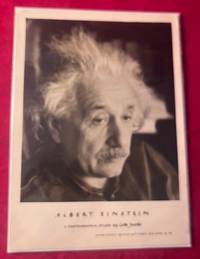
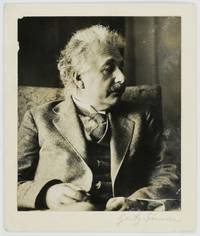
1938Best.-Nr. 9498New Jersey: Jacobi Studio 1938. Very Good. 5 X 7 Inches. SCARCE original headshot of Albert Einstein by Lotte Jacobi circa 1938. This iconic photograph of Einstein features him wearing his leather coat inside his Princeton New Jersey home. Scarce cropped photograph of Einstein's face with Jacobi Studio text in lower border. "Albert Einstein: A Photographic Study By Lotte Jacobi - Jacobi Studio 46 West 52nd Street New York 19 NY." Lotte Jacobi took this photograph of the theoretical physicist Albert Einstein at his home in Princeton New Jersey at the time he was a professor at the university. Both Jewish the two had been family friends a decade earlier in Germany. Einstein had renounced his German citizenship for political reasons after leaving Nazi Germany in 1933 and Jacobi had been forced to emigrate to the United States from Nazi Germany after she too renounced her German citizenship in 1935. Jacobi and Einstein collaborated on the crafting of his media image in a series of late-1930s Princeton portraits commissioned by Life magazine. Einstein agreed to sit for the photo session only if Lotte Jacobi was assigned to photograph him. The image of Einstein in a leather jacket is unusual in that it catches him in a less-guarded less-constructed moment than the others and offers the viewer a glimpse of the world-famous theoretical physicist as an individual rather than as a stereotyped professor. Rubbing and light wear at corners. A SCARCE advertising piece from the Jacobi Studio. Jacobi Studio unknown
Best.-Nr. 77255Berlin Gerty Simon unpublished ca. 1935. Original photograph 21.3 x 17.8 cm on original cardboard mount 25.0 x 21.0 cm. = Gertrud "Gerty" Simon 1887-1970 was a German photographer who worked during the interwar period. "Born Gertrud Cohn in Bremen to a well-to-do Jewish family with her father being a lawyer she practiced in Berlin and later in London. She captured many important political and artistic figures in Weimar Berlin including singer and actress Lotte Lenya her husband composer Kurt Weill sculptor painter and print maker Käthe Kollwitz her colleague Max Liebermann and physicist Albert Einstein. Gerty Simon moved to Berlin after the First World War. Her husband Wilhelm like her father was a lawyer. They had one son Bernard Bernd born in 1921. Her Berlin studio was at Clausewitzstrasse. With the arrival of the Nazi Party in power in 1933 life became very difficult for Simon and her family. In 1933 her son's school the Landschulheim Herrlingen later the Bunce Court School a progressive boarding school transferred from Southern Germany to Otterden Kent. Simon followed while her husband remained in Berlin unable to continue as a lawyer and judge but finding work as a notary. The family was not reunited until 1939 and father and son were both imprisoned as enemy aliens. At 19 Bernard was even sent to an internment camp in Australia until 1942 despite having lived in the UK for seven years. Simon rapidly re-established her studio in Chelsea and portrayed many significant individuals there such as historian and broadcaster Sir Kenneth Clark actress Dame Peggy Ashcroft and politician Aneurin Bevan. She stopped working as a professional photographer from 1937 for unknown reasons" Wikipedia. The photo shows Einstein in suit and tie looking toward his left with a "Rembrandtesque" light falling on his right side. Signed i.e. approved outside the plate by the photographer. One of the lesser-known and very rare photographs of Einstein. Tiny chips to the left and upper edge and some surface damage to the outer right side; otherwise very good the impression fine and strong. A beautiful photograph.
1925Best.-Nr. 131958Paris, G. Doin 1925 In-8 22 x 13,5 cm. Reliure demi-basane fauve, dos à nerfs, pièce de titre maroquin rouge, couvertures conservées, XII-401 pp., 124 figures dans le texte et 18 planches hors texte, table des matières. Exemplaire en bon état.
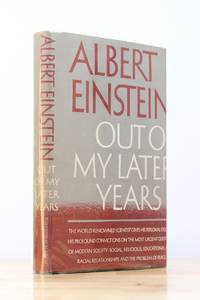
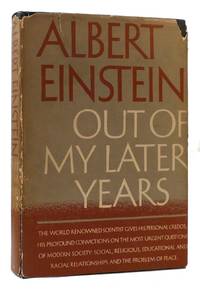
1950Best.-Nr. 33503New York: Philosophical Library 1950. Hardcover. First Edition First Printing in the U.S.: with full cloth boards and Einstein's signature in gilt and price of $4.75 present on the front jacket flap. 5 x 8in. 282pp. Publisher's cloth boards. FINE/AS NEW in Near Fine dust jacket protected in a removable archival cover. The book itself is flawless. The dust jacket shows the spine somewhat misaligned a hint of shelf rubbing of the extremities otherwise remains Fine/As New. As pictured. Philosophical Library hardcover
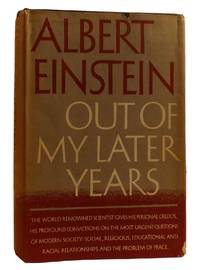
1950Best.-Nr. 213518New York: Philosophical Library 1950. First Edition; First Printing. Hardcover. Good in a Very Good dust jacket. FEP clipped. Rubbing along panel edges. Light chipping at spine crown/heel. Philosophical Library hardcover
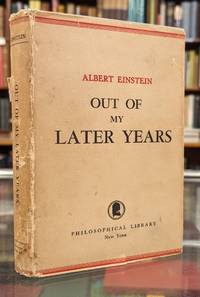
1950Best.-Nr. 6000330Philosophical Library 1950. Hardcover. Very good/Good. Covers edgeworn. Front hinge cracked. Dust jacket soiled and chipped. Philosophical Library hardcover
1950Best.-Nr. 176621New York: Philosophical Library 1950. First Edition; First Printing. Hardcover. Very Good in a Very Good dust jacket. Rubbing open tearing along panel edges. Philosophical Library hardcover
1950Best.-Nr. WARE923KM0033Philosophical Library 1950. hard cover. Good. Prompt shipment with tracking. we ship in CLEAN SECURE NEW boxes Good hard cover book with torn dust jacket first edition sunned price clipped signature on front title page 8vo. Philosophical Library hardcover
1950Best.-Nr. 46353New York: Philosophical Library 1950. First Edition; First Printing. Hardcover. Very Good in a Very Good dust jacket. Chipping to jacket. Owner inscription to FEP. Markings to jacket at front panel.; 8vo 8" - 9" tall. Philosophical Library hardcover