2 976 résultats
1938réf. 46954Baltimore, Princeton University Press, 1938 a.1940. Royal8vo. Bound in 2 full cloth, gilt lettering to spines. In: Annals of Mathematics"", Series 2, Vol. 39 and vol. 40. (Entire volumes offered). The papers: pp. 65-100 a. pp. 455-464. Clean and fine.også on a generalization...... pais p. 496
1951réf. R160220220Methuen & Co.Ltd. London. 1951. In-12. Relié. Bon état, Couv. convenable, Dos satisfaisant, Intérieur frais. 161 pages - ouvrage en anglais.. . . . Classification Dewey : 420-Langue anglaise. Anglo-saxon
réf. 108151aafPrinceton Univ. Press, 1995, in-4to, XVII (+1) +384 p., paperback.
réf. 108142aafPrinceton Univ. Press, 1998, in-4to, XXII + 2 ll. + 713 p., paperback.
réf. 108140aafPrinceton Univ. Press, 1987, in-4to, LXVI + 1 ll. + 433 p., / XXII + 196 p., clothbound, jackett / paperback.
1949réf. 38876London, Dennis Dobson, 1949. Orig. cloth. 324 pp. Illustr. by Hugh Gray Lieber.
1912réf. 38839Leipzig, J.A. Barth, 1912. Bound in two contemp. hcalf, richly gilt spine and one later full cloth. A library stamp on the first volume. ""Annalen der Physik. Vierte Folge. Band 37 (und) 38. Hrsg. von W. Wien und M. Planck."" VIII,1048"VIII,1064 pp., 5+8 plates. Einstein papers: pp. 832-38 (vol.37), pp. 881-84 (Nachtrag vol. 38) pp. 443-458 (vol. 38) p. 888 (vol. 38) pp. 1059-1064 (vol. 38)" Planck: pp. 642-656. Internally fine and clean. Both volumes offered.
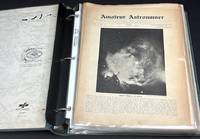
1936réf. H40351New York: Amateur Astronomers Association 1936. Very good. Old cloth 3-ring binder with acetate sheaths containing the issues. This started out as a 4 pp. periodical but expanded in later issues. In 1936 the journal merged with The Sky published by Hayden Planetarium which subsequently merged with The Telescope in 1941 to become Sky & Telescope which is still being published. Condition is mainly very good although the first three issues we have have some damage to fore-edges. The first issue has a supplementary sheet laid in "Professor Einstein Sends Greetings to the Amateur Astronomers Association" reprinting in facsimile the handwritten note with a printed translation and a facsimile of another note from Einstein. We have Vol. I nos. 1 & 2 April and May 1929; Vol. 2 nos. 1 September 1929 - 9 May-June 1930 -- the April 1930 issue has a cover story on the discovery of Pluto then considered the ninth planet. Pluto was first discovered on February 18 1930 by Clyde Tombaugh at the Lowell Observatory in Flagstaff Arizona.The discovery was announced on March 13 1930 in the Astronomical Journal.; Vol. III nos. 1 October-November 1930 - 7/8 May-June 1931; Vol. IV nos. 1 September-October 1931 - 8 Summer 1932; Vol. V nos. 1 September-October 1932 - 3 March 1933 -- these expanded to 6 pp. each; Vol. VI nos. 1 - 3 Winter & Spring 1933-1934 - Summer 1934 -- beginning with Vol. VI these are 16 pp. each; with the Spring issue cover story on Hayden Planetarium; Vol. VII nos. 1 Autumn 1934 - 3 Spring 1935; Vol. VIII nos. 1 Autumn 1935 - 3 Spring 1936. We don't know if we're missing any or not but it's a nice early run of this rare astronomical journal. Amateur Astronomers Association unknown
1944réf. 556012New York: The American Christian Palestine Committee 1944. Softcover. Very Good. First separate edition. Small octavo. 12pp. Stapled self-wrappers. Slight age-toning on the wrappers and very tiny nicks soiling and light wear very good or better. Two articles jointly written by Einstein and Kahler in response to two articles laying out anti-Zionist testimony given by Dr. Philip Hitti of Princeton before the Committee on Foreign Affairs of the House of Representatives. Both of Hitti's articles and the Einstein and Kahler articles were all published in The Princeton Herald. This publication doesn't include the Hitti articles but summarizes them in the Einstein and Kahler rejoinders. Scarce. The American Christian Palestine Committee unknown
réf. Q-0070195315McGraw-Hill Companies. paperback. New. New. In shrink wrap. Looks like an interesting title! McGraw-Hill Companies paperback
1980réf. Q-0690018983Lippincott & Crowell 1980-01-01. Hardcover. New. In shrink wrap. Looks like an interesting title! Lippincott & Crowell hardcover
1997réf. 035964aPrinceton N.J: Princeton University Press 1997. 1st . Paperback. Very Good. 4 vo. First Thus; Volume 7 Seven of The Collected Papers of Albert Einstein; 383 clean unmarked pages Princeton University Press paperback
réf. 1450072178.Ghardcover. Good. Access codes and supplements are not guaranteed with used items. May be an ex-library book. hardcover
réf. 0394494598.Ghardcover. Good. Access codes and supplements are not guaranteed with used items. May be an ex-library book. hardcover
réf. 0449232255.Gpaperback. Good. Access codes and supplements are not guaranteed with used items. May be an ex-library book. paperback
réf. 1515425479.Ghardcover. Good. Access codes and supplements are not guaranteed with used items. May be an ex-library book. hardcover
1953réf. 137755New York: Dell Publishing 1953. First Edition. First Edition a paperback original. Basis for the 1956 film noir "While the City Sleeps" directed by Fritz Lang and starring George Sanders and Dana Andrews. Near Fine in illustrated wrappers. Dell Publishing unknown books
réf. 3183198-nnew. unknown
réf. 3183198like new. unknown
2005réf. x-1403944962Palgrave Macmillan 2005. Hardcover. New. new title edition. 256 pages. 8.00x5.25x1.00 inches. Palgrave Macmillan hardcover
1971réf. 046762New York: Walker & Company 1971. 1st Edition 1st Printing. Hardcover. Near Fine/Very Good. Xi 240 Pp. First Printing. Near Fine Book No Marks. Dj Priced $8.50 Light Wear Walker & Company hardcover
réf. 0802703267.Ghardcover. Good. Access codes and supplements are not guaranteed with used items. May be an ex-library book. hardcover
2014réf. x-1349729116Palgrave Macmillan 2014. Paperback. New. 238 pages. 8.50x5.75x0.75 inches. Palgrave Macmillan paperback
réf. 61075615MacMillan . Hardback. New. pp. xxxii 235 MacMillan hardcover
1880réf. 24284A unique and important artifact of his childhood. ALBERT EINSTEIN. Ephemera. Set of Anker-Steinbaukasten children's building blocks by F. Ad. Richter & Cie. Rudolstadt Germany c.1880s. Approximately 160 composite quartz sand chalk and linseed oil blocks in red limestone and slate gray in various sizes and shapes together with three or more sets of building plans all contained in two wooden boxes with printed Anker-Steinbaukasten labels. Einstein spent his childhood building "complicated structures" with these Anker-Steinbaukasten blocks. Accepting his later theory that "Imagination is more important than knowledge" the toys that encouraged his imagination became building blocks for the most important scientific theories of the last millennium. His sister Maja Winteler-Einstein describing his childhood recalled that "The games he played … were very characteristic of Albert's capacities. These were mostly puzzles fretsaw work the erection of complicated structures with the well-known Anker building blocks and above all the construction of multi-storied card castles with which he filled his leisure." "Beitrag für sein Lebensbild" in The collected papers of Albert Einstein. ed. John Stachel. Volume 1: The early years. 1879-1902. Princeton University Press 1987 p.lix. Translated from German. Based on the work of German educator Friedrich Froebel who created the concept of kindergarten these composite stone blocks were a popular toy of the 1880s and 1890s. The blocks were designed to help develop childrens' tactile senses and manual dexterity and also to stimulate imagination creativity and three-dimensional perception. Fellow scientist J. Robert Oppenheimer as well as architects Frank Lloyd Wright and Walter Gropius are among the geniuses who are known to have played with Anker blocks. Provenance The set had passed by direct descent from Albert Einstein to the consignor from whom we acquired the blocks at Christie's London on July 13 2016. Condition A few blocks chipped and worn with original instructions and boxes worn soiled and defective. Albert Einstein 1879-1955 was a German-Swiss born theoretical physicist internationally recognized as one of the greatest physicists of all time. He enunciated the general theory of Relativity with law explaining the relationship between the speed of light and its consequence the equivalence of mass and energy E=MC2. For his work in theoretical physics—largely for his 1905 paper on photons and photo-electricity—Einstein was awarded the Nobel Prize for Physics announced in November 1922 retroactive for 1921. Working on a unified field theory he then attempted to explain gravitation and electromagnetism within one set of laws. With the expulsion of Jewish scholars from Germany after Hitler's rise to power Einstein joined the Institute for Advanced Study in Princeton New Jersey 1933 which became the most celebrated research center in the world. In 1939 he signed a letter written to President Franklin Roosevelt warning him of the possibility of Germany developing a nuclear bomb. He urged the U.S. to begin uranium research thus beginning the top secret "Manhattan Project." Later at Princeton he tried to develop a unified field theory and to refute the accepted interpretation of quantum physics both unsuccessfully. Einstein received U.S. citizenship in 1940.