"EINSTEIN, A.Livre Rare Book

3.003 Ergebnisse
1913Best.-Nr. 47060Leipzig, S. Hirzel, 1913. Royal8vo. Uncut, unopened in the original wrappers. In ""Physikalische Zeitschrift"", Vol. 14, 1913. Entire issue offered. Front wrapper detached and lower right corner is missing. Extremities with nicks, otherwise very fine and clean. Rare unopened. Pp. 1249-1266. Discussion"" Pp. 1262-66. [Entire volume: XXXI, (1), 1312 pp. + LVI plates].
1913Best.-Nr. 38802(Leipzig), 15. December 1913. 4to. ""Physikalische Zeitschrift No. 25, 15. December 1913. 14 Jahrgang"", pp. 1249-1312. Einsteins paper: 1249-1266 (Discussion pp. 1262-66).
1924Best.-Nr. 47162Berlin Julius Springer 1924. Royal8vo. Bound in contemporary half cloth with gilt lettering to spine. In "Die Naturwissenschaften" 12. Jahrg 1924. The whole year offered. "12" written in hand to spine otherwise a very fine and clean copy. Pp. 601-602. Entire volume: XXV 1 1412 60 pp. First printing of Einstein's paper on Lord Kelvin and his scientific work. The occasion was the Centenary Year of Thomson's birth and Einstein wrote 'Zum hundertjährigen Gedenktag von Lord Kelvins Geburt 26. Juni 1824'. In the mid-nineteenth century Thomson's ideas on thermodynamics established the base line for future generations of scientists. Likewise in 1905 Einstein changed the world of physics forever with the publication of his radical new ideas on special relativity."We may learn from Einstein the philosopher of his interest in the founding scientists of the nineteenth century such as Kelvin and Maxwell of science being not only about instrumentation mathematics and formulae but also about sharing in the aspirations and achievements of other scientists past or present." Trainer Einstein's Centenary Tribute The volume contain several other papers by influential contemporary phycisians. Weil 140. hardcover
1924Best.-Nr. 38641Berlin Julius Springer 1924. 4to. Orig. printed wrappers. In "Die Naturwissenschaften" 12. Jahrg. Heft 30 pp. 601-602. The whole of Heft 30 present. First edition. - Weil 140. unknown
1924Best.-Nr. 38641Berlin, Julius Springer, 1924. 4to. Orig. printed wrappers. In ""Die Naturwissenschaften"", 12. Jahrg., Heft 30, pp. 601-602. The whole of Heft 30 present.
1924Best.-Nr. 47162Berlin, Julius Springer, 1924. Royal8vo. Bound in contemporary half cloth with gilt lettering to spine. In ""Die Naturwissenschaften"", 12. Jahrg, 1924. The whole year offered. ""12"" written in hand to spine, otherwise a very fine and clean copy. Pp. 601-602. [Entire volume: XXV, (1), 1412, 60 pp.].
1931Best.-Nr. 289801931. S.Ber. Akad. Wiss. Berl. 1931/12. - Berlin Verlag der Akademie der Wissenschaften 1927 8°5 S. orig. Broschur. First Edition! A fine and fresh copy in the rare off-print form from the "Sitzungsbereichte." Interesting is to note in the publisher's ad on the last page of the back-cover that all the off-prints of Einstein's papers published by the Academy between 1914 and 1921 are marked out ofprint as early as 1931! Weil N0.179; Schilp-Shields No. 249 unknown
1931Best.-Nr. 28366Berlin Gruyter & Co. 1931. 4to. Orig. printed orange wrappers. Offprint/Sonderausgabe aus Sitzungsberichten.pp.1-5. Fine fresh copy. First edition in the rare Offprint with the separate printed title and separate pagination. See Weil No. 179 where this is not mentioned.The early Offprints from "Sitzungsberichten." are called "Sonderabdruck" up to Weil No.165 including this. From Weil 166 they are called "Sonderausgabe.". - Before 161 up to 160 the Offprints do not have separate title and pagination the pagination follows the numbering in the periodical. From 166 the Offprint has both separate printed title and pagination. - So Weil Nos 161-165 is still "Abdruck" but with separate title and pagination. These facts are not mentioned in the bibliographies. unknown
1931Best.-Nr. 38899Berlin Akademie der Wissenschaften 1931. 4to. Orig. printed wrappers. Small nicks to margin of wrapper. "Sitzungsberichte der Preussischen Akademie der Wissenschaften" issue XII pp. 233-247. Einstein paper: pp. 235-237 Schrödinger paper: pp. 238-247. Both papers first edition. - Weil No 179. unknown
1931Best.-Nr. 37423Berlin: Akad. Wiss 1931. Akad. Wiss unknown
1931Best.-Nr. 38899Berlin, Akademie der Wissenschaften, 1931. 4to. Orig. printed wrappers. Small nicks to margin of wrapper. ""Sitzungsberichte der Preussischen Akademie der Wissenschaften"", issue XII, pp. 233-247. Einstein paper: pp. 235-237, Schrödinger paper: pp. 238-247.
1931Best.-Nr. 28366Berlin, Gruyter & Co., 1931. 4to. Orig. printed orange wrappers. Offprint/Sonderausgabe aus Sitzungsberichten....pp.(1)-5. Fine fresh copy.
1931Best.-Nr. 37423Berlin: Akad. Wiss 1931. Akad. Wiss unknown books
1917Best.-Nr. 38838Braunschweig Vieweg & Sohn 1917. Contemp. hcalf. Spine worn and covers detached. Internally clean and fine. "Verhandlungen der Deutschen Physikalischen Gesellschaft im Jahre 1917. Neunzehnter Jahrgang. Herausgegeben von Karl Scheel." V372 pp. Einstein paper: pp. 82-92. The whole volume offered. First edition. Containing also Max von Laue: "Bandenspektrum und molekulare Quantendrehungen; pp.130-38. and "Ein Versagen der klassischen Optik: pp. 19-21. - Weil No 94. unknown
1917Best.-Nr. 38838Braunschweig, Vieweg & Sohn, 1917. Contemp. hcalf. Spine worn and covers detached. Internally clean and fine. ""Verhandlungen der Deutschen Physikalischen Gesellschaft im Jahre 1917. Neunzehnter Jahrgang. Herausgegeben von Karl Scheel."" V,372 pp. Einstein paper: pp. 82-92. The whole volume offered.
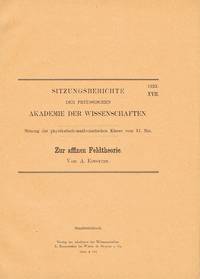
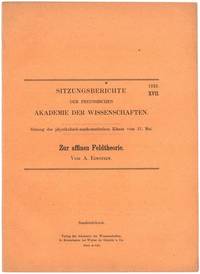
1923Best.-Nr. 5730KBerlin: Verlag der Akademie der Wissenschaften in commission at Walter de Gruyter Reichsdruckerei 28th June 1923. Near Fine. Imperial 8vo 25 4: 18 2 cm. 4 pages numbered 137-140. Letterpress on machine paper in original publisher’s brochure on orange stock with black title printing. First offprint in the original wrappers of this first attempt of Einstein to formulate a unified field theory. - Content: In this important paper Einstein gives his first investigation of ""Affine geometries"" and introduces the notion of ""Distant parallelism"" thus for the first time attempting to formulate a unified field theory based on the research of the German mathematician theoretical physicist and philosopher Hermann Weyl. - Condition: Mint. - Reference: Alicke 113; Norman Library 698; Schilpp-Shields 175; Weil 132. Verlag der Akademie der Wissenschaften (in commission at Walter de Gruyter [Reichsdruckerei]) unknown
1923Best.-Nr. 317401923. S.Ber. Akad. Wiss. Berl. 1923/ 8. - Berlin Verlag der Akademie der Wissenschaften 1923 8° 4 S. orig. Broschur. First edition. A fine fresh copy in the rare off-print form. Marked with an asterisk by Weil denoting a major paper. "Einstein's attempts to formulate a unified field theory stemmed from his dissatisfaction with the general relativity theory which did not adequately incorporate the electromagnetic field into the geometry of space-time. In 1918 Hermann Weyl had begun investigating the possibility of constructing a unified field theory preserving the dimensionality of space-time while formally altering its geometry making it a special case of the class known as affine geometries. Einstein's first investigation of Weyl's ideas published in the present paper introduced the notion of distant parallelism; however Einstein later rejected Weyl's theory." Weil No. 132; Schilpp--Shields No. 171; Alicke No.113; Norman Library 698; Boni 141 unknown
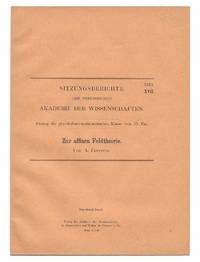
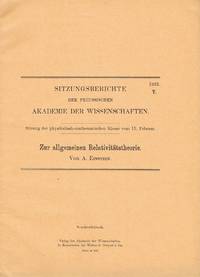
Best.-Nr. 08777Np; 1923. First Edition. Fine. offprint from Sitzungsberichten der Presussichen Akademie der Wissenschaften Sitzung der physikalishch-mahematischen klasse vom 31 mai XVII. p. 137-140 bound in original orange printied wraps; quarto 254 x 184mm. Einstein's first investigation of Weyl's ideas published in the present work introduced the notion of distant parallelism; however Einstein later rejected Weyl's theory. Housed in a custom quarter-leather clamshell box. A fine copy. unknown
1923Best.-Nr. 28357Berlin Gruyter & Co. 1923. 4to. Orig. printed orange wrappers. Offprint/Sonderabdruck aus "Sitzungsberichteder Preus.pp. 137-40. Fine fresh copy. First edition in the rare Offprint still called "Abdruck". Weil No. 132 with an asterix denoting a major work. - Here Einstein gives his first investigation of the "Affine geometries" and introduces the notion of "Distant parallelism".The early Offprints from "Sitzungsberichten." are called "Sonderabdruck" up to Weil No.165 including this. From Weil 166 they are called "Sonderausgabe.". - Before 161 up to 160 the Offprints do not have separate title and pagination the pagination follows the numbering in the periodical. From 166 the Offprint has both separate printed title and pagination. - So Weil Nos 161-165 is still "Abdruck" but with separate title and pagination. These facts are not mentioned in the bibliographies. unknown
1923Best.-Nr. 32429Berlin: Berlin: Sitzungsberichte der Preussischen Akademie der Wissenschaften XVIII 1923. First Thus. Soft cover. First Thus. Soft cover. Einstein Albert 1879-1955. Zur affinen Feldtheorie. Offprint from Sitzungsberichten der Preussischen Akademie der Wissenschaften 1923. XVIII. 8vo.4 137-140 First edition. Orange wrappers. A fine fresh copy in the rare off-print form marked with an asterisk by Weil denoting a major paper "Sonderabdruck" & deemed of sufficient interest that a translation was published in Nature Magazine. "Einstein's attempts to formulate a unified field theory the theoretical framework to account for the fundamental forces of nature. stemmed from his dissatisfaction with the general relativity theory which did not adequately incorporate the electromagnetic field into the geometry of space-time". Einstein's first investigation of Weyl's ideas published in the present paper which Weyl had begun working on in 1918. Weyl was investigating the possibility of constructing a unified field theory preserving the dimensionality of space-time while formally altering its geometry making it a special case of the class known as affine geometries. However Einstein later rejected Weyl's theory. "Weil No. 132; Schilpp--Shields No. 171; Alicke No.113; Norman Library 698; Boni 141. Affine Geometry is not concerned with the notions of circle angle and distance. It's a known dictum that in Affine Geometry all triangles are the same. In this context the word affine was first used by Euler affinis. In modern parlance Affine Geometry is a study of properties of geometric objects that remain invariant under affine transformations mappings. Affine transformations preserve collinearity of points: if three points belong to the same straight line their images under affine transformations also belong to the same line and in addition the middle point remains between the other two points." The early Offprints from "Sitzungsberichten." are called "Sonderabdruck" up to Weil No.165 including this. From Weil 166 they are called "Sonderausgabe.". - Before 161 up to 160 the Offprints do not have separate title and pagination the pagination follows the numbering in the periodical. From 166 the Offprint has both separate printed title and pagination. - So Weil Nos 161-165 is still "Abdruck" but with separate title and pagination. Berlin: Sitzungsberichte der Preussischen Akademie der Wissenschaften, XVIII unknown
1923Best.-Nr. 374071923. Einstein Albert 1879-1955. Zur affinen Feldtheorie. Offprint from Sitzungsberichte der preussischen Akademie der Wissenschaften 17 1923. 137-140pp. 256 x 185 mm. Original printed wrappers. Fine. First Edition Offprint Issue. In 1923 Einstein published four short papers of which "Zur affinen Feldtheorie" is the third on Eddington's attempt at a unified field theory marking the beginning of a scientific passion that would dominate the remainder of his career. In 1921 British physicist Arthur Eddington had proposed a unified field theory inspired by the work of Hermann Weyl. "Einstein's own initial reaction was that Eddington had created a beautiful framework without content. Nevertheless he began to examine what would be made of these ideas and finally decided that 'I must absolutely publish since Eddington's idea must be thought through to the end.' That was what he wrote to Weyl. Three days later he wrote to him again about unified field theories: 'Above stands the marble smile of implacable Nature which has endowed us more with longing than with intellectual capacity.' Thus romantically began Einstein's adventures with general connections adventures that were to continue until his final hours" Pais Subtle is the Lord p. 343. This paper is included on Shields's list of Einstein's most significant papers; see Albert Einstein Philosopher-Scientist 1949 p. 758. Shields 175. Weil 132. . unknown
Best.-Nr. 08777Np; 1923. First Edition. Fine. offprint from Sitzungsberichten der Presussichen Akademie der Wissenschaften Sitzung der physikalishch-mahematischen klasse vom 31 mai XVII. p. 137-140 bound in original orange printied wraps; quarto 254 x 184mm. Einstein's first investigation of Weyl's ideas published in the present work introduced the notion of distant parallelism; however Einstein later rejected Weyl's theory. Housed in a custom quarter-leather clamshell box. A fine copy. unknown books
1923Best.-Nr. 28357Berlin, Gruyter & Co., 1923. 4to. Orig. printed orange wrappers. Offprint/Sonderabdruck aus ""Sitzungsberichteder Preus...pp. 137-40. Fine fresh copy.
1923Best.-Nr. 374071923. Einstein Albert 1879-1955. Zur affinen Feldtheorie. Offprint from Sitzungsberichte der preussischen Akademie der Wissenschaften 17 1923. 137-140pp. 256 x 185 mm. Original printed wrappers. Fine. First Edition Offprint Issue. In 1923 Einstein published four short papers of which "Zur affinen Feldtheorie" is the third on Eddington's attempt at a unified field theory marking the beginning of a scientific passion that would dominate the remainder of his career. In 1921 British physicist Arthur Eddington had proposed a unified field theory inspired by the work of Hermann Weyl. "Einstein's own initial reaction was that Eddington had created a beautiful framework without content. Nevertheless he began to examine what would be made of these ideas and finally decided that 'I must absolutely publish since Eddington's idea must be thought through to the end.' That was what he wrote to Weyl. Three days later he wrote to him again about unified field theories: 'Above stands the marble smile of implacable Nature which has endowed us more with longing than with intellectual capacity.' Thus romantically began Einstein's adventures with general connections adventures that were to continue until his final hours" Pais Subtle is the Lord p. 343. This paper is included on Shields's list of Einstein's most significant papers; see Albert Einstein Philosopher-Scientist 1949 p. 758. Shields 175. Weil 132. . unknown books
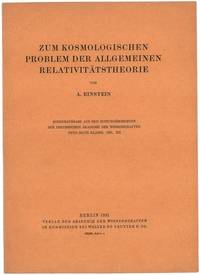
1923Best.-Nr. 5729KBerlin: Verlag der Akademie der Wissenschaften in commission at Walter de Gruyter Reichsdruckerei 12th March 1923. Near Fine. Imperial 8vo 25 4: 18 2 cm. 8 pages numbered 34-38 1. Letterpress on machine paper in original publisher’s brochure on orange stock with black title printing. First offprint in the original wrappers. - Content: In this paper Einstein accepted that his introduction of the 'cosmological constant' in 1917 in order to allow for the possibility of a static universe may have been a mistake. - Condition: Very fine. - Rarity: ABPC 1973ff. and APO 1988ff. record 4 copies of this edition at auction 2012 2x 2011 1994. - Reference: Boni-Russ-L. 140; Schilpp-Shields 174; Weil 131. Verlag der Akademie der Wissenschaften (in commission at Walter de Gruyter [Reichsdruckerei]) unknown