Einstein, AlbertBiblio.com
2 557 résultats
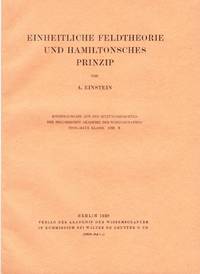
1929réf. 6551Berlin: Verlag der Akademie der Wissenschaften in Kommision bei Walter de Gruyter U. Co 1929. First separate edition. Fine. 6 pages in printed wraps. Not exactly an "offprint" since the pages are numbered from 1 and the pamphlet is given its own title page this is considered the first separate edition of a paper Einstein published in the periodical of the Prussian Academy. It is considered Einstein's initial effort having established general and special relativity to find a unified theory uniting gravity and electromagnetism a problem he struggled with for his remaining life. Verlag der Akademie der Wissenschaften in Kommision bei Walter de Gruyter U. Co paperback
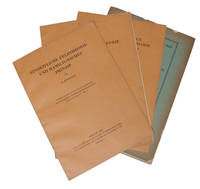
1925réf. 59960Berlin Königlich Akademie der Wissenschaften 1925-1929. 1. Einheitliche Feldtheorie von Gravitation und Elektrizität. 1925 pp. 414-419. Uncut unopened n the original printed wrappers. missing small parts of spine and upper part of front wrapper detached otherwise fine. Weil 147 / Boni 155.2. Neue Möglichkeit für eine einheitliche Feldtheorie von Gravitation und Elektrizität. Offprint: S. B. preuss. Akad. Wiss. 1928 pp.235-245. In the original yellow wrappers. Very fine and clean. Weil 162/ Boni 175.3. Zur einheitlichen Feldtheorie. Offprint: S. B. preuss. Akad. Wiss. 1929 pp.2-7. In the original yellow wrappers. Very fine and clean. Weil 165/ Boni 183.4. Einheitliche Feldtheorie und Hamiltonsches Prinzip. Offprint: S. B. preuss. Akad. Wiss. 1929 pp.156-159. In the original yellow wrappers. Very fine and clean. Weil 166/ Boni 184. Fine collection three in offprint and one in the original printed wrappers of the four papers that together constitute Einstein's attempt towards creating a unified field theory: "a new theory of space with a view to unification of all forms of activity that fall within the sphere of physics giving them a common explanation" PMM416. The task of unifying nuclear electromagnetic and gravitational force is nowadays by many considered the holy grail of theoretical physics.Maxwell was the first to develop such a theory when he described the forces of electricity and magnetism as the single force electromagnetism. After Einstein had completed his general theory of relativity a field theory for gravitation he turned his attention towards generalizing his theory even further to include Maxwell's theory. Even though Einstein never succeeded in completing this task in the way that he finished his earlier theories he pioneered and explored many areas of this subject."It had been repeatedly observed that Einstein's general theory of relativity necessitated a pluralistic explanation of the universe. In 1925 he announced that he had resolved this difficulty but the announcement was premature. In 1928 he attacked the problem once more only to find that Riemann's conception of space on which the general theory was based would not permit of a common explanation of electromagnetic and gravitational phenomena. In a series of papers the present devoted to the development of 'A Uniform Theory of Gravitation and Electricity' he outlined a new theory of space with a view to unification of all forms of activity that fall within the sphere of physics giving them a common explanation. All that would then remain to complete a scientific unison is the correlation of the organic and inorganic".PMM 416Barchas 586Weil 147 162 165 & 166. unknown
1929réf. 28364Berlin Gruyter & Co. 1929. 4to. Orig. printed orange wrappers. Offprint/Sonderausgabe aus Sitzungsberichten.pp. 1-6. Fine fresh copy. First edition in the rare Offprint now called "Sonderausgabe" instead of "Sonderabdruck" having separate printed title and separate pagination. See Weil: 166 where this is not mentioned.The early Offprints from "Sitzungsberichten." are called "Sonderabdruck" up to Weil No.165 including this. From Weil 166 they are called "Sonderausgabe.". - Before 161 up to 160 the Offprints do not have separate title and pagination the pagination follows the numbering in the periodical. From 166 the Offprint has both separate printed title and pagination. - So Weil Nos 161-165 is still "Abdruck" but with separate title and pagination. These facts are not mentioned in the bibliographies.Weil No. 166. unknown
1931réf. 28370Berlin Gruyter & Co. 1931. 4to. Orig. printed orange wrapper. Offprint/Sonderausgabe aus Sitzungsberichten.pp. 1-19. Fine fresh copy. First edition in the rare Offprint with separate printed title and separate pagination. Se Weil No. 182 where this is not mentioned. Weil No. 182 with an asterix denoting a major work.The early Offprints from "Sitzungsberichten." are called "Sonderabdruck" up to Weil No.165 including this. From Weil 166 they are called "Sonderausgabe.". - Before 161 up to 160 the Offprints do not have separate title and pagination the pagination follows the numbering in the periodical. From 166 the Offprint has both separate printed title and pagination. - So Weil Nos 161-165 is still "Abdruck" but with separate title and pagination. These facts are not mentioned in the bibliographies. unknown
1925réf. 52559Berlin Königlich Akademie der Wissenschaften 1925-1929. 1. Einheitliche Feldtheorie von Gravitation und Elektrizität. Offprint: S. B. preuss. Akad. Wiss. 1925 pp.414-419. Original wrappers. Mint. Weil 147 / Boni 155.2. Neue Möglichkeit für eine einheitliche Feldtheorie von Gravitation und Elektrizität. Offprint: S. B. preuss. Akad. Wiss. 1928 pp.235-245. Original wrappers. Mint. Weil 162/ Boni 175.3. Zur einheitlichen Feldtheorie. Offprint: S. B. preuss. Akad. Wiss. 1929 pp.2-7. Original wrappers. Mint. Weil 165/ Boni 183.4. Einheitliche Feldtheorie und Hamiltonsches Prinzip. Offprint: S. B. preuss. Akad. Wiss. 1929 pp.156-159. Original wrappers. Mint. Weil 166/ Boni 184.5. Über den gegenwärtigen Stand der Feldtheorie. In: Festschrift Dr. A. Stodola Zürich Füssli 1929 pp.126-132. Publishers full cloth. Spine slightly faded. Otherwise mint. Weil 168 / Boni 178.All in all a very fine set. Offprint of all four papers and first edition of the final essay constituting Einstein's attempt toward creating a unified field theory: "a new theory of space with a view to unification of all forms of activity that fall within the sphere of physics giving them a common explanation" PMM416. The task of unifying nuclear electromagnetic and gravitational force is nowadays by many considered the holy grail of theoretical physics.Maxwell was the first to develop such a theory when he described the forces of electricity and magnetism as the single force electromagnetism. After Einstein had completed his general theory of relativity a field theory for gravitation he turned his attention towards generalizing his theory even further to include Maxwell's theory. Even though Einstein never succeeded in completing this task in the way that he finished his earlier theories he pioneered and explored many areas of this subject. "It had been repeatedly observed that Einstein's general theory of relativity necessitated a pluralistic explanation of the universe. In 1925 he announced that he had resolved this difficulty but the announcement was premature. In 1928 he attacked the problem once more only to find that Riemann's conception of space on which the general theory was based would not permit of a common explanation of electromagnetic and gravitational phenomena. In a series of papers the present devoted to the development of 'A Uniform Theory of Gravitation and Electricity' he outlined a new theory of space with a view to unification of all forms of activity that fall within the sphere of physics giving them a common explanation. All that would then remain to complete a scientific unison is the correlation of the organic and inorganic".PMM 416Barchas 586 hardcover
1931réf. 38732Berlin Akademie der Wissenschaften 1931-32. 4to. Both papers with orig. printed orange wrappers. Offprints Sonderausgabe "Sitzungsberichten der Preussischen Akademie der Wissenschaften". 19;10 pp. Fine and clean. First edition. - Weil: 182 and 185. With asteerix denoting major paper. unknown
1929réf. 6551Berlin: Verlag der Akademie der Wissenschaften in Kommision bei Walter de Gruyter U. Co 1929. First separate edition. Fine. 6 pages in printed wraps. Not exactly an "offprint" since the pages are numbered from 1 and the pamphlet is given its own title page this is considered the first separate edition of a paper Einstein published in the periodical of the Prussian Academy. It is considered Einstein's initial effort having established general and special relativity to find a unified theory uniting gravity and electromagnetism a problem he struggled with for his remaining life. Verlag der Akademie der Wissenschaften in Kommision bei Walter de Gruyter U. Co paperback books
1929réf. 28364Berlin, Gruyter & Co., 1929. 4to. Orig. printed orange wrappers. Offprint/Sonderausgabe aus Sitzungsberichten...pp. (1)-6. Fine fresh copy.
1925réf. 52559Berlin, Königlich Akademie der Wissenschaften, 1925-1929. 1. Einheitliche Feldtheorie von Gravitation und Elektrizität. Offprint: S. B. preuss. Akad. Wiss., 1925, pp.414-419. Original wrappers. Mint. (Weil 147 / Boni 155).2. Neue Möglichkeit für eine einheitliche Feldtheorie von Gravitation und Elektrizität. Offprint: S. B. preuss. Akad. Wiss., 1928, pp.235-245. Original wrappers. Mint. (Weil 162/ Boni 175).3. Zur einheitlichen Feldtheorie. Offprint: S. B. preuss. Akad. Wiss., 1929, pp.2-7. Original wrappers. Mint. (Weil 165/ Boni 183).4. Einheitliche Feldtheorie und Hamiltonsches Prinzip. Offprint: S. B. preuss. Akad. Wiss., 1929, pp.156-159. Original wrappers. Mint. (Weil 166/ Boni 184).5. Über den gegenwärtigen Stand der Feldtheorie. In: Festschrift Dr. A. Stodola, Zürich, Füssli, 1929, pp.126-132. Publishers full cloth. Spine slightly faded. Otherwise mint. (Weil 168 / Boni 178).All in all a very fine set.
1925réf. 59960Berlin, Königlich Akademie der Wissenschaften, 1925-1929. 1. Einheitliche Feldtheorie von Gravitation und Elektrizität., 1925, pp. 414-419. Uncut, unopened n the original printed wrappers. missing small parts of spine and upper part of front wrapper detached, otherwise fine. (Weil 147 / Boni 155).2. Neue Möglichkeit für eine einheitliche Feldtheorie von Gravitation und Elektrizität. Offprint: S. B. preuss. Akad. Wiss., 1928, pp.235-245. In the original yellow wrappers. Very fine and clean. (Weil 162/ Boni 175).3. Zur einheitlichen Feldtheorie. Offprint: S. B. preuss. Akad. Wiss., 1929, pp.2-7. In the original yellow wrappers. Very fine and clean. (Weil 165/ Boni 183).4. Einheitliche Feldtheorie und Hamiltonsches Prinzip. Offprint: S. B. preuss. Akad. Wiss., 1929, pp.156-159. In the original yellow wrappers. Very fine and clean. (Weil 166/ Boni 184).
1931réf. 28370Berlin, Gruyter & Co., 1931. 4to. Orig. printed orange wrapper. Offprint/Sonderausgabe aus Sitzungsberichten..pp. (1)-19. Fine fresh copy.
1931réf. 38732Berlin, Akademie der Wissenschaften, 1931-32. 4to. Both papers with orig. printed orange wrappers. Offprints (Sonderausgabe) ""Sitzungsberichten der Preussischen Akademie der Wissenschaften"". 19"10 pp. Fine and clean.
1913réf. 003231Leipzig: J. A. Barth 1913. Contemporary three-quarter cloth marbled boards. Minor abrasions on front cover. . First Edition. Very Good. J. A. Barth hardcover
1913réf. 38832Berlin J.A. Barth 1913. Later full cloth. "Annalen der Physik. Vierte Folge. Band 40. Hrsg. von W. Wien und M. Planck." VIII1056 pp. 1 plate. Einstein paper: pp. 551-60. Internally fine and clean. The whole volume offered. First edition. In this paper "Some arguments for the existance of a molecular agitation at the absolute zero point" Einstein derives Planck's radiation law without the usual discontinuity assumptions.The volume contains also papers by W. Pauli Stark Nordström and others. - Weil No 53. hardcover
1913réf. 50339Leipzig: Johann Ambrosius Barth 1913. Einstein Albert 1879-1955. Einige argumente fur die annahme einer molekularen agitaation beim absoluten nullpunkt. In Annalen der Physik 40 pp.551-560. With: Otto Stern 1888-1969. Red cloth with gilt lettering on the spine. Whole volume: 1056 pp. 1 plate. 210 x 130 mm. A very good copy. "Some arguments for the assumption of molecular agitation at absolute zero." In this paper Einstein and Stern show that the quantum theory of solids to give the best agreement with experiments at normal temperatures seems to demand that at absolute zero a residual energy would remain in the solids which they term "zero-point energy." They thus introduced this important concept to physics." p. 292. Calaprice Kennefick & Shulmann. An Einstein Encyclopedia. 2015. Otto Stern was a German-American physicist and Nobel Laureate in Physics. He was the second most nominated person for a Nobel Prize with 82 nominations in the years 1925-1945 ultimately winning in 1943 "for his contribution to the development of the molecular rat method and his discovery of the magnetic moment of the proton". In 1912 Stern did his doctoral dissertation in concentrated solutions. After receiving his Ph.D. degree Stern took advantage of his economic independence to join Albert Einstein at Prague. Stern was with Einstein from the spring of 1912 until 1914. Weil's Bibliography no. 53. . Johann Ambrosius Barth unknown books
1913réf. 38832Berlin, J.A. Barth, 1913. Later full cloth. ""Annalen der Physik. Vierte Folge. Band 40. Hrsg. von W. Wien und M. Planck."", VIII,1056 pp., 1 plate. Einstein paper: pp. 551-60. Internally fine and clean. The whole volume offered.
1982réf. V33028Reinbek (Rowohlt Taschenbuch Verlag) 1982 (= rororo sachbuch 7215, Erste Ausgabe). 8°, Originalbroschur ( Paperback) 166 S., ISBN 3 499 17215 1 1
réf. 5922P., Hachette, 1966, un volume in 8 reliure souple de l'éditeur, 248pp., nombreuses gravures dans le texte
réf. 2090Paris, Hachette, Coll. "Génies et réalités", 1966 - in-8 : 253 pp. - rel. edit. - ex libris Patrick Baudet.
1999réf. 61825Freiburg, Herder Verlag, 1999. "Originalausgabe, in der Reihe ""Herder Spektrum Meisterdenker"", 8°, 206 S., kartonierter Einband"
2004Brossura editoriale in cartoncino semirigido lucido, dalla copertina illustrata. Buonissimo lo stato di conservazione, pagine perfettamente tenute, ossidate da tonalità seppia, come i tagli. Traduzione di Valeria Ottonelli. Volume n. CDLXV ( 465 )della collana. Numero pagine 232. USATO
1992réf. 102411Flammarion, coll. « Figures de la science » 1992 In-8 broché 22 cm sur 13,5. 298 pages. Bon état d’occasion.
1967cm. 23, rilegatura in similpelle, titolo in oro al piatto e al dorso; pp. 218, 32, tavole in nero fuori testo
2009ill., br. La descrizione della Germania scientificamente e industrialmente avanzata del XIX secolo introduce, in modo spiritoso e divertente, all'infanzia di Einstein, al suo rapporto conflittuale con la scuola, al rifiuto del militarismo imperante, ai suoi legami con giovani studiosi e rivoluzionari fino all'entusiasmo per la fisica e alle prime, originali intuizioni della teoria della relatività. I continui ma semplici richiami a matematici e filosofi dell'antichità, dai babilonesi agli etruschi, da Galileo a Newton, aiutano il lettore a familiarizzare con i complessi rapporti tra spazio, tempo e velocità, e a comprendere uno dei più grandi geni della storia dell'umanità. "Se la relatività si dimostrerà corretta, i tedeschi mi considereranno tedesco, gli svizzeri diranno che sono cittadino elvetico e i francesi mi definiranno un grande scienziato. Se si dimostrerà errata, i francesi diranno che sono svizzero, gli svizzeri che sono tedesco e i tedeschi che sono ebreo." Albert Einstein
Milano, Garzanti, 1969, in-8, brossura editoriale, pp. 112. Estratto dai volumi quinto e sesto della «Storia del pensiero filosofico e scientifico» di Ludovico Geymonat.