Einstein, AlbertBiblio.com

1.949 Ergebnisse
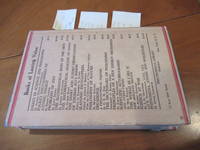
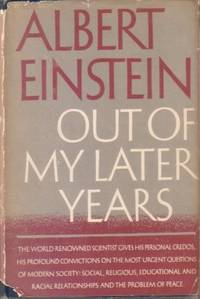
1950Best.-Nr. 000010284New York: Philosophical Library 1950 1950. First edition. Hardcover. Near Fine/Near Fine. 8vo. 7 2 2 5-282 pp. Bound in navy cloth with a facsimile of Einstein's signature stamped in gold on the front board gold lettering on the spine. This is the variant with the grey and red jacket and Einstein's picture on the rear panel priority unknown with the price of $4.75 on the front jacket flap. Boni 515. A lovely copy of this collection of some of Einstein’s general essays on science and social issues. A Near Fine book with minor toning to the gutters; jacket is Near Fine with the spine panel and the edges of the flaps toned. Philosophical Library [1950] hardcover
1950Best.-Nr. 046941New York: Philosophical Library 1950. 1st Edition 1st Printing. Hardcover. Near Fine/Very Good. Frontispiece. 282 Pp. Green Cloth Lettered In Gilt On Front CoverAlso Lettered In Gilt In Spine Stamped On Two Blocks Of Dark Blue Background. Dust Jacket Priced $4.75 With Only 15 Titles On Rear Panel Two First Published In 1950 The Others First Published By Philosophical Library 1942 To 1949. Frontispiece Portrait Of Einstein By Lotte Jacobi. There Are Many Issues With Identical Pagination In Cloth Or Boards Of Various Colors All With Later Post-1950 Publications Indicated On The Rear Panel In Both The Plainer Dust Jacket As On This Copy And In A More Elaborate Jacket; We Believe This Is The First Issue Only By A Process Of Elimination Not Having Seen Many Different Bindings And Dust Jackets. Book With Light Wear Gilt Brilliant No Marks. Dust Jacket With Wear Small Losses/Chips At Corners Not Price Clipped Slight Browning To Spine Panel. Philosophical Library hardcover
1950Best.-Nr. 74182London: Thames & Hudson 1950. Boards lightly rubbed in places with several spot stains corners and spine ends bumped spine lightly sunned light wear to spine edges gilt lettering to front board and spine binding slightly cocked ink inscription to head of fep black and white photograph of author to frontispiece pp bright and clean unmarked text clear to read pp secure in binding. First UK Edition. Hard. Good/No Dust Jacket. 8vo. Thames & Hudson Hardcover
1950Best.-Nr. 013768Philosophical Library. First Printing. Frontispiece Photographic Portrait By Lotte Jacobi. Unclipped DJ in archival cover toning chips edge wear. . Fine. Hardcover. 1st Edition. 1950. Philosophical Library hardcover
1950Best.-Nr. 00009517New York: Philosophical Library 1950 1950. First edition. Hardcover. Very Good/Very Good. 8vo. 4 v-vii 1-282 pp. Light blue cloth with facsimile of Einstein's signature in gold on the front board gilt lettering blocked in dark blue rectangles on the spine light blue topstain. Price of $4.75 on the front flap of the dust jacket. This is the variant with the frontispiece black and white portrait of Einstein and the typographical jacket which lacks a picture of Einstein priority unknown. Boni 515. A presentable copy of this collection of Einstein's general writings. Very Good with light wear to the boards and fading to the topstain in an about Very Good dust jacket with toning and a small chip to the top of the spine panel and a bit of light wear to the extremities. Philosophical Library [1950] hardcover
Best.-Nr. dola812London: Thames And Hudson 1950. First Edition. 8vo. pp. viii 282. frontis. portrait. index. cloth light stain on upper cover spine ends starting to fray London: Thames And Hudson, [1950] hardcover
1950Best.-Nr. 18266New York: Philosophical Library. Very Good in Very Good dust jacket. Hardcover. The beliefs and philosophies of the noted scientist. A nice early edition; 8vo; 282 pages . 1950. Philosophical Library hardcover
1950Best.-Nr. 17988New York: Philosophical Library. Very Good in Very Good- dust jacket. Hardcover. DJ browned and with light chipping. Rough spot on front free endpaper from removed sticker.; The beliefs and philosophies of the noted scientist. A nice early edition; 8vo; 282 pages . 1950. Philosophical Library hardcover
1950Best.-Nr. 32447N.Y. Philosophical Library 1950. Orig. full cloth. Very light wear to spine ends. 7282 pp. First edition. Schilpp:446 - Weil: Appendix. hardcover
1950Best.-Nr. 15962New York: Philosophical Library. Very Good in Very Good- dust jacket. First Edition. Hardcover. DJ browned and with light chipping especially to DJ spine ends; The beliefs and philosophies of the noted scientist from essays published 1934-1950.; 8vo 8" - 9" tall; 282 pages . 1950. Philosophical Library hardcover
1993Best.-Nr. 64339New York: Wings Books 1993. Revised Edition. Hardcover. Very Good in a Very Good dust jacket. Creaes to front flap.; 7.80 X 5.50 X 1.20 inches; 288 pages. Wings Books hardcover
Best.-Nr. GOR001800200Hardback. Very Good. hardcover
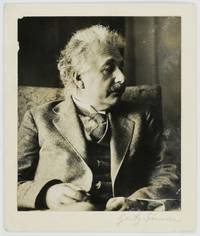
Best.-Nr. 77255Berlin Gerty Simon unpublished ca. 1935. Original photograph 21.3 x 17.8 cm on original cardboard mount 25.0 x 21.0 cm. = Gertrud "Gerty" Simon 1887-1970 was a German photographer who worked during the interwar period. "Born Gertrud Cohn in Bremen to a well-to-do Jewish family with her father being a lawyer she practiced in Berlin and later in London. She captured many important political and artistic figures in Weimar Berlin including singer and actress Lotte Lenya her husband composer Kurt Weill sculptor painter and print maker Käthe Kollwitz her colleague Max Liebermann and physicist Albert Einstein. Gerty Simon moved to Berlin after the First World War. Her husband Wilhelm like her father was a lawyer. They had one son Bernard Bernd born in 1921. Her Berlin studio was at Clausewitzstrasse. With the arrival of the Nazi Party in power in 1933 life became very difficult for Simon and her family. In 1933 her son's school the Landschulheim Herrlingen later the Bunce Court School a progressive boarding school transferred from Southern Germany to Otterden Kent. Simon followed while her husband remained in Berlin unable to continue as a lawyer and judge but finding work as a notary. The family was not reunited until 1939 and father and son were both imprisoned as enemy aliens. At 19 Bernard was even sent to an internment camp in Australia until 1942 despite having lived in the UK for seven years. Simon rapidly re-established her studio in Chelsea and portrayed many significant individuals there such as historian and broadcaster Sir Kenneth Clark actress Dame Peggy Ashcroft and politician Aneurin Bevan. She stopped working as a professional photographer from 1937 for unknown reasons" Wikipedia. The photo shows Einstein in suit and tie looking toward his left with a "Rembrandtesque" light falling on his right side. Signed i.e. approved outside the plate by the photographer. One of the lesser-known and very rare photographs of Einstein. Tiny chips to the left and upper edge and some surface damage to the outer right side; otherwise very good the impression fine and strong. A beautiful photograph.
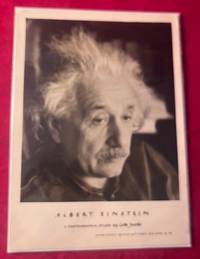
1938Best.-Nr. 9498New Jersey: Jacobi Studio 1938. Very Good. 5 X 7 Inches. SCARCE original headshot of Albert Einstein by Lotte Jacobi circa 1938. This iconic photograph of Einstein features him wearing his leather coat inside his Princeton New Jersey home. Scarce cropped photograph of Einstein's face with Jacobi Studio text in lower border. "Albert Einstein: A Photographic Study By Lotte Jacobi - Jacobi Studio 46 West 52nd Street New York 19 NY." Lotte Jacobi took this photograph of the theoretical physicist Albert Einstein at his home in Princeton New Jersey at the time he was a professor at the university. Both Jewish the two had been family friends a decade earlier in Germany. Einstein had renounced his German citizenship for political reasons after leaving Nazi Germany in 1933 and Jacobi had been forced to emigrate to the United States from Nazi Germany after she too renounced her German citizenship in 1935. Jacobi and Einstein collaborated on the crafting of his media image in a series of late-1930s Princeton portraits commissioned by Life magazine. Einstein agreed to sit for the photo session only if Lotte Jacobi was assigned to photograph him. The image of Einstein in a leather jacket is unusual in that it catches him in a less-guarded less-constructed moment than the others and offers the viewer a glimpse of the world-famous theoretical physicist as an individual rather than as a stereotyped professor. Rubbing and light wear at corners. A SCARCE advertising piece from the Jacobi Studio. Jacobi Studio unknown
1999Best.-Nr. 9293774Office Of Intl Criminal Justice 1999. This is an ex-library book and may have the usual library/used-book markings inside.This book has soft covers. Clean from markings. In fair condition suitable as a study copy. Library sticker on front cover. Please note the Image in this listing is a stock photo and may not match the covers of the actual item850grams ISBN:0942511891 Office Of Intl Criminal Justice paperback
Best.-Nr. 67548A.G. Berlin: Ernst Wasmuth N.D. Hardcover. Very Good boards. Boards slightly bowed. Wear to spine ends. Text is in German. No date.; 4to - over 9¾" - 12" tall. Ernst Wasmuth hardcover
2012Best.-Nr. Q-0486602052Dover Publications 2012-05-17. Paperback. New. New. In shrink wrap. Looks like an interesting title! Dover Publications paperback
Best.-Nr. 123466London G. Bell & Sons Ltd. 1931. . Fifth edition the first with Einstein's foreword; 8vo; illustrations within the text some spotting to the edges of the text block and endpapers some light spotting in the gutter in a few places spotting to pages 222 & 223 from previously inserted material; original blue cloth titles to spine and upper board gilt a very good copy in the rubbed and spotted jacket with some creasing at the extremities and a few short splits; 414pp. The first edition with Einstein's foreword fifth overall. An unusually nice copy in the uncommon dust jacket. The 1730 fourth edition of the Opticks was the final one to appear with Newton's revisions and the text was not republished again until this edition. Newton's Opticks is notable for anticipating the gravitational lensing of light as predicted by Einstein's General Relativity with Newton writing in 1704 'Do not Bodies act upon Light at a distance and by their action bend its Rays; and is not this action caeteris paribus strongest at the least distance' Einstein's foreword begins 'Fortunate Newton happy childhood of science! He who has time and tranquility can by reading this book live again the wonderful events which the great Newton experienced in his young days. Nature to him was an open book whose letters he could read without effort. He stands before us strong certain and alone: his joy in creation and his minute precision are evident in every word and in every figure'. London, G. Bell & Sons, Ltd., 1931. hardcover
2003Best.-Nr. Q-076241698XRunning Press Adult 2003-12-24. paperback. New. New. In shrink wrap. Looks like an interesting title! Running Press Adult paperback
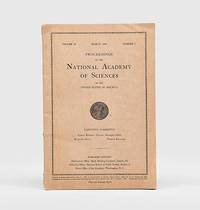
1932Best.-Nr. 180272Easton Pennsylvania: Mack Printing Company 1932. Einstein revises his "biggest blunder" First edition journal issue of the paper in which Einstein rejected his 1917 cosmological constant and acknowledged the expansion of the universe. Drawing on Hubble's law Einstein and de Sitter proposed that the constant should be set equal to zero thereby offering a new model of the universe. "In 1917 Einstein had shown how to construct a universe that was static by introducing a 'cosmological constant' into his equations. This matched well with the idea current before Hubble's 1924 measurement of the distances to the nebulae of a small and static 'universe' that was confined to the stars of the Milky Way galaxy. Einstein's idea of a static universe suspended between gravity pulling inward and the cosmological constant making the universe expand was ruled out by Hubble's data" Kirshner pp. 9-12. In Einstein and de Sitter's revised model "the galaxies receded forever but the recession rate declines to zero as time approaches infinity. Some sources indicate that this is the first attempt to describe our universe rather than a mathematical abstraction of universes possible under general relativity. Shortly after Einstein formally renounced his cosmological constant and according to George Gamow called it 'the biggest blunder of my life'" Wenner. Einstein and de Sitter 1872-1934 were close collaborators in the 1920s at Leiden where de Sitter was chair of astronomy and Einstein was a visiting professor. De Sitter is also known for the concepts of De Sitter space and the De Sitter universe. Large octavo. Original brown wrappers covers printed in black. Short closed tears to spine a little loss to ends corners gently creased: a very good copy. Boni 214; Weil 184; Wenner p. 256. Robert P. Kirshner "Hubble's Diagram and Cosmic Expansion" Proceedings of the National Academy of Sciences of the United States of America vol. 101 no. 1 December 2003. unknown
1949Best.-Nr. 180348Ottowa: Canadian Mathematical Society 1949. Their final collaboration First edition offprint issue. Einstein and Infeld demonstrate that "field equations alone suffice as a basis for solving the problem of motion in general relativistic theory since the Einstein equations not only determine how particles must respond to gravitational forces but also contain the information necessary to describe those forces" Calaprice p. 323. Octavo pp. 34. Original orange wrappers wire-stitched as issued front cover lettered in black. Front wrapper lightly marked: a near-fine copy. Boni 259; Weil 223. Alice Calaprice An Einstein Encyclopedia 2015. unknown
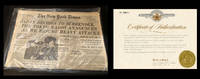
1945Best.-Nr. 1437New York: The New York Times 1945. 1st Edition. First edition of the August 14th 1945 issue of the New York Times complete with "Certificate of Authentication" by the Historic Newspaper Archives. The certificate is #379910; it is signed and includes the seal of the archive. Einstein's article appears in Calaprice's Einstein Almanac No. 244. The certificate will accompany the paper. Most assume that Einstein received the Nobel Prize for his theory of relativity and his famous equation E=mc2. However it was for neither. In 1921 Einstein won the Nobel Prize for discovering the photoelectric effect in 1905. This principle states that when sunlight shines on a metal it emits electrons from the surface of the material. The energy from sunlight photons then transfers to the atoms' electrons and knocks them loose. This discovery was so significant that it has influenced the development of many types of technology from electron microscopes to modern solar cells as we know them today. ALSO INCLUDED: An article by Lewis headlined: "Atoms Not Occult Einstein Declares; Physicist Explains Nuclear and Solar Energy but Refuses to Discuss Use in Bomb" ALSO INCLUDED: New York Time's announces Japan's surrender in 3 line large headline "Japan Decides To Surrender The Tokyo Radio Announces As We Resume Heavy Attacks". CONDITION: Historic Newspaper Archives see above has placed the issue in archival plastic and then into an Archive snap close bag. see photo By any measure this complete issue appears in very good condition. The New York Times unknown
1907Best.-Nr. 25711Weinheim: Offprint from: Zeitschrift für Elektrochemie. Nr. 6. 1907 February. First Edition Offprint Issue from Volume 13 number 6. Single sheet approximately 10" x 8" pp 41-42 pp. A very fine example of this rare issue a very minor and unobtrusive stain to an upper corner. SCARCE OFFPRINT ISSUE OF AN IMPORTANT EINSTEIN PAPER OF STATISTICAL MECHANICS and a continuation of his remarkable 1905 and 1906 publications on Brownian Motion which not only led to the proof of the existence of the atom but also worked to determine the size of atoms and how many atoms there are in a mole or the molecular weight in grams of a gas. This paper also contains a note on the technical meaning of "average velocity. Offprint from: Zeitschrift für Elektrochemie. Nr. 6. unknown
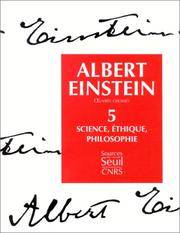
Best.-Nr. BN327717Seuil CNRS Editions. Oeuvres choisies tome 5 : Science éthique philosophie Oeuvres choisies tome 5 : Science éthique philosophie Albert Einstein Seuil CNRS Editions unknown
1922Best.-Nr. 37430Berlin: Slowa 1922. 51 5pp. Original printed wrappers faded front hinge weak tears at spine. First edition in Russian of Weil 111; see Weil 111e. Slowa unknown