EINSTEIN, ALBERTBiblio.com

1.956 Ergebnisse
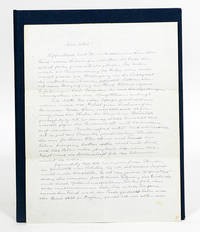
1943Best.-Nr. 2376Princeton NJ: np 1943. First edition. nb. Fine. EINSTEIN OFFERS STRONG AND PRESCIENT WORDS OF ENCOURAGEMENT TO THE LEADER OF THE NAACP IN THE FIGHT AGAINST RACIAL SEGREGATION AND DISCRIMINATION IN THE UNITED STATES. Background: Einstein's fight against racial discrimination in the United States: The imperative "to protect the rights of the individual. was Einstein's most fundamental political tenet. Individualism and freedom were necessary for creative art and science to flourish. Personally politically and professionally he was repulsed by any restraints. "That is why he remained outspoken about racial discrimination in America. As a Jew who had grown up in Germany Einstein was acutely sensitive to such discrimination. 'The more I feel an American the more this situation pains me' he wrote in an essay called 'The Negro Question' for the January 1946 issue of Pageant magazine. 'I can escape the feeling of complicity in it only by speaking out.'" Isaacson Albert Einstein 505. Even more directly in his 1946 commencement speech to Lincoln University the first degree-granting Historically Black College and University HBCU in the United States Einstein strongly denounced segregation as "an American tradition which is uncritically handed down from one generation to the next" noting that "There is separation of colored people from white people in the United States. That separation is not a disease of colored people. It is a disease of white people. I do not intend to be quiet about it." This remarkable letter - from 1943 - is one of the earliest examples of his interest in condemning racism in the United States. The letter: Dated 22 September 1943 and handwritten on his embossed Mercer Street Princeton letterhead Einstein writes in English to Walter F. White the enormously influential African-American civil rights leader who led the NAACP from 1929-1955 praising him for his work and revealing his own awareness of and frustrations with racism and prejudice in America. The text reads in full: Dear Mr. White: I have been quite impressed by the address you delivered some years ago at a meeting of the Princeton Branch of the National Association for the Advancement of Colored People. I know how hard it is to awaken the conscience even of good-hearted and well-meaning people when deep rooted prejudices are in the way. It is a great work indeed which you are doing relentlessly for the betterment of the living conditions of our Colored fellow-citizens for justice and for the accomplishment of national unity of the American people. With sincere respect and kind wishes Yours Albert Einstein ------------- On April 28 1940 White was the keynote speaker at "an inter-racial meeting sponsored by the Princeton branch of the National Association for the Advancement of Colored People" where his topic was "What Happens to Democracy When It Encounters the Color Line." Princeton Herald April 26 1940. At the time Princeton did not admit African Americans and the community was debating the question of whether or not to end segregation at the university. Princeton in fact did not admit its first African-American student until the fall of 1947. Einstein - writing in 1943 - notes that he heard White speak "some years ago". Something clearly must have deeply impressed Einstein about White's speech for him to write this thoughtful letter to White over three years after the event. Note: In addition to its content this apparently unpublished letter is also remarkable for being one of the very few letters Einstein hand-wrote in English during this period as German was still very much his preferred tongue. Princeton: September 22 1943. One page on Einstein's embossed Mercer Street Princeton letterhead 7.25x10 in visible handsomely matted and framed with a photograph of Einstein. Fine condition. np unknown
1930Best.-Nr. 2349np: np 1930. First edition. Fine. EINSTEIN ON THE CONCEPT OF PEACE: A POWERFUL AUTOGRAPH STATEMENT IN EXCEPTIONALLY LARGE FORMAT. Translated from the original German: "No person has the moral right to call himself a Christian or Jew so long as he is prepared to engage in systematic murder at the command of an authority or allow himself to be used in any way in the service of war or the preparation for it." Beginning in 1925 the World League for Peace Ligue mondiale pour la paix under the direction of its president Georges Dejean solicited statements on peace from prominent scientists writers artists political leaders and other public figures throughout the world sending them large 11.5x16.5 inch sheets for their submissions. The resulting collection of more than 1000 original manuscripts was assembled between 1925 and 1932. A selection was reproduced in facsimile in the limited-edition volume Pax Mundi: Livre d'or de la paix published in Geneva by Paxunis in 1932. This is Einstein's original manuscript contribution to the project. A highly unusual format with exceptionally large Einstein signature 2.25 in / 6 cm of an important Einstein statement consistent with his life-long dedication to pacifism. c.1925-1930. One large folio page 11.5 x 16.5 inches. In German. Fine condition. np unknown
1937Best.-Nr. 1984Princeton: np 1937. First Edition. Very Good. AN EXTRAORDINARY LETTER BY EINSTEIN TO HIS SON OFFERING LIFE ADVICE AND DISCUSSING FREUD SHAKESPEARE AND SCHILLER. Addressed to his son Eduard "Tetel" Einstein and signed "Papa" the letter written in ink on both sides of one sheet reads in full translated from the original German: Dear Tetel I hope by now you've received Freud's lectures from Vienna. I've read most of them myself in the past. They really made me admire the Author but they didn't convince me that his theories were correct. I must admit however that based on my personal experiences my conviction about those theories is weakening -- I feel now that he was onto something at least in regards to the main theses. I would have written to you sooner but work is keeping me very busy. Even though they say that the work of a single person will not have much of an impact in the big picture it does not diminish the passion in which we pursue our interests and that is a good thing. Although personal illusions may bring warmth and joy into one's life when young they don't last a lifetime. Life would be bleak if the work and the passion for discovery did not exist. In my free time I am currently reading Schiller's poems which I have neglected since my youth. They feel a bit pompous but at the same time they are enthralling in their choice of words and grammar. I am really happy that I picked them up again. I would have liked to send you another book on the top of the Freud but didn't know which one to send -- especially because I don't get a lot of German writings anymore. When I have some extra free time after finishing Schiller I really want to start reading Shakespeare everything from him I can get my hands on. If you like to read it too perhaps we could discuss it at some later time Albert is a real delight -- he has been traveling up and down the country for the past 6 weeks and will have seen and experienced many interesting things. I really hope he has followed my advice and kept a journal but I am not holding high hopes. When it comes to talking and writing he seems to be chronically constipated. With my warmest regards Papa Einstein's life advice underscoring one of his core beliefs: Einstein often stated that his main goal in life was the quest for truth no matter how difficult and painstaking the quest. He advises Eduard in this letter that it is the pursuit and the work in attaining the goal that brings satisfaction and sustains one throughout life even if "the work of a single person will not have much of an impact in the big picture". This he notes is critical to understand after the illusions of youth have succumbed to reality. Einstein Eduard and Freud: Eduard Einstein nicknamed "Tete" or "Tetel" born in 1910 was the second son of Albert and his first wife Mileva. From an early age he became enamored with the teachings of Freud even hanging a picture of famous psychiatrist on his bedroom wall. By the age of twenty he was diagnosed with schizophrenia and consequently was institutionalized several times throughout his life. Einstein's views of Freud's teachings were somewhat more nuanced than those of his son. Initially Einstein did not show much interest in Freud's theories and after their first meeting in 1927 Freud famously remarked "He understands as much about psychology as I do about physics." Over the years however Einstein began studying Freud's works. After corresponding with Freud somewhat regularly throughout the 1930s and even collaborating with him on a project sponsored by the League of Nations "Why War" 1932 Einstein began to move from a deep skepticism to - as indicated in this letter - a growing acceptance. By 1936 - just before this letter was written - Einstein sent birthday greetings to Freud acknowledging: "Until recently I could only apprehend the speculative power of your train of thought together with its enormous influence on the Weltanschauung of the present era without being in a position to form a definite opinion about the amount of truth it contains. Not long ago however I had the opportunity of hearing about a few instances not very important in themselves which in my judgment exclude any other interpretation than that provided by the theory of repression. I was delighted to come across them since it is always delightful when a great and beautiful conception proves to be consonant with reality." In this letter to Eduard Einstein admits to Eduard that he now believes Freud "was onto something at least in regards to the main theses." Einstein Shakespeare Schiller: Einstein's fondness for music is well-known but not as much has been recorded about his literary tastes. It is not surprising and has been previously documented that Einstein had a fondness for the great German poet Schiller but we can find no other references to Shakespeare by Einstein in any other letters or manuscripts. His words to Eduard "I really want to start reading Shakespeare everything from him I can get my hands on" imply that Einstein has recently "discovered" Shakespeare and is excited at the discovery. Note: Although the letter is not dated we can assume that it was written late November - December in 1937 when Einstein's son Albert was visiting the United States a trip he refers to in the letter. Princeton: November - December 1937. One 8.5x11 inch leaf written on both sides. In German. Usual folds otherwise fine. A LONG REMARKABLE AND REVEALING LETTER UNITING THE INTELLECTUAL GIANTS EINSTEIN FREUD AND SHAKESPEARE AND SHARING ONE OF HIS CORE BELIEFS WITH HIS SON. np unknown
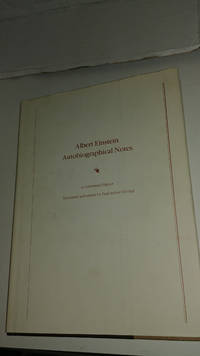
1979Best.-Nr. 444510324cm by 18cm 89pp white dustjacket lightly soiled unmarked. Open Court Publishing Company hardcover
1999Best.-Nr. Q-0812691792Open Court 1999-01-06. Paperback. New. In shrink wrap. Looks like an interesting title! Open Court paperback
Best.-Nr. 3421027307.Ghardcover. Good. Access codes and supplements are not guaranteed with used items. May be an ex-library book. hardcover
1941Best.-Nr. 43508New York; German-Jewish Club Inc 1941. with no dust jacket. 1st edition. Original Illustrated Wrappers. 8vo. 192 pages. 23 cm. Illustrated. In German and English. Photographic and line illustrations in text includes many advertisements as well as a black and white frontispiece portrait of President Franklin D. Roosevelt. Includes foreword of endorsement by Albert Einstein. Handbook for recently arrived German-Jewish exiles from Nazi Germany with information and instruction on Jewish-German immigrant associations citizenship classes American life and customs particularly in New York City the text of The Star Spangled Banner and God Bless America and the meaning of such vernacular expressions as the 'Bronx cheer' and 'sawbucks.' Produced by the editors of the monthly magazine Aufbau which began publishing in 1934. A copy sold for $2000 with buyers commissions at auction in 2018. Subjects: Almanacs American -- New York State OCLC: 970939227 248298786 243425010 959348607. OCLC Locates 4 copies in North America HUC JHU NYHS LBI plus a copy at the US Holocaust Museum which they keep in their Rare Book Room. "L. T. Edelberg" penned on title page. Covers laminated and spine rebacked. German-Jewish historical institute stamps Otherwise Good condition. B HOLO2-110-12-RESA. New York; German-Jewish Club, Inc unknown
1930Best.-Nr. 433061930. Offprint from Mathematische Annalen 102 1930. 685-697pp. Original printed self-wrappers. 233 x 157 mm. Very good apart from small split in lower spine. Weil Albert Einstein Bibliography 171. unknown
1922Best.-Nr. 2081002109000573SPRINGER-VERLAG 1922. Soft Cover. Fine. Number of pages: 15 SPRINGER-VERLAG paperback
1920Best.-Nr. 1433Berlin: Julius Springer 1920. 1st Edition. FIRST EDITION IN ORIGINAL WRAPPERS OF EINSTEIN'S LEIDEN LECTURE EXPLAINING AT LENGTH HIS THEORY OF THE ETHER ALONG WITH THOSE OF LORENTZ & MAXWELL. Very good condition. "Einstein's lecture at the University of Leiden on the occasion of his appointment as a visiting professor summarized his current views on the ether and retrospectively looked at the development of his opinions on the physical properties of space" Calaprice The Einstein Almanac 86. In this lecture Einstein recanted his earlier denial of the ether writing: "Recapitulating we may say that according to the general theory of relativity space is endowed with physical qualities; in this sense therefore there exists an ether. According to the general theory of relativity space without ether is unthinkable; for in such space there not only would be no propagation of light but also no possibility of existence for standards of space and time measuring-rods and clocks nor therefore any space-time intervals in the physical sense. But this ether may not be thought of as endowed with the quality characteristic of ponderable media as consisting of parts which may be tracked through time. The idea of motion may not be applied to it" Einstein Ather 1920. In this lecture Einstein also sought "to reconcile his theory of relativity with his mentor's Lorentz's cherished concept of the aether. Einstein stressed that special relativity took away the last mechanical property of Lorentz's aether: immobility. However he continued that special relativity does not necessarily rule out the aether because the latter can be used to give physical reality to acceleration and rotation. This concept was fully elaborated within general relativity in which physical properties which are partially determined by matter are attributed to space but no substance or state of motion can be attributed to that "aether" aether = curved space-time" Wikipedia. CONDITION & DETAIL: Berlin Julius Springer 1920. Complete in original cream colored wrappers. 8vo. 22 x 15cm. 15pp. Slight toning. Very good condition. ITEM: Ather und Relativitätstheorie. Rede gehalten am 5. Mai 1920 an der Reichs-Universität zu Leiden. Julius Springer unknown
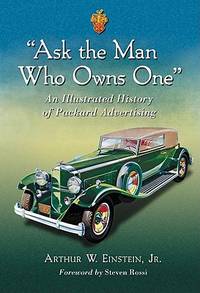
2010Best.-Nr. 220730001McFarland 2010-09-10. Hardcover. Like New. 7x5x1. Hardcover. Near fine with minor shelf wear. Tight binding. Clear text. For any additional information or pictures please inquire. McFarland hardcover
2010Best.-Nr. ANAIS-0786447737McFarland 2010-09-24. hardcover. Good. 25.7x17.8x2. Buy with confidence. Excellent Customer Service & Return policy. McFarland hardcover
2017Best.-Nr. 1-1476667918McFarland Publishing 2017. Paperback. New. reprint edition. 258 pages. 10.00x7.00x0.75 inches. McFarland Publishing paperback
2005Best.-Nr. G9875505870I5N00Longseller 2005. Paperback. Acceptable. Readable copy. Pages may have considerable notes/highlighting. ~ ThriftBooks: Read More Spend Less.Dust jacket quality is not guaranteed. Longseller paperback
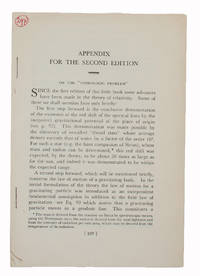
1950Best.-Nr. 465431950. 8vo. Original proof-copy of the latest stage presumably final proof in the same format as the printed version and with no corrections printed on rectos and versos. Stapled twice in left margin. A few marginal creases. A proof- number to upper left corner in red ink 297. Pp. 109-148 tipped-in errata slip at p. 147. Very rare original proof-copy of the two highly important appendices for Einstein's "The Meaning of Relativity" third edition 1950 the second appendix being one of the most important pieces Einstein ever wrote namely the appendix "in which he described his most recent work on unification" Pais and the work which was hailed by The New York Times under the heading "New Einstein theory gives a master key to the universe". The first appendix which appeared for the second edition of the work remained unchanged throughout the history of "the Meaning of Relativity" and was written because "Since the first edition of this little book some advances have been made in the theory of relativity. . The first step forward is the conclusive demonstration of the existence of the red shift of the spectral lines by the negative gravitational potential of the place of origin" . A second step forward which will be mentioned briefly concerns the law of motion of a gravitating body." . A third step forward concerning the so-called "cosmologic problem" wiil be considered here in detail." pp. 109-10. The present 40 pages constitute the final proof-copy of the entire appendices I and II to the Generalized Theory of Gravitation exactly as they appeared in the third edition Princeton in 1950. Einstein's "The Meaning of Relativity" was originally published in 1922 on the basis of his "Vier Vorlesungen ueber Relativitetstheorie" given at Princeton in 1921. A second edition with an appendix appendix I appeared in 1945 several issues and editions of this appeared also and in 1949 the third edition with the seminal Appendix II printed for the first time appears also appeared in 1950 in Princeton. In 1950 a revised edition of the third edition appears having Appendix II slightly revised and in 1953 the heavily revised fourth edition appears. THIS IS THE PROOF-COPY OF APPENDICES I AND II FOR THE "THIRD EDITION INCLUDING THE GENERALIZED THEORY OF GRAVITATION" PRINCETON 1950. The main focus of the work throughout all these editions of the work since 1949 is Appendix II which deals with Einstein's main interest the generalization of the Gravitation Theory which was to unite the general theory of relativity with electromagnetism recovering an approximation for quantum theory and presenting us with a theory to explain the universe as a unified entity the ultimate goal for the greatest physicist that ever lived. "This was Einstein's ultimate response to the mechanical-electromagnetic crisis in physical theory he had first talked about in the opening of his 1905 light quantum-paper." Nandor in D.S.B. p. 330. It was indeed Einstein's aim to provide an explanation of the universe through his unified field theory although he was well aware that his sort of field theory might not exist. However even the establishing of the non-existence of it could bring us closer to an explanation than we had ever been before. There is no topic of greater importance to Einstein than his theory of unification. "In 1949 Einstein wrote a new appendix for the third edition of his "The Meaning of Relativity" in which he described his most recent work on unification. It was none of his doing that a page of his manuscript appeared on the front page of "The New York Times" under the heading "New Einstein theory gives a master key to the universe". He refused to see reporters and asked Helen Dukas to relay this message to them: "Come back and see me in twenty years"." Pais p. 350. unknown
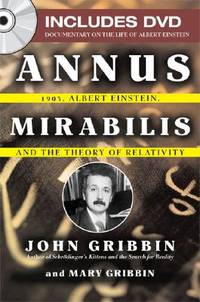
2005Best.-Nr. b0979Chamberlain Bros. 2005. X310 pages. New Hardcover with sealed CD. New DJ. 8.5"x5.8"x1.0". be35 Chamberlain Bros. hardcover
1921Best.-Nr. 302276Leipzig Felix Meiner 1921. 1921. First edition. 8vo. Foreword by Raymund Schmidt. Articles by Oskar Kraus Friedrich Lepsius Paul F. Lincke Joseph Petzoldt. Text pages numbered 334-500. Original stiff green wrappers printed in black. Very good. Cover title: Zur Relativitatstheorie. Kraus' article entitled: "Fiktion und Hypothese in der Einsteinschen Relativitatstheorie.". 1st Edition. Soft cover. Very Good/No Jacket. Leipzig, Felix Meiner, 1921. paperback
1929Best.-Nr. ZB727262Leipzig : J.A. Barth 1929. 5. Folge 5th Series. Volumes 1 through 43 1929-1943 ALL PUBLISHED; all bound ex library else text clean & bindings tight. - If you are reading this this item is actually physically in our stock and ready for shipment once ordered. We are not bookjackers. Buyer is responsible for any additional duties taxes or fees required by recipient's country. Photos available upon request. Leipzig : J.A. Barth unknown
Best.-Nr. 0994006918.Gpaperback. Good. Access codes and supplements are not guaranteed with used items. May be an ex-library book. paperback
1961Best.-Nr. 714603PN. New. 1961. Soft Cover. Date is original print. This is a reprint edition. . PN paperback
1935Best.-Nr. 1383623/05/1935. He prophesizes however that the road ahead for the Jews will be “arduous and very painful” The Institute for Advanced Study in Princeton New Jersey was founded in 1930 by educator Abraham Flexner with funding from department store magnate Louis Bamberger. Flexner first recruited noted mathematicians from Princeton University to join the Institute then broadened its scope by including established scholars in economics politics and humanistic studies. In 1932 Flexner offered Einstein a faculty position at the Institute. Einstein’s decision was effected by historical events as in January 1933 Adolf Hitler became Chancellor of Germany. Soon after Einstein made the decision to resign from his Berlin position give up his German citizenship and accept the position in Princeton. The ocean liner Westmoreland which carried Einstein at age 54 to what would become his new home country arrived in New York Harbor on October 17 1933. <img class=""alignnone size-full wp-image-24695"" src=""https://cdn.raabcollection.com/wp-content/uploads/20231204145639/einsteinsig.gif"" alt="""" width=""1920"" height=""1080"" /> Einstein found the Institute and life in the United States congenial so in April 1934 just six months after his arrival Einstein announced that he was staying in Princeton indefinitely and assuming a permanent full-time status at the Institute. He would remain in the United States the rest of his life. Meanwhile he was very much a celebrity and was invited to the White House to meet with the Roosevelts. He politely declined saying he did not want to call attention to himself a position that German Jews had become accustomed to adopting during the rise of Naziism. However the First Lady Eleanor Roosevelt intervened writing Einstein directly requesting his presence. So Einstein and his wife Elsa arrived at the White House on January 24 1934 had dinner and spent the night. President Roosevelt was able to converse with them in passable German. Among other things they discussed Roosevelt’s marine prints and Einstein’s love for sailing. On learning that the Einsteins had decided to stay in the United States Roosevelt suggested that the Einsteins should accept the offer of some Congressmen to have a special bill passed on their behalf that he would sign granting them citizenship so that they would not have to endure the five year waiting period. The Einsteins declined the President’s generous suggestion saying they wanted to be treated like any other applicant for American citizenship. Because the Einsteins had not been sure of their ultimate destination and declared themselves as visitors instead of immigrants when they arrived in October 1933 this meant that they would need to leave the U.S. and return again to declare intention to seek citizenship. The United Jewish Appeal UJA planned a fund-raising dinner in Einstein’s honor for May 28 1935. This was exactly the time the Einsteins had set aside to leave the country to perfect their citizenship so he was forced to decline the invitation. He did however provide them with a statement that was received by the UJA on May 25 the very day the Einsteins stepped onboard the Queen Mary to travel to British-owned Bermuda for a few days to satisfy the formalities. The royal governor was there to greet them when they arrived in Hamilton and he recommended the island’s two best hotels. Einstein found them stuffy and pretentious. As they walked through town he saw a modest guest cottage and that is where they ended up. <img class=""alignnone wp-image-32085 size-post-window"" src=""https://cdn.raabcollection.com/wp-content/uploads/20240908143641/Einstein-May-23-1935-1-1600x968.jpg"" alt="""" width=""1600"" height=""968"" /> Typed statement signed in German Princeton May 23 1935 time stamped as received on May 25 to be read at the UJA dinner and issued to the press accordingly. It takes the moral high ground but warns of great dangers ahead. ”Unfortunately because of non-deferrable obligations I can only express in writing my recognition and gratitude for the assistance provided to the many unfortunate people by the dinner on the 28th of May. We can gain consolation in this critical time if we compare the moral standard of our friends and our enemies with each other. The result of such a comparison shows us that our way for world history can be considered the better one even if at times it is arduous and very painful.” Our research indicates that this important statement is unpublished as the dinner was postponed and it was never released to the press. But even this moving and forceful statement was not enough for the event organizers. Learning that Einstein could not attend they postponed the dinner. Instead the $50-a-plate dinner for the benefit of the UJA arranged by that organization and the Council of Jewish Organizations was held in New York City on June 26 with Einstein in attendance. About 1000 people attended the banquet at which Einstein spoke. In his speech Einstein returned to the same theme of morality as in the above statement saying that the ""moral disintegration and intensified national egoism"" of the times requires all Jews to strengthen their ranks to preserve Jewry. Of foremost importance he said was the upbuilding of the settlement in Palestine. On June 28 the UJA announced it was using the proceeds from the dinner to aid German refugees in New York City by allocating funds to local agencies equipped to care for the refugees. Einstein reentered the U.S. from Bermuda on June 3 1935. On January 15 1936 the Einsteins submitted their declaration of intention to become citizens of the United States. <img class=""alignnone wp-image-25018 size-post-window"" src=""https://cdn.raabcollection.com/wp-content/uploads/20231204144051/Folder-site-11-1600x1327.jpg"" alt="""" width=""1600"" height=""1327"" /> unknown
Best.-Nr. 1298941474.Ghardcover. Good. Access codes and supplements are not guaranteed with used items. May be an ex-library book. hardcover
Best.-Nr. 101957027X.Ghardcover. Good. Access codes and supplements are not guaranteed with used items. May be an ex-library book. hardcover
Best.-Nr. 0265215838.Ghardcover. Good. Access codes and supplements are not guaranteed with used items. May be an ex-library book. hardcover
Best.-Nr. E04E-02027McGraw-Hill Osborne Media. Used - Very Good. Very Good condition. Sorry CD missing. A copy that may have a few cosmetic defects. May also contain light spine creasing or a few markings such as an owner’s name short gifter’s inscription or light stamp. McGraw-Hill Osborne Media unknown