2.375 Ergebnisse
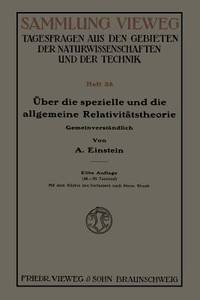
Best.-Nr. NAT2035aBraunschweig Vieweg 1921. IV 91 S. OKart. etwas gebräunt Umschlag randrissig = Sammlung Vieweg ; 38. Weil 90 zur Erstausgabe von 1917. Braunschweig, Vieweg 1921. unknown
Best.-Nr. 1015495907.Ghardcover. Good. Access codes and supplements are not guaranteed with used items. May be an ex-library book. hardcover
Best.-Nr. 3322982726.Gpaperback. Good. Access codes and supplements are not guaranteed with used items. May be an ex-library book. paperback
Best.-Nr. 3322983196.Gpaperback. Good. Access codes and supplements are not guaranteed with used items. May be an ex-library book. paperback
Best.-Nr. 3663037754.Gpaperback. Good. Access codes and supplements are not guaranteed with used items. May be an ex-library book. paperback
Best.-Nr. 3642312780.Gpaperback. Good. Access codes and supplements are not guaranteed with used items. May be an ex-library book. paperback
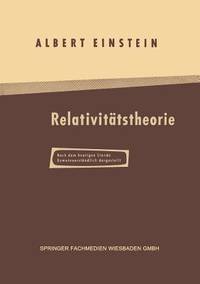
Best.-Nr. x-3322983196Vieweg Teubner Verlag 1963. Paperback. New. 19 edition. 113 pages. German language. 8.26x5.82x0.32 inches. Vieweg + Teubner Verlag paperback
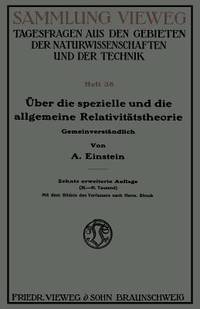
Best.-Nr. x-3322982726Vieweg Teubner Verlag 1921. Paperback. New. 11 edition. 98 pages. German language. 8.82x5.98x0.32 inches. Vieweg + Teubner Verlag paperback
Best.-Nr. x-3663037754Vieweg Teubner Verlag 1920. Paperback. New. 10 spi rep edition. 95 pages. German language. 8.51x5.52x0.25 inches. Vieweg + Teubner Verlag paperback
1917Best.-Nr. 22780Braunschweig Fridr. Vieweg. & Sohn 1917. "Heft 38 sammlung Vieweg" 8vo. Orig. printed wrappers. Title page with ink note and owners name. Some underlinings in ink. IV70 pp. Second printing of the original from the same year. Weil No. 90. unknown
1907Best.-Nr. 38817Leipzig J.A. Barth 1907. Contep. hcloth. Both hinges with a tear at upper part. "Annalen der Physik Vierte Folge. Band 23. Herausgegeben von W.Wien und M. Planck" VIII1000 pp. and 4 plates. Einstein's papers pp. 197-98 a. 206-209 a. 371-384. Internally fine and clean. The whole volume offered. All 3 papers in first edition. - The first paper "New possibility of testing the relativity principle" deals with the shift of canal rays in the Dobbler effect as a possible confirmation of the Principle of Relativity - the confirmation became actual only in 1938 when new improved instrumentation made it possible. - The second paper "remarks concerning Paul Ehrenfest's note: 'Translation of the deformable electron and the momentum law' Einstein gives his answer by relating it to his Theory of Relativity. - The third paper "The inertia of energy as demanded by the principle of relativity" which is a importen paper as it i is the first to state E=mc2 in its general form. general form. This new relation which was adumbrated already in his paper of 1906 Das prinzip von der Erhaltung der Schwerpunktsbewegung brings about the complete unification of mass and energy into a single concept. In natural units which make c=1 we have E=m i.e. mass and energy are one and the same quantity. Every form of energy also has a mass value just as every mass represents a definite amount of energy. - Weil Nos 1718 a. 19 hardcover
1907Best.-Nr. 41347Leipzig Barth 1907. 8vo. Extract from "Annalen der Physik IV23" pp.197-198. First edition in the periodical form. - Weil No. 17. unknown
1907Best.-Nr. 29338Leipzig Barth 1907. 8vo. Extract from "Annalen der Physik IV23" pp.197-198. Some slight browning to leaves. First edition. Weil No. 17. unknown
1922Best.-Nr. 34667Berlin Julius Springer 1922-24. 8vo. In: "Zeitschrift für Physik" Vol. 10 pp. 377 ff.Vol.11 pp.326 vol.16 pp.228 vol.21 pp.326-332. The entire four volumes offered here. Contemporary half cloth bindings. Two landmark papers in the history of cosmology: All first editions. In 'Über die Krümmung des Raumes' Friedman derived the non-stationary solutions to Einstein's field equations. Einstein quickly responded in a short comment 'Bemerkung' in which he expressed his suspicion of such a model of the Universe and apparently pointed out an error in Friedman's calculations. However Friedman now wrote a letter to Einstein in which he enclosed his full calculations. Shortly after this Einstein submitted a short notice Notiz in which he admitted that he himself had performed a calculation error and that Friedman's solutions which shed new light on the matter were valid. Friedman's expanding universe model was corroborated by Edwin Hubble's red-shift observations in 1929. In 'Über die Möglichkeit einer Welt mit konstanter negativer Krümmung des Raumes' Friedman derived the Friedman-equations and demonstrated that he had command of all three Friedman-models describing positive zero and negative curvature respectively nearly a decade before the independent discoveries of the same models by Lemaître Robertson and Walker. hardcover
1922Best.-Nr. 49429Berlin Julius Springer 1922-24. 8vo. 4 contemporary half cloth binding: two in uniform half green cloth and two en uniform grey/blue half cloth. In "Zeitschrift für Physik" Bd. 10 11 16 & 21. Entire volumes offered. All volumes with stamp to title page and front free end paper otherwise a fine and clean set. Friedmann: Bd. 10: Pp. 377-386; Bd. 21: P.p. 326-332. Einstein: Bd. 11:P. 326; Bd. 16: P. 228. First printing of these four landmark paper in which Friedman "introduced into cosmology two concepts of revolutionary importance the age og the world and the creation of the world" Kragh Cosmology and Controversy. "In his paper of 1922 Friedmann offered a complete analysis of the solutions of Einstein's cosmological field equations that went beyond the earlier solutions of Einstein and de Sitter as it also included nonstatic solutions. Friedmann did so clearly and explicitly: "The purpose of this note" he wrote "is firstly to show that the cylindrical Einsteinand spherical de Sitter worlds are special cases of more general assumptions and secondly to demonstrate the possibility of a world in which the curvature of space is independent of the three spatial coordinates but does on time".Ibid.In 'Über die Krümmung des Raumes' Friedman derived the non-stationary solutions to Einstein's field equations. Einstein quickly responded in a short comment 'Bemerkung' in which he expressed his suspicion of such a model of the Universe and apparently pointed out an error in Friedman's calculations. However Friedman now wrote a letter to Einstein in which he enclosed his full calculations. Shortly after this Einstein submitted a short notice Notiz in which he admitted that he himself had performed a calculation error and that Friedman's solutions which shed new light on the matter were valid. Friedman's expanding universe model was corroborated by Edwin Hubble's red-shift observations in 1929. In 'Über die Möglichkeit einer Welt mit konstanter negativer Krümmung des Raumes' Friedman derived the Friedman-equations and demonstrated that he had command of all three Friedman-models describing positive zero and negative curvature respectively nearly a decade before the independent discoveries of the same models by Lemaître Robertson and Walker. "Friedmann made a valuable contribution to Einstein's general theory of relativity. As always his interest was not limited simply to familiarizing himself with this new field of science but led to his own remarkable investigations. Friedmann's work on the theory of relativity dealt with one of its most difficult questions the cosmological problem. In his paper "Über die Krümmung des Raumes" 1922 he outlined the fundamental ideas of his cosmology: the supposition concerning the homogeneity of the distribution of matter in space and the consequent homogence of "world" time for which at any moment in time the metrics of space will be identical at all points and in all directions. This theory is especially important because it leads to a sufficiently correct explanation of the fundamental phenomenon known as the "red shift." This solution of the Einstein field equations obtained from the above propositions is the model for any homogeneous and isotropic cosmological theory. It is interesting to note that Einstein thought that the cosmological solution to the equations of a field had to be static and had to lead to a closed model of the universe. Friedmann discarded both conditions and arrived at an independent solution. Einstein welcomed Friedmann's results because they showed the dispensability of the ad hoc cosmological term Einstein had been forced to introduce into the basic field equation of general relativity". DSB. Weil 122 & 130. hardcover
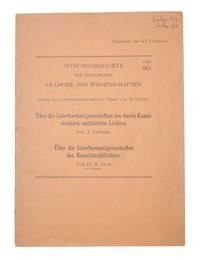
Best.-Nr. H3998Berlin Akademie der Wissenschaften 1926 In: Sitzungsberichte der Königl.Preuss. Akademie der Wissenschaften Band 1926. 4to. S.334-340. Anbei u.a.: Schrödinger E.: Die Energiestufen des idealen einatomigen Gasmodells. S.23-36; Planck Max: Über die Begründung des zweiten Hauptsatzes der Thermodynamik. S.453-466. Halbleinenband der Zeit leicht berieben Bibl.-Nr.am Rücken Original-Broschur miteingebunden unaufgeschnitten gutes Exemplar. The Einstein and Rupp articles are the heart of the Einstein-Rupp scandal perhaps the most famous of all scientific scandals. unknown
1926Best.-Nr. 465401926. Royal8vo. Author's presentation offprint with the printed presentation statement on top of frontwrapper "Überreicht von den Verfassern" i.e. "Given by the authors". Original printed wrappers. Front wrapper loose but fully intact. "Chilpp 202" and "Recdese 160" written in hand to top of front wrapper. A very fine and clean copy. Pp. 334-351. First edition in the scarce author's presentation offprint issue of this important paper which contains Einstein's theories on wave-particle duality and German physicist Rupp's work on the same subject seemingly to corroborating Einstein's theories. Rupp's experimental results later turned out to have been falsifications and today he is mainly known as the protagonist in one of the biggest scandals in physics in the 20th century.Rupp published a number of papers on the interference properties of light emitted by canal ray sources. These articles particularly the present that came into being in close collaboration with Albert Einstein attracted quite a lot of attention as they probed the wave versus particle nature of light. They also significantly propelled Rupp's career even though they were considered highly controversial to begin with.In April 1926 Albert Einstein proposed to Emil Rupp to carry out two experiments that were to prove the wave nature of light versus the particle nature of light: the so-called 'Wire Grid Experiment' and the 'Rotated Mirror Experiment' experiments that Einstein had worked on theoretically and now would like to gain confirmation of through experiments. Rupp at the time regarded as one of the most important and most competent experimental physicists gladly took up the challenge. Rupp's observations - though highly controversial - confirmed Einstein's theory. Due to the surprising outcome of the experiments Einstein was interested in exactly how it they were conducted as Rupp's initial descriptions did not convince him that the results were feasible."Rupp stood by his observations and suggested yet other circumstances that might explain them. Did Einstein now realize that there was something rather dubious about Rupp's work He had seen him change his data repeatedly-and each time in better accordance with his own criticism and on one occasion in no less than two days. He had had to accept that Rupp claimed to earlier have "unknowingly" or "unconsciously" rotated a mirror and he will likely have seen that Rupp's work was highly controversial amongst experimentalists leading to very public criticism in Die Naturwissenschaften. He himself was now also convinced that in fact Rupp's results were incomprehensible. So did Einstein choose to suspend the publication of Rupp's piece so that an additional round of checks and balances could take place The answer is no: Rupp's paper was presented by Einstein to the Prussian Academy in a session on 21 October 1926 and it appeared in print in the Academy's proceedings in November of 1926-the articles by Einstein and Rupp came out back to back and reprints circulated with both papers bound together with a joint cover page that displayed both titles. Einstein referred in his article to Rupp's claims and he had even written the abstract of Rupp's paper" Dongen: "Emil Rupp Albert Einstein and the Canal Ray Experiments on Wave-Particle".The first clear indication that Rupp's work was impossible to recreate came in 1930 in a paper published by Staub - nothing was wrong with Einstein's theory but Rupp's work was simply impossible: "Rupp immediately set out to respond to Straub's publication. On 12 July 1930 he sent a first draft to Einstein to whom he also announced his intention of redoing his canal ray experiments-Straub was dismissed as a clumsy graduate student with a lousy apparatus. Einstein suggested inviting Straub once Rupp had his experiment up and running again but cautioned him not to engage the polemic in too sharp a tone". Rupp managed to convince the physics society and continued to publish the new few years. In 1934 various different physicians pointed out that Rupp's work was impossible to recreate and in 1935 the final blow to Rupp's career came about when the German Physical Society's decided not to allow any citations of Rupp's work. This seems to have had very severe consequences as today it is almost impossible to find any quotations - or even mentioning of Rupp in general let alone his fraud - in any historical studies of either quantum theory or of Einstein.Despite the unquestionable fraud by Rupp his experiments and collaboration with Einstein might have had a positive influence on the further progression to quantum mechanics. The two present papers became of seminal importance in the discussions between Bohr and Heisenberg which eventually in 1927 resulted in Heisenberg publishing his landmark thesis on the uncertainty principle. When Max Born received the Nobel Prize in physics he stated that: "An idea of Einstein gave me the lead From the present paper. He had tried to make the duality of particles-light quanta or photons-and waves comprehensible by interpreting the square of the optical wave amplitudes as probability density for the occurrence of photons."Boni 160; Weil 153. unknown
1908Best.-Nr. 140937838Leipzig: Johann Ambrosius Barth 1908. First Edition. Very Good. First edition scarce author's offprint ''Uberreicht von den Verfassern'' essentially a presentation copy of the article for the authors' use. One of a small unspecified number perhaps 25-50 of copies thus also printed in the journal Annalen der Physik Vierte Folge Band 26; very few survive. 532-540 pp. Original cream-colored wrappers. In German. Very Good with chips in brittle front and back double-sided wraps tear along entire back wrap repaired with clear tape on verso; contents fine. No foxing. The first separate publication of the paper "On the Fundamental Electromagnetic Equations for Moving Bodies" by Einstein then still a patent clerk and Laub. Johann Ambrosius Barth unknown books
1909Best.-Nr. 47376Braunschweig Friedrich Vieweg und Sohn 1909. 8vo. Bound in contemporary half calf with gilt lettering to spine. In "Verhandlungen der Deutsche Physikalische Gesellschaft" 11 Jahrgang 1909. Reprinted same year in "Physikalische Zeitschrift 10". Bound with "Berichte der Deutschen Physikalischen Gesellschaft" 7 Jahrgang 1909. Capitals and hindges with wear. Internally very fine and clean. Pp. 482-500. Entire volume: 2 749 3 VII 450 pp. First printing of Einstein's famous lecture in which he anticipated the discovery of black-body radiation and famously stated that: "the next phase in the development of theoretical physics will bring us a theory of light which may be regarded as a sort of fusion of the undulatory and emission theories of light" The present paper Pp. 482-3. He furthermore stated that the electromagnetic fields that constitute light will no longer appear to be states of a hypothetical medium but rather independent entities emitted by the sources of light exactly as in the Newtonian emission theory of light. The paper was delivered as a lecture before the 81st assembly of the 'Gesellschaft Deutscher Naturforscher' in Salzburg on 21st September 1909.The occasion was important for Einstein since he for years had been working in scientific exile. Among those who attended Einstein's lecture were some of the world's foremost physicists such as; Max von Laue Max Born Arnold Sommerfeld. All published papers of their own in the present volume. Weil No. 30. unknown
1908Best.-Nr. 39155Leipzig J.A. Barth 1908. 2 contemp. hcalf and hcloth. Spines slightly rubbed. In "Annalen der Physik. Hrsg. von W. Wien und M. Planck" vol. 26 and 27. VI1032 and plates pp. VIII1112 pp. and plates.- Einstein & Laub papers: pp.532-541 pp. 541-550 pp. p. 232. Whole volumes offered. First editions of all three papers.- Volume 26 contains also a first printing of Max Planck. "Zur Dynamik bewegter Systeme". Pp. 1-34. Planck Akademie No 76. - Weil: 22 1-2 and 23. hardcover
Best.-Nr. BN156976Bern Herbert Lang & Cie 1975. Hardcover. Über den Frieden. Weltordnung oder Weltuntergang Hgg. von Otto Nathan und Heinz Norden. Vorwort von Bertrand Russell. Übersetzung der englischen und französischen Originale von Will Schaber. Über den Frieden. Weltordnung oder Weltuntergang Hgg. von Otto Nathan und Heinz Norden. Vorwort von Bertrand Russell. Übersetzung der englischen und französischen Originale von Will Schaber. Albert Einstein Bern, Herbert Lang & Cie 1975. hardcover
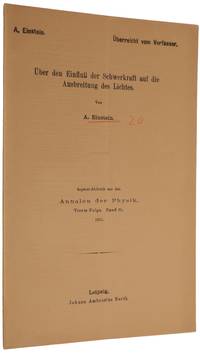
1911Best.-Nr. 6407Leipzig: Johann Ambrosius Barth 1911. First edition. First edition an extremely rare author's presentation offprint with 'Überreicht vom Verfasser' - Presented by the Author from the library of the eminent German physicist Arnold Sommerfeld of Einstein's "first paper completely devoted to general relativity" Brandt Harvest of a Century. In this groundbreaking work Einstein applied the equivalence principle - the idea that acceleration and gravitation are physically indistinguishable - to predict two profound effects of gravity on light: the gravitational redshift and the bending of light by massive bodies. These predictions would later be spectacularly confirmed notably in the 1919 solar eclipse observations cementing Einstein's reputation worldwide. . GRAVITATIONAL RED-SHIFT AND THE BENDING OF LIGHT . First edition extremely rare author's presentation offprint with 'Überreicht vom Verfasser' Presented by the Author stamped on front wrapper from the library of the great German physicist Arnold Sommerfeld of Einstein's "first paper completely devoted to general relativity" Brandt p. 105. This epochal paper applies the equivalence principle that acceleration and gravitation are equivalent in their physical effects to demonstrate two effects of gravity on light: the gravitational bending of light and the gravitational redshift. "In 1911 Einstein proceeded to revise and improve his earlier presentation in 1907 making the principle of equivalence the central feature of his treatment. Einstein now included an elegant proof based on a cyclic process reminiscent of thermodynamics that the gravitational mass of a body as well as its inertial mass is increased by the amount E/c2 when the body absorbs energy E c being the speed of light" Collected Papers p. xxix. Einstein applies this result to show first that if light of frequency ν travels a distance d against a gravitational field which would exert an acceleration g on a gravitating body its frequency is reduced by Δν = νgd/c2 - this is the gravitational redshift. And second Einstein deduced the deflection of a light ray moving in the gravitational field of a spherical body - he finds that the light suffers a deflection toward the source given by 2Gm/dc2 where d is the distance of closest approach to the body of mass m and G is the gravitational constant. "The paper ends with a plea to the astronomers: 'It is urgently desirable that astronomers concern themselves with the question brought up here even if the foregoing considerations might seem insufficiently founded or even adventurous'" Pais p. 200. The bending of light was famously observed by Eddington and his team during a solar eclipse in 1919; the gravitational redshift was more difficult to measure but Einstein's prediction was confirmed by Pound & Rebka at Harvard in 1960 using a laboratory experiment not astronomical observations. "Thus in 1911 we discern the first glimpses of the new Einstein program: to derive the equivalence principle from a new theory of gravitation. This cannot be achieved within the framework of what he called the ordinary relativity theory the special theory. Therefore one must look for a new theory not only of gravitation but also of relativity. Another point made in this paper likewise bears on that new program. 'Of course one cannot replace an arbitrary gravitational field by a state of motion without gravitational field as little as one can transform to rest by means of a relativity transformation all points of an arbitrarily moving medium.' This statement would continue to be true in the ultimate general theory of relativity" Pais pp. 195-196. OCLC lists three copies: King's College London; Württembergische Landesbibliothek; Swiss National Library. RBH list only two other copies both sold by Christie's: the Plotnick copy in 2002 and that in Einstein's own collection of his offprints in 2008. Provenance: Arnold Sommerfeld 1868-1951 his characteristic numbering in red pencil '20' on front cover. "The son of a physician Sommerfeld was educated at the University of Königsberg. After teaching briefly at the universities of Göttingen Clausthal and Aachen he was appointed professor of physics at the University of Münich in 1906. Sommerfeld should have retired in 1936 in favour of his pupil Werner Heisenberg. Opposition from the Nazi party to Heisenberg's appointment prolonged Sommerfeld's tenure and it was not in fact until late 1939 that he finally retired to be succeeded not by Heisenberg but by Wilhelm Müller a Nazi aerodynamicist without a single publication in physics to his credit. Although Sommerfeld and Heisenberg were not Jewish they were regarded by the Nazis as Jewish sympathizers. Sommerfeld however survived the war and returned to his Münich chair in 1945 continuing to work at physics until he died in a car accident in 1951" Oxford Reference. "Arnold Sommerfeld was one of the most distinguished representatives of the transition period between classical and modern theoretical physics. The work of his youth was still firmly anchored in the conceptions of the nineteenth century; but when in the first decennium of the century the flood of new discoveries experimental and theoretical broke the dams of tradition he became a leader of the new movement and in combining the two ways of thinking he exerted a powerful influence on the younger generation. This combination of a classical mind to whom clarity of conception and mathematical rigour are essential with the adventurous spirit of a pioneer are the roots of his scientific success while his exceptional gift of communicating his ideas by spoken and written word made him a great teacher" Max Born p. 275. "In 1907 still working at the patent office in Bern Einstein began to study the laws of physics in reference frames with an accelerated relative motion. When he completed this work in 1915 he called it the General Theory of Relativity. At various occasions Einstein recalled his starting point in this project. It struck him that a man falling from the top of a roof he said did not feel his own weight. In the reference frame of the building it is the weight or gravitational force which make the man fall but in a reference frame moving with the man there is another force exactly counteracting the weight so that there is no net force. In that frame the man stays at rest. Einstein realized that acceleration and gravitation are equivalent to each other. That was later called the equivalence principle. If he would be able to extend his theory of relativity to accelerated reference frames he would be able to do for the theory of gravitation what he had done for electrodynamics with special relativity. He gave a first glimpse at his new topic in a review article on special relativity written in 1907 'Über das Relativitätprinzip und die aus demselben gezogenen Folgerungen' Jahrbuch der Radioaktivität und Elektronik Bd. 4 pp. 411-62" Brandt p. 105. "A few months before the Solvay Congress Einstein had returned to the questions concerning gravitation and accelerated frames of reference that he first raised in his 1907 review article on relativity. These subjects had gone unmentioned in his papers for four years and hardly ever appear in his correspondence during that time. But in June 1911 Einstein completed a short paper 'On the Influence of Gravitation on the Propagation of Light.' This was only a month after his letter to Besso announcing that he was abandoning his efforts to create a new theory of radiation. It looks as though his renunciation of that quest set him free to focus his attention once more on gravitation" Collected Papers p. xxix. "It is characteristic for Einstein that in the same paper he proposed a way to verify his predictions experimentally . From his formula for the gravitational redshift he computed that the frequency of a spectral line emitted by an atom on the surface of the sun would be reduced by two parts in a million when that light reached the earth. Thus a line spectrum originating from the sun is shifted to lower frequencies and therefore to longer wavelengths compared to a spectrum emitted in the laboratory. This redshift is difficult to measure because the surface of the sun is a nasty environment with high pressure storms and magnetic fields all influencing spectral lines. But with modern techniques it has been well established even in the laboratory with radiation climbing against the earth's gravitation for only a few meters. "Einstein also computed the bending of light by gravitation. If the light of a star passes near the surface of the sun and is then observed by an astronomer on the earth the star appears to be in a slightly different position because the light was attracted by the sun and thus the ray was bent on its way from star to the earth. Einstein found a bending angle of 0.83 seconds of an arc. This number was too small by a factor of two but nobody knew because the effect had not been measured. However Einstein himself realized that his theory had to be refined. For a homogeneous gravitational field a field that is constant everywhere he could replace gravitation by a single transformation to an accelerated coordinate system. For a more complicated field like that of the sun or that of all stars the transformation would have to be different for every point in space. That seemed a formidable problem" Brandt p. 106. The correct calculation of light bending was made only in 1915 when Einstein had the final version of general relativity. "His 1911 paper was specifically prompted by his new realization that it should be possible to observe the gravitational bending of light . One had to observe a star whose light would travel close by the sun on its way to the observer. This could be done during a total eclipse of the sun . "Einstein took the initiative in consulting experimental colleagues about the possibilities for checking these results. In August 1911 he began corresponding with W.H. Julius of Utrecht about the gravitational redshift among other matters. At about the same time he raised with Erwin Freundlich at Berlin the question of observing the deflecting of starlight by the gravitational field of the sun a subject on which he corresponded with George Ellery Hale at the Mount Wilson Observatory two years later. There would however be no reliable results on either of these subjects for years to come. But whether or not there were experimental results to help in guiding his work generalizing relativity and creating a new theory of gravitation became the problem that absorbed his attention for the next few years. 'I am just now lecturing on the foundations of that poor dead mechanics which is so beautiful' he wrote to Zangger a month after the Solvay Congress. 'What will its successor look like With that question I torment myself ceaselessly'" Collected Papers pp. xxix-xxx. "English interest in the bending of light developed soon after copies of Einstein's general relativity papers were sent from Holland by de Sitter to Arthur Stanley Eddington at Cambridge . a subsequent report by Eddington . stressed the importance of the deflection of light. In March 1917 the Astronomer Royal Sir Frank Watson Dyson drew attention to the excellence of the star configuration on May 29 1919 another eclipse date for measuring the alleged deflection . Two expeditions were mounted one to Sobral in Brazil led by Andrew Crommelin from the Greenwich Observatory and one to Principe Island off the coast of Spanish Guinea led by Eddington. Before departing Eddington wrote 'The present eclipse expeditions may for the first time demonstrate the weight of light i.e. the Newton value; or they may confirm Einstein's weird theory of non-Euclidean space which predicted twice the Newton value; or they may lead to a result of yet more far-reaching consequences - no deflection' . The expeditions returned. Data analysis began. According to a preliminary report by Eddington to the meeting of the British Association held in Bournemouth on September 9-13 the bending of light lay between 0.87 and double that value. Word reached Lorentz. Lorentz cabled Einstein . Then came November 6 1919 the day on which Einstein was canonized . the setting a joint meeting of the Royal Society and the Royal Astronomical Society resembled a Congregation of Rites. Dyson acted as postulator ably assisted by Crommelin and Eddington as advocate-procurators. Dyson speaking first concluded his remarks with the statement 'After a careful study of the plates I am prepared to say that they confirm Einstein's prediction. A very definite result has been obtained that light is deflected in accordance with Einstein's law of gravitation'" Pais pp. 304-305. The gravitational bending of light has recently found a new application - the search for extra-solar planets. ". the 'most curious effect' of the bending of starlight by the gravity of intervening foreground stars - now commonly referred to as 'gravitational microlensing' - has become one of the successfully applied techniques to detect planets orbiting stars other than the Sun while being quite unlike any other . Gravitational microlensing favours a range of orbital separations that covers planets whose orbital periods are too long to allow detection by other indirect techniques but which are still too close to their host star to be detected by means of their emitted or reflected light. Rather than being limited to the Solar neighbourhood a unique opportunity is provided for inferring a census of planets orbiting stars belonging to two distinct populations within the Milky Way with a sensitivity not only reaching down to Earth mass but even below with ground-based observations. The capabilities of gravitational microlensing extend even to obtaining evidence of a planet orbiting a star in another galaxy" Dominik. BRL 39; Parkinson p. 471; Weil 43. The Collected Papers of Albert Einstein vol. 3 The Swiss Years: Writings 1909-1911 Princeton: Princeton University Press 1994. Born 'Arnold Johannes Wilhelm Sommerfeld 1868-1951' Obituary Notices of Fellows of the Royal Society 8 1952 pp. 275-296. Brandt The Harvest of a Century Oxford: Oxford University Press 2009. Dominik 'Studying planet populations with Einstein's blip' Philosophical Transactions of the Royal Society A: Mathematical Physical and Engineering Sciences vol. 368 no. 1924 2010. Pais Subtle is the Lord Oxford: Clarendon Press 1982. 8vo 222 x 144 mm pp. 1 blank 898-908. Original printed orange wrappers light vertical crease for posting. Johann Ambrosius Barth unknown
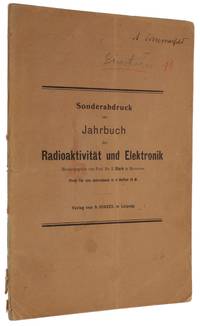
1907Best.-Nr. 6410Leipzig: S. Hirzel 1907. First edition. First edition an extremely rare offprint from the library of the renowned German physicist Arnold Sommerfeld of one of the most important transitional papers in Einstein's scientific career. In this landmark work Einstein first articulated the equivalence principle - the insight that uniform acceleration and gravitation are physically indistinguishable - a profound realization he later described as "the happiest thought of my life." This concept became the foundation of general relativity marking a pivotal departure from special relativity and setting Einstein on the path toward a relativistic theory of gravitation. . THE EQUIVALENCE PRINCIPLE 'THE HAPPIEST THOUGHT OF MY LIFE' . First edition extremely rare author's presentation offprint with 'Überreicht vom Verfasser' Presented by the Author stamped on front wrapper from the library of the great German physicist Arnold Sommerfeld of this crucially important transitional paper in which Einstein introduced the equivalence principle that uniform acceleration and gravitation are equivalent in their physical effects which launched him on his path to general relativity. "Einstein's efforts to incorporate gravitation into the theory of relativity led him in 1907 to formulate a new formal principle later named the principle of equivalence. He stressed that when gravitational effects are taken into account it is impossible to maintain the privileged role that inertial frames of reference still have in the original relativity theory. He concluded that if gravitation is to be included it is necessary to extend the relativity principle. The search for a group of transformations wider than the Lorentz group under which the laws of physics remain invariant when gravitation is included lasted from 1907 until the end of 1915 leading finally to what Einstein considered his greatest achievement the general theory of relativity" Collected Papers 2 p. xxix. "On p. 443 are probably the first explicit statements both of the equivalence of inertial and gravitational mass and of the equation for mass in terms of energy E = mc2 now regarded as the theoretical basis for the release of atomic energy" Weil. In 1905 "Einstein said that all energy of whatever sort has mass. It took even him two years more to come to the stupendous realization that the reverse must also hold: that all mass of whatever sort must have energy. . With mass and energy thus wholly equivalent Einstein was able in 1907 in a long and mainly expository paper published in the Jahrbuch der Radioactivität the offered paper to write his famous equation E = mc2 . In presenting his equation in 1907 Einstein spoke of it as the most important consequence of his theory of relativity" Hoffmann Albert Einstein p. 81. "Of greatest importance is the last part of the paper which generalizes the principle of relativity from uniformly moving systems to uniformly 'accelerated' systems. . He introduces the principle of equivalence which claims that the problem of a uniform and stationary gravitational field on the one hand and the system moving with a constant acceleration without any gravitation on the other hand are physically indistinguishable situations. This principle put him in a position to find out what effect gravitation has on an arbitrary physical phenomenon because all he had to do was to observe that phenomenon from an accelerated reference system. He thus obtains the speeding up of clocks in a field of increased gravitational potential which must lead to a universal red shift of the spectral lines coming from the Sun and likewise to a bending of light rays near to the limb of the Sun. Furthermore this hypothesis at once makes it clear why inertial mass and gravitational mass must be under all circumstances strictly proportional to one another. . Hence the principle of the energy value of inertial mass must be extended to the gravitational mass" Lanczos The Einstein Decade p. 153. Later Einstein wrote that when he was working on this paper "There occurred to me the happiest thought of my life in the following form. The gravitational field has only a relative existence in a way similar to the electric field generated by magnetoelectric induction. Because for an observer falling freely from the roof of a house there exists - at least in his immediate surroundings - no gravitational field" Einstein's emphasis Pais Subtle is the Lord p. 178. Although Einstein submitted the paper on 4 December 1907; it was published in the January 22 issue of the Jahrbuch. This is one of Einstein's rarest major papers in offprint form. RBH lists three copies: Plotnick Christie's 2002; Einstein's own collection of his offprints Christie's 2008; and Richard Green Christie's 2008. OCLC lists 6 copies worldwide Morgan; Princeton; Stanford; Trinity College Cambridge; Queen's University Kingston ON; Thomas Fisher. This copy was presented by Einstein to one of the leading physicists of the time surely hoping to make himself known in the scientific world when he was still a technical expert in the Swiss Patent Office. Provenance: Arnold Sommerfeld 1868-1951 his signature and characteristic numbering in red pencil '11' on front cover. "The son of a physician Sommerfeld was educated at the University of Königsberg. After teaching briefly at the universities of Göttingen Clausthal and Aachen he was appointed professor of physics at the University of Münich in 1906. Sommerfeld should have retired in 1936 in favour of his pupil Werner Heisenberg. Opposition from the Nazi party to Heisenberg's appointment prolonged Sommerfeld's tenure and it was not in fact until late 1939 that he finally retired to be succeeded not by Heisenberg but by Wilhelm Müller a Nazi aerodynamicist without a single publication in physics to his credit. Although Sommerfeld and Heisenberg were not Jewish they were regarded by the Nazis as Jewish sympathizers. Sommerfeld however survived the war and returned to his Münich chair in 1945 continuing to work at physics until he died in a car accident in 1951" Oxford Reference. "Arnold Sommerfeld was one of the most distinguished representatives of the transition period between classical and modern theoretical physics. The work of his youth was still firmly anchored in the conceptions of the nineteenth century; but when in the first decennium of the century the flood of new discoveries experimental and theoretical broke the dams of tradition he became a leader of the new movement and in combining the two ways of thinking he exerted a powerful influence on the younger generation. This combination of a classical mind to whom clarity of conception and mathematical rigour are essential with the adventurous spirit of a pioneer are the roots of his scientific success while his exceptional gift of communicating his ideas by spoken and written word made him a great teacher" Max Born p. 275. "His first important paper on relativity theory after 1905 is the 1907 review. This article was written at the request of Johannes Stark the editor of the Jahrbuch. On September 25 1907 Einstein had accepted this invitation. On November 1 Einstein further wrote to Stark: 'I am now ready with the first part of the work for your Jahrbuch. I am working zealously on the second part in my unfortunately scarce spare time.' Since this second part contains the remarks on gravitation it seems probable that Einstein's 'happiest thought' came to him sometime in November 1907. We certainly know where he was when he had this idea. In his Kyoto lecture he told the story: 'I was sitting in a chair in the patent office at Bern when all of a sudden a thought occurred to me. 'If a person falls freely he will not feel his own weight!' I was startled. This simple thought made a deep impression on me. It impelled me toward a theory of gravitation' . "Three main issues are raised in Section V of the Jahrbuch article. The Equivalence Principle. 'Is it conceivable that the principle of relativity also holds for systems which are accelerated relative to each other' That is Einstein's starting question. Then he gives the standard argument. A reference frame Σ1 is accelerated in the x direction with a constant acceleration γ. A second frame Σ2 is at rest in a homogeneous gravitational field which imparts an acceleration -γ in the x direction to all objects. 'In the present state of experience we have no reason to assume that . Σ1 and Σ2 are distinct in any respect and in what follows we shall therefore assume the complete physical equivalence of a gravitational field and the corresponding acceleration of the reference frame. This assumption extends the principle of relativity to the case of uniformly accelerated motion of the reference frame . he began by applying his new postulate to the Maxwell equations always for uniform acceleration. He did not raise the question of the further extension to nonuniform acceleration until 1912 the year he first referred to his hypothesis as the 'equivalence principle.' The Gravitational Red Shift. Many textbooks on relativity ascribe to Einstein the method of calculating the red shift by means of the Doppler effect of light falling from the top to the bottom of an upwardly accelerating elevator. That is indeed the derivation he gave in 1911. However he was already aware of the red shift in 1907. The derivation he gave at that time is less general more tortured and yet oddly more sophisticated. It deserves particular mention because it contains the germ of two ideas that were to become cornerstones of his final theory: the existence of local Lorenz frames and the constancy of the velocity of light for infinitesimally small paths . Maxwell's Equations; Bending of Light; Gravitational Energy = mc2. Indomitably Einstein goes on. He tackles the Maxwell equations next. He concludes that Maxwell's equations have the same form in a uniformly accelerated reference frame as in a non-accelerated frame but with a modified velocity of light. 'It follows that the light rays . are bent by the gravitational field.' Second he examines the energy conservation law in the accelerated frame and finds 'a very notable result . In a gravitational field one must associate with every energy E an additional position-dependent energy which equals the position-dependent energy of a 'ponderable' mass of magnitude E/mc2. The law E = mc2 therefore holds not only for inertial but also for gravitational mass' . "This review does not have the perfection of the 1905 paper on special relativity. The approximations are clumsy and mask the generality of the conclusions. Einstein was the first to say so in 1911. The conclusion about the bending of light is qualitatively correct quantitatively wrong - though in 1907 not yet logically wrong. Einstein was the first to realize this in 1915. Despite all this I admire this article at least as much as the perfect relativity paper on 1905 not as much for its details as for its courage" Pais pp. 179-182. "In 1920 Einstein recalled how he first arrived at the ideas behind the equivalence principle: 'While I was occupied in 1907 with a comprehensive survey of the special theory for the 'Yearbook for Radioactivity and Electronics' I also had to attempt to modify Newton's theory of gravitation in such a way that its laws fitted into the theory. Attempts along these lines showed the feasibility of this enterprise but did not satisfy me because they had to be based on physical hypotheses that were not well-founded. Then there came to me the most fortunate thought of my life in the following form: 'Like the electric field generated by electromagnetic induction . the gravitational field only has a relative existence. Because for an observer freely falling from the roof of a house during his fall there exists-at least in his immediate neighborhood-no gravitation field. Indeed if the observer lets go of any objects relative to him they remain in a state of rest or uniform motion independently of their particular chemical or physical composition note by AE: air resistance is naturally ignored in this argument. The observer is thus justified in interpreting his state as being at rest. 'Through these considerations the unusually extraordinary experimental law that all bodies fall with equal acceleration in the same gravitational field immediately obtains a deep physical significance. For if there were just one single thing that fell differently from the others in the gravitational field then with its help the observer could recognize that he was falling in a gravitational field. If such a thing does not exist-which experiment has shown with great precision-then there is no objective basis for the observer to regard himself as falling in a gravitational field. Rather he has the right to regard his state as one of rest and with respect to a gravitational field his neighborhood as field free. The experimental fact of the material-independence of the acceleration due to gravity is thus a powerful argument for the extension of the relativity postulate to coordinate systems in non-uniform relative motion with respect to each other . The generalization of the relativity principle thus indicates a speculative path towards the investigation of the properties of the gravitational field.' "Einstein alludes here to his initial attempts to set up a special-relativistic theory of gravitation but gives no details. In 1933 he gave the fullest account of how he 'arrived at the equivalence principle by a detour Umweg' through such attempts. After mentioning his doubts after 1905 about the privileged dynamical role of inertial systems and his early fascination by Mach's idea that the acceleration of a body is not absolute but relative to the rest of the bodies in the universe he turns to the events of 1907: 'I first came a step closer to the solution of the problem when I attempted to treat the law of gravitation within the framework of special relativity. Like most authors at the time I attempted to establish a field law for gravitation since the introduction of an unmediated action at a distance was no longer possible at least in any sort of natural way on account of the abolition of the concept of absolute simultaneity. 'The simplest thing naturally was to preserve the Laplacian scalar gravitational potential and to supplement Poisson's equation in the obvious way by a term involving time derivatives so that the special theory of relativity was satisfactorily taken into account. The equation of motion of a particle also had to be modified to accord with the special theory. The way to do so was less uniquely prescribed since the inertial mass of a body might well depend on its gravitational potential. This was even to be expected on the basis of the law of the inertia of energy. 'However such investigations led to a result that made me highly suspicious. For according to classical mechanics the vertical acceleration of a body in a vertical gravitational field is independent of the horizontal component of its velocity. This is connected with the fact that the vertical acceleration of a mechanical system or rather of its center of mass in such a gravitational field turns out to be independent of its internal kinetic energy. According to the theory I was pursuing however such an independence of the gravitational acceleration from the horizontal velocity or from the internal energy of a system did not occur. 'This did not accord with an old fact of experience that all bodies experience the same acceleration in a gravitational field. This law which can also be formulated as the law of equality of inertial and gravitational mass now appeared to me in its deep significance. I was most highly amazed by it and guessed that in it must lie the key to the deeper under- standing of inertia and gravitation.' "Turning from later reminiscences let us see how Einstein presented his approach to gravitation in 1907: 'Up to now we have only applied the principle of relativity i.e. the presupposition that the laws of nature are independent of the state of motion of the reference system to acceleration-free reference systems. Is it conceivable that the principle of relativity also holds for systems that are accelerated relative to each other 'This is not the place for an exhaustive treatment of this question. Since however it is bound to occur to anyone who has followed the previous applications of the relativity principle I shall not avoid taking a position on the question here. Consider two systems in motion Σ1 and Σ2. Let Σ1 be accelerated in the direction of its X -axis and let γ be the magnitude constant in time of this acceleration. Let Σ2 be at rest but in a homogeneous gravitational field that imparts an acceleration -γ in the direction of the X -axis to all objects. As far as we know the laws of physics with respect to Σ1do not differ from those with respect to Σ2; this is due to the circumstance that all bodies in a gravitational field are equally accelerated. So we have no basis in the current state of our experience for the assumption that the systems Σ1and Σ2differ from each other in any respect; and therefore in what follows shall assume the complete physical equivalence of a gravitational field and the corresponding acceleration of a reference system. 'This assumption extends the principle of relativity to the case of uniformly-accelerated translational motion of the reference system. The heuristic value of this assumption lies in the circumstance that it allows the replacement of a homogeneous gravitational field by a uniformly accelerated reference system which to a certain extent is amenable to theoretical treatment.' "Some further comments on this equivalence in his next paper on gravitation in 1911 are illuminating. He notes that in both systems objects subject to no other forces fall with constant acceleration: 'For the accelerated system K′ corresponding to the 1907 Σ1 this follows directly from the Galileian principle of inertia; for the system K at rest in a homogeneous gravitational field corresponding to the 1907 Σ2 however it follows from the experimental fact that in such a field all bodies are equally strongly uniformly accelerated. This experience of the equal falling of all bodies in a gravitational field is the most universal with which the observation of nature has provided us; in spite of that this law has not found any place in the foundations of our physical picture of the world . From this standpoint one can as little speak of the absolute acceleration of a reference system as one can of the absolute velocity of a system according to the usual special theory of relativity. Naturally one cannot replace an arbitrary gravitational field by a state of motion of the system without a gravitational field; just as little as one can trans- form all points of an arbitrarily moving medium to rest by a relativity transformation. From this standpoint the equal falling of all bodies in a gravitational field is obvious. 'As long as we confine ourselves to purely mechanical processes within the realm of validity of Newtonian mechanics we are certain of the equivalence of the systems K and K′. Our point of view will only have a deeper significance however if the systems K and K′ are equivalent with respect to all physical processes i.e. if the laws of nature with respect to K agree completely with those with respect to K′. By assuming this we obtain a principle that if it really is correct possesses a great heuristic significance. For by means of theoretical consideration of processes that take place relative to a uniformly accelerated reference system we obtain conclusions about the course of processes in a homogeneous gravitational field.' "With hindsight one can see that Einstein's attempt to find the best way to implement mathematically the physical insights about gravitation incorporated in the equivalence principle was hampered significantly by the absence of the appropriate mathematical concepts. His insight as he put is a few years later that gravitation and inertia are "essentially the same" wesensgleich cries out for implementation by their incorporation into a single inertio-gravitational field represented mathematically by a non-flat affine connection on a four-dimensional manifold. But the concept of such a connection was only developed after and largely in response to the formulation of the general theory. So Einstein had to make do with what was available: Riemannian geometry and the tensor calculus as developed by the turn of the century i.e. based on the concept of the metric tensor without a geometrical interpretation of the covariant derivative" Stachel pp. 83-86. BRL 20; Stanitz 94; Weil 21. Born 'Arnold Johannes Wilhelm Sommerfeld 1868-1951' Obituary Notices of Fellows of the Royal Society 8 1952 pp. 275-296. Stachel 'The first two acts' pp. 81-112 in: Gravitation in the Twilight of Classical Physics. The Promise of Mathematics Renn & Schemmel eds. 2007. 8vo 231 x 157 mm pp. 411-462. Original printed wrappers upper cover a bit soiled lower part of spine worn light vertical crease for posting faint ink stain to page 418 spine strip with wear and tear. S. Hirzel unknown
1917Best.-Nr. 22780Braunschweig, Fridr. Vieweg. & Sohn, 1917. (""Heft 38 sammlung Vieweg""), 8vo. Orig. printed wrappers. Title page with ink note and owners name. Some underlinings in ink. IV,70 pp.
1907Best.-Nr. 29338(Leipzig, Barth, 1907). 8vo. Extract from ""Annalen der Physik IV,23"", pp.197-198. Some slight browning to leaves.