A True Theory of WealthBiblio.com

12 829 résultats
réf. 1332907660.Gpaperback. Good. Access codes and supplements are not guaranteed with used items. May be an ex-library book. paperback
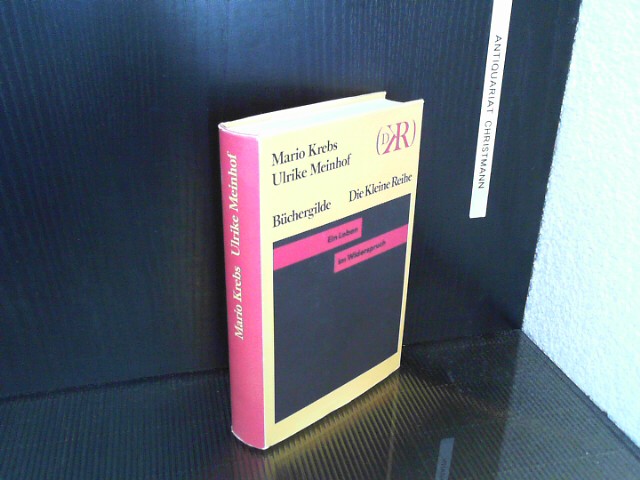
1989réf. 19464Frankfurt am Main ; Wien : Büchergilde Gutenberg 1989. 449 S. ; 19 cm, mit Schutzumschlag, kleine Eigentümersignatur auf Vorsatzblatt gebundene Ausgabe, Hardcover/Pappeinband, Exemplar in gutem Erhaltungszustand
2009réf. 8767229Blast Theory 2009. This is an ex-library book and may have the usual library/used-book markings inside.This is a pamphlet. In good all round condition. Please note the Image in this listing is a stock photo and may not match the covers of the actual item150grams ISBN:9780954325817 Blast Theory unknown
2017ill., br. Ugo Ojetti (Roma 1871 - Firenze 1946) fu collezionista e opinionista sagace, ma fu, soprattutto, un raffinato censore del sistema delle arti italiano e, ancor più, un manager delle esposizioni, sorta di curatore ante litteram, teso fra passione antiquaria e ricerca di nuove qualità espressive, possibilmente connotate da un alto potenziale identitario ed economico. L'amore per i canoni visivi del nostro passato - avvertiti come necessaria consolazione al presente - lo spinse a promuoverne largamente il recupero, in una perenne ricerca di alleanze intellettuali, politiche e finanziarie. Opzione rischiosa, che lo portò - fra vittorie e delusioni - a incrociare i nodi più oscuri della programmazione culturale fascista. Questo volume indaga l'intensità del personaggio sotto il segno del fare. Segue il filo rosso della sua esperienza, affiancando scritti pubblici e carte private, così da individuare non soltanto il legame ch'egli seppe attivare fra indirizzo critico e attività organizzativa, ma anche la sua appassionata battaglia per avvicinare "la bellezza" a un pubblico esteso.
1944(Codice CV/2692) In 16° 264 pp. Brossura originale verde. Ex libris. Buono stato. ~~~ SPEDIZIONE IN ITALIA SEMPRE TRACCIATA
1851réf. 17139BHeidelberg, J. C. B. Mohr, 1851. (Dritte vermehrte Ausgabe), 8° (18 x 11,5 cm), XX, 230 Seiten, 1 lithogr. Portr., mschr. Namenregister Brauner Pappband der Zeit (Kanten beschabt) mit rotem Rückentitel Teilweise stockfleckig
réf. 0364359358.Ghardcover. Good. Access codes and supplements are not guaranteed with used items. May be an ex-library book. hardcover
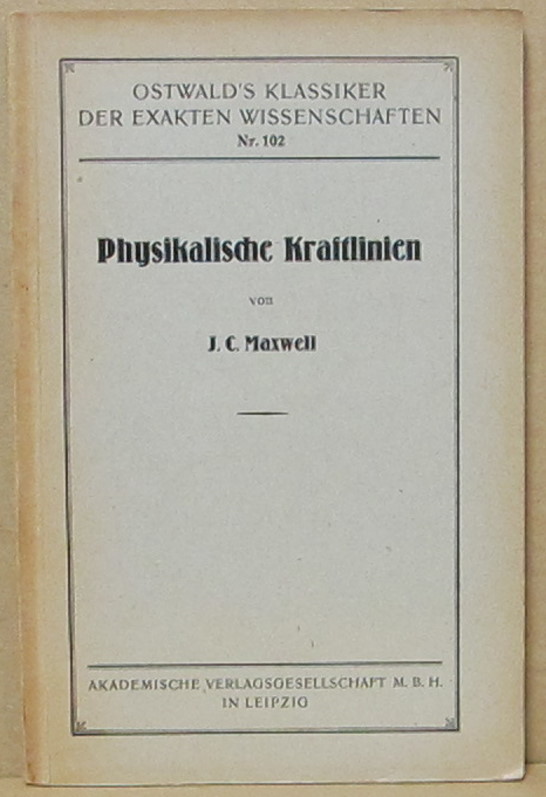
1920réf. 51102Leipzig, Akademische Verlagsgesellschaft, ca. 1920. 8°; 146 Seiten, 12 Textfiguren; Orig.-Broschur Einband randgebräunt; Rücken gebräunt und etwas fleckig, leichte Gebrauchsspuren Ostwalds Klassiker der exakten Wissenschaften, Nr.
1900réf. 48173Berlin Johann Ambrosius Barth 1900. Contemp. hcloth. over marbled boards gilt title to spine. Housed in a fine black morocco slicase gilt borders on sides spine with raised bands and gilt lettering. In: "Annalen der Physik" Vierte Folge Band 1. VIII 792 pp. 3 folded engraved plates.Entire volume offered. Planck's papers: pp. 69-122; 621-624;719-737. A very fine and clean copy. With the bookplate of Andras Gedeon on inside frontcover. First edition of these fundamental and highly influential Planck-papers in which he defines his concept of entropy and heat radiation and hereby ANTICIPATES HIS FAMOUS SEMINAL PAPER OF 1900 which redefined physics and took it to the 20th century. - The first two papers "Ueber irreversible Strahlungsvorgänge" were rewritten for the "Annalen" and was first introduced in "Sitzungsberichte d.k. Akad. Wissensch. zu Berlin"."By invoking the hypothesis of natural radiation Planck not only succeeded in obtaining a relation between the energy of the resonator and the intensity of radiation for a given wavelength or frequency but also in defining the entropy of radiation by a proper expression such that the change of the total entropy was always a positive quantity". Mehra Jagdish. The historical development of quantum theory 2001 p. 36. These results found in the period 1894-00 culminated in the present paper "Ueber irreversible Strahlungsvorgänge" and for the first time incorporates the concept of natural radiation and made a purely electromagnetic definition of entropy and of temperature. hardcover
1900réf. 49800Berlin Johann Ambrosius Barth 1900. Later full buckram. Stamp on verso of titlepage. Narrow inner margins binding style with cords in margin. In: "Annalen der Physik" Vierte Folge Band 1. VIII 792 pp. 3 folded engraved plates.Entire volume offered. Planck's papers: pp. 69-122; 621-624;719-737. Internally fine and clean. First edition of these fundamental and highly influential Planck-papers in which he defines his concept of entropy and heat radiation and hereby ANTICIPATES HIS FAMOUS SEMINAL PAPER OF 1900 which redefined physics and took it to the 20th century. - The first two papers "Ueber irreversible Strahlungsvorgänge" were rewritten for the "Annalen" and was first introduced in "Sitzungsberichte d.k. Akad. Wissensch. zu Berlin"."By invoking the hypothesis of natural radiation Planck not only succeeded in obtaining a relation between the energy of the resonator and the intensity of radiation for a given wavelength or frequency but also in defining the entropy of radiation by a proper expression such that the change of the total entropy was always a positive quantity". Mehra Jagdish. The historical development of quantum theory 2001 p. 36. These results found in the period 1894-00 culminated in the present paper "Ueber irreversible Strahlungsvorgänge" and for the first time incorporates the concept of natural radiation and made a purely electromagnetic definition of entropy and of temperature. hardcover
1852réf. 43564Leipzig Johann Ambrosius Barth 1852. Without wrappers as issued in "Annalen der Physik und Chemie. Hrsg.von Poggendorff" Dritte Reihe Bd. 26 Achtes Stück.= Heft No. 8 of 1852. The entire issue No. 8 offered. Titlepage to vol. 26. Pp. 501-600. Helmholtz's paper: pp. 501-523. Clean and fine. First appearance of this founding paper in the modern theory of colour in which Helmholtz proved the surprising fact that there are only two among the colours of the spectrum yellow and indigo-blue which together yields pure white that is are complementary to each other whereas their combination had always been supposed to produce green."Helmholtz turned to the intricate problems of color vision in 1852 with an attack on Sir David Brewster's new theory of light. Brewster had maintained the objective reality of three primary colors by supposing in opposition to Newton that there exist three distinct kinds of light each of which excites in the eye one of the sensations red yellow or blue. Helmholtz regarded the theory as still another confusion of physical stimulus and subjective responce.He also revived Young's theory of color visoin.only to refute it. He had discovered that spectral colors when mixed always yield a duller color of less-than-spectral saturation. Therefore the whole idea that all colors may be obtained from mixtures of three primary colors must be incorrect he concluded for the spectral colorss at least can never be obtained in their full saturation by mixing any three of their number.Although Helmholtz dismissed Young's theory in 1852 by 1858 he had changed his mind and become its formost advocate. In order to save Ypoung's theory.Helmholtz asumed that Young's physiological primaries are not spectral colors att all but colors of far greater-than-spectral saturation."DSB VI pp. 246-247. Garrison & Morton 1508. unknown
1780réf. 36378Halle, Waisenhaus, 1780. 1 Bl., 166, 296 S. Mit gestochener Titelvignette. Moderner Halbleder. [2 Warenabbildungen]
1890réf. 3436856Jena, Fischer, 1890. VI, 87 S. Lwd (Stempel auf Titel).
1858réf. 43056Leipzig Johann Ambrosius Barth 1858. Contemp. hcalf. 5 raised bands gilt spine and gilt lettering to spine. A few scratches to spine. Small stamp on verso of first -and general- titlepage. In: "Annalen der Physik und Chemie. Hrsg. von J.C. Poggendorff" Vierte Reihe Bd. 15 =Poggendorff Bd. 105. X636 pp. and 4 folded lithographed plates. Clausius's paper: pp. 239-258. The entire volume offered. Fine and clean. First printing of this main paper in the working out of the Kinetic Theory of Gases in which Clausius announced his determination of the equation governing the mean free path lenght of a molecule moving freely in gases. By this he inscribed his name as one of the founders of the Kinetic Theory of Gases."Clausius was one of the founders of the kinetic theory of gases and of the science of thermodynamics. He and Lord Kelvin at about the same time and independently announced the Second Law of thermodynamics. Clausius particularly developed the theory of thermodynamics by applying it to the study of gases and vapors."Magie in "A Source Book in Physics" p. 228."In order to analyze the process of molecular collisions Clausius adopted a simplified model for his admittedly complicated molecule. He assumed that whatever the actual patterns on intermolecular forces one could suppose that there is some advantage distance between the centers of molecules which would represent a general boundary between attractive and repulsive forces. If two molecules were to approach each other within that boundary repulsion would generally occur. Thus the very complex problem of intermolecular action was reduced to a "billiard ball" model." DSB III p. 307-06. - Parkinson Breakthroughs C/P 1858. hardcover
1862réf. 43530Leipzig Johann Ambrosius Barth 1862. Without wrappers as issued in "Annalen der Physik und Chemie. Hrsg. von J.C. Poggendorff" 115. Bd. 1. issue "Heft" No 1 1862. Titlepage to vol. 115. Pp. 1-176 a. 1 folded engraved plate. The entire issue offereed "Heft" 1. Clausius' paper: pp. 1-56. Some brownspots to right marginon some leaves. First printing of this importent paper the seciond of C's papers in the working out of the Kinetic Theory of Gases. In the paper he states that he found an error in Maxwell's theory of gases an error Maxwell was to admit as far more serious. "In his initial approach to the conduction of heat in gases Maxwell drew a brilliant analogy between diffusion a transfer of mass and conduction a transfer of kinetic energy thereby making it possible to use the form of his diffusion equation to represent conduction simply replacing the mass of a molecule with its kinetic energy. Clausius critized this adoption of the diffusion equation because given the assumptions mass transfer would accompany the heat conduction and the process would not be one of energy transfer alone. He then offered a revised theory of conduction. "DSB III p. 308."Clausius was one of the founders of the kinetic theory of gases and of the science of thermodynamics. He and Lord Kelvin at about the same time and independently announced the Second Law of thermodynamics. Clausius particularly developed the theory of thermodynamics by applying it to the study of gases and vapors."Magie in "A Source Book in Physics" p. 228. unknown
1803réf. 44129Halle Rengerschen Buchhandlung 1803. Without wrappers as extracted from "Annalen der Physik. Herausgegeben von Ludwig Wilhelm Gilbert" Bd. 12. Pp. 310-318 a. pp. 385-395. First German edition of both papers constituting the first 2 papers in his "Experimental Essays on the constitution of mixed gases." 1802 in which he formulated his famous gas laws and raised the foundation of the atomic theory in chemistry.The publication of these papers gave him at once international reputation they tried to explain why the gases of the atmosphere remain mixed instead of segregating with the heaviest element at the bottom it states that the maximum density of a vapour in contact with its liquid remains the same whether other gases be present or not and the vies that the particles of everykind of elastic fluid are elastic only with regard to their own kind and that the total pressure of the atmosphere equals the sum of the pressures exerted by the individual gases each of which excerts its pressure independently of the others. This was the first step toward his atomic theory of in chemistry. unknown
1808réf. 43629Halle Rengerschen Buchhandlung 1808. Without wrappers as published in "Annalen der Physik. Herausgegeben von Ludwig Wilhelm Gilbert" Bd. 28 Viertes Stück. The entire issue offered =Heft 4. Titlepage to vol. 28 small stamps on verso. Pp. 377-496 a. 3 engraved plates. Dalton's paper: pp. 397-416 a. 1 engraved plate showing apparatus. First appearence i German of Dalton's epoch-making paper in which is contained THE FIRST CLEAR STATEMENT OF MODERN ATOMIC THEORY and having the FIRST LIST OF ATOMIC WEIGHTS "Verhältniss der Gewichte der kleinsten Theilschen von gasförmigen und andern Körpern." Table of the relative weights of the ultimate particles of gaseous and other bodies. The paper offered is a free translation of Dalton's paper "On the Absorption of Gases by Water and Other Liquids" published 1805 in "Memoirs of the Literary and Philosophical Society of Manchester"."The paper was read to the Manchester Philosophical Society by Dalton in 1803 and printed in 1805. The appended table in this paper is the first list of atomic weights. Dalton in this publication took the law which William henry had recently enunciated that the amount of of gas absorbed by a liquid is proportional to the pressure and extended it to apply to mixtures of gases using his own law of partial pressures." Leicester & Klicktein "A Source Book in Chemistry" p. 258.Parkinson "Breakthroughs" 1803 C.- Smyth No. 38. unknown
1834réf. 43361Leipzig Johann Ambrosius Barth 1834. Without wrappers as issued in "Annalen der Physik und Chemie. Hrsg.von Poggendorff" 1. Bd. 31. Bd. der Reihe No. 21 22 a. 23. Pp. 321-368. Liebig's paper: Titlepage to 1. Bd. pp. 321-360. Clean and fine. First appearance - the paper was published at the same time in "Annalen der Pharmacie" - of an importent paper on Radicals in which he regards alcohol as a hydrate of the ethyl radical and ether as the oxide of the ethyl radical. The paper is also relevant for the discovery and development of ether as an anaesthesia. unknown
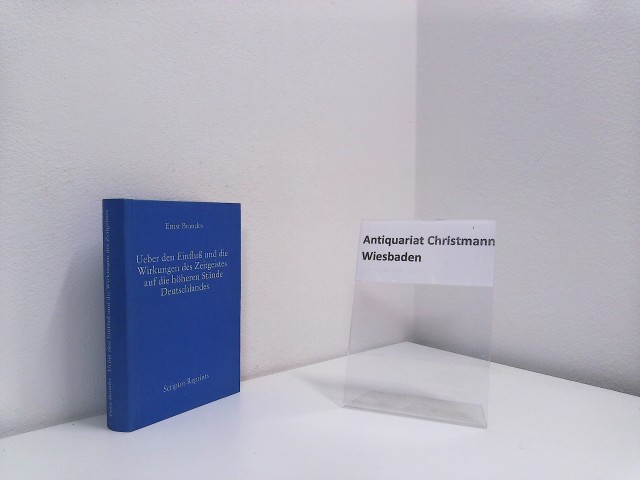
1977réf. 57007Kronberg/Ts. : Scriptor-Verlag 1977. 266, 277 S. ; 19 cm, Schrift: Fraktur / Altdeutsche Schrift. Pp., gebundene Ausgabe, Hardcover/Pappeinband, Schnitt oben bräunlich, sonst Exemplar in gutem Erhaltungszustand, Neupreis in DM: 120,--
1862réf. 43530Leipzig, Johann Ambrosius Barth, 1862. Without wrappers as issued in ""Annalen der Physik und Chemie. Hrsg. von J.C. Poggendorff"", 115. Bd., 1. issue (""Heft"" No 1, 1862). Titlepage to vol. 115. Pp. 1-176 a. 1 folded engraved plate. (The entire issue offereed (""Heft"" 1)). Clausius' paper: pp. 1-56. Some brownspots to right marginon some leaves.
1803réf. 44129Halle, Rengerschen Buchhandlung, 1803. Without wrappers as extracted from ""Annalen der Physik. Herausgegeben von Ludwig Wilhelm Gilbert"", Bd. 12. Pp. 310-318 a. pp. 385-395.
1852réf. 43564Leipzig, Johann Ambrosius Barth, 1852. Without wrappers as issued in ""Annalen der Physik und Chemie. Hrsg.von Poggendorff"", Dritte Reihe Bd. 26, Achtes Stück.(= Heft No. 8 of 1852). (The entire issue (No. 8) offered). Titlepage to vol. 26. Pp. 501-600. Helmholtz's paper: pp. 501-523. Clean and fine.