1 380 résultats
réf. 40104LONDON JOHN CHURCHILL 1835. . EXHIBITING ON DISSECTED PLATES MANY IMPORTANT SUBJECTS IN MIDWIFERY. SECOND EDITION ENLARGED AND IMPROVED IN TWO VOLUMES. REBOUND IN GREEN CLOTH WITH NEW ENDPAPERS. SPORADIC FOXING THROUGHOUT BUT VERY GOOD CONDITION. PART 1 HAS 10 PLATES OF WHICH 5 ARE PULL-OUTS. PART 2 HAS 9 PLATES 8 PULL-OUTS. VERY SCARCE. LONDON, JOHN CHURCHILL, 1835 hardcover
réf. 41535LONDON WOODWARD 1726. 'CONTAINING AN EXACT AND COMPLEAT ACCOUNT OF THE NATURE SIGNS CAUSES AND CURES THEREOF .' OCTAVO FIRST ENGLISH EDITION TRANSLATED FROM THE FRENCH. A SUPER EXAMPLE OF A SCARCE BOOK. MODERN FINE BINDING IN HALF CALF OVER MARBLED BOARDS NEW ENDPAPERS. 490 PAGES PLUS CONTENTS ILLUSTRATIONS IN THE TEXT. VERY SCARCE. LONDON, WOODWARD, 1726 hardcover
réf. 6847Two brush & ink drawings in the text. 89 folding leaves. 8vo 190 x 127 mm. orig. wrappers wrappers somewhat frayed orig. stitching. Japan: mid-Edo. A most interesting and extensive manuscript on acupuncture and moxibustion divided into seven parts. Based on WorldCat and Kyoto University’s manuscript with the same title we can attribute the authorship of these texts to Chishin Tanaka a physician of the early Edo period. The first four parts “East” “West” “South” “North”; 17 17 25 12 leaves respectively are devoted to general principles of acupuncture and moxibustion. In each of these parts many symptoms and case histories are described in great detail along with their treatments through acupuncture and moxibustion. There are guides to locate the pressure points. Part Five eight leaves is devoted to female illnesses and their treatment. Menopause vaginal discharges irregular menstruation breast cancer difficulties during pregnancy and childbirth abortion etc. are all discussed. The sixth part in three leaves describes pediatric illnesses. The final section of seven leaves contains several “secret” methods including the “bone length method” to locate pressure points. The two illustrations depict the spine and associated pressure points. In very good condition. unknown
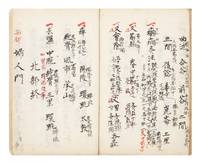
réf. 6847Two brush & ink drawings in the text. 89 folding leaves. 8vo 190 x 127 mm. orig. wrappers wrappers somewhat frayed orig. stitching. Japan: mid-Edo. A most interesting and extensive manuscript on acupuncture and moxibustion divided into seven parts. Based on WorldCat and Kyoto University’s manuscript with the same title we can attribute the authorship of these texts to Chishin Tanaka a physician of the early Edo period. The first four parts “East” “West” “South” “North”; 17 17 25 12 leaves respectively are devoted to general principles of acupuncture and moxibustion. In each of these parts many symptoms and case histories are described in great detail along with their treatments through acupuncture and moxibustion. There are guides to locate the pressure points. Part Five eight leaves is devoted to female illnesses and their treatment. Menopause vaginal discharges irregular menstruation breast cancer difficulties during pregnancy and childbirth abortion etc. are all discussed. The sixth part in three leaves describes pediatric illnesses. The final section of seven leaves contains several “secret” methods including the “bone length method” to locate pressure points. The two illustrations depict the spine and associated pressure points. In very good condition. unknown books
réf. 47108Juko Jushikei Hakki. Three parts in one volume. Kyoto Enami Jinbee Genroku 8 = 1685. 4to size 27.0 x 19.0 cm. Xylographically printed on 69 double leaves folded in an accordion or oriental style with 16 full-page woodcut plates. Original blue paper wrappers with xylographic text vignette on front. Contained in a modern blue cloth box made in Japanese style. = Very rare illustrated work on acupuncture. Bibliographically little is known about this work. It was anonymously published and our copy seems to be a second issue. Mestler describes a similar work that was issued in 1684; this copy was published in 1685. The book was written in classical Chinese in Japanese typescript. The author claims that he bases his writings on several classic Chinese medical texts from the 14th and 15th century. The beautiful illustrations appear to be made in the style of the mid-14th-century Chinese classic Shi si jing fa hui An Elucidation of the Fourteen Channels by Hua Shou. The plates show bodies of men with the acupunctural nodes indicated. The first 10 leaves have extensive contemporary handwritten annotations in two different hands in red and black. Minor worming to lower blank margin of last two leaves. Wrappers with some wear and slight loss of blue paper some uniform light age toning but otherwise a very good copy of this rare work. Mestler A Galaxy of Old Japanese Medical Books II 474-475. hardcover