52 results
ref. 70272Photograph. Very Good. Unmounted albumen print 10.5 cm x 18.5 cm Light rippling to top and bottom edge. 1/2 centimeter closed tear to top edge. Number 6017. Tunnel located on highway 371 north of Buena Vista Colorado. William Henry Jackson 1843-1942 was the first photographer to capture Colorado's Mount of the Holy Cross in turn providing actual proof of its existence. The Midland Tunnels were built for the railroad in the late 1800s and can still be seen today. unknown books
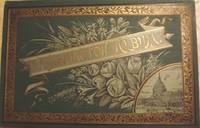
1890ref. 45015Chisholm Brothers 1890. WASHINGTON DC VIEW BOOK. WASHINGTON VICTORIAN SOUVENIR VIEW ALBUM. Portland Maine: Chisholm Brothers 1890. A Charles Frey Souvenir Album. Oblong 16mo. pictorial green cloth stamped in gilt & white. First Edition. Contains dozens of Washington DC images. Very Good bright. $75.00. Chisholm Brothers unknown books
1934ref. 4014Mendville PA etc.: Keystone View Company 1934. Good. Sterograph 176 x 85 mm on gray card mount identified as "Tex 45" and "No. 34163." Ink number "9" on upper right corner. Scarce stereograph view "Texas State College for Women" as it became known in 1934 the name was changed to Texas Woman's University in 1957. The photo depicts the Administrative Building which is now known as the Old Main Building. The manufacturer Keystone View Company was a major distributor of stereographic images active from 1892 to 1963. The present item bears the Keystone number "TEX 45" suggesting that it formed part of a series of Texas stereoviews. Unlike many other contemporaneous Keystone products the present item does not have any text on the verso. There is an actual photograph of this image held in the Keystone-Mast Collection at UC Riverside; other than that we have found no other examples of it. From the Dorothy Sloan Collection of Women and Their Work. Keystone View Company unknown books
1943ref. 322535Los Angeles: Wetzel Publishing Co 1943. Hardcover. Near Fine/Very Good. First edition. Boards a little bowed else near fine in very good dustwrapper with shallow chipping mostly near the foot of the spine. First novel by a Missouri-born Hollywood gossip columnist. Advance Review Copy noted as such in ink. Inscribed by the author. Wetzel Publishing Co hardcover books
ref. 298813Lantern slides are positive transparent photographs made on glass and viewed with the aid of a "magic lantern" the predecessor of the slide projector. With exceptional detail and a rich tonal range lantern slide plates were commercially manufactured for home entertainment public lectures and photographic exhibitions from the 1860s to the 1950s.~~Around the time these images were taken the largely female immigrant workforce shut down the Everett Mills for 2 months in what is known as the Bread and Roses strike of 1912. The Industrial Workers of the World union supported the striking workers resulting in pay increases overtime pay and wide-ranging consequences for worker's rights. ~~These glass lantern slides were produced by the Keystone View Company's Education. They developed and sold Glass lantern slides to schools throughout the country along with stereoscopic views and equipment to view them. These slides depict the mass production of paper and fabric in Lawrence and Holyoke Massachusetts c.1916. ~~3 ¼" x 4" with black paper border. Each is labeled captioned and numbered 14-20. Image area is 3" x 2 ¾". The border is torn on one side of one slide. ~. unknown books
1867ref. 70819NY: Chas. Magnus 12 Frankfort St 1867. Unused letter sheet 10 ½ x 8 ¼ inches printing the view 3 ½ x 8 inches at the top. Approximately 15 steamboats and sailing vessels are on the water between the buildings of the two cities a bridge in the distance and docks and piers along the shoreline. OCLC: "Magnus published at this address between 1860 and 1867." Never folded a very good copy. Chas. Magnus, 12 Frankfort St unknown books
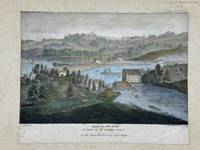
ref. 70181Color lithograph 8 ½ x 11 inches trimmed to the image and laid down on a larger sheet of paper. The lovely scene was drawn from a spot near present-day 155th Street in New York City the mill on the river surrounded by hilly woods and farmland. "State of New-York" has been clipped from what was the upper margin and mounted between the image and the caption title. Foxing to the mount a good copy. unknown books
1920ref. 224278Meadville PA New York Chicago & London Underwood and Underwood ca. 1910-1920. 1920. 3 3/8" x 6 7/8." Very good. Nice panoramic photo views of Universal City when most of the Valley land was agricultural. To be used in a view-master. F. Hardcover. Meadville, PA, New York, Chicago, & London, Underwood and Underwood [ca. 1910-1920]. hardcover books
1904ref. 69539Brooklyn NY: Albertype Co 1904. Very Good. View book with albertypes. Oblong quarto 24 cm x 29 cm Black wraps with an illustrated paper label depicting City Hall on the front wrap and a string-tie binding. Edges of wraps lightly creased. Very minor fading to the edges of the rear wrap. Title on front wrap a bit rubbed. The Albertype Company was founded by the Wittemann brothers in the late 1880s as a postcard and view book publishing company. This view book contains a fold-out panorama of Salt Lake City. Other images include "Main Street Looking South" "Main Entrance- Salt Lake Security and Trust Co." "Knutsford Hotel" "Elks Club" "Lafayette School" "Saltair" "Jewish Synagogue" "Mormon Temple and Tabernacle" "Groves Hospital" "Lehi Sugar Factory" and "Views of Lagoon. Albertype Co unknown books
ref. 194130NEW YORK CHICAGO & LONDON UNDERWOOD AND UNDERWOOD CA 1910-20. TWO PANORAMIC PHOTO VIEWS OF UNIVERSAL CITY TO BE USED IN A VIEW-MASTER VERY GOOD. NEW YORK, CHICAGO & LONDON, UNDERWOOD AND UNDERWOOD, [CA 1910-20] unknown books
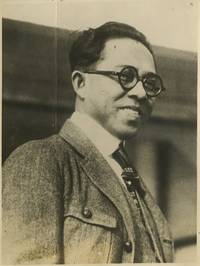
1920ref. List38122New York City: Keystone View Co. Inc 1920. Photo measuring 5 ⅞ x 7 ¾ inches. With caption Keystone stamp manuscript and later sticker verso. Fold along left third of image with several pinholes around margins and one small hole in photo; very good. A portrait of Hadji Gulamu Rasul around the 1920s. Rasul was the son of Filipino statesman Abd ul-Bagui Butu Rasul and some sources state that he was the adopted son of Jamalul Kiram II the last sultan of Sulu. The sultanate was a Sunni Muslim state that ruled parts of what are now the Philippines Malaysia and Indonesia from the 1400s until the 1915 Carpenter Agreement was signed in the American-occupied Philippines. Under American rule Rasul represented the district of Sulu in the Philippines' congress from 1938-1941 and 1949-1953. The caption on this photograph states that he was in Seattle "in search of his white wife who deserted him when she found he had several native wives"; however other newspaper articles from the same period state that he was in Washington to study law. Keystone View Co., Inc unknown books
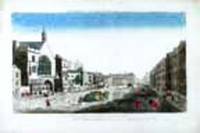
1766ref. 18808London and Paris: a Londres ches Wichnyther A Paris chez J. Chereau rue St. Jacques au dessus de la Fontaine St. Severin aux 2 Colonnes No. 257 1766. Engraving with original colour. Printed on laid paper. In good condition with mild soiling and creasing. A beautiful Vue d'Optique with strong early colour depicting the old Palace of Westminster where the Lords and Commons met. An interesting late 18th century view of Westminster prior to the great fire of 1834 which brought into being the present Houses of Parliament. Westminster had been a royal residence until Henry VIII left it after a fire to reside at Whitehall. After that the Houses of Parliament met there. During the eighteenth century "vues d'optique" or "perspective views" became extremely popular in England and Europe. Like other optical prints they capitalized on a connoisseur market eager for the latest novelty. English publishers such as John Bowles and Robert Sayer had great success with these optical views which quickly developed into a collecting craze that swept through print shops on both sides of the Channel. "Vues d'optiques" were specifically designed to create the illusion of perspective when viewed with a zograscope or perspective glass. These viewing devices used a series of reflecting mirrors to enhance the illusion of depth in the print creating a veritable "view" for the onlooker. Typically these prints depicted city or landscape views and were horizontal in format. They had roughly the same dimensions and were sold with heavy opaque colouring so as to show the tints when viewed through the lens. In their heyday optical prints were a technical revolution; they could be seen in almost every fashionable drawing room and were enjoyed by the poorer classes in print shops or at traveling fairs. For a small fee the citizens of Europe and England could travel the world without leaving their village. The "vue d'optique" was the first medium to bring the visible appearance of the wider world to a large European public. Ironically the artists and engravers who created these prints rarely had first hand knowledge of the scenes depicted hence the views were often not as accurate as they were advertised to be. As a result of their constant handling optical prints such as these are rare especially in good condition. They are not only beautiful images but a fascinating glimpse into the history of printmaking. Clayton The English Print 1688-1802 140-141. a Londres ches Wichnyther (?) A Paris chez J. Chereau rue St. Jacques au dessus de la Fontaine St. Severin aux 2 Colonnes No. 25 unknown books
1760ref. 103861760. Engraving with original colour. Printed on laid paper. In good condition with the exception of some creases within the image. Sides have been remargined with laid paper and bottom edge is trimmed within the platemark. Surface soiling within image. Image size: 11 x 16 1/4 inches. A wonderful "vue d'optique" of Somerset House on the Strand in London. During the eighteenth century "vues d'optique" or "perspective views" became extremely popular in England and Europe. Like other optical prints they capitalized on a connoisseur market eager for the latest novelty. English publishers such as John Bowles and Robert Sayer had great success with these optical views which quickly developed into a collecting craze that swept through print shops on both sides of the Channel. "Vues d'optiques" were specifically designed to create the illusion of perspective when viewed with a zograscope or perspective glass. These viewing devices used a series of reflecting mirrors to enhance the illusion of depth in the print creating a veritable "view" for the onlooker. Typically these prints depicted city or landscape views and were horizontal in format. They had roughly the same dimensions and were sold with heavy opaque colouring so as to show the tints when viewed through the lens. In their heyday optical prints were a technical revolution; they could be seen in almost every fashionable drawing room and were enjoyed by the poorer classes in print shops or at traveling fairs. For a small fee the citizens of Europe and England could travel the world without leaving their village. The "vue d'optique" was the first medium to bring the visible appearance of the wider world to a large European public. Ironically the artists and engravers who created these prints rarely had first hand knowledge of the scenes depicted hence the views were often not as accurate as they were advertised to be. As a result of their constant handling optical prints such as these are rare especially in good condition. They are not only beautiful images but a fascinating glimpse into the history of printmaking. Clayton The English Print 1688-1802 140-141. unknown books
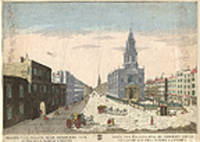
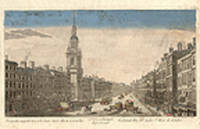
1760ref. 10384Paris: chez Daumont rue St. Martin 1760. Engraving with original colour. Printed on watermarked laid paper. In excellent condition with the exception of some surface soiling in the upper section of the image. Image size: 8 7/8 x 15 13/16 inches. A wonderful "vue d'optique" of St. Mary's Church in London During the eighteenth century "vues d'optique" or "perspective views" became extremely popular in England and Europe. Like other optical prints they capitalized on a connoisseur market eager for the latest novelty. English publishers such as John Bowles and Robert Sayer had great success with these optical views which quickly developed into a collecting craze that swept through print shops on both sides of the Channel. "Vues d'optiques" were specifically designed to create the illusion of perspective when viewed with a zograscope or perspective glass. These viewing devices used a series of reflecting mirrors to enhance the illusion of depth in the print creating a veritable "view" for the onlooker. Typically these prints depicted city or landscape views and were horizontal in format. They had roughly the same dimensions and were sold with heavy opaque colouring so as to show the tints when viewed through the lens. In their heyday optical prints were a technical revolution; they could be seen in almost every fashionable drawing room and were enjoyed by the poorer classes in print shops or at traveling fairs. For a small fee the citizens of Europe and England could travel the world without leaving their village. The "vue d'optique" was the first medium to bring the visible appearance of the wider world to a large European public. Ironically the artists and engravers who created these prints rarely had first hand knowledge of the scenes depicted hence the views were often not as accurate as they were advertised to be. As a result of their constant handling optical prints such as these are rare especially in good condition. They are not only beautiful images but a fascinating glimpse into the history of printmaking. Clayton The English Print 1688-1802 140-141. chez Daumont rue St. Martin unknown books
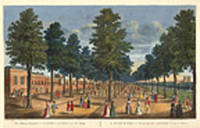
1800ref. 10694London: Printed for Bowles & Carver No. 69 St. Pauls Church Yard 1800. Engraving with beautiful hand-colour. In excellent condition with the exception of tape on the verso of sheet. Image size: 9 3/8 x 15 3/4 inches. Vue d'Optique of the Royal Palace in St. James' Park in London During the eighteenth century "vues d'optique" or "perspective views" became extremely popular in England and Europe. Like other optical prints they capitalized on a connoisseur market eager for the latest novelty. English publishers such as John Bowles and Robert Sayer had great success with these optical views which quickly developed into a collecting craze that swept through print shops on both sides of the Channel. "Vues d'optiques" were specifically designed to create the illusion of perspective when viewed with a zograscope or perspective glass. These viewing devices used a series of reflecting mirrors to enhance the illusion of depth in the print creating a veritable "view" for the onlooker. Typically these prints depicted city or landscape views and were horizontal in format. They had roughly the same dimensions and were sold with heavy opaque colouring so as to show the tints when viewed through the lens. In their heyday optical prints were a technical revolution; they could be seen in almost every fashionable drawing room and were enjoyed by the poorer classes in print shops or at traveling fairs. For a small fee the citizens of Europe and England could travel the world without leaving their village. The "vue d'optique" was the first medium to bring the visible appearance of the wider world to a large European public. Ironically the artists and engravers who created these prints rarely had first hand knowledge of the scenes depicted hence the views were often not as accurate as they were advertised to be. As a result of their constant handling optical prints such as these are rare especially in good condition. They are not only beautiful images but a fascinating glimpse into the history of printmaking. Clayton The English Print 1688-1802 140-141. Printed for Bowles & Carver, No. 69 St. Pauls Church Yard unknown books
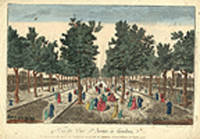
1780ref. 10559Paris: Chez. Daumont rue St. Martin. Presentement chés Lachaussée rue S. Jacques 1780. Engraving with original colour. Printed on wove paper. This is a later copy of the earlier print of St. James' published by Daumont. In good condition with the exception of some scattered brown marks. Trimmed within the platemark. Image size: 9 1/4 x 14 1/2 inches. Vue d'Optique of St. James' Park in London During the eighteenth century "vues d'optique" or "perspective views" became extremely popular in England and Europe. Like other optical prints they capitalized on a connoisseur market eager for the latest novelty. English publishers such as John Bowles and Robert Sayer had great success with these optical views which quickly developed into a collecting craze that swept through print shops on both sides of the Channel. "Vues d'optiques" were specifically designed to create the illusion of perspective when viewed with a zograscope or perspective glass. These viewing devices used a series of reflecting mirrors to enhance the illusion of depth in the print creating a veritable "view" for the onlooker. Typically these prints depicted city or landscape views and were horizontal in format. They had roughly the same dimensions and were sold with heavy opaque colouring so as to show the tints when viewed through the lens. In their heyday optical prints were a technical revolution; they could be seen in almost every fashionable drawing room and were enjoyed by the poorer classes in print shops or at traveling fairs. For a small fee the citizens of Europe and England could travel the world without leaving their village. The "vue d'optique" was the first medium to bring the visible appearance of the wider world to a large European public. Ironically the artists and engravers who created these prints rarely had first hand knowledge of the scenes depicted hence the views were often not as accurate as they were advertised to be. As a result of their constant handling optical prints such as these are rare especially in good condition. They are not only beautiful images but a fascinating glimpse into the history of printmaking. Clayton The English Print 1688-1802 140-141. Chez. Daumont rue St. Martin. Presentement chés Lachaussée rue S. Jacques unknown books
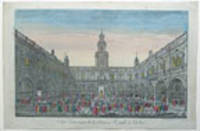
1770ref. 15059Paris: Chez Daumont rue St. Martin 1770. Engraving with beautiful early colour. Printed on watermarked laid paper. In excellent condition with the exception of being trimmed within the platemark on the lower margin. Small tear on upper margin. Small puncture mark on left margin. Image size: 10 1/8 x 16 1/8 inches. This is a beautiful perspective view of the courtyard of the Royal Stock Exchange in London published by a Parisian printseller at the close of the eighteenth century. During the eighteenth century "vues d'optique" or "perspective views" became extremely popular in England and Europe. Like other optical prints they capitalized on a connoisseur market eager for the latest novelty. English publishers such as John Bowles and Robert Sayer had great success with these optical views which quickly developed into a collecting craze that swept through print shops on both sides of the Channel. "Vues d'optiques" were specifically designed to create the illusion of perspective when viewed with a zograscope or perspective glass. These viewing devices used a series of reflecting mirrors to enhance the illusion of depth in the print creating a veritable "view" for the onlooker. Typically these prints depicted city or landscape views and were horizontal in format. They had roughly the same dimensions and were sold with heavy opaque colouring so as to show the tints when viewed through the lens. In their heyday optical prints were a technical revolution; they could be seen in almost every fashionable drawing room and were enjoyed by the poorer classes in print shops or at traveling fairs. For a small fee the citizens of Europe and England could travel the world without leaving their village. The "vue d'optique" was the first medium to bring the visible appearance of the wider world to a large European public. Ironically the artists and engravers who created these prints rarely had first hand knowledge of the scenes depicted hence the views were often not as accurate as they were advertised to be. As a result of their constant handling optical prints such as these are rare especially in good condition. They are not only beautiful images but a fascinating glimpse into the history of printmaking. Clayton The English Print 1688-1802 140-141. Chez Daumont rue St. Martin unknown books
2004ref. 12140Washington DC: Teaching For Change 2004. First Edition. Paperback. Near fine. Signed by civil rights leader Lawrence Guyot first edition of Putting the Movement Back into Civil Rights Teaching; A Resource Guide for K-12 Classrooms by Menkart et al. Quarto xiv 562pp. Paperback title printed on spine. Stated "first edition" on copyright page. Solid text block slight wear to corners a near fine example. This copy is signed by civil rights activist Lawrence Guyot. Inscription states "To the children! You come on I must fight to be free. This Book is only the start you will determine the finish! / Lawrence Guyot 10/24/04." Lawrence Guyot graduated from Tougaloo a private HBCU in Mississippi with a degree in biology and chemistry in 1963. He was a civil rights leader and director of the Mississippi Freedom Democratic Party MFDP in 1964. Through his work with the MFDP and the Student Nonviolent Coordinating Committee he was able to help work on the Voting Rights Act of 1965. Teaching For Change paperback books
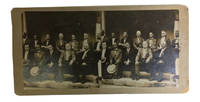
1910ref. 82170n.p. 1910. Very Good. 18 x 9 cm. Card almost entirely flat unlike most stereo cards. Light scuffing and wear. No caption front or back and no identification of publisher or date. BTW and three other African Americans eight white men are seated in two rowsseated at left end of back row. All men are wearing suits; two are holding white hats. We've seen other stereo card groupings of BTW with the white Tuskegee trustees. We wouldn't be surprised if many if not all of the prosperous-looking whites in this image were trustees. unknown books
1864ref. 10253New York: the photographer; John D. Chase Optician 1864. Albumen silver print stereograph 8.5 x 17.5 cm. Two prints mounted on card. The photographer is identified in a copyright registration statement. "The New England Kitchen" in The Brooklyn & Long Island Sanitary Fair February 22 1864 pages 72-78 states that this demonstration kitchen not of contemporary cooking methods but of old fashioned hearth cooking was a hit with the crowds at the fair and a significant financial success. An experiment in cooking education by example The New England Kitchen was aimed at weaning immigrants off of their food traditions and toward a "New England diet" see Laura Shapiro's excellent Perfection Salad pages 147 ff. Apparently the plans for the New England Kitchen began before the fair plans been begun. The image offered here labeled "Interior View" was one of a series of twelve photographs taken by W.E. James of 247 Fulton Steet. We have located no sets of the photographs in any institution collection. the photographer; John D. Chase, Optician unknown books
1943ref. 17883Los Angeles: Wetzel Publishing Co. Inc 1943 First edition presentation copy. Thirteen copies in OCLC most located in California. Red cloth black lettering; in dust jacket. . Octavo. Mild shelf-wear to spine. Minor stain to upper fore-edge of back cover. Moderate chipping at dust jacket edges and head of spine. Inscribed by author with self-portrait cartoon to a friend shortly after publication. A very good copy of a scarce book published by an obscure Los Angeles publisher that operated in the 1920s through 1940s. Stine 1896-1965 born on a farm near Purdy MO moved to Los Angeles after World War I. The presentation in this copy is to Louise McAllister Tebbetts a friend of the author's from Missouri who became a writer and book reviewer in Chicago. Stine published fiction and worked as a gossip columnist and reporter for Hollywood Lowdown a picture trade paper from 1933-1936. Her other novels include Blood Kin The Talented Wench and Half World. Wetzel Publishing Co., Inc hardcover books
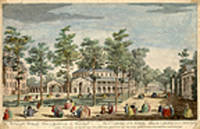
1751ref. 10664London: Printed for & Sold by Rob. Sayer at the Golden Buck opposite Fetter Lane Fleet Street. & Hen. Overton at the White Horse without Newgate 1751. Engraved by N. Parr after Canaleti. Engraving with original colour. Printed on laid paper. In good condition with the exception of being trimmed within the platemark. Corners are stained. Image size: 9 3/16 x 15 3/16 inches. A beautiful Vue d'Optique of the Rotunda House at Ranelagh. During the eighteenth century "vues d'optique" or "perspective views" became extremely popular in England and Europe. Like other optical prints they capitalized on a connoisseur market eager for the latest novelty. English publishers such as John Bowles and Robert Sayer had great success with these optical views which quickly developed into a collecting craze that swept through print shops on both sides of the Channel. "Vues d'optiques" were specifically designed to create the illusion of perspective when viewed with a zograscope or perspective glass. These viewing devices used a series of reflecting mirrors to enhance the illusion of depth in the print creating a veritable "view" for the onlooker. Typically these prints depicted city or landscape views and were horizontal in format. They had roughly the same dimensions and were sold with heavy opaque colouring so as to show the tints when viewed through the lens. In their heyday optical prints were a technical revolution; they could be seen in almost every fashionable drawing room and were enjoyed by the poorer classes in print shops or at traveling fairs. For a small fee the citizens of Europe and England could travel the world without leaving their village. The "vue d'optique" was the first medium to bring the visible appearance of the wider world to a large European public. Ironically the artists and engravers who created these prints rarely had first hand knowledge of the scenes depicted hence the views were often not as accurate as they were advertised to be. As a result of their constant handling optical prints such as these are rare especially in good condition. They are not only beautiful images but a fascinating glimpse into the history of printmaking. Clayton The English Print 1688-1802 140-141. Printed for & Sold by Rob. Sayer at the Golden Buck, opposite Fetter Lane, Fleet Street. & Hen. Overton at the White Horse witho unknown books
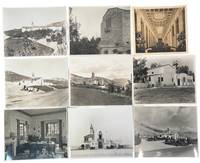
1923ref. 239071923. Southern California community mausoleum photo archive c. 1923 to 1935 documenting when burial was recast as a modern architectural commercial and consumer enterprise. Centered on Cecil E. Bryan Clarence L. Jay Sunnyside Mausoleum in Long Beach and Mountain View Mausoleum in Altadena the photographs show how architecture landscaping publicity and office administration turned the communal mausoleum into a purchasable alternative to the traditional cemetery. Bryan entered the community mausoleum business in 1912 and became one of its principal national advocates ultimately designing more than eighty mausoleums while promoting aboveground entombment as sanitary permanent economical and modern. This archive documents the transition of American burial conventions showing the architecture real estate administration and salesmanship behind the development of California community mausoleums. Photo archive of 31 silver gelatin photographs mostly 7.5 x 9.5 inches though some measure approximately 7.5 x 8.5 inches Southern California c. 1923 to 1935. The photographs show Bryan at his desk; administrative offices lined with card files; architectural perspectives and site plans; a scale model labeled "Sunnyside Memorial Park"; landscaped courts arcades galleries entrances reception rooms and richly furnished interiors. One rendering identifies "Cecil E. Bryan executive vice president" and "Clarence L. Jay architect." Versos carry stamps for Hiller Studio W. Albert Martin Padilla Company Photography and the Mountain View Mausoleum Association as well as "file copy" notations crop marks print numbers and reproduction instructions. The rapid development of community mausoleums was in part due to advent of reinforced concrete construction and an aggressive new business model for death. Builders across the country solicited crypt buyers before construction sometimes tying installment payments directly to completion of the foundation walls roof and finished building; a 1920 Detroit project had sold $160900 in crypt contracts by the end of the following year. In Long Beach Pacific Builders Company operating as the Sunnyside Mausoleum Association commissioned Bryan in 1922 for a $300000 Spanish style complex planned for 1000 crypts and 1000 niches while Architectural Digest later presented Sunnyside in 1929 with Jay as architect Bryan as engineer and Padilla photography. Long Beach Historic Cemeteries The enterprise belonged squarely to 1920s Southern California where speculative development planned landscapes Spanish revival architecture professional advertising and rapid metropolitan growth were reshaping ordinary life; here the same machinery was applied to death packaging permanence beauty sanitation and status as something a family could purchase. Light surface wear handling marks occasional curling and contemporary working annotations. Overall in very good condition. unknown books
1920ref. 169341920. California Bay View Hospital photograph album circa 1920s documenting hospital-based nursing labor clinical environments and domestic social networks within an early twentieth-century medical setting. The album provides visual evidence of women's professional roles in institutional healthcare during a period of expanding nursing formalization while also capturing physician authority patient care practices and the integration of therapeutic design principles such as open-air treatment. The material supports research into gendered medical labor hospital culture and evolving standards of care in the interwar United States particularly through its combined focus on clinical social and environmental aspects of institutional medicine. Photograph album containing 63 original silver gelatin prints many with handwritten captions identifying individuals as "mother" "Ed" or "our gang" alongside named medical personnel including "Drs. Sowers and Orr and Miss Duffy" "Dr. Burns" and "Mrs. Rehak." A building identified in one image as "Bay View Hospital" provides the only direct institutional reference. Sixteen photographs depict women in nurses' uniforms often posed in groups outdoors or on hospital terraces where rows of empty patient beds are visible behind them indicating the use of open-air treatment spaces. Additional images show physicians in clinical contexts including a group of five men dressed in surgical attire with caps and masks lowered around their necks suggesting an operating team between procedures. One image labeled "Dr. Burns Walter" depicts a young child bathing in a shallow tub under the supervision of an adult male likely documenting pediatric care practices. The album also includes informal photographs of family members children and pets in rural or outdoor settings indicating overlap between professional and personal social worlds. The Album has 63 photographs mounted across 100 pages with approximately 70 pages left blank; images measuring approximately 2.75 x 3.5 inches; original black cloth boards; album measuring 7.25 x 11.5 inches. Early twentieth-century hospital design emphasized fresh air as a therapeutic necessity particularly in the treatment of tuberculosis and other chronic illnesses and the repeated presence of outdoor patient beds and staff gatherings reflects these prevailing medical theories in practice. The juxtaposition of clinical and domestic imagery situates nursing staff within both institutional hierarchies and broader social networks offering insight into the lived experience of women working in healthcare during this period. First four pages detached minor wear to boards photographs generally well-preserved with occasional light fading; overall good to very good condition. A cohesive and well-captioned visual record of early twentieth-century hospital life with particular relevance to the history of nursing and medical practice. unknown books
1858ref. 67977Concord NH: H. P. Moore Lith. Of Endicott & Co. N.Y. 1858. Black and white lithograph 15 ½ x 22 1/4 inches view on a larger sheet 19 x 24 inches a view of the city from above residents on the hill looking down into the picturesque scene. "Bird's-eye view of Saint Albans Vermont fields people buildings with Said Albans Bay in the background" OCLC located the Vermont Historical Society copy only a colored example. Reps 4075 also locating copies at Shelburne Museum and Yale Art Gallery. Glazed and framed the print laid down on thin card. Some browning to the margins and sky several brown vertical streaks through the image especially noticeable in the sky and lower margin through title. Still a good example. H. P. Moore (Lith. Of Endicott & Co., N.Y.) unknown books