728 résultats
réf. DADAX0471058602New unknown
réf. SONG0070220026Used: Good unknown
réf. DADAX0128138203New unknown
réf. DADAX0306450046New unknown
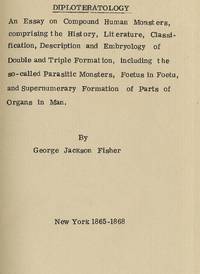
1858réf. 14840New York State Medical Society. G. Hardcover. Blue cloth boards with gilt writing. Binding is very good marks on a few places only. Pages start with page 231 and continue to page 306. An essay on compound human monsters comprising of the history literature classification description embryology of double and triple formation including the so-called Parasitic Monsters Foetus in Foetu and Supernumerary Formation of Parts of Organs in Man. Illustrated with drawings starting with Figure 1 numbering to 120. Includes figures of humans and animals History of the Science of Teratology Diploteratology. Pictures of cojoined twins . 1858. New York State Medical Society hardcover
réf. DADAX0198203772New unknown
réf. DADAX1896251021New unknown
2017réf. 002004South Africa: Ampath Trust 2017 An excellent clean and tightly bound book. 445 pages including index. Size: 7" X 9" Ampath Trust paperback
réf. SONG1405157208Used: Good unknown
réf. 1014E6883SVGood. London: J. & A. Churchill 1872 first ed. first printing. 321 pps. 40 1 pps publisher's adverts in back. Good on the outside VG inside Scarce. Red pebbled cloth hardcover original with gilt titling to spine corner bends slight loss at extrems. complete. Spine cloth attached only on back board horizontal closed tear of 1". No reader's marks. hardcover
1889réf. 110815London: HMSO 1889. First Edition. Hardcover. Fine. London HMSO 1889. Foolscap folio iv 336 pages with numerous tables plus 23 mounted lithographs 13 are chromolithographs one a folding panorama of a diseased tongue and 4 folding maps. Contemporary parliamentary library binding quarter calf and matching cloth with the original printed paper label of contents laid down on the spine; leather a little scuffed with expert conservation to the joints; the contents are in fine condition. British Parliamentary Paper C. 5679 of 1889. The highly detailed and impressive plates illustrate the sections on swine fever anthrax tubercular mammitis and actinomycosis bovis 'lumpy jaw'. Reading these reports suggests the rise of vegetarianism in Victorian England was not without good cause. This paper is contained in the full Volume 27 for the year being one of the 30 volumes of the Reports from Commissioners Inspectors and Others series. The other papers in this volume exceeding 580 pages relate to the Land Commission England Irish Land Commission Public Works Loan Board and Public Works Ireland. HMSO hardcover
réf. DADAX1591950139New unknown
réf. DADAX0199244731New unknown
réf. SONG140517014XUsed: Good unknown
1998réf. 85515Fort Detrick MD: US Army Medical Research Institute of Infectious Diseases Public Health Training Network Centers for Disease Control and Prevention and the Food and Drug Administration 1998. Presumed First Edition of this compilation. Box with participant materials included. Box is approximately 9 inches by 12 inches. Very good. Box has slight wear and soiling. Contents in very good condition. Unclear is some are reprints or produced for this satellite broadcast training. This includes a Dear Participant letter from the Office of the Commander US Army Medical Research Institute of Infectious Diseases Colonel Gerald W. Parker dated July 7 1998; Key Information sheet of Dates of Broadcasts and Taped Rebroadcast Dates and Time Telephone Call-in Instructions and Fax Instruction Forms; Optical Scan Forms Instruction Sheets; List of State and Territorial Health Departments; Student Booklet for Satellite Broadcasts on Tuesday September 22 1998 Wednesday September 23 1998 and Thursday September 24 1998; Student Booklet for Taped Rebroadcasts Saturday October 3 1998 and Sunday October 4 1998; Handout on Packaging and Shipping Infectious Materials; Case Definitions for Infectious Conditions Under Public Health Surveillance CDC Morbidity and Mortality Weekly Report May 2 1997 Vol. 46 No. RR-10 approximately 60 pages; NATO Handbook on the Medical Aspects of NBC Defensive Operations AMedP-6B Part II - Biological FM 8-9 NVMED-P-509 AFJMAN 44-151V1V2V3 February 1996 Approximately 100 pages; Medical Management of Biological Casualties Handbook Third Edition July 1998 approximately 150 pages plus fold-outs Format is approximately 4.5 inches by 6.25 inches; Defense Against Toxin Weapons by David Franz approximately 5.5 inches by 8.5 inches approximately 50 pages; Booklet at Open At Final Exam Time seal still intact--unopened. The United States Army Medical Research Institute of Infectious Diseases USAMRIID; pronounced: you-SAM-rid is the U.S Army's main institution and facility for defensive research into countermeasures against biological warfare. It is located on Fort Detrick Maryland near Washington D.C. and is a subordinate lab of the U.S. Army Medical Research and Development Command USAMRDC headquartered on the same installation. USAMRIID is the only U.S. Department of Defense DoD laboratory equipped to study highly hazardous viruses at Biosafety Level 4 within positive pressure personnel suits. USAMRIID employs both military and civilian scientists as well as highly specialized support personnel totaling around 800 people. In the 1950s and '60s USAMRIID and its predecessor unit pioneered unique state-of-the-art biocontainment facilities which it continues to maintain and upgrade. Investigators at its facilities frequently collaborate with the Centers for Disease Control and Prevention the World Health Organization and major biomedical and academic centers worldwide. USAMRIID was the first bio-facility of its type to research the Ames strain of anthrax determined through genetic analysis to be the bacterium used in the 2001 anthrax attacks. By U.S. Department of Defense DoD directive as well as additional U.S. Army guidance USAMRIID performs its "biological agent medical defense" research in support of the needs of the three military services. This mission and all work done at USAMRIID must remain within the spirit and letter of both President Richard Nixon's 1969 and 1970 Executive Orders renouncing the use of biological and toxin weapons and the U.N. Biological Weapons Convention of 1972. During the period of Desert Shield and Desert Storm 1990-91 USAMRIID provided the DoD with expert advice and products vaccines and drugs to ensure an effective medical response if a medical defense were required. USAMRIID scientists trained and equipped six special laboratory teams for rapid identification of potential BW agents which fortunately never appeared. Following the conflict USAMRIID physicians and engineers were key members of a United Nations Special Commission UNSCOM Inspection Team that evaluated the BW capabilities in Iraq during the 1990s. US Army Medical Research Institute of Infectious Diseases ,Public Health Training Network, Centers for Disease Control and Preve unknown
réf. DADAX0471980897New unknown
1998réf. x-0471980897John Wiley & Sons Inc 1998. Hardcover. New. 1st edition. 218 pages. 9.50x6.50x0.75 inches. John Wiley & Sons Inc hardcover
1863réf. 48186Paris Mallet-Bachelier 1863 a. 1864. 4to. No wrappers. In: "Comptes Rendus Hebdomadaires des Séances de L'Academie des Sciences" Tome 57 No 23 a. Tome 58 No 3. Pp. 925- 964 a. pp. 141- 180. 2 entire issues offered. Pasteur's paper: pp. 936-942 a. 142-150 and 1 engraved plate Maladies des Vins - leurs Fermets. First appearance of these famous papers initiating Pasteur's renowned studies on wine and its "diseases" being his most importent papers on wine."In December 1863 Pasteur published the first of the papers that culminated in his Études sur le vin 1866; 2nd ed. 1873. In that first paper dealing with the role of atmospheric oxygen in vinification he sought to establish that the aging of wine resulted from the slow penetration of atmospheric oxygen through the porous wook casks into which new wine was decanted. By virtue of this slow oxidation he claimed new wine grows less harsh and acid to the taste as it becomes clearer and lighter from the to the taste as it becomes clearer and lighter from the precipation of dark coloring matters. In his second paper January 1864 Pasteur examined the "alterations" or "diseases of wine especially wine from the Jura his native department. Reviewing the familiar disease of "turned" "acid" "ropy" or "oily " wine he associated each with a microscopic organism. He summarized the results of his first two papers by nothing that "wine which is proudced by a cellular vegetation acting as a ferment namely yeast is altered only by the influence of other vegetations of the same order; and once removed from the effects of their parasitism it is made or matured principally by the action of atmospheric oxygen penetrating slowly through the staves of the casks."DSB. unknown
1792réf. 15305London: Charing-Cross; and Hookham Bond-Street. Fair. Hardcover. Date: MDCCXCII. Binding intact hinges heavily cracked. Outer boards are wrapped in an off-white paper covering of which are soiled. Browning pages have mild waviness. 442 pages Full title: A Practical Essay on Diseases of the Viscera; Particularly Those of the Stomach and Bowels The Liver Spleen and Urinary Bladder: In Which Their Nature Treatment and Cure are clearly pointed out and explained. Nameplate on endpaper -decorative Hebrew nameplate Ex-Libris Julius Friedenwald. Dr Friendenwald was a prominent Baltimore MD physician and professor . 1792. Charing-Cross; and Hookham, Bond-Street hardcover
réf. SONG0702027774Used: Good unknown
1966réf. 2092902137704028Professor Retirement Commemorative Party 1966. Soft Cover. Fine. The book is in fine condition. Professor Retirement Commemorative Party paperback
réf. DADAX0824713621New unknown
réf. DADAX0894904655New unknown
1841réf. 84327London: George Henderson 1841. Second Edition Entirely Remodelled . Hard. Good/No Jacket as issued. 4to - over 9¾" - 12" tall. Translated from the French by D.Spillan. Plain dull edgeworn binding: rear endpapers marked; xx 120p coloured plates George Henderson unknown
réf. SONG1498774172Used: Good unknown