DISDIER, Francois-MichelBiblio.com
5.782 Ergebnisse
1784Best.-Nr. 000285Etienne Charpentier 1784. Hardcover. See Description. Tall folio 385 mm. The entire book including the text was printed from engraved copper plates 60 plates an illustrated title page plate 29 anatomical plates and 30 calligraphic letterpress plates. Bound in a contemporary or near contemporary binding with calf spine and decorative paste paper boards - rubbed edges shelf worn old ink stain on rear cover. Both the upper portion of the spine and the tail cap are carefully restored. Board corners are neatly repaired. Interior contains an occasional minor spots of marginal foxing; a couple of tiny holes or paper defects are present on the text plate opposite plate 20. The leaves are otherwise generally clean. Francois-Michel Disdier 1708-1781 was a professor of surgery and a drawing master at the Academy of Painting in Paris. His "Tableaux anatomiques" a deluxe anatomy book for physicians was first published in 1758. Many of the plates were done by Crepy and Charpentier some after the style of Vesalius and others following Eustachi. The engraved title page designed by François Bouchet depicts students in an anatomy class studying a cadaver. The whole scene is framed in ornate baroque style. Blake NLM p. 122; Heirs of Hippocrates 894 listing 1778 edition; Hirsch II p. 190. Etienne Charpentier hardcover
1931Best.-Nr. 13047Masson et Cie., Paris 1897-1931. ca. 400-650 S. je Band mit zahlreichen Abbildungen und sehr zahlreichen Tafeln, Groß 8°, marmoriertes Halbleinen oder Ganzleinen, Bibliotheksexemplare (ordnungsgemäß entwidmet) mit kleinem unscheinbarem Papier-Rückenschild, Papier verinzelt gering gebräunt, kaum beriebene, sehr gute und innen saubere Exemplare, (library copies in very good condition),
Best.-Nr. 21293Paris, Baudoin, puis Crochard et Fantin (T2), an VIII [1799] - An XIV - 1805 ; 5 tomes in 8 veau raciné, dos lisse à décor de croisillons “à la grotesque” et palette dorés, pièces de titre et de tomaison vertes, dentelle d’encadrement, tranches rouges (reliure de l’époque) : XXXI, 521, [1] pp. d’errata, [1] f. bl., 7 grands tableaux de Classification dépliants ; XVI, 697, [3] pp. ; XXVIII, 558, [2] pp. d’errata ; XII, 539, [3] pp. d’errata ; 368 pp., 52 pl.
1817Best.-Nr. 21413Paris, Deterville (imprimerie de A. Belin), 1817 ; 4 tomes in-8, veau raciné, dos lisse, nerfs à quadruple filet doré, fleurons dorés, pièce de titre rouge et de tomaison vert empire, tranches marbrées (reliure de l’époque) ; XXXVII, [1 bl.], 540 ; XVIII, 532 ; XXIX, [1 bl.], 653 ; VIII, 255 pp., XV planches gravées hors-texte.
Best.-Nr. 12061Rome, 1728, sumptibus Laurentii, & Thoma Pagliarini, ex typographia Rochi Bernabo, in-folio de XXVIII (titre - portrait-frontispice du cardinal Annibali Albano de N. Ricciolini gravé par C. Gregori - III, Lectori salutem (des éd.) - V, beatissimo patri Clementi XI - VII, humanissime lector - VIII à XXIV, préface (sic) - XXV à XXVIII, Index) - 79-[1] pp. - 5 ff.n.ch. (Index) et 47 planches. Grande vignette au titre gravée par Gherrius figurant une scène de dissection.Reliure basane de l'époque, dos à 6 nerfs, titre or sur pièce de maroquin rouge, caissons ornés, tranches rouges jaspées, gardes de papier coquille, exemplaire soigneusement restauré (coiffes, coins, second plat, deux caissons au dos) ; une mouillure claire aux 2 premiers feuillets, quelques piqûres marginales. De la bibliothèque du chirurgien rouennais et bibliophile Pierre Derocque, avec son bel ex-libris gravé.
1809In-folio max. (mm. 655x490), mz. pelle coeva, fregi e titolo oro al dorso, pp. IV,84, illustrato fuori testo da 20 splendide tavole: 10 in chiaroscuro e 10 (ripetute) al tratto, disegnate ed inc. in rame da Faustino Anderloni, con relativa descrizione. Vi sono contenute 5 Memorie. "Rara edizione originale". Cfr. Choulant "Bibl. of Anatomic Illustr.", p. 298: "Scarpa himself trained the famous Faustino Anderloni to become his engraver. His prints are therefore models of anatomic representation as regards correctness of form, and the utmost perfection of engraving" - Morton,3583: "Scarpa's contribution to the subject of hernia ranks with that of Cooper, and he did much towards modernizing the knowledge of this speciality" - Sallander, p. 377 cita solo la II ediz. di Pavia, 1819 - Castiglioni, p. 614-16: "Scarpa (1752-1832) fu anatomico e chirurgo di grandissimo valore. Assieme allo Spallanzani, al Volta, al Frank, fu uno dei più illustri insegnanti alla scuola di Pavia che raggiunse verso la fine del '700 l'apice del suo splendore". Testo con fiorit. per lo più margin.; tavole ben conservate.
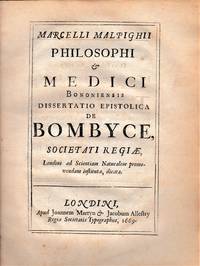
1669Best.-Nr. 20151London: J Martyn & J Allestry Regie Societatis Typographos 1669. First Edition. Full contemporary calf. Good; some modest overall toning and light spotting to several plates text crisp and clear; binding worn chafed and taped along the backstrip; short clean tears into four plates no loss; very good margins throughout. 4to 10 100 pp 12 engraved folding plates. Contemporary engraved bookplate of the Viscount of Scudmore with a shelf mark in ink. Initial and final blank present. "Malpighi's work on the silkworm represents the first monograph on an invertebrate and records one of the most striking pieces of research work on his part. He dissected the silkworm under the microscope with great skill and observed its intricate structure; before the appearance of this work the silkworm was believed not to have internal organs" G-M #293. "In de Bombyce Malpighi had carefully observed the artisan nature construct each of the three stages - larva chrysalis and moth - through which the silkworm is formed. He further remarked on the specific apparatuses with which the silkworm is provided among them the air ducts tracheae and the blood duct with a number of pulsating centers corcula" DSB IX p.65. Frati #20; Norman #1428; Wing M-349. J Martyn & J Allestry Regie Societatis Typographos unknown books
1734In-folio (mm. 490x290), cartonato coevo (dorso rifatto), pp. (10),256,(8), incluso il pregevole ritratto di Gaspard de Saunier; bella vignetta al frontespizio con titolo in rosso e nero e grande vignetta alle armi, alla dedica, disegnati e finemente inc. in rame da D. Coster. Il volume è molto ben illustrato da 61 tavole (anche con numer. figg.), inc. in rame da Bleyswick, La Cave et Creite. Vi sono rappresentati: cavalli con l'indicazione delle varie malattie, cavalli scorticati per la loro illustrazione anatomica, organi, ossa; 5 tavole sono dedicate ai ferri ed agli attrezzi del maniscalco fra cui una curiosa "moule pour tailler les grandes oreilles et les rendre petites en leur naturel". Sotto a ciascuna tavola è incisa la frase "dessiné dappré natture" ma per lo più sono state copiate dall'opera del Ruini "Dell'Anatomia del cavallo" ( E.O. 1598). "Prima edizione" di questa celebre opera, importante monografia anatomica e di medicina veterinaria. Fu tradotta in tedesco nel 1767 ed in inglese nel 1769. Cfr. Mennessier,II, p. 489: "Ecuyers et hippiatres français: Jean de Saunier, Inspecteur de la Grande Ecurie du Roi de France (né à une date inconnue, mort dans les premières années du XVIII siècle). Gaspard, son fils (1663-1748), ecuyer de l'Académie de l'Université à Leide". Cfr. anche Wells,6664 - Brunet,V,149 - Cohen, p. 940 - Lewine, p. 497. Fresco esemplare con barbe, ben conservato.
1908Best.-Nr. 27061Theodor Fischer, Berlin 1884-1908. ca. 400 S. je Band mit zahlreichen oft mehrfach gefalteten teils farbigen lithographischen Tafeln, Groß 8°, marmoriertes Halbleinen, Bibliotheksexemplare (ordnungsgemäß entwidmet) mit kleinem unscheinbarem Papier-Rückenschild, insgesamt sehr gute und innen saubere Exemplare,
1911Best.-Nr. 13013Christiana, Roma, Casa Editrice Jacob DybwadArt-Market Edizioni d'Arte, 1911-1916, 1980. Deux grands et forts volumes in-folio de 446-[6] et 506-[6] pages, plein maroquin brun, dos à nerfs ornés d'un dessin de Leonard doré, repris sur les premiers plats, étuis.
1783Best.-Nr. 30052ABBerlin und Leipzig, G.J. Decker und Heinrich Rottmann (Heft 5 und 6)., 1783-1794. 4° bzw. Folio. Zusammen ca. 340 Textseiten. Mit 66 (6 doppelblattgross) gestochenen Tafeln. Halblederbände der Zeit mit goldgeprägtem Rückenschild und floraler Rückenvergoldung. 6 Hefte in 1 Band + Atlasband.
1783Best.-Nr. 30052AB6 Hefte in 1 Band + Atlasband. Berlin und Leipzig, G.J. Decker und Heinrich Rottmann (Heft 5 und 6). 1783-1794. 4° bzw. Folio. Zusammen ca. 340 Textseiten. Mit 66 (6 doppelblattgross) gestochenen Tafeln. Halblederbände der Zeit mit goldgeprägtem Rückenschild und floraler Rückenvergoldung.
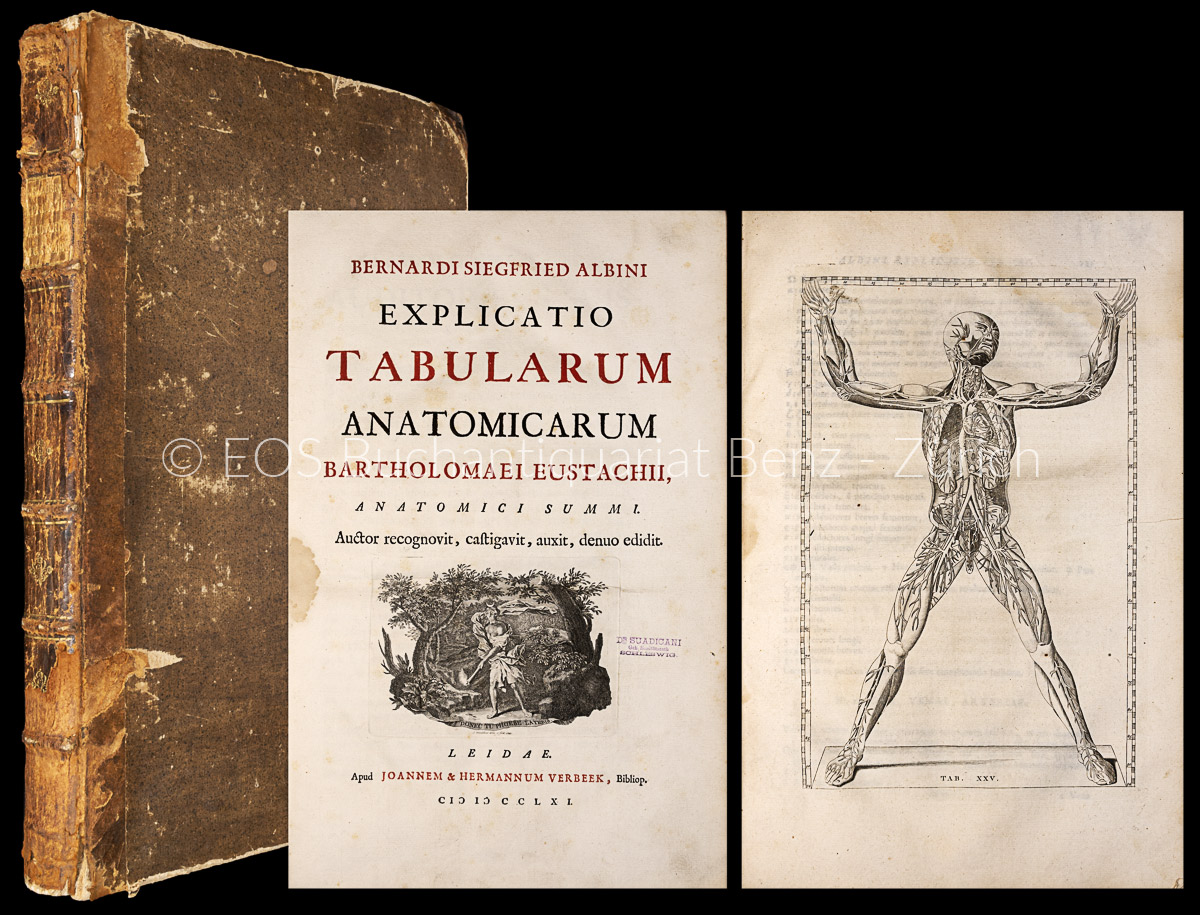
1761Best.-Nr. 30077DBLeiden, Johann und Hermann Verbeek, 1761. Folio. (2) Bl., 295, 1 S. Mit 89 Kupfertafeln. Halblederband aus der Zeit mit goldgeprägtem Rückenschild. + Wichtig: Für unsere Kunden in der EU erfolgt der Versand alle 14 Tage verzollt ab Deutschland / Postbank-Konto in Deutschland vorhanden +, A
1737Best.-Nr. 47215ABLeyden, Johannes van Kerckhem 1737-38. 2°. [24] Bl., 452 (recte 450) S., [11] Bl. Halbleder der Zeit auf 6 Bünden mit Rückenschild und etwas Rückenvergoldung. Etwas berieben, ein Gelenk geringf. angeplatzt. Deckel-Ecken bestoßen. Eine Tafel mit kl. Wasserrand, sonst ganz sauber.
182246x32 cm, rilegatura originale in tela lavorata, dorso in pelle di epoca posteriore, titolo in oro al dorso e al piatto con decorazione. c. (2), III-V, (2), VI, (2), I-IX, (2), X-XVI, (2), XVII-L, (3), LI-LX, (2), LXI-LXXXVIII, 2, 4, (2), I-VIII, (2), IX-X, (2), XI-XIII, (2), XIV, (2), XV-XVI. Il testo ha un bel frontespizio inciso in rame, inquadrato in elegante cornice architettonica in ocra, un "Discorso preliminare", 4 tavole con il confronto del cranio, del feto e dello scheletro dell’uomo e delle scimmie, 70 tavole disegnate dall’artista francese Nicolas Henri Jacob ed incise in rame, che raffigurano le scimmie dell'antico e nuovo continente divise per le caratteristiche della coda, le 'Notizie intorno a scimie poco conosciute' di Latreille, un saggio sull'ourang-outang, e sulle proprietà medicinali della carne di scimmia. Infine la parte sui lemuri. In questa edizione viene omesso qualsiasi riferimento all'A. Nicholas Henri Jacob e il testo è solo in italiano (cfr. Iccu)
1687Best.-Nr. 21683Lugduni Batavorum (Leyde), Petrum Vander Aa, 1687 ; deux tomes reliés en un volume in-4° (218 mm), veau fauve jaspé, dos à nerfs, pièce de titre ancienne tranches rouges (reliure moderne) ; [16] y compris le frontispice, 170, [22] pp. ; 379, [37] pp. et en tout 118 planches hors-texte dont 10 dépliantes (sign. : ( ), **, A-Z, Aa4 ; A-Z, Aa-Zz, A2a-F2f4). Frontispice dessiné et gravé par Adrian Schonebeek (1658-1705), artiste flamand.
1830Best.-Nr. D7399Italy c. 1830. Hardcover. Very Good. Modern half morocco and marbled boards gilt-stamped lettering and ornament on spine; 430 x 560 mm; contains 26 anatomical drawings in red and grey chalk most of them full-page but also including double-page spreads tipped onto stubs. Spine tips and corners gently bumped; some faint dampstaining; a few leaves with repaired tears. Images of skeletal and muscular representations of arms legs feet torsos and heads. hardcover
1830Best.-Nr. D7399Italy c. 1830. Hardcover. Very Good. Modern half morocco and marbled boards gilt-stamped lettering and ornament on spine; 430 x 560 mm; contains 26 anatomical drawings in red and grey chalk most of them full-page but also including double-page spreads tipped onto stubs. Spine tips and corners gently bumped; some faint dampstaining; a few leaves with repaired tears. Images of skeletal and muscular representations of arms legs feet torsos and heads. hardcover books
1966Best.-Nr. 13984Tokyo 1922-1966. je Band ca. 400 S. mit zahlreichen Tafeln und Abbildungen, 4°, privates marmoriertes Halbleinen (Bände 1-4) und Ganzleinen mit Rückentitel, Bibliotheksexemplare (ordnungsgemäß entwidmet), mehrfach gestempelt, die ersten Jahrgänge noch mit kleinem unscheinbarem Papier-Rückenschild, insgesamt gute und innen saubere Exemplare,
1802In-4° grande; pp. (4), incluso frontespizio in rame figurato, inciso su rame da Lasinio, da disegno di Carradori, pp. XXXVII, (1 ), pp. (17) (di "spiegazione delle tavole" e di indice, intercalate alle tavole), tavole 13 fuori testo, che contengono 17 illustrazoni. Rarissima edizione originale di quest’opera di Francesco carradori – professore di scultura nella Regia Scuola di Firenze – ricca di tavole incise su rame in cui si raffigura la figura umana con le sue proporzioni, e si illustrano, ad uso dei giovani artisti, i metodi pratici e tecnici con cui tradurre il disegno in scultura, con cui sbozzare il blocco di marmo, preparare una fusione in bronzo, e in cui si mostra alfine la bottega di uno scultore con tutti gli strumenti occorrenti. Brunet I, 1598; Graesse II, 54. Legatura in cartonato colorato. Piccolo timbro a inchiostro al margine del frontespizio. arte scultura etruria firenze artisti anatomia disegno art sculpture anatomy drawing artist
1655In -4°, pp. (8), 203, (5), cartonato. Frontespizio in rosso e nero. Prima (e unica) edizione. “Zaccaria Pasquale nelle “Decisioni morali” avea sostenuto che i padri hanno diritto di mutilar i flgliuoli per conservarne o svilupparne la voce. Il gesuita Teofilo Raynaud di Sospello genovese, famoso per ampia e disordinata dottrina, lo confutò” in quest’opera (cfr. Cesare Cantù, “L’abate Parini e la Lombardia nel secolo passato”), che tratta di castrazione e di asessualità derivata da varie cause, raccogliendo materiale dottrinario e letterario. Da notare che la condizione di “eunuco”, secondo alcune tradizioni sacre, comprende anche l’omosessualità (gli eunuchi classificati come “nati”). Théophile Raynaud, italianizzato come Teofilo Rainaldo (Sospello, 15 novembre 1583 – Lione, 31 ottobre 1663), è stato un teologo gesuita francese. Entrò nei gesuiti il 21 novembre 1602. Insegnò grammatica e lettere ad Avignone, poi filosofia e teologia a Lione e Roma. The eunuchus condition, according to some interpretation of Scriptures, could include homosexuals (i.e. the eunuchi classified as “nati” i.e. “born”). In this review the author, a jesuit prolific writer, take in exam the holy and profane litterature about the eunuchs condition and status.
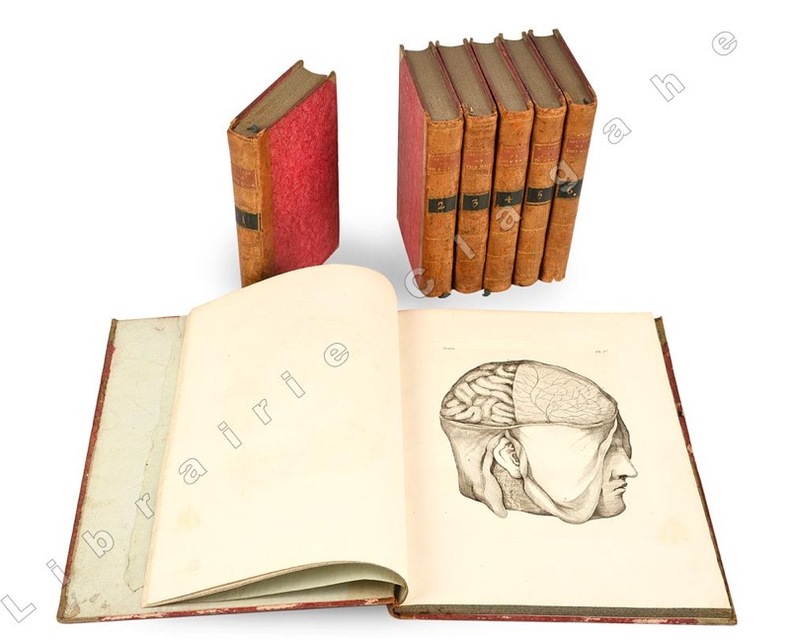
1805Best.-Nr. 21362Paris, L. Duprat-Duverger, imprimerie de Baudouin, an XIII-1805 ; 6 tomes in-8 et Atlas grand in-4° (338 mm), demi-veau fauve et petits coins de vélin, pièces de titre décorées rouge-orangé et de tomaison décorées vert-empire, plat de papier rouge à l’époque, tranches mouchetées (reliure de l’époque); XI, 88, 332 pp., frontispice de Girodet, gravé par Robert De Launay, [1] f. serpente imprimée de l’explication de l’estampe ; [2] ff. (Table et Errata) ; 446 pp., [1] f. (Errata) ; 444 ; 410 ; 372 ; 372; 360 pp. ; Atlas : [1] f. Titre, IV pl. pour les Mémoires ; 35 planches sur le cerveau (XXXII et II bis, V bis et XXIIbis), dont 8 doubles.
1761Best.-Nr. 30077DBLeiden, Johann und Hermann Verbeek, 1761. Folio. (2) Bl., 295, 1 S. Mit 89 Kupfertafeln. Halblederband aus der Zeit mit goldgeprägtem Rückenschild.
Best.-Nr. 4657Venetiis, Baptistam Recurti, 1724, un volume grand in 4 relié en demi-parchemin, grand de marges (reliure de l'époque), (6), 250pp., 3 planches
16852 vol. in-folio, pp. (32, compreso tit. inc), 763 (numerosi errori nella paginazione, completo), (1); (4), 1106, (privo dell'ultimo f. bianco), leg. coeva mezza pergamena, titolo su tassello ai dorsi. Frontispizi impressi in rosso e nero con grande figura simbolica incisa. Fregi tipografci e capilettera istoriati, stupendo antiporta inc. in rame al tomo primo raffigurante un'aula anatomica con lezione pratica. I due volumi illustrati da 87 interessanti incisioni fuori testo a soggetto anatomico (nel secondo volume la tavola LXXXV si trova a p. 110 anziché a p. 1011, la tav. L a p. 462 anziché 262;la tav. LXXII a p. 780 anziché a p. 708). Prima edizione di uno straordinario vasto studio di anatomia, ad opera di Daniel Leclerc (1652-1728) e Jean-Jacques Manget (1652-1742), storici e primi bibliografi di medicina e anatomia. Nella presente opera i due autori riassumono gli autorevoli studi di scienza anatomica del passato: di William Harvey particolarmente, con numerose illustrazioni, di Swammerdam, Malpighi, Bellini, Glisson, Derckring, Lower, Mayow, Steno, Willis, ed altri. Una eccellente analisi sull'opera di Leclerc et Manget si trova nella prima edizione 1719 del Morgagni G.B. "Adversaria Anatomica omnia". Voluminosa e importante opera di scienza anatomica. (La carta seicentesca presenta arrossature marcate. Il presente esempl., grande di margini, ha forti fioriture, qualche segno di tarlo, e rari lievi strappeti ininfluenti). Rara.. Wellcome III, 470. Krivatsky 6758. Bibliotheca Osleriana 3192..