Blumenbach, Joh. Friedr. (Johann Friedrich)Antiquariat.de
5 838 résultats
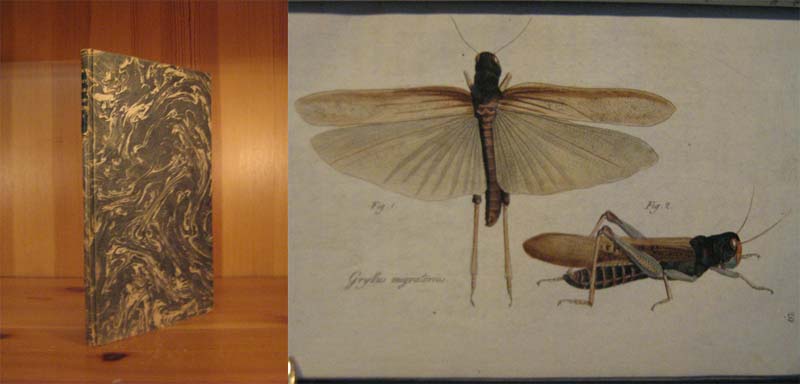
1804réf. SB-14272Göttingen, Heinrich Dieterich, 1797 - 1804. Unpag. (21, 105 Bl.). Grau-beige marmorierte Pbde. der Zeit mit goldgeprägtem Rückentitel auf grünem Rückenschild. Formate: 21 x 13; 20 x 13 cm. Wissenschaftliche Illustrationsreihe des Göttinger Anatomen, Zoologen und Anthropologen Johann Friedrich Blumenbach (1752 - 1840). Blumenbach gilt als maßgeblicher Mitbegründer der Zoologie und der Anthropologie als wissenschaftlicher Disziplinen. Seine Göttinger Vorlesungen zur Naturgeschichte fanden regelmäßig eine internationale Zuhörerschaft. Blumenbachs erstmals 1804 erschienenes "Handbuch der vergleichenden Anatomie und Physiologie" gilt als maßgebliches Standardwerk seiner Zeit und wurde in nahezu alle europäischen Sprachen übersetzt. Die hier vorliegenden Hefte 2 bis 7 der Reihe (Hefte 2 bis 5 und 7 in einem Band sowie Heft 6 als separater Band) enthalten 60 Artikel mit jeweils zugehöriger ganzseitiger Kupfertafel (Kupfertafeln teilweise koloriert) zu folgenden zoologischen anatomischen und anthropologischen Motiven: 11. Simia troglodytes. 12. Simia satyrus. 13 Simia rostrata. 14. Manis tetradactyla. 15. Trichechus rosmarus. 16. certhia coccinea. 17. Serpula gigantea. 18. Basalt-Glieder von giant's Causeway. 19. Backenzähne vom fossilen Ohio-Incognitum...20. Der fossile Murex contrarius. 21. Gefleckter Neger. 22. Myrmecophaga didactyla. 23. Bos grunniens. 24. Buceros rhinoceros. 25. Pelecanus sinensis. 26. Lacerta crocodilos. 27. Derselbe, noch im Ey. 28. Anguis platuros. 29. gryllus migratorius. 30. Thalia lingulata. 31. Vespertilio spectrum. 32. Embryo vom Bär. 33. Ursus maritimus. 34. Küchelchen aus ... Hühnerei. 35. Didus ineptuds. 36. Rana pipa. 37. Gebiss der giftigen und giftlosen Schlangen. 38. Aranea tarantula. 39. Hydatis finna. 40. Phacites fossilis. 41. Ornithorhynchus paradoxus. 42. Vespertilio ferrum equinum. 43. Castor fiber. 44. Monodon narhwal. 45. motacilla calliope. 46. Aptenodytes chrysocone. 47. Oestrus bovis, equi, ovis. 48. glaucus atlanticus. 49. Fortpflanzungsweise der Conferva fontinalis. 50. Entomolitkus paradoxos. 51. Bildschöner Schädel einer Georgianerinn. 52. Schedel des Orang-Ontang von Borneo. 53. Bradypus tridactylus. 54. Didelphis marsupialis. 55. Falco serpentarius. 56. Emberiza aureola. 57. Raja torpedo. 58. Ostracion bicuspis. 59. Serpula comtortuplicata. 60. Encrinites fossilis. 61. Alle vier Hauptarten von Monstrositäten an Einem Ferkelkopf. 62. Ursus lotor. 63. Schedel des Riesenbüffels. 64. Küchelchen aus einem hundert Stunden bebrüteten Hühnerey. 65. Bucco astroflaunus. 66. Testudo graeca. 67. cancer dromia. 68. Lepas anatifera. 69. Venus mercenaria. 70. Pentacrinites fossilis.
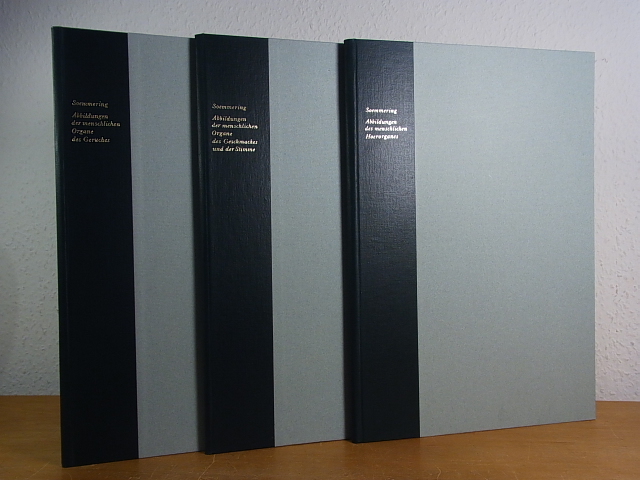
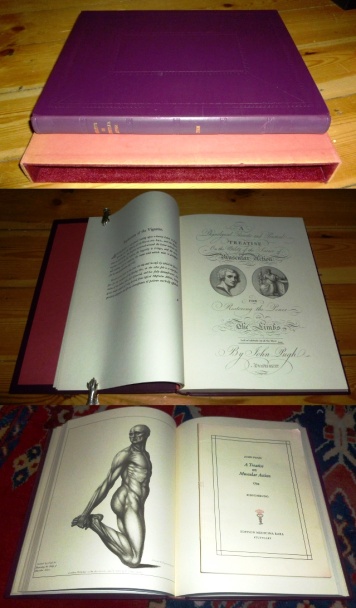
1975réf. 119630Stuttgart: Editions Medicina Rara, um 1975. X, 36 S., 9 Taf. ; VII, 7, II, 6 S., 4 Taf. ; IX, 24 S., 9 Taf. ; 40,5 x 28,5 cm ; Halbleinen.
1975réf. 0005181Arlington MA: Editions Medicina Rara 1975. Limited edition. printed wrappers. Fine/issued without. Folio grey printed wrappers in Fine publisher's slipcase with 22pp. Introductory booklet in wrappers. Copy 567 of 2800 facsimiles. Woodcuts. " Soemmering was a professor of anatomy and physiology. Dissection was a focus for him. These works originally published in 1806 and 1809 show his sketches of human auditory organs human taste and vocal organs and olfactory organs. Garrison-Morton 1454 1455 1554. Editions Medicina Rara unknown
1750réf. 1009DGum 1750. Kupferstich. Blattgrösse: 18 x 14 cm. + Wichtig: Für unsere Kunden in der EU erfolgt der Versand alle 14 Tage verzollt ab Deutschland / Postbank-Konto in Deutschland vorhanden +
1750réf. 1009DGum 1750. Kupferstich. Blattgrösse: 18 x 14 cm.
1821xii + 300pp.+ 2 engraved plates out-of-text (with 14 figures), with 4pp.of publicity (editor's catalogue), cart.cover (some use: corners bumped), 23cm., G
1821réf. P60647London, Longman, Hurst, Rees, 1821 xii + 300pp.+ 2 engraved plates out-of-text (with 14 figures), with 4pp.of publicity (editor's catalogue), cart.cover (some use: corners bumped), 23cm., G
1970réf. 40583BBStuttgart, Edition Medicina Rara, (ca. 1970). Gross-4°. IX, XVI, 106 S., 1 Bl. Mit vielen Illustrationen. Originalhalbleder mit goldgeprägtem Rücken in Schuber.
1970réf. 40583DBStuttgart, Edition Medicina Rara, o.J. (ca. 1970). Gr.-4°. IX, XVI, 106 S., 1 Bl. Mit zahlreichen Illustrationen. Orig.-Halbleder mit goldgeprägtem Rücken in Schuber. + Wichtig: Für unsere Kunden in der EU erfolgt der Versand alle 14 Tage verzollt ab Deutschland / Postbank-Konto in Deutschland vorhanden +
1970réf. 40583BBStuttgart, Edition Medicina Rara, (ca. 1970) Gross-4°. IX, XVI, 106 S., 1 Bl. Mit vielen Illustrationen. Originalhalbleder mit goldgeprägtem Rücken in Schuber.
1970réf. 40583DBStuttgart, Edition Medicina Rara, o.J. (ca. 1970) Gr.-4°. IX, XVI, 106 S., 1 Bl. Mit zahlreichen Illustrationen. Orig.-Halbleder mit goldgeprägtem Rücken in Schuber.
1975réf. 119115[Stuttgart]: Editions Medicina Rara, um 1975. 80 S. ; 32,5 x 24,5 cm ; Leder.
1975réf. 30544ABStgt, Medicina Rara (um 1975). Gr.4°. 12 Bll., 106 S., 1 Bl.; 28 S. Orig. Dreiviertel-Lederband mit Buckram, Schuber. (Beiheft OKt.). Schuber mit Lichtspur.
Vol. I only, xii, 260pp. 8vo (220 x 135 mm), 3 works in one, presentation inscription "Dr Samuel Peach, Presented by D. C. Newman for the class of 83", library stamp and blind stamp to title, bookplate of Lane Medical Library, some light foxing, cont. calf, rubbed, upper joints cracked and holding by cords, red morocco title label to spine. 3 works from the Dunglison's American Medical Library series.
1900réf. 40050HBPhiladelphia, W. B. Saunders & Company, 1900. 351 Abb., 501 S. (17 Bl. Publikationsliste W. B. Saunders). Original-Leinenand mit goldgeprägtem Rückentitel (Beschädigung im Rücken, Kapitale und Ecken leicht bestoßen). Vorsatz gestempelt und mit Buchhändlermarke, Titelblatt gestempelt. Hinteres Innengelenk geplatzt. Sonst innen sehr sauber und gut erhalten.
réf. 6454,Edinburgh, Maclachlan & Stewart 1836, 933 pp., 1 vol. in 8 relié de deux tomes en un volume demi-basane, dos cassé (plats et dos détachés), rousseurs. Frontispice et planches gravées sur cuivre hors-texte, dont une réhaussée de couleurs, figures gravées in texte.
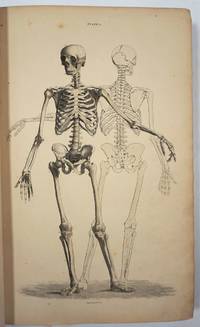
1857réf. 29295Edinburgh: W.H. Lizars 3 St. James Square; S. Highley 32 Fleet St. London and W. Curry Junr & Co 9 Upper Sackville St. Dublin 1857. Hardcover book. Good overall. Large remarkable plates illustrating the human body skeleton organs circulatory muscular and nervous and lymphatic systems fetal respiratory eyes internal organs. The plates with tissue guards most hand colored engraved by W.H. Lizars. Owners signature on ffep "George Edward Rundle 30th September 1889" plus his bookplate on inside front cover. Rundle c. 1846 - 1906 was born in Hampshire England and received his education at the University College London and Edinburgh University qualifying in 1873. He first practiced at Hillston NSW and subsequently at Tenterfield and in Sydney by 1876. In July 1875 he was listed as enrolled on the list of medical practitioners of Tasmania in the Launceston Examiner 29 Jul 1875. He is listed in a government gazette with many degrees including a Fellow of the Royal College of Surgeons in Edinburgh in 1878. After retiring he became a trustee of the Sydney Museum and a member of the Zoological Society and for some time had been president. He died 16 Oct 1906 at 14 Wylde Street Potts Point. He is buried at Waverley Church of England cemetery. OCLC 338701549 cites 1 copy at the Univ. of York. Folio 26pp Contents 101 plates 241pp text xxxvi indices complete. Brown leather and cloth covers detached but present spine partially perished. Internally very clean. W.H. Lizars, 3 St. James Square; S. Highley 32 Fleet St. London, and W. Curry Junr & Co, 9 Upper Sackville St. Dublin hardcover
1796réf. 015628Cambridge: Printed by J. Burges Printer to the University; And Sold By W. H. Lunn and J. Deighton Cambridge; Messrs. White Fleet-Street and J. Walter Charing-Cross London; And J. Cook Oxford 1796. First Edition First Impression . Cloth Bound Boards. Very Good. 1796 First Edition. Size slim square quarto 72 pages plus 15 pages of plates at the rear. Bound in modern brown cloth Birdsall & Son of Northampton with gilt titles and vignette to the spine. Condition very good corners and spine ends a little rubbed some light spotting and dust soiling at front and rear pages including to the margins of the final plate else the contents are very clean throughout. Contains 15 full page engraved plates at the rear of the book. The plates depict skulls and other bones in the head of various different animals and birds. The title states volume I This was intended as a projected work in two volumes of five fascicules but this first fascicule was the only one ever published. Harwood was a professor of anatomy at Cambridge and an early developer of blood transfusion techniques. OCLC lists only ten copies and no copies sold at auction have been traced. Size: 4to - over 9" - 12" tall Printed by J. Burges Printer to the University; And Sold By W. H. Lunn, and J. Deighton Cambridge; Messrs. White, Fleet-Street, hardcover
8vo (210 x 130mm), viii, 76 pp., half-title, interleaved throughout with blank paper, contemporary Ms. notes in ink and pencil on 9 blank leaves at the beginning, contemporary calf-backed marbled boards, upper hinge detached. Sir Busick Harwood was Professor of Anatomy in the University of Cambridge from 1785 to 1814 and simultaneously Downing Professor of Medicine from 1800 to 1814. "He demonstrated the transfusion of blood from sheep to blood-depleted dogs under differing experimental conditions. Student annotated copies of the synopsis record relevant comments from all fields of medicine and indicate that Harwood possessed an extensive knowledge of contemporary medical research. Having failed to get attendance at lectures and dissections made compulsory, Harwood gave up public dissections because nobody came to them." (ODNB). Russell, British Anatomy, 391.
réf. 61852Printed by J. Dixwell No. 148 St. Martin's Lane near Charing Cross. London. 1777. 8vo. pp. 8168 i182-250. Text is continuous despite erratic pagination. Contemporary half calf and marbled boards though now with a later cloth spine occasional foxing more especially at the front ex-libris with stamps and book-label on the front paste-down neat oval stamp on verso of title and in margin of last page overall a very good copy. MAGNUS FALCONAR not in Munk or Plarr was a friend and colleague of William Hewson surgeon anatomist and physiologist; in 1772 Hewson established and ran an anatomy school at 36 Craven Street where Franklin lodged in London now the Benjamin Franklin House museum. In 1998 workmen restoring this building dug up the remains of six children and four adults hidden below the home. The Times reported on 11 February 1998: 'Initial estimates are that the bones are about 200 years old and were buried at the time Franklin was living in the house which was his home from 1757 to 1762 and from 1764 to 1775. Most of the bones show signs of having been dissected sawn or cut. One skull has been drilled with several holes. Paul Knapman the Westminster Coroner said yesterday: "I cannot totally discount the possibility of a crime. There is still a possibility that I may have to hold an inquest." ' The Friends of Benjamin Franklin House noted that the bones were likely placed there by Hewson who lived in the house for two years. They also note that Franklin likely knew what Hewson was doing. Proof was demonstrated by archaeological evidence which showed liquid mercury associated with turtle bones and vermilion colouring associated with dog bones found in the deposit. Hewson had documented experimentation on the lymphatic system using both substances and animals. Hewson died on 1 May 1774 as a result of sepsis contracted whilst dissecting a cadaver. His work was continued after his death by Magnus Falconar who had married Hewson's sister Dorothy in September 1774. Falconar repeated Hewson's experiments on the spleen and thymus and as a result re-published Hewson's work on red blood cells in 1777 together with his corroboration Experimental inquiries: part the third. Containing a description of the red particles of the blood in the human subject and in other animals; with an account of the structure and offices of the lymphatic glands of the Thymus Gland and of the Spleen: being the remaining part of the observations and experiments of the late Mr. William Hewson F. R. S. and Teacher of Anatomy. By Magnus Falconar Surgeon and Teacher of Anatomy. Printed for T. Longman No. 39. Pater-Noster-Row MDCCLXXVII. Samuel Paterson in 1778 published the catalogue of the auction sale of Falconar's anatomical collection - 'Museum falconarianum. A catalogue of the entire and capital museum of anatomical preparations and other subjects of natural history; a great variety of chirurgical anatomical and philosophical instruments; medicaments cabinets preparation-glasses and other effects; of the late Mr. Magnus Falconar surgeon and professor of anatomy deceased: which by order of the adminstrator will be sold by auction by Mr. Paterson at his Great Room No 6. in King-Street Covent-Garden London on Monday the 12th of October 1778 and the nine following evenings to begin precisely at five o'clock. To be viewed on Wednesday the 7th instant and to the time of sale. Catalogues price one shilling may be had at the place of sale; where also may be had Mr. Falconar's synopsis of his course of lectures on anatomy and surgery printed only for the use of his pupils and never before published Price five shillings.' ESTC also records the publication of 'A syllabus of a course of lectures on anatomy on physiology and on the operations and practice of surgery' 1777 Printed by J. Dixwell, No. 148, St. Martin's Lane, near Charing Cross. London. 1777. 8vo. hardcover
1942pp. 47-74. Illustrated. 4to. Original printed wraps. Submitted in Partial Fulfillment of the Requirements for the Degree of Doctor of Philosophy, in the Faculty of Pure Science, Columbia University. Excellent copy. Burton Lowell Baker (1912-1978) was a lecturer in Department of Anatomy, College of Physicians and Surgeons, Columbia University, New York. FIRST EDITION. SCIENCE BOX 3
1951(Firenze, 1951) stralcio con copertina posticcia muta, pp. 130/134 con una figura. - !! ATTENZIONE !!: Con il termine estratto (o stralcio) intendiamo riferirci ad un fascicolo contenente un articolo di rivista, sia che esso sia stato stampato a parte utilizzando la stessa composizione sia che provenga direttamente da una rivista. Le pagine sono indicate come "da/a", ad esempio: 229/231 significa che il testo è composto da tre pagine. Quando la rivista di provenienza non viene indicata é perchè ci è sconosciuta. - !! ATTENTION !!: : NOT A BOOK : “estratto” or “stralcio” means simply a few pages, original nonetheless, printed in a magazine. Pages are indicated as in "from” “to", for example: 229/231 means the text comprises three pages (229, 230 and 231). If the magazine that contained the pages is not mentioned, it is because it is unknown to us.
1977réf. vb1581Leo S. Olschki Editore Plaquette 1977 In-8 (17 x 24 cm), plaquette agrafée, paginée de 443 à 458 ; quelques traces sur les plats, bon état général. Livraison a domicile (La Poste) ou en Mondial Relay sur simple demande.
1975réf. 014621Dilly / Editions Medicina Rara, London / Stuttgart. O.J., ca. 1975/80. Faksimile der Ausgabe 1794 Schuber Ganzlederband Tadellos
1868réf. 55580ABLondon, R.Hardwicke, 1868. Folio. XI, 237 S., 30 zweifarb. Tafeln, Halbleinen, Titelschild, Bindung gelockert, 1 Bl. lose, Sonst sauberes u. guterhaltenes Exempl. The Ray Society.