Passow, Franciscus (Franz Friedrich Passow 1786 - 1833)Antiquariat.de
8 778 résultats
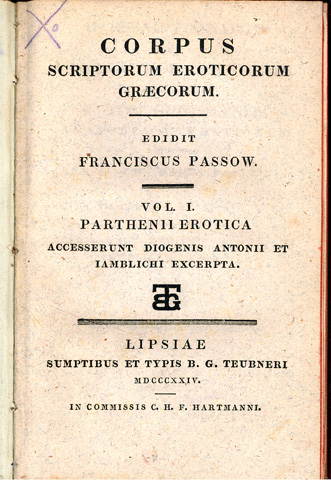
1824réf. 10305ALipsiae, Sumptibus et Typis B. G. Teubneri, 1824. Kl.8°: 16,5 x 10,5 cm. IV, 84 S., 2 Bll. Verlagsanz. Pappband d. Zt.
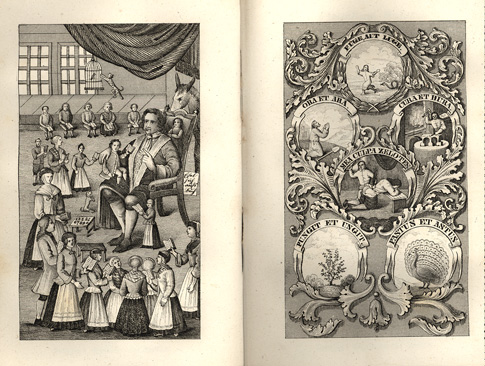
1847réf. 8509AStuttgart, Verlag des Herausgebers / Leipzig: Expedition des Klosters, 1847. Kl.8°. 2 Bll., 2 gestochene Frontispize, 3 Bll., 279 S., 4Bll. Verlagswerbung, 1 Bl. Inhalt. HLeinen d. Zt mit RTitel. (= Der Schatzgräber in den literarischen und bildlichen Seltenheiten, Sonderbarkeiten ec. hauptsächlich des deutschen Mittelalters. Zweiter Theil. Hrsg. von J. Scheible).
1865réf. 4326BWittenberg, Herrosé Verlag, 1863. - 2. Band: Berlin, Vogel & Comp., 1865. 1. Band: Zweite, verm. u. vollst. umgearb. Aufl. - 2. Band in erster Auflage. 2 Bände (in einem gebunden). 8°. X, 1 Bl., 148 S. und 2 Bll., 167 S., 2 Bll. Verlags-Anz. Etwas späteres HLeinen mit goldgepr. RTitel. Die betitelten Orig.-Broschuren zum 1. und 2. Band mit eingebunden. [4 Warenabbildungen] 1
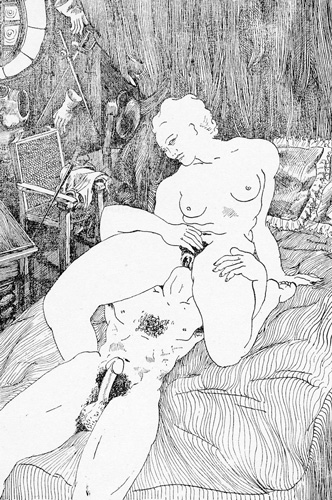
1950réf. 5345AOhne weitere Angaben. 1950. 8°. 125 S. und 16 erotische Illustrationen auf Tafeln. Als ungebundene Lagen eingelegt in einen Umschlag, im Schuber. [8 Warenabbildungen]
1887réf. 48946(Paris, Gauthier-Villars), 1887. 4to. No wrappers. In: ""Comptes Rendus Hebdomadaires des Séances de L'Academie des Sciences"", Tome 105, No 7. Pp. (325--) 563. (Entire issue offered). Maupas' paper: pp. 356-359.
1887réf. 48946Paris Gauthier-Villars 1887. 4to. No wrappers. In: "Comptes Rendus Hebdomadaires des Séances de L'Academie des Sciences" Tome 105 No 7. Pp. 325-- 563. Entire issue offered. Maupas' paper: pp. 356-359. First appearance of this classic paper in whic Maupas determined that fertilization in protozoa is essential to the indefinite continuation of a cell strain. His discovery proved an importent stimulus to subsequent investigation not only upon protozoa but also in the area of parthenogenesis."He found in Paramecium that after generations of division the stock becomes infeebled. Ultimately the individuals die unless they meet partners for conjugation. When two such enfeebled individuals meet their bodies are approximated and they interchange nuclear elements. Next division takes place. The stock has regained its vigour. No differentiation of sexes is evident in the conjugatory process though such differentiation can be traced in other prorozoa."Singer "The Story of Living Tings" p. 531 ff.Thomas Hall "A Source Book in Animal Biology" pp. 458-60. unknown
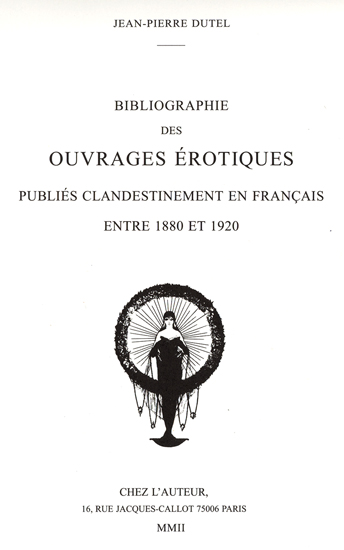
2002réf. 7429AParis, J-P. Dutel, 2002. 24x17 cm. 688 pp. Rel.toile, jaquette bicolore.
2002réf. 1691BParis, J.-P. Dutel, 2002. Gr.8°. 688 S. Orig.-Leinen mit Orig.-Umschlag.
1934réf. List3641New York: Leo Feist Inc 1934. Folio sheet music color pictorial cover. 5 pp 9 ⅛ x 12 inches. Near Fine. Sheet music for the title song from the Fleischer Studios animated short Poor Cinderella a 1934 Paramount production starring Betty Boop. Directed by Dave Fleischer and produced by Max Fleischer the film was issued as part of the studio’s Color Classics series and is notable as the only Betty Boop cartoon originally produced in color during the Fleischer studio’s classic run. The cover illustration shows Betty in her ragged Cinderella costume before a mirror the fairy godmother’s wand transforming her reflection into a princess an image that captures both the Depression-era fairy-tale theme and the character’s Jazz Age style. Although the cartoon itself contains no explicitly Black performers the cultural origins of Betty Boop’s voice and persona emerged from Harlem nightclub entertainment and became the subject of a widely publicized 1934 lawsuit involving singer Helen Kane and the African American child performer Esther Jones whose vocal style was introduced as evidence during the trial. Kane sued Fleischer Studios and Paramount claiming that Betty Boop’s distinctive “boop-oop-a-doop” singing style had been taken from her stage act. During the proceedings however theatrical manager Lou Bolton testified that the same vocal mannerism had been performed several years earlier by Jones in Harlem cabarets undermining Kane’s claim of originality. The court ultimately ruled against Kane.1 Created in 1930 Betty Boop quickly evolved from an anthropomorphic cartoon figure into a humanized Jazz Age flapper and one of the earliest animated sex symbols. Early Fleischer cartoons frequently placed the character in adult urban settings: nightclubs stage performances and surreal jazz environments. The character’s exaggerated blend of innocence and sexuality wide-eyed baby face combined with flapper dress and nightclub mannerisms made Betty one of the most recognizable figures in early American animation. With the strict enforcement of the Motion Picture Production Code in 1934 Betty Boop’s image was softened: skirts were lengthened risqué humor diminished and the once flirtatious character gradually recast into a more domesticated and wholesome figure. Issued by the prolific Tin Pan Alley publisher Leo Feist Inc. the sheet is a representative and surprisingly scarce item from this period. 1 Erin Blakemore “The People v. Betty Boop” The History Channel https://www.history.com/articles/the-people-v-betty-boop accessed March 11 2026. Leo Feist Inc unknown
1934réf. List3641New York: Leo Feist Inc 1934. Folio sheet music color pictorial cover. 5 pp 9 ⅛ x 12 inches. Near Fine. Sheet music for the title song from the Fleischer Studios animated short Poor Cinderella a 1934 Paramount production starring Betty Boop. Directed by Dave Fleischer and produced by Max Fleischer the film was issued as part of the studio’s Color Classics series and is notable as the only Betty Boop cartoon originally produced in color during the Fleischer studio’s classic run. The cover illustration shows Betty in her ragged Cinderella costume before a mirror the fairy godmother’s wand transforming her reflection into a princess an image that captures both the Depression-era fairy-tale theme and the character’s Jazz Age style. Although the cartoon itself contains no explicitly Black performers the cultural origins of Betty Boop’s voice and persona emerged from Harlem nightclub entertainment and became the subject of a widely publicized 1934 lawsuit involving singer Helen Kane and the African American child performer Esther Jones whose vocal style was introduced as evidence during the trial. Kane sued Fleischer Studios and Paramount claiming that Betty Boop’s distinctive “boop-oop-a-doop” singing style had been taken from her stage act. During the proceedings however theatrical manager Lou Bolton testified that the same vocal mannerism had been performed several years earlier by Jones in Harlem cabarets undermining Kane’s claim of originality. The court ultimately ruled against Kane.1 Created in 1930 Betty Boop quickly evolved from an anthropomorphic cartoon figure into a humanized Jazz Age flapper and one of the earliest animated sex symbols. Early Fleischer cartoons frequently placed the character in adult urban settings: nightclubs stage performances and surreal jazz environments. The character’s exaggerated blend of innocence and sexuality wide-eyed baby face combined with flapper dress and nightclub mannerisms made Betty one of the most recognizable figures in early American animation. With the strict enforcement of the Motion Picture Production Code in 1934 Betty Boop’s image was softened: skirts were lengthened risqué humor diminished and the once flirtatious character gradually recast into a more domesticated and wholesome figure. Issued by the prolific Tin Pan Alley publisher Leo Feist Inc. the sheet is a representative and surprisingly scarce item from this period. 1 Erin Blakemore “The People v. Betty Boop” The History Channel https://www.history.com/articles/the-people-v-betty-boop accessed March 11 2026. Leo Feist Inc unknown books
1935réf. 54115New York: Falstaff Press Inc. Privately Issued for Cultured Adults 1935. 8vo. 16 pp unpaginated. printed on sepia-tinted paper with numerous text illustrations printed in brown ink. Self-printed softcovers uncut very slight dustsoiling NF copy. First edition of this very rare pamphlet on birth control issued by the notorious mail-order erotica publisher Falstaff Press which specialized in republishing many of the Panurge anthropological titles including titles on sexuality sexual disorders birth control eugenics phallic worship scientific sexualia and flagellation. Most of these titles were written by some of the most significant anthropologists and sociologists working in the new and growing field of sexual sciences in the 1930s including Hirschfeld Reclus Niemoeller and Rohleder. Solomon Malkin was a young New York University scholar who had studied under Magnus Hirschfeld at the Institute for Sexual Science in Berlin and oversaw the choosing of illustrations and text for the birth control pamphlets. This work details the very unreliable “Rhythm Method” of contraception depending on the charting of menstrual cycles however notes that this is has only 50% effectiveness and should be combined with artificial birth control methods. Worldcat locates 6 copies UC Davis Emory NLM Case Western Cleveland Melbourne; See: Jay Gertzman Bookleggers and Smuthounds: The Trade in Erotica 1920-1940 pp. 192-195; 353-354. Falstaff Press, Inc., Privately Issued for Cultured Adults, paperback
1898This undated edition was published by L. Rene in London, probably in the late 1890s. "Complete Edition, with engravings." - title page. Colour plates. A fascinating nostalgic presentation of the birds and the bees, and the development of the child from conception to birth, and beyond. "Erection is chiefly caused by scuraum, eringoes, cresses, crysmon, parsnips, artichokes, turnips, asparagus, candied ginger, acorns bruised to powder and drank in muscadel, scallion, sea sheel fish, etc... The act of coition being over, let the woman repose herself on her right side, with her head lying low..." - p.10. Hinges open. Some plates loose but present. Above-average but not excessive wear. Tiny binder's tag inside back board, otherwise unmarked. A worthy vintage copy. Book
1971réf. 10265A[1971]. 4°: 28 x 22 cm. Ca. 90 einseitig getippte Seiten, Abzüge. Geklammert mit Deckblatt.
1963An early men's publication in the model of Playboy. 64 pages with color and black and white photos. Features: Gorgeous cover photo of Sophie Dorn; Artsy black and white photo of Laura Cummings inside front cover; Coney Island - a winter portrait by Robert Burg; More photos of Laura Cummings (in color and black and white); The Hungry One - a true friendship is worth fifty women, by Herbert Andrews; Battle of the Bosoms - the continuing controversy in girlie-show business in Las Vegas; Vandenberg Air Base - photo essay on this key defense base; The Two Minds of Frederick Garst, by Tom Phillips; Girls of Tahiti - Lovely color and black and white photos; Fistful of Life - A Little Lesson in a Singapore Bar, by Richard B. Johnston; More black and white photos and color centerfold of Laura Cummings, a student at Colorado State University; The 36th floor - story by Stephen R. Allen; Flip! - a series of 18 color photos of a cute dancing girl which may be clipped, then flipped to watch her move; An Introduction to Jazz; New Zealand's Finest - photo feature of Bernadette Kell; Ski Sailing - photo-article on a new winter sport; Ad for the Tisch-Bumbass one-man jazz band; and more. Unmarked with moderate wear. A sound vintage copy. Book
1980réf. 52150Paris Editions de Minuit 1980 1 vol. broché in-8, broché, non coupé, 182 pp. Edition originale de ce recueil d'essais sur la pédophilie, seul paru, impubliable aujourd'hui. Un des 47 exemplaires numérotés sur alfa mousse (seul grand papier), et parmi ceux-ci l'un des 7 hors commerce (ex. n°VI). En parfait état.
1980réf. 52150Paris Editions de Minuit 1980 1 vol. broché in-8, broché, non coupé, 182 pp. Edition originale de ce recueil d'essais sur la pédophilie, seul paru, impubliable aujourd'hui. Un des 47 exemplaires numérotés sur alfa mousse (seul grand papier), et parmi ceux-ci l'un des 7 hors commerce (ex. n°VI). En parfait état.
1979réf. 6440AWien, Edition Graphischer Zirkel, 1979. 4°. 8 nn. Blätter mit Text, 9 Tafeln mit erotischen Holzschnitten von Axl Leskoschek. Eingelegt in den Orig.-Umschlag mit Deckeltitelschild. (Neunte Buchpublikation der Ed. Graphischer Zirkel).
197156 pages. Features: Encounter Groupers Up Against the Wall - a psychologist says it is not for everyone; Is it Anti-Zionism oor Anti-Semitism? - article with reproductions of interesting contemporary graphic items; San Francisco - The Porn Capital of America - photo illustrated article with photos of Jim Mitchell, Alex de Renzy, Davey Rosenberg and Arlene Elster; Stop Raising Wages to Stop Inflation; Tasteful Mainstream ladies' swimwear ad; Beautiful Knit Row centerfold ad features models in alpine meadow; Photos of Long Island Victorian home redesigned by Karl Springer. Average wear. Unmarked. A sound copy of this vintage issue. Book
réf. 119226A Paris, Chez C. Mercier, 1795, 1 volume in-18 de 75x130 mm environ, 1 frontispice, 156 pages (texte en français suivi de sa version latine). Pleine basane racinée, dos long portant titre doré sur pièce de cuir noire, dos ornés de fers dorés, filet doré sur les coupes, tranches légèrement mouchetées de rouge, gardes marbrées. Coins et coiffes légèrement frottés, quelques épidermures et marques sur les plats, annotations au crayon de papier sur une des gardes, 3 cahiers à la couleur légèrement bleutée, bon état général, bel exemplaire.
197180 pages. Features: Color cover photo of prima donnas Joan Sutherland and Marilyn Horne; Interesting Pitney Bowes ad entitled "Who Killed the Cash Register" shows their futuristis Spice device with LED lights; Beautiful color fashion ads; What it Means to be a Homosexual; A Plan for the Sinai - 'Something less than peace in return for something less than total withdrawal'; Marilyn Horne Becomes a Prima Donna; A Psychoanalyst Looks at Student Revolutionaries; Strange two-page color-photo Jack Winter 'crotch' photo of lady wearing purple patterned pants; 'Blackglama' ad by Chester Weinberg Furs; Very colorful Dalani ad; Save the Children Federation ad features photo of young Glen Conway; Great denim fashion photos; G. Altman & Co. satin sheet ad features model in blue sheets; Dannon Yogurt ad features butterfly in grassy scene; Attractive PBM ad features 'Italian Dressing American Style'; Average wear. Light pencil markings to front cover. A sound copy of this vintage issue. Book
1913réf. 2916ABerlin, Verlag Die Wende, 1913. 1. - 5. Tausend. Kl.8°. 252 S. u. Vlgsanz., illustr. mit mehreren Federzeichungen auf Tafeln von Schertel. Orig.-Pappband. [= Bücher der Wende. Romanreihe Nr. 4.] 5
1962An early men's publication in the model of Playboy. 74 pages with color and black and white photos. Features: The Seven Year Itch - Fact or Fancy? - article by Dr. Albert Ellis; Love for Six Broccolis - fantasy by Bruce Jay Friedman; Photo feature of Patricia Stockton; Profile of Comedian Lenny Bruce; The Goal - fiction by Stuart James; The Women who Helped Settle the West - A look behind the screen at one of TV's more distorted images; The Election - fiction by Richard Harper; The Jazz Makers - Part I of a Symposium by Arnold Shaw; Photos of men's leisure wear fashions; The Casting Couch - satirical article by Robert G. Elliott; Photos of women in showers/mud baths at the Westerlands Kurbadehauser, or Westerland Health Club on the island of Sylt in Germany; and more. Unmarked with moderate wear. A sound vintage copy. Book
1965réf. 8432AHamburg, Asmus Verlag, 1965. 4°. 18 nn. Blätter und zusätzlich zu den 6 Lithographien eine Extra-Suite der Lithographien auf echt Kaiserlich Japan. Als Blockbuch gebunden in Seidenleinen mit montiertem Deckelschild. Suite unter Passepartouts. In den Orig.-Pappschubern.
1907Bound volume of 22 issues of L'Humanité Féminine, from Femme D'Italie 22 December 1906 to Femmes D'Afrique 3rd Series 2 March 1907. Edwardian soft porn that includes the photograph of two naked Tuareg girls that inspired Henri Matisse to sculpt the "Two Women" in bronze 1908. In good condition except for a purple mark on back cover and damage to top front corner of cover and some text page and also damage to base of spine. Bizarre as it may sound we suspect this damage was caused by a member of the parrot family as we have previous experience of such damage.
1790réf. 2754BPadua [d.i. Berlin], bei Pietro Tarone [d.i. Himburg], o. J. [d.i. um 1790]. 16°. 336 S. Neuerer Pappband mit goldgepr. RTitelschild.