9255 risultati
1962rif. 62985New York: Bernard Geis Associates 1962. First Edition. First printing. Tall octavo. Cloth-backed boards hardcover; dustjacket; 382pp; illus. Light evidence of use; board corners tapped; Near Fine. In the original dustwrapper price-clipped lightly rubbed at edges Very Good. Classic mid-century advice for the upwardly-mobile middle-class American male on fashion sex courtship etiquette fitness career management etc. Includes a chapter on how to join the CIA; another on how to drive a sports car. With numerous cartoons and prose extracts from the pages of the magazine by Paul Gallico Harvey Swados Jack Kerouac others. Bernard Geis Associates unknown books
1955rif. 85437Frederick Publications 1955. First Thus. Octavo. 17cm. Publisher's dark blue pebblegrain cloth titled in gilt to spine. Dustjacket. 325pp. 54 unnumbered bibliography and index to rear. Light scuffing and rubbing to extremities and corners some dulling of the cheap gilt; internally clean with some staining to the front pastedown; in a lightly toned and soiled example of the dustjacket with some shallow chipping to spine ends and wear to the flap folds and edges. A very good copy in a jacket with some cosmetic wear. A popular reprint of Rosenbaum's 1901 work on sexuality lust and deviant debauchery in the annals of Ancient Greece and the Roman Empire. Frederick Publications unknown books
2009rif. 85431New York: Semiotext 2009. First Edition. Octavo. 26cm. Publisher's illustrated paper covered boards. 196pp. Some very slight wear to boards mostly limited to a couple of small scratches to the laminate clean and bright; internally clean signed and dated with kisses and hugs by Penny Arcade to the title page. A very good attractive copy. A collection of essays and performance pieces interspersed with interviews and editorial commentary providing a kind of retrospective of Penny Arcade's long career as an incendiary and divisive performance artist she is virtually the originator of the term in its modern context and her collaborations with artists like Jayne County Patti Smith Mink Stole John Waters and the majestic Quentin Crisp. Semiotext unknown books
1913rif. 85169Chicago: O. M. Heath & Co 1913. First Edition. First printing. Octavo 19cm. Purple ribbed cloth spine and cover titles in gilt; 3031pp; portrait frontispiece and five unnumbered leaves of photographic plates halftones. A tight clean copy free of markings with just a hint of sunning to spine cloth; very Near Fine. A collection of six short tales each intended to illustrate a different aspect of "the prevalence of degeneracy in the modern era" jacket. Composts of Tradition was self-published and marketed aggressively in contemporary periodicals including The Masses and Pearson's; one such advertisement in the January 1915 issue of Pearson's outlines the book's intention: "It is not a book for prudes either male or female. It is a book for aggressive and advanced thinkers. Among other doctrines it advocates: 1 Sterilization of physical social and mental defectives; 2 Annihilation of the stigma attached to the bar-sinister; 3 Encouragement of reproduction upon the part of the fit; 4 Maintenance of all children by society; 5 Monogamy but marriage ceremonies to be optional not obligatory; 6 Divorce by collusion." At least one of the stories "Maid of the Neptunian Strand" has fantasy elements. Oscar Morrill Heath c.1872-1952 was a Chicago secondary school teacher and lecturer-for-hire on social subjects; beginning about 1905 through at least the 1920s we lose sight of him around 1930 he was the proprietor of a Chicago correspondence school for schoolteachers The Cultural Review School through whose auspices he issued a few ephemeral publications as well as a monthly magazine Teaching As A Profession. Additionally thanks to the trade card mounted in the front we know that Heath was the proprietor of at least two Chicago beauty parlors. From contemporary newspaper acccounts it appears that the current work landed Heath at least temporarily in hot water; the Chicago Tribune for November 6 1913 includes an article stating that Heath's status as an instructor at Englewood High School was "under review" pending publication of a book that was "critical of the nuptial bond" and seemed to condone childbirth out of wedlock. It is quite possible that Heath lost his position over the book as in subsequent years we find him advertising his services as a freelance instructor in a variety of topics including a review course in math for candidates to Army Officers' Candidate School during WW1. Despite its fetching title the current work is somewhat uncommon with fewer than 20 locations in OCLC most apparently in circulating collections. SMITH H-442. Not in Bleiler despite clear fantasy content. O. M. Heath & Co unknown books
1970rif. 63549New York: Peter H. Wyden Inc 1970. First Edition. First Printing. Octavo 20.75cm; light grey cloth with titles stamped in black on spine; dustjacket; x1775pp. Spine ends gently nudged gentle sunning to lower board edges with a tiny nick to cloth at upper rear board edge and a faint stain to upper right corner of front cover; contents clean; Very Good. Dustjacket is unclipped priced $5.95 showing moderate wear some tears and attendant creases and some dampstains on verso at upper flap folds; Very Good. A report based on a study of 208 middle-class adults who have used marijuana in order to enhance their sex lives. ".an informal but balanced report.It assesses marijuana not as an aphrodisiac but as a sexual stimulant and de-inhibitor for many users and as a "turn-off" for some others" from front flap. 63549. Peter H. Wyden, Inc unknown books
1970rif. 80984New York: Weybright and Talley 1970. First Edition. Octavo. 22cm. Publisher's original black cloth titled in red gilt to spine. Dustjacket. 271pp. Slight bumping to the spine ends no appreciable wear in a clean bright priceclipped dustjacket with some minor discoloration in parts a very good copy indeed. Internally clean. A rather cynical and US-centric attempt to describe the cultural and social diffferences in attitudes towards sex and sexuality in Scandinavia versus what is acceptable in US. There's an element of rabble rousing and scandal mongering regarding the potential for a wave of shameless Scandinavian pornography and less puritanical social attitudes sweeping across the ocean and poisoning American youth; there are also some interesting early points made about the economic and social benefits and detriments of sex work the sex industry as a whole and the far reaching effects that sexuality has upon social stability and function. Weybright and Talley unknown books
1973rif. 63239New York: Trident Press 1973. First Edition. First printing. Octavo. Black cloth hardcover; dustjacket; 251pp. Tight fine copy. In the original dustwrapper unclipped priced $6.95 on front flap gently rubbed at head and heel but still crisp clean and free of toning or notable wear; very Near Fine. Vassi's fifth book preceded by four works of Olympia Press erotica. A memoir of Vassi's sexual and psychedelic experiments of the Sixties. Vassi who has been called the finest erotic writer of his generation would go on to a long career as a literary spokesman for sexual and psychological liberation; he was a daring early writer on non-normative definitions of gender and redefinition of sex roles. Vassi died of complications from AIDS in 1989; this was his only volume of memoir. Trident Press unknown books
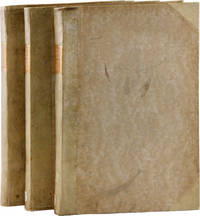
1754rif. 56749Venetiis Venice: Apud Nicolaum Pezzana 1754. Folio 37cm. Three volumes rebound in early twentieth-century half-vellum with tan paper over boards titles in gilt on orange-painted spines; later plain endpapers; vol. I: lxxvi380pp; vol. II: 308pp; vol. III: 438pp. Title page of vol. I printed in red and black. Ex-library with stamp "Biblioteca Seminario Cividale" to vol. II t.p. and call number labels to base of spines. Stamp of unidentified Archbishop showing galero with 10 tassels to title pages. Sturdy copies with minor general wear and scuffing to boards endpapers discolored contents clean apart from occasional minor foxing: Very Good. Vol. I: 2o: a4 b-e8 χ2 A-Z8 2A6. Vol. II: 2o: A-T8 χ2. Vol. III: 2o: A-S8 T-V6 X-2D8 2E-2F4. Detailed work on marital sexuality written by a Jesuit priest and casuist to guide other priests hearing confessions about sexual behavior. Sánchez "depicted human nature as strongly sexualized and proclaimed that a wide range of sexual pleasures could be enjoyed in marriage without being tainted by mortal sin" Watt. The Church disagreed with his permissive stance on some activities and caused some passages to be expurgated in 1610. Later in 1666 and 1679 multiple Popes placed the third volume on the Index of Prohibited Books. Nonetheless the work was frequently reprinted from its first appearance in 1602-1605 until this 1754 edition. Sánchez whose other well-known work discussed lying and mental reservation is also recognized as "one of the greatest casuists" FRAXI i.e. Ashbee Bibliography of Prohibited Books II p.81. See Watt Review of Fernanda Alfieri Nella camera degli sposi Bibliothèque d'Humanisme et Renaissance LXXIII.1 2011. Apud Nicolaum Pezzana unknown books
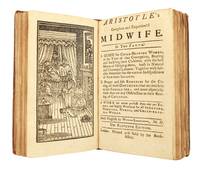
1762rif. 5539London: Printed and sold by the booksellers 1762. The Twenty-Eighth edition of the first work 1st ed. 1684. ESTC T200023. Hardcover. Fine. A composite collection of works dealing with sexuality childbirth medicine astrology and other subjects comprising four works. Each work is preceded by a woodcut frontispiece the first showing a woman whose body is entirely covered by hair and a black boy. The second has a scene showing midwives attending a woman who has just given birth. The third and fourth both show Aristotle in contemporary dress sitting in his study. The second work has a folding sheet showing the fetus' position in the womb. The first has small woodcuts showing conjoined twins and deformities. Bound in contemporary calf rebacked the boards ruled in gold corners bumped light wear to boards very subtle repairs. The text is in very good condition a bit shaken slight rounding to the corners a burn hole in one leaf occ. dog-earing some margins cut close just touching the text in a few instances. In the "Master-Piece" there is a light stain in inner margin of leaf B8 a clean tear in the lower margin of leaf C2 just entering the text without loss and a natural paper flaw in the corner of leaf C5. In the "Experienc'd Midwife" the folding leaf with the woodcut has a number of creases and folds including one along the fold in the image no loss. The same leaf has a long closed tear far from the image with no loss. The headline of the leaf is slightly shaved. There is burn hole in one leaf E9 with loss to a few words and a nickel-sized area of discoloration. In the "Book of Problems" there is a small hole in the upper margin not affecting the text. These treatises on pregnancy childbirth sexuality folk science and home medicine trading on the name of Aristotle appeared individually and then in collected editions throughout the 18th century mostly in undated editions. Due to the alluring nature of some of the texts the "Master-Piece" and "Legacy" had pornographic content and the utilitarian function of the midwives' manual all printings are uncommon and rarely found complete. Some of the collected editions also featured a general title page not called for here. The first work in the volume "Aristotle's Masterpiece" was an extraordinarily popular guide to sex and pregnancy designed for the patients who could not afford professional medical care. Originally published in 1684 it was published and pirated into the 19th century. The frontispiece was one of very few erotic images available to the common reader. The "Master-Piece" "was the most popular book about women's bodies sex pregnancy and childbirth in Britain and America from its first appearance in 1684 up to at least the 1870s. It was not written by Aristotle it was assembled from a number of popular medical works . . . and is a bizarre assortment of superstition folklore and sex facts and fancies all mixed in with the sort of common-sense medical advice that had been passed down by midwives for centuries."Fissell Mary E. "Hairy Women and Naked Truths" pp. 46-64 The second work in the volume is a childbirth manual covering the entire process from conception through pregnancy labor and birth. There are instructions for performing complicated deliveries caring for newborn babies and older children and contending with stillborn children. The folding plate shows the position of a baby in the womb. The third is a collection of pseudo-Aristotelian questions "How comes it that the heart is continually moving "Why do beasts move their ears and not man" "Why are the lips moveable" "Why do fish not make a sound" "Why do madmen's arms become slender" "Why have men not as great breasts as women" The fourth is a work on human reproduction and women's sexual health with detailed descriptions of genitalia sexual intercourse and venereal disease. Written for midwives it is a re-arrangement of relevant chapters from the "Masterpiece". Chapters include "Of Virginity. its Signs and Tokens" "Of the Organs of Generation in Women" "Of the Use and Action of the Genitals" "Of Conception; and how a Woman may know whether she has conceiv'd" "Of Barrenness with remedies against it" and "Directions to both Sexes how to manage themselves in the Act of Coition". All four works are discussed in more depth below. Bibliographical description of the other three books in the volume: Aristotle's compleat and experienc'd midwife. In two parts. I. Guide for child-bearing women in the Time of their Conception Bearing and Suckling their Children; with the best Means of Helping them both in Natural and Unnatural Labours: Together with suitable Remedies for the various Indispositions of New-Born Infants. II. Proper and safe remedies for the curing all those distempers that are incident to the female sex; and more especially those that are any Obstruction to their Bearing of Children. A Work far more perfect than any yet Extant; and highly Necessary for all Surgeons Midwives Nurses and Child-Bearing Women. Made English by W- S- M.D. The Eleventh Edition. London: Printed and sold by the booksellers N.d. 1760 One of two editions stating ELEVENTH EDITION. Duodecimo: 15.5 x 9 cm. 4 iv 156 4 p Collation: A-G12 ESTC T119636 Bound with Aristotle's book of problems with other astronomers astrologers physicians and philosophers. Wherein is contained divers questions and answers touching the state of man's body. Together with the reasons of divers wonders in the creation: the generations of birds beasts fishes and insects; and many other problems on the most weighty matters by way of question and answer. The twenty-seventh edition. London: Printed for J.W. J.K. D.M. A.B. E.R. M.R. T.L. B.M. and A.W. 1760 TWENTY-SEVENTH EDITION. Duodecimo: 15.5 x 9 cm. 156 p. Collation: A-F12 G6 ESTC T504128 Bound with Aristotle's last legacy unfolding the mystery of nature in the generation of man: treating I. Of virginity its signs and tokens and how a man may know whether he married a virgin or not. II. Of the organs of generation in woman with a description of the fabrick of the womb. III. Of the use and action of genitals in the work of generation. IV. Of conception; and how to know whether a woman has conceived and whether of a male or female. V. Of the pleasure and advantage of marriage; with the unhappy consequences of unequal matches and miseries of unlawful love. VI. Of barrenness with remedy against it; and the signs of insufficiency both in men and women. VII. Directions to both sexes how to manage themselves in the act of coition or their venereal embraces. VIII. A vade mecum for midwives and nurses containing particular directions for the faithful discharge of their several employments. IX. Excellent remedies against all diseases incident to virgins and child-bearing women: fitted for the use of midwives nurses and all such persons only as are concerned in these matters. London: Legacy C. Hitch and L. Hawes. 1761 SEVENTH EDITION. Duodecimo: 15.5 x 9 cm. 120 p. Collation: A-E12 ESTC N504342 I. The "Master-Piece": The "Master-Piece" "was the most popular book about women's bodies sex pregnancy and childbirth in Britain and America from its first appearance in 1684 up to at least the 1870s. It was not written by Aristotle it was assembled from a number of popular medical works . . . and is a bizarre assortment of superstition folklore and sex facts and fancies all mixed in with the sort of common-sense medical advice that had been passed down by midwives for centuries."Fissell Mary E. "Hairy Women and Naked Truths" pp. 46-64 "The text repeatedly suggests that women's sexual knowledge is unreliable or deceptive. In addition to proposing that a woman might cuckold her husband without detection if a child resulted the text raised profound doubts about women's honesty concerning virginity. "The frontispiece depicts two "monstrous" individuals a hairy woman and a black baby born to white parents. Each is monstrous because each was deformed by the maternal imagination. The hairy woman's mother while pregnant had looked at a picture of St. John the Baptist in the desert dressed in animal skins. The image imprinted itself on her mind and thus on the body of her unborn baby. The story emphasizes the frailty of women's understanding-the mother's poor compre- hension transformed an ascetic saint dressed in skins into a hairy animal and produced a female monster from that distorted impression. Similarly the black baby was born to a white couple who had a picture of a black man hanging in their bedroom. At the moment of conception the woman looked at the painting and the image supposedly imprinted itself on the child-to-be."Ibid. II. "Compleat and Experienced Midwife": While more affluent women may have been able to afford a doctor or trained midwife poorer people turned to these inexpensive manuals as a guide to all aspects of childbirth and reproduction and as such deserve to be studied as an important source for information on women's health in the period. The present book trades on Aristotle's name but provides much more practical and medically informed advice on the process of childbirth. The book purports to be a translation into English and the dedication is to "The Midwives" on account of the "many Persons as I saw every Day in danger of Perishing by the committing themselves into the Hands of unskilled Midwives." p.1 The initial sections set out the rudimentary process of conception with anatomical attention given to the sexual reproductive parts of both the male and female. Next follows a section on successful conception and the biological signs of pregnancy. Great detail is then given on a month-by-month basis regarding the correct preparation for childbirth including the questionable practice of anointing with duck hen or goose fat p.27. In this section the rudimentary woodcut diagram shows a child in the womb prior to delivery. The next sections are on labor and birth and provide information on the delivery of the afterbirth and the correct procedure for "labouring of a dead child" p.74. The rest of the work concentrates on the care of the newborn child medical complications after birth and the nursing of the newborn. There are also chapters on disease related to the womb. III. Aristotle's Book of Problems: A translation of a popular 14th-15th c. pseudo-Aristotelian compilation of hundreds of questions about the natural world much of it "folk science" and wider philosophical questions from "Why does a woman conceive a female child" "Why do we wonder at the eclipse of the sun and moon and not at the generation of plants and animals from seed" "Why is the flesh nearest the bone sweetest" "Why are some overcome and dismayed by drunkenness" to "Why is sneezing good". A number of the questions concern human sexuality descriptions of genitalia sexual arousal intercourse fertility pregnancy gestation birth birth defects and deformities etc. The book was first translated into English in the 16th c. with new questions added by the translator. Subsequent editions added yet more questions probably with the input of in-house staff working in the print shops that produced them see Ann Blair "Authorship in the Popular 'Problemata Aristotelis'" Early Science and Medicine 4 1999: 189-227. The book also includes questions taken from the authentic collections of Alexander of Aphrodisias fl. 200 and Marcantonio Zimara d. after 1529. IV. His Last Legacy: A work on human reproduction and women's sexual health with detailed descriptions of genitalia sexual intercourse venereal disease infertility etc. Chapters include "Of Virginity: its Signs and Tokens" "Of the Organs of Generation in Women" "Of the Use and Action of Genitals" "Of Conception; and how to know whether a Woman has conceiv'd" "Of Barrenness with Remedy against it" and "Directions to both Sexes how to manage themselves in the Act of Coition". The female genitalia is carefully described including the clitoris: "the Clytoris is a sinewy and hard Body full of spongy and black Matter within; and in form represents the Yard of a Man and is subject to Erection and Falling as that does. This is that which is the Seat of Venereal Pleasure and gives Women delight in the Act of Copulation; for without this a Woman neither desires Coition nor hath Pleasure in it nor conceives by it. The Clytoris sometimes grows out of the body two Inches but this very seldom happens." Ch. 2 The author provides "Directions to the new married Persons how to manage themselves in the Exercises of one of the greatest most natural and agreeable Pleasures thereof and that is their Nocturnal or Venereal Embraces. Ch. 8 My Rudder with thy bold Hand like a try'd And skilful Pilot thou shalt steer and guide My Bark into Love's Channel where it shall Dance as the bounding Waves do rise and fall; And my tall Pinnace in the Cyprian Streight Shall ride at Anchor and unlade her Freight. "When Coition is over some further Directions are necessary: And therefore let the vanquished Bridegroom for he must needs be vanquished that has in the Encounter loft his Artillery take heed how he retreats too soon out of the Field of Love left he should thereby leave an Entrance too open and some inimick Cold should strike into the Womb." Ch. 8 Some myths about women's bodies are refuted and explained. For instance the author explains that the presence of milk in a woman's breast is not a sign she has lost her virginity: "there is a two-fold Milk the one of Virgins is a Malady contrary to Nature . . . made of Blood that cannot get out of the Womb and so goes to the Breasts". Chapter 1. Printed and sold by the booksellers hardcover books
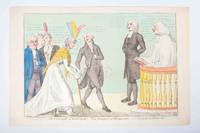
1800rif. 5629London: S. W. Fores 1800. First edition. Illustrated hand-colored broadside measuring 270 x 400mm and printed to verso only. Faint offsetting to recto and faint traces of mounting to corners. In all a Fine example of this visual satire commenting on the phenomenon of younger men seeking marriage with elderly widows for their own financial gain -- and the cultural anxiety surrounding the marital sexuality of such brides. Unrecorded in ESTC and OCLC we have located two examples of the present work at the British Museum and Yale. The present broadside draws together a wide matrix of debates and social anxieties surrounding the economic and sexual status of widows and the financial motivations for marriage among second sons and men of the middle class. Though women were more frequently forced into experiencing marriage as a form of 'honorable prostitution' in which their physical desirability served as their key for accessing wealth and stability under coverture it was increasingly acknowledged that large swaths of young men also suffered under this system. And while widows could escape the system -- shifting from the disempowered femme covert to the more legally independent femme sole on their husbands' deaths -- there was both a social fantasy of reinserting them into the marriage market as a means for regaining control over their money and bodies as well as a social anxiety about their ability to corrupt through the range of knowledge and authority they gained through previous marital experience. Here a young man walks his aging crone down the aisle. Ornately clad and expressing her anticipation for "the comforts of matrimony" she is ridiculed by the ministers at the pulpit who posit that if "matrimony was first ordained.for a remedy against fornication" then "the remedy will be worse than the disease" in this instance. Untroubled the young groom focuses on the land deeds bank notes and jewelry accounts which stuff his pockets -- assets which will legally become his after the ceremony and which serve as his marital comforts. Meanwhile two young women observe from the sidelines one of them planning her future with the groom after his aging bride's eventual demise. "Those jewels will look better on me than on the last owner" she notes as her companion whispers hopefully "you'll let me take a morning ride with you sometimes." A visual commentary on the financial and social issues surrounding marriage under coverture which Daniel Defoe would deride as "matrimonial whoredom." British Museum 1935.0522.8.109. Yale Center for British Art B1974.12.328. S. W. Fores unknown books
1787rif. 5031London: Charles Eyre & Andrew Strahan 1787. First edition. 27 George III Chapter 44. A Fine copy measuring 310 x 190mm and collating complete: 2 987-988. A scarce and important piece of legal history which ESTC records at only one library Lincoln's Inn and which does not appear in the modern auction record. The present is the only example on the market. At the start of the Restoration "English church courts were revived by an act of Parliament on 27 July 1661 to resume their traditional task of correcting spiritual and moral misdemeanors. Soon thereafter parishioners across England's dioceses once more faced admonition fines excommunication and even imprisonment if they failed to conform to the laws of the restored Church of England" Aklund. As much as these courts sought to reestablish a monolithic Anglican communal identity during Charles II's reign their position in the 18th century became "a case study in the secularization of the legal system" particularly given their theoretical justification based in the problematic concept of divine right Harris. Numerous acts the present example among them "represented an important step in the direction of limiting the reach of of ecclesiastical jurisdiction" Harris. An Act to Prevent Frivolous and Vexatious Suits in Ecclesiastical Courts was passed in 1787 drawn from a bill presented in Parliament the previous year. Its major accomplishment was the removal of Church authority in the regulation of private sexual behaviors: "It shall be further enacted by the Authority aforesaid That no Suit shall be commenced in any Ecclesiastical Court for Fornication or Incontinence of for any striking or brawling." While the Church may have voiced its moral codes or enacted social shaming within its own communities it no longer had the legal authority to regulate or punish sexual behavior. Such secularization had significant benefits across a number of communities. For survivors of assault it ended the Church's ability to mandate that a woman marry her attacker; for queer communities it prevented Biblically based persecution; for sex workers it took away the risk of arrest or fines for conducting their livelihoods. Ultimately the jurisdiction of ecclesiastical courts over sexual behavior whether in the form of obscene or defamatory words sexual engagement and sensual pleasure was terminated by this act. Little to no legal regulation of sex would be enacted until the next century when the 1861 Offences Against the Person Act and a series of Contagious Diseases Acts would seek to give secular courts more control over individuals' bodies. ESTC N58717. Charles Eyre & Andrew Strahan unknown books
1962rif. 15068New York: Grove Press - Film Division 1962 . Edition unknown. Original box with a paper label. Very good. Ten minute black and white 8 mm film with sound. Although uncredited the British filmmaker Anthony Balch famous for his collaborations with William Burroughs contributed footage to this montage of sexually suggestive images and soundtrack. As Vogel states: ' Sexologists psychologists and proponents of sexual freedom the Kronhausens here attempt to induce erotic response in the audience by carefully chosen visual stimuli and juxtapositions aimed at both the conscious and unconscious. Phallic symbols and open orifices . almost any object or act no matter how innocuous the Kronhausens show can be made to appear erotic and reveals our predisposition towards shaping visual evidence for purposes of erotic gratification'. See Vogel Film as Subversive Art pp. 229 - 230; OCLC shows only Harvard for a 16mm version in 1962. Grove Press - Film Division unknown books
1934rif. List3641New York: Leo Feist Inc 1934. Folio sheet music color pictorial cover. 5 pp 9 ⅛ x 12 inches. Near Fine. Sheet music for the title song from the Fleischer Studios animated short Poor Cinderella a 1934 Paramount production starring Betty Boop. Directed by Dave Fleischer and produced by Max Fleischer the film was issued as part of the studio’s Color Classics series and is notable as the only Betty Boop cartoon originally produced in color during the Fleischer studio’s classic run. The cover illustration shows Betty in her ragged Cinderella costume before a mirror the fairy godmother’s wand transforming her reflection into a princess an image that captures both the Depression-era fairy-tale theme and the character’s Jazz Age style. Although the cartoon itself contains no explicitly Black performers the cultural origins of Betty Boop’s voice and persona emerged from Harlem nightclub entertainment and became the subject of a widely publicized 1934 lawsuit involving singer Helen Kane and the African American child performer Esther Jones whose vocal style was introduced as evidence during the trial. Kane sued Fleischer Studios and Paramount claiming that Betty Boop’s distinctive “boop-oop-a-doop” singing style had been taken from her stage act. During the proceedings however theatrical manager Lou Bolton testified that the same vocal mannerism had been performed several years earlier by Jones in Harlem cabarets undermining Kane’s claim of originality. The court ultimately ruled against Kane.1 Created in 1930 Betty Boop quickly evolved from an anthropomorphic cartoon figure into a humanized Jazz Age flapper and one of the earliest animated sex symbols. Early Fleischer cartoons frequently placed the character in adult urban settings: nightclubs stage performances and surreal jazz environments. The character’s exaggerated blend of innocence and sexuality wide-eyed baby face combined with flapper dress and nightclub mannerisms made Betty one of the most recognizable figures in early American animation. With the strict enforcement of the Motion Picture Production Code in 1934 Betty Boop’s image was softened: skirts were lengthened risqué humor diminished and the once flirtatious character gradually recast into a more domesticated and wholesome figure. Issued by the prolific Tin Pan Alley publisher Leo Feist Inc. the sheet is a representative and surprisingly scarce item from this period. 1 Erin Blakemore “The People v. Betty Boop” The History Channel https://www.history.com/articles/the-people-v-betty-boop accessed March 11 2026. Leo Feist Inc unknown books
rif. List2943Likely Chicago area 1944. Single 5 x 8 inch journal with forty-two double-sided pages filled out and many more blank. Near fine. Offered here is an unusual document: a dream journal from the 1940s. Written by an anonymous woman the journal documents dreams from January and February of 1943 and 1944. Dream interpretation is an ancient practice with many varied purposes1 but given the rising popularity of psychoanalysis at the time in the US2 it is plausible that this journal was kept for therapeutic purposes. Indeed there would be quite a bit for an analyst to say about A.B.’s dreams. She recalls moments from dreams such as when “It seems that also I have a sexual organ very faint from no cause at all” January 15 1943 “It seems I almost have to bite my mother to make her let me go” January 16 and: “I had a dream of going to Chicago with my brother. We went to a hotel as husband and wife. He slept in the same bed but nothing sexual passed between us.” February 16 1944 One dream in particular deals in some detail which we omit with A.B.’s history of onanism or lack thereof. This dream includes the sensation that: “someone is trying to probe into the dark recesses of my ‘past’ to unearth the little secret hidden sins of childhood and the lapses of young girlhood and womanhood” February 9 a feeling that would likely be close to the truth if A.B. were in fact the subject of analysis. Other themes include work health and money and bizarre imagery such as “a left arm swaddled in a white surgical bandage from wrist to armpit” January 15. Overall an uncommon survival and a peculiar read of interest to dream interpreters and their historians. 1 J. Donald Hughes “Dream Interpretation in Ancient Civilizations” Dreaming 10 2000: 7–18 https://doi.org/10.1023/A:1009447606158. 2 Otto Kernberg “Psychoanalysis in America” interview by Sergio Benvenuto and Raffaele Siniscalco Multi-Media Encyclopedia of Philosophical Sciences for Radiotelevisione Italiana July 1996 transcript https://www.journal-psychoanalysis.eu/articles/psychoanalysis-in-america/. unknown books
1982rif. 1913First Edition. 72 pp. illustrated program book for an event officially known as The Scholar and the Feminist : Toward a Politics of Sexuality held on Saturday April 24 1982 at The Women's Center now the Barnard Center for Research on Women. 8vo. Very good. Illus. Glossy wrappers slightly creased. 1772 A landmark document of the so-called "feminist sex wars" of the 1980s most copies of this conference program were preemptively seized and destroyed by Barnard College officials under pressure from activists associated with Women Against Pornography WAP. The episode remains a hotspot of conflicting allegations and rumor. Leading up to the date of the conference Ellen V. Futter then President of Barnard College became the focal point of an anti-pornography phone call campaign by WAP members and their allies. In response to the calls College officials confiscated 1500 copies of the Diary hours before the event was scheduled to begin. The booklet which had been intended for distribution to conference attendees consists of steering committee minutes personal narratives information about conference events and sex-positive artwork by feminist illustrators including erotic images that had provoked the ire of anti-pornography crusaders. Examples rarely surface. [Barnard College Women's Center] books
1977rif. 238222Altadena: The Marcliff Foundation 1977. Eight-panel brochure folded to 3.5x8.5 inches information about the Institute the program application form dark soiling on cover and canceled stamp and address on rear. Held at the Miramar Hotel on Sunday July 17 1977. The Marcliff Foundation unknown books
2004rif. 40901NY:: Reganbooks Harpercollins . Near Fine in Near Fine dust jacket. 2004. Hardcover. 0060539097 . Color and black and white photographs throughout. First printing. Very near fine in like dust jacket. . Reganbooks (Harpercollins) , hardcover books
2000rif. 31400NY: Scribner. Near Fine in Near Fine dust jacket. 2000. Hardcover. 0684849437 . First printing. Very near fine in like dust jacket. . Scribner hardcover books
1998rif. 2861Boston: Little Brown. Fine in Fine dust jacket. 1998. Hardcover. 0316102334 . With Billie Fitzpatrick. First printing. Fine in a fine dust jacket. . Little, Brown hardcover books
1992rif. 213643New Jersey: Barricade Books 1992. First Edition; First Printing. Softcover. Near Fine in wraps. Barricade Books unknown
2000rif. x-069105813XPrinceton Univ Pr 2000. Paperback. New. 288 pages. 9.00x6.25x1.00 inches. Princeton Univ Pr paperback
1955rif. 85437Frederick Publications 1955. First Thus. Octavo. 17cm. Publisher's dark blue pebblegrain cloth titled in gilt to spine. Dustjacket. 325pp. 54 unnumbered bibliography and index to rear. Light scuffing and rubbing to extremities and corners some dulling of the cheap gilt; internally clean with some staining to the front pastedown; in a lightly toned and soiled example of the dustjacket with some shallow chipping to spine ends and wear to the flap folds and edges. A very good copy in a jacket with some cosmetic wear. A popular reprint of Rosenbaum's 1901 work on sexuality lust and deviant debauchery in the annals of Ancient Greece and the Roman Empire. Frederick Publications unknown
2009rif. 85431New York: Semiotext 2009. First Edition. Octavo. 26cm. Publisher's illustrated paper covered boards. 196pp. Some very slight wear to boards mostly limited to a couple of small scratches to the laminate clean and bright; internally clean signed and dated with kisses and hugs by Penny Arcade to the title page. A very good attractive copy. A collection of essays and performance pieces interspersed with interviews and editorial commentary providing a kind of retrospective of Penny Arcade's long career as an incendiary and divisive performance artist she is virtually the originator of the term in its modern context and her collaborations with artists like Jayne County Patti Smith Mink Stole John Waters and the majestic Quentin Crisp. Semiotext unknown
1913rif. 85169Chicago: O. M. Heath & Co 1913. First Edition. First printing. Octavo 19cm. Purple ribbed cloth spine and cover titles in gilt; 3031pp; portrait frontispiece and five unnumbered leaves of photographic plates halftones. A tight clean copy free of markings with just a hint of sunning to spine cloth; very Near Fine. A collection of six short tales each intended to illustrate a different aspect of "the prevalence of degeneracy in the modern era" jacket. Composts of Tradition was self-published and marketed aggressively in contemporary periodicals including The Masses and Pearson's; one such advertisement in the January 1915 issue of Pearson's outlines the book's intention: "It is not a book for prudes either male or female. It is a book for aggressive and advanced thinkers. Among other doctrines it advocates: 1 Sterilization of physical social and mental defectives; 2 Annihilation of the stigma attached to the bar-sinister; 3 Encouragement of reproduction upon the part of the fit; 4 Maintenance of all children by society; 5 Monogamy but marriage ceremonies to be optional not obligatory; 6 Divorce by collusion." At least one of the stories "Maid of the Neptunian Strand" has fantasy elements. Oscar Morrill Heath c.1872-1952 was a Chicago secondary school teacher and lecturer-for-hire on social subjects; beginning about 1905 through at least the 1920s we lose sight of him around 1930 he was the proprietor of a Chicago correspondence school for schoolteachers The Cultural Review School through whose auspices he issued a few ephemeral publications as well as a monthly magazine Teaching As A Profession. Additionally thanks to the trade card mounted in the front we know that Heath was the proprietor of at least two Chicago beauty parlors. From contemporary newspaper acccounts it appears that the current work landed Heath at least temporarily in hot water; the Chicago Tribune for November 6 1913 includes an article stating that Heath's status as an instructor at Englewood High School was "under review" pending publication of a book that was "critical of the nuptial bond" and seemed to condone childbirth out of wedlock. It is quite possible that Heath lost his position over the book as in subsequent years we find him advertising his services as a freelance instructor in a variety of topics including a review course in math for candidates to Army Officers' Candidate School during WW1. Despite its fetching title the current work is somewhat uncommon with fewer than 20 locations in OCLC most apparently in circulating collections. SMITH H-442. Not in Bleiler despite clear fantasy content. O. M. Heath & Co unknown
1970rif. 63549New York: Peter H. Wyden Inc 1970. First Edition. First Printing. Octavo 20.75cm; light grey cloth with titles stamped in black on spine; dustjacket; x1775pp. Spine ends gently nudged gentle sunning to lower board edges with a tiny nick to cloth at upper rear board edge and a faint stain to upper right corner of front cover; contents clean; Very Good. Dustjacket is unclipped priced $5.95 showing moderate wear some tears and attendant creases and some dampstains on verso at upper flap folds; Very Good. A report based on a study of 208 middle-class adults who have used marijuana in order to enhance their sex lives. ".an informal but balanced report.It assesses marijuana not as an aphrodisiac but as a sexual stimulant and de-inhibitor for many users and as a "turn-off" for some others" from front flap. 63549. Peter H. Wyden, Inc unknown