9,581 results
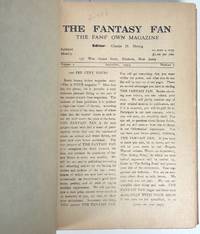
1933ref. 31883Elizabeth New Jersey: Charles D. Hornig 1933-1935. Darkening to cheap paper but pages quite supple the full set is attractively bound a full leather binding with front and spine stamped in gold. Complete sets are rare. 31883. Octavo 18 issues printed or self wrappers. The first important weird fiction fanzine and one of the most desirable of the fanzines of the thirties. For two years it published news and fiction related to the genre. Stories first published in THE FANTASY FAN include H. P. Lovecraft's "The Other Gods" and "From Beyond" Clark Ashton Smith's "The Epiphany of Death" "The Ghoul" "The Kingdom of the Worm" and "The Primal City" as well as tales by Robert Bloch August Derleth Robert E. Howard David H. Keller and others. THE FANTASY FAN was "an interesting mix of news articles stories poems and miscellany. Hornig however made an error in initiating a column of controversy entitled 'The Boiling Point' which quickly led to acrimonious letter exchanges between Lovecraft Forrest J. Ackerman Clark Ashton Smith and numerous others; the column was terminated with the February 1934 issue. Perhaps Hornig's greatest accomplishment was the serialization of the revised version of Lovecraft's 'Supernatural Horror in Literature' October 1933-February 1935. However the serialization proceeded at such a slow pace that it had reached only the middle of Chapter VIII before the magazine folded. THE FANTASY FAN also saw the first publication of Lovecraft's stories. 'The Other Gods' November 1933 and 'From Beyond' June 1934 as well as reprints from amateur papers of 'Polaris' February 1934 and 'Beyond the Wall of Sleep' October 1934; it also published 'The Book' October 1934 'Pursuit' October 1934 'The Key' January 1935 and 'Homecoming' January 1935 from 'Fungi from Yuggoth.' Brief excerpts of Lovecraft's letters to Hornig appeared regularly in the magazine's letter column. The October 1934 issue was dedicated to Lovecraft. After the demise of THE FANTASY FAN numerous attempts were made to revive or succeed it but no magazine truly filled its place as a news organ a forum for the expression of fan's views and a venue for work by distinguished writers in the field" Joshi and Schultz An H. P. Lovecraft Encyclopedia pp. 90-91. "As a real help to the lover of weird and fantasy fiction Hornig's magazine reigned supreme in the field at that time . Almost every weirdist of importance in fandom was at one time or another represented in its pages. And as a love-feast for such fans it has never again been equaled" Moskowitz The Immortal Storm pp. 18-20. ". one of the legendary magazines of the 1930s . an extremely consistent and reliable magazine ." Tymn and Ashley eds. Science Fiction Fantasy and Weird Fiction Magazines pp. 822-23. According to Hornig writing in 1988 "THE FANTASY FAN was printed by Conrad Ruppett of Jamaica New York hand set. Julius Schwartz and I helped him collate and staple each copy every month for eighteen months. Except for the second issue 500 copies there were only 250 printed and the paid circulation never reached over 50. What happened to the residue Well I found someone to buy up most of the unsold copies and that was B. K. Gores of Austin Texas. I never heard from him before or since never knew him in fandom and don't know whatever happened to him. Somewhere there should be stacks of TFF unless they're destroyed." Reference: Joshi I-B-ii-232. Pavlat and Evans Fanzine Index 1965 p. 37. Charles D. Hornig unknown
1933ref. 34594Elizabeth New Jersey: Charles D. Hornig 1933-1935. Bound in brown buckram titled in gold on the front and spine panels with "F. Lee Baldwin" stamped on the upper cover retaining the original wrappers where so issued. Overall the issues are in excellent condition which is not usually the case as they tend to be quite fragile when encountering single issues. A unique set of this uncommon and important publication. Complete sets are rare. 34594. Octavo 18 issues printed or self wrappers bound in cloth. Label affixed to front paste down with a presentation inscription from editor Charles D. Hornig to noted fan and publisher Gerry de la Ree. A contributor's complete set of this amateur magazine the first important weird fiction fanzine and one of the most desirable of the fanzines of the thirties. This set belonged to F. Lee Baldwin whose name is stamped in gold on the upper cover of the binding. "Franklin Lee Baldwin 1913-1987 corresponded with H. P. Lovecraft 1933-1936. "Baldwin first wrote HPL in the fall of 1933 proposing to issue 'The Colour Out of Space' as a booklet. HPL revised the tale slightly for the prospective publication but the plan never materialized. In early 1934 HPL put Baldwin in touch with Duane W. Rimel who by coincidence lived in the same small town Asotin Washington. The two took turns reading HPL's letters to each of them. Baldwin wrote two columns of news notes for the FANTASY FAN: 'Side Glances' April May September 1934 and 'Within the Circle' June July August October November 1934 January February 1935 much of the information for which was derived from HPL's letters to him as was the significant early article 'H. P. Lovecraft: A Biographical Sketch' originally scheduled to appear in the FANTASY FAN but following the magazine's demise published in FANTASY MAGAZINE April 1935. Baldwin later revised the article as 'Some Lovecraft Sidelights' FANTASY COMMENTATOR Spring 1948" Joshi and Schultz An H. P. Lovecraft Encyclopedia pp. 14-15. In 1989 Baldwin's copy was presented to early fantastic fiction fan and publisher Gerry de la Ree by Charles D. Hornig the editor of THE FANTASY FAN. Stories first published in THE FANTASY FAN include H. P. Lovecraft's "The Other Gods" and "From Beyond" Clark Ashton Smith's "The Epiphany of Death" "The Ghoul" "The Kingdom of the Worm" and "The Primal City" as well as tales by Robert Bloch August Derleth Robert E. Howard David H. Keller and others. THE FANTASY FAN was "an interesting mix of news articles stories poems and miscellany. Hornig however made an error in initiating a column of controversy entitled 'The Boiling Point' which quickly led to acrimonious letter exchanges between Lovecraft Forrest J. Ackerman Clark Ashton Smith and numerous others; the column was terminated with the February 1934 issue. Perhaps Hornig's greatest accomplishment was the serialization of the revised version of Lovecraft's 'Supernatural Horror in Literature' October 1933-February 1935. However the serialization proceeded at such a slow pace that it had reached only the middle of Chapter VIII before the magazine folded. THE FANTASY FAN also saw the first publication of Lovecraft's stories. 'The Other Gods' November 1933 and 'From Beyond' June 1934 as well as reprints from amateur papers of 'Polaris' February 1934 and 'Beyond the Wall of Sleep' October 1934; it also published 'The Book' October 1934 'Pursuit' October 1934 'The Key' January 1935 and 'Homecoming' January 1935 from 'Fungi from Yuggoth.' Brief excerpts of Lovecraft's letters to Hornig appeared regularly in the magazine's letter column. The October 1934 issue was dedicated to Lovecraft. After the demise of THE FANTASY FAN numerous attempts were made to revive or succeed it but no magazine truly filled its place as a news organ a forum for the expression of fan's views and a venue for work by distinguished writers in the field" Joshi and Schultz An H. P. Lovecraft Encyclopedia pp. 90-91. "As a real help to the lover of weird and fantasy fiction Hornig's magazine reigned supreme in the field at that time . Almost every weirdist of importance in fandom was at one time or another represented in its pages. And as a love-feast for such fans it has never again been equaled" Moskowitz The Immortal Storm pp. 18-20. ". one of the legendary magazines of the 1930s . an extremely consistent and reliable magazine ." Tymn and Ashley eds. Science Fiction Fantasy and Weird Fiction Magazines pp. 822-23. According to Hornig writing in 1988 "THE FANTASY FAN was printed by Conrad Ruppett of Jamaica New York hand set. Julius Schwartz and I helped him collate and staple each copy every month for eighteen months. Except for the second issue 500 copies there were only 250 printed and the paid circulation never reached over 50. What happened to the residue Well I found someone to buy up most of the unsold copies and that was B. K. Gores of Austin Texas. I never heard from him before or since never knew him in fandom and don't know whatever happened to him. Somewhere there should be stacks of TFF unless they're destroyed." Reference: See Kenneth W. Faig Jr. ed. Within the Circle: In Memoriam F. Lee Baldwin Moshassuck Press 1988. Pavlat and Evans Fanzine Index 1965 p. 37. Charles D. Hornig unknown
A COMPLETE SET, WITH EXCELLENT IMPRESSIONS AND HUGE MARGINS, OF ONE OF THE TRULY GREAT LATE-18TH CENTURY SUITES OF ORNAMENTAL PRINTS. 33 leaves in all: an etched title-page, by Bossi after Petitot; an engraved title-page; an etched dedication (numbered 1 in the upper right-hand corner), by Bossi after Petitot; and thirty fine, extremely imaginative etchings of vases (numbered from 2 to 31 in the upper right-hand corners) by Bossi after Petitot. All plates are outstanding impressions in the final state. Printed on extremely fine laid paper. Large folio (leaf size: 50 x 33 cm). ENTIRELY UNCUT, IN THE ORIGINAL BOARDS. A few small, faint, old spots, else FINE AND BRIGHT, ON BRIGHT WHITE PAPER IN EXCELLENT CONDITION. Plate 3, supplied from another set, has narrower (yet still very ample) margins. Boards somewhat worn and a bit soiled but still structurally sound. See W. Cole, "The States of Petitot and Bossi's Suite de Vases (Print Quarterly vol. X, no 2 [June 1993], pp. 156-160). See also M. Myers, Regency to Empire, pp 182-184; Guilmard, p 225; and P. Bedarida, Feste, Fontane, Festoni a Parma nel Settecento, pp. 84-96. EXCEEDINGLY RARE IN THE ORIGINAL BOARDS.
2008Book 2 in the Goddess Summoning series, which retells ancient myths giving them a sexy, modern twist - original, scorchingly sexy and utterly unputdownable. "Making a bargain with the goddess Demeter to save herself from financial ruin, bakery owner Lina is transformed into Persephone, the Goddess of Spring, and must restore order to the Underworld, but her attraction to Hades endangers her mission."
2004ref. ERO5662MBroché, 240 pages, paru le 15 septembre 2004 chez Taschen, livre comme neuf. ! Photos à caractère sexuelle !
2002DISPONIBILITÀ GARANTITA AL 99%; SFONDO DI MAGAZZINO PARI AL NUOVO. LIEVISSIMI SEGNI DEL TEMPO, GRAFFIETTI ALLA COPERTINA. Michel Zévaco (Ajaccio, 1º febbraio 1860, Eaubonne, 8 agosto 1918) è stato un romanziere, insegnante, giornalista, editore e attivista anarchico francese. Degno successore di Alexandre Dumas, Michel Zévaco, popolarissimo autore di feuilletons a cavallo tra Otto e Novecento, ci offre con Nostradamus, il primo romanzo del ciclo da lui dedicato alla figura del celebre autore delle profetiche Centurie. L'Autore dipinge il ritratto, cupo e sanguinoso, della Francia di Caterina de' Medici, delle guerre di religione, della caccia alle streghe... In un susseguirsi di duelli, agguati notturni, rapimenti, magie, evocazione di morti, prende corpo la trama della ventennale vendetta, con cui l'ormai anziano Nostradamus vuol punire coloro che gli hanno rovinato la giovinezza e sottratto Marie, la giovane sposa: re Enrico II di Valois, e i suoi infidi amici, Roncherolles e Saint-André. Recentemente ristampato in Francia dalla casa editrice Laffont, il romanzo ha riscosso un enorme successo. Descrizione bibliografica Titolo: Nostradamus Autore: Michel Zévaco Traduzione di: Marta Bellini Editore: Napoli: Tullio Pironti, 2002 Lunghezza: 685 pagine; 23 cm Peso: 1 Kg ISBN: 8879372939, 9788879372930 Soggetti: Romanzi storici, Fantasy, Letteratura francese, Ottocento, Classici, Eroi, Narrativa moderna e contemporanea (dopo il 1945), Streghe, Avventura, Magia, Previsioni, Futurologia, Futuro, Destino, Catastrofi, Racconti popolari, Intrighi, Duelli, Guasconate, Miguel de Zevaco, El hijo de Nostradamus, Gerfaut de Croixmart, Fran ois Ier, Romans populaires, écrivain français, Romanticismo, Cappa e spada, Cavalieri, Mantelli e spade, Pardaillan, Cape et d'épée, Suite romanesque, Cycle romanesque, Personnages romanesques, Cicli storici, Spagna, Francia, Filippo II, Roman-feuilleton, Le Matin, Fayard, Le Livre populaire, Romancier français du XXe siècle, Roman d'aventures, Affare Dreyfus, Romanzo d'appendice, Le Capitan, Borgia, Buridan, L'Héroïne, L'Hôtel Saint Pol, Parigi, Il Ponte dei sospiri, La marchesa di Pompadour, XX secolo, Ignazio di Loyola, Gesuiti, Carlo V, Caterina, Brabante, Enrico II, Re, Famiglie reali, Guerre, Battaglie, Corti, Regina, Cloak and dagger novels, Intrigue, Secrecy, Espionage, Mystery, Alexandre Dumas, Libri Vintage, Fuori catalogo, Magie, Morti, Evocazioni, Spiriti, Roncherolles, Valois, Cinquecento, Saint-André, Rapimenti, Vendette, Michel de Nostredame, Astrologia, Profezie, Medici, Montpellier, Montgomery, Myrtha, Montecuculi, Delfino, Marie, Chiaroveggenza, A posteriori, Beaurevers, Bouracan, Brabant, Trinquemaille, Renaud, Historical Novels, French Literature, Nineteenth Century, Classics, Heroes, Modern and Contemporary Fiction (after 1945), Witches, Adventure, Magic, Predictions, Futurology, Future, Destiny, Catastrophes, Popular Tales, Intrigues, Duels, Guasconades, Romance, Hood and sword, Knights, Cloaks and swords, Historical cycles, Spain, France, Philip II, Appendix novel, Paris, The Bridge of Sighs, The Marquise of Pompadour, 20th century, Ignatius of Loyola, Jesuits, Charles V, Catherine, Brabant, Henry II, Kings, Royal families, Wars, Battles, Courts, Queen, Books Out of print, Spells, Deaths, Evocations, Spirits, Saint-André, Abductions, Revenge, Astrology, Prophecies, Clairvoyance