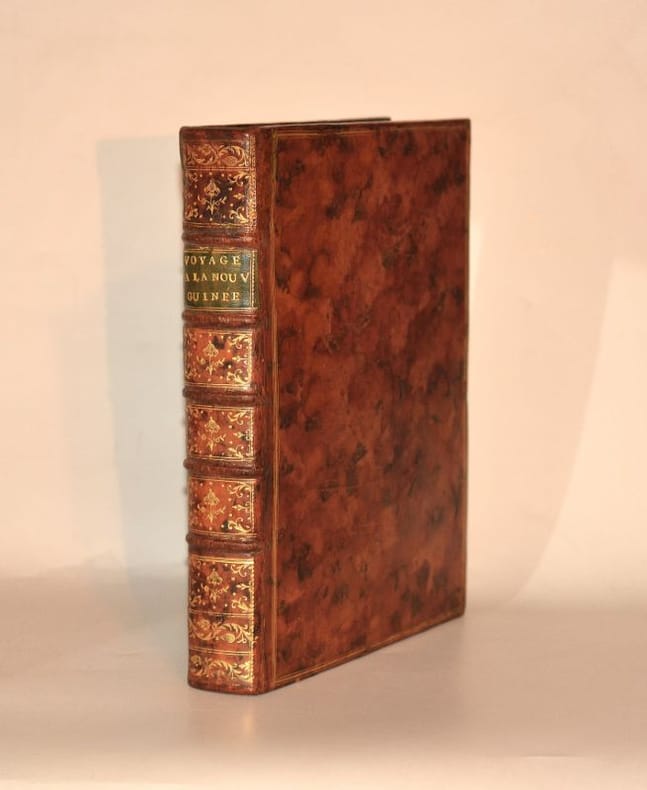
VALMONT DE BOMARE Jacques-Christophe.Livre Rare Book

8175 risultati
rif. 6591Lyon, Bruyset frères, 1791. 8 volumes in-4 (207 x 270 mm). Demi-maroquin vert à coins, dos lisse orné (reliure de l'époque).
1878rif. 569DBWien, Kaiserlich-Königliche Hof- und Staatsdruckerei, 1878. 8°. XI,310 S. 1 wBlatt (und Vorsätze) Graue Originaldeckel schwarz bedruckt, Rücken mit altem Leinenstreifen., 1
1737in-4, pp. (8), 130, (2), 55, (1), legatura posteriore in marocchino citron, filetti oro ai piatti, titolo e fregi al dorso a nervi, tagli dor. Illustrato da un'antiporta allegorica e da 32 tavole assai belle raffiguranti 106 specie di uova suddivise tra uccelli rapaci, non rapaci e acquatici, e varie tipologie di cavallette, cui è infatti dedicata la seconda parte dell'opera. Precede il testo lettera dedicatoria a Ferdinando Maria duca di Baviera. Prima ed unica edizione di opera rara e unica nel suo genere: si tratta del primo trattato dedicato alle uova e ai nidi dei volatili. A questo "libro primo" doveva probabilmente seguirne un'altro, mai realizzao. L'autore, attestato anche come Ginanni (Ravenna 1692 - 1753), fu celebre zoologo e naturalista. Volume assai elegantemente impresso e illustrato, su carta forte. Ottimo esemplare (cerniera anteriore un po' debole).. Ceresoli 559: ''Edizione originale e dunica, rara, del primo libro, solo pubblicato, di opera rimasta incompiuta, la prima che tratti dell'argomento''. Gamba 2265. Graesse III, 85. Nissen IV, 1031. Morazzoni 233..
In Roma, appresso M. Angelo de Rossi, 1684, in-4, pergamena coeva, cc. (5), 77, (6). Con frontespizio inciso e 66 splendide incisioni in rame all'acquaforte. Copia con due carte (T2 e T3) provenienti da altro esemplare e rimarginate e 2 carte (F2 e F3) provenienti da un esemplare della prima edizione (Roma, A. Fei, 1622) e rimarginate; 2 tavole con strappo riparato (senza alcuna perdita), una rimarginata, 2 margini esterni lievemente restaurati, ma copia ad ampi margini (misure cm. 27.2x20.5), pulita e fresca come si trova raramente. (Ceresoli pag. 385: “Quest'opera, testo di lingua, è divenuta rara nel corso dei secoli ed è ancora più difficile a trovarsi in buone condizioni, essendo quasi sempre deturpata da tracce d'uso”).
1783rif. 22712Budapest, Typis Regiae Universitatis, 1783. 147 S. 16 zumeist gefalt. Kupfertafeln von Ignaz Kibler. Gr.-8°. Mod. Pp. [5 Warenabbildungen]
1776rif. 0056251776 Paris, Ruault, 1776. In-quarto (268 X 206 mm) veau porphyre, encadrement de triple filet doré sur les plats, dos à nerfs orné de roulettes, fers et fleurons dorés, pièce de titre, tranches marbrées (Reliure de l'époque) ; (1) f. blanc, frontispice, XII pages, (4) pages de table des chapitres, 206 pages, (2) pages d'approbation et privilège, (1) f. blanc. Une rousseur brune au frontispice, habiles et discrètes restaurations à la reliure.
1896rif. 43223Gera-Untermhaus, (1896-1905). Folio. 12 orig. hcloth, gilt backs. Backs with light traces of use. Textillustr. and 449 plates of which 439 are fine chromolithographed plates. Volume 12 with a faint dampstain to inner corners of leaves and plates, mostly seen on the egg-plates. Bookplate of Lorenz Ferdinand.
1896Gera-Untermhaus, (1896-1905). Folio. 12 orig. hcloth, gilt backs. Backs with light traces of use. Textillustr. and 449 plates of which 439 are fine chromolithographed plates. Volume 12 with a faint dampstain to inner corners of leaves and plates, mostly seen on the egg-plates. Bookplate of Lorenz Ferdinand.
1896rif. 11036Gera-Untermhaus, (1896-1905). Folio. 12 orig. hcloth, gilt backs. Backs with traces of use and some hinges reinforced, corners a little bumped. Top of spine a little worn on a few vols. Internally fine. Textillustr. and 449 plates of which 439 are fine chromolithographed plates.
1896Gera-Untermhaus, (1896-1905). Folio. 12 orig. hcloth, gilt backs. Backs with traces of use and some hinges reinforced, corners a little bumped. Top of spine a little worn on a few vols. Internally fine. Textillustr. and 449 plates of which 439 are fine chromolithographed plates.
16221 volume in-4°, mm 240x175, pp. (12), 81, (12), con 66 tavole a piena pagina incise a bulino da Tempesta, Villamena e Maggi. Elegante legatura settecentesca in mezzo marocchino rosso con titolo e fregi in oro al dorso, piatti inquadrati da cornice geometrica dorata, ben conservata e solida. Esemplare complessivamente in buono stato e abbastanza marginoso; qualche macchia e arrossature sparse, più marcate al frontespizio e alle pagine: 6, 7, 8, 40, 41, 42, 45, 46, 47, 48. Uno strappo riparato a pagina 15 e uno a pagina 18; una mancanza al margine bianco di pagina 57. Edizione originale, piuttosto rara, del più celebre trattato ornitologico italiano. "Non deve destare meraviglia la grande fama che l'Uccelliera ebbe in ogni tempo, se si ricorda che fu considerata e si considera tutt'ora il capolavoro dell'arte tipografica e figurativa del secolo XVII" (Ceresoli, p. 384, 385). Inoltre "l'intero volume è un vero e proprio testo di lingua citato dagli Accademici della Crusca" (L'Esopo, 1981). EXPORT LICENCE AVAILABLE
1683rif. 54694BBParis, Gabriel Quinet, 1683. 16,3x9 cm. 10 n.n. Bl., 139 S., 5 n.n. S. Privilege. Lederband der Zeit mit goldgeprägtem Rückentitel und floraler Rückenvergoldung.
1776Paris, Ruault, 1776. 4to (260 x 207 mm). In a very nice contemporary full calf binding with five raised bands with richly gilt spine, gilt boarders to boards, gilt ornamentation to edges of boards. All edges gilt. Ex-libris pasted on to pasted down front end-paper. Light wear to extremities, corners lightly bumped and hindges with a bit of wear, an overall very nice and clean copy. XII, (4), 206, (2) pp + 120 engraved plates (No. 90 and 91 being on the same leaf).
rif. 115632o.J. The descriptions from the systema naturae of Linnaeus; with general observations, either original, or collected from the latest and most esteemed English ornithologists. Vol. 1-5 (von 10) in 2 Bänden. Mit 124 kolor. Kupfertafeln. Hldr. d. Zt.; berieben, vord. Gelenk von Bd. 1 aufgeplatzt u. beschabt. [7 Warenabbildungen]
rif. 1940720th century. Watercolour on rice paper inscribed "Yama-Dori" with Japanese characters. Framed designed by William Haines. Ink and colors on paper inscribed 'Yama-Dori' male mountain bird mounted in a plexiglas and white painted wooden frame designed by William Haines Framed size: 15 1/4 inches high 53 1/2 inches wide. unknown
rif. 1940720th century. Watercolour on rice paper inscribed "Yama-Dori" with Japanese characters. Framed designed by William Haines. Ink and colors on paper inscribed 'Yama-Dori' male mountain bird mounted in a plexiglas and white painted wooden frame designed by William Haines Framed size: 15 1/4 inches high 53 1/2 inches wide. unknown books
1905rif. 56275ABGera-Untermhaus, Köhler, 1897-1905. Folio. Mit 449 (439 chromolithographischen) Tafeln. Original-Halblederbände im Schuber.
1622in-4, pp. (12), 81, (12), leg. mod. p. perg. con uso di materiale antico, tass. e tit. oro al d. Con 66 splendide tavv. inc. in rame a p. pag. dal Tempesta e Villamena. Dedicat. a Cassiano Dal Pozzo il cui stemma araldico è inciso in una gr. vignetta in rame al front. Rariss. ediz. orig., solitamente rifilata e mai marginosa e ben conservata come nel nostro esempl. Cicognara 2072. Gamba 2029: “L’Autore, di patria novarese, dedica quest’opera al celebre Cav. Cassiano Dal Pozzo. L’opera è di interesse sia ornitologico che venatorio, dato che l’Olina è considerato anche l’inventore della tecnica di uccellagione “a ragnaja”. Sono descritte molto accuratamente 45 specie di uccelli, ed i modi di prenderli e di conservarli”. Secondo alcuni l’Olina non fu l’originale autore del testo che costituirebbe un adattamento di un precedente poema composto da Valli da Todi e pubblicato a Roma nel 1601, dal titolo “Il canto degl’augelli”. Bacchi della Lega 21. Graesse V, 19. Piantanida 146. Ceresoli p. 384. Brunet IV, 180. Minimo intervento in due punti dell’angolo bianco inf. destro. Bell’esempl. marginoso. [219]
1878Kassel, Theodor Fischer, 1878-1883. Folio. (39,5x30 cm.). Original full cloth. Corners slightly bumped. Broad rectangular blindtooling on front cover, inside which gilt title. Some neat repairs to spine ends and front hinge. (10),(66) pp. + Nachträge (6) pp. With all 33 fine chromolithographed plates, the colouring hand-finished. Occasionally very light marginal foxing.
1924rif. 56274ABStockholm, Baarsen, 1924. 39x28cm. 9, (2), 295pp; 9, 296-546pp; 16, 547-902, XXpp. With 364 handcoloured lithographic plates and numerous photographic text-illustrations. Orig. red full morocco, richly gilt, a.e.g., in orig. slipcases.
1830rif. 340519Brodtmann's lithographische Kunstanstalt, Leipzig (1819) - 1830. 1 Blatt, 144 lithographische handkolorierte Tafeln - XXXVI, 445, XIII Seiten, Groß 4°, Halblederbände der Zeit, in Format und Bindung etwas abweichend, Einbände minimal berieben und bestoßen, Papier geringfügig stock- oder braunfleckig, insgesamt gute und innen saubere Exemplare, Tafeln weitgehend sehr sauber,
1893rif. CRR2302Farnborough Kent: Published by the Author 1893. FIRST EDITION. 385 x 298 mm. 15 1/4 x 11 5/8". xvi lacking final two leaves of introduction 111 1 pp. Recent dark green quarter morocco over green cloth boards raised bands spine panels with gilt lettering. Housed in a matching green morocco-backed clamshell box lined with velvet by J & S Brockman. CONTAINING 27 HAND-COLORED PLATES each enhanced with gum Arabic by J. G. Kuelemans. Fine Bird Books p. 92; Ayer/Zimmer p.178; Wood p. 324. ◆A couple of plates with very minor foxing or an isolated spot but IN VERY FINE CONDITION inside and out the leaves quite smooth and clean and with vast margins. This is an important and beautifully illustrated work on the Coraciidae a spritely family of birds known for their vibrant plumage and acrobatic aerial displays. Predominantly found in Africa and parts of the near East "rollers" as these birds are commonly known are much admired for their extraordinary coloring ranging from bright blues violets and bright pinks to soft peach and burnt orange. The artist of the present work Dutch illustrator John Gerrard Keulemans 1842-1912 was a much sought-after draughtsman in the world of ornithology. Here he depicts each bird with his usual precision and fine detail and captures a rainbow of shades with richly saturated hues and subtle gradations. Zimmer calls the work a "Thoroughly detailed study of the group with excellent hand-colored plates." The son of a timber merchant Henry Eeles Dresser 1838-1915 travelled widely for his father's business which also afforded him the opportunity to study birds in far-flung regions such as Finland the Baltics and New Brunswick where the company operated a lumber mill. He even travelled to Texas during the Civil War bringing back with him more than 400 species of bird skins from the region. Dresser became one of the leading ornithologists of his day was elected to the British Ornithologists' Union the Linnean Society and the Zoological Society and amassed a formidable collection of skins and eggs. In addition to the present work he wrote another monograph on a related species of birds the monumental multi-volume "History of Birds in Europe" as well as numerous scholarly articles. We are able to price our handsomely presented and quite fine copy advantageously because of the two missing leaves from the introduction. Published by the Author unknown
1893rif. CRR2302Farnborough Kent: Published by the Author 1893. FIRST EDITION. 385 x 298 mm. 15 1/4 x 11 5/8". xvi lacking final two leaves of introduction 111 1 pp. Recent dark green quarter morocco over green cloth boards raised bands spine panels with gilt lettering. Housed in a matching green morocco-backed clamshell box lined with velvet by J & S Brockman. CONTAINING 27 HAND-COLORED PLATES each enhanced with gum Arabic by J. G. Kuelemans. Fine Bird Books p. 92; Ayer/Zimmer p.178; Wood p. 324. ◆A couple of plates with very minor foxing or an isolated spot but IN VERY FINE CONDITION inside and out the leaves quite smooth and clean and with vast margins. This is an important and beautifully illustrated work on the Coraciidae a spritely family of birds known for their vibrant plumage and acrobatic aerial displays. Predominantly found in Africa and parts of the near East "rollers" as these birds are commonly known are much admired for their extraordinary coloring ranging from bright blues violets and bright pinks to soft peach and burnt orange. The artist of the present work Dutch illustrator John Gerrard Keulemans 1842-1912 was a much sought-after draughtsman in the world of ornithology. Here he depicts each bird with his usual precision and fine detail and captures a rainbow of shades with richly saturated hues and subtle gradations. Zimmer calls the work a "Thoroughly detailed study of the group with excellent hand-colored plates." The son of a timber merchant Henry Eeles Dresser 1838-1915 travelled widely for his father's business which also afforded him the opportunity to study birds in far-flung regions such as Finland the Baltics and New Brunswick where the company operated a lumber mill. He even travelled to Texas during the Civil War bringing back with him more than 400 species of bird skins from the region. Dresser became one of the leading ornithologists of his day was elected to the British Ornithologists' Union the Linnean Society and the Zoological Society and amassed a formidable collection of skins and eggs. In addition to the present work he wrote another monograph on a related species of birds the monumental multi-volume "History of Birds in Europe" as well as numerous scholarly articles. We are able to price our handsomely presented and quite fine copy advantageously because of the two missing leaves from the introduction. Published by the Author unknown books
1871In-4 p., 9 volumi (di cui 1 di Supplemento), mz. pelle coeva con ang., dorso a cordoni con filetti e tit. oro, tagli sup. dorati. L'opera, in 8 volumi, pubblicati nel 1871-1881, è cosi' composta: - Vol. 1°: pp. XIII (list of subscribers), III-XLVI,102 (prefatory matter and indices) /// Vol. 2°: pp. (2),VIII,644, con 95 tavv. /// Vol. III: pp. (2),VIII,620, con 86 tavv. /// Vol. 4°: pp. (2),VIII,636, con 92 tavv. di cui 1 (la 262) in b.n. /// Vol. 5°: pp. (2),VIII,668, con 90 tavv. /// Vol. 6°: pp. (2),VIII,708, con 92 tavv. /// Vol. 7°: pp. (2),VIII,660, con 89 tavv. di cui 1 (la 485) in b.n. /// Vol. 8°: pp. (2),VIII,666, con 90 tavv. (la 599 è bis). - Il "Supplement", vol. 9°, pubblicato nel 1895-96, pp. (2),XXV,441, con 89 tavv. Importante e ricercata opera di ornitologia, magnificamente illustrata da complessive 723 tavole litografate di cui: 721 con pregevole coloritura a mano e 2 in b.n. Le bibliografie citano 722 tavv. "Ediz. originale", rara. Cfr. Zimmer,I, p. 177/179: "A very thorough manual of the subject, beautifully illustrated by J.G. Keulemans, Joseph Wolf, E. Neale and others.. Vol. IX was intended to treat only of species not included in the original work, but offers occasional corrections to the original letterpress, also" - Nissen,DIV,267 - The British Museum (Natural History),I, p. 479. Cfr. anche Benezit,VII, p. 774 che dell'artista olandese precisa: "Johannes Gerardus Keulemans (1842-1912), peintre animalier, graveur, illustrateur. Passionné d'histoire naturelle, ornithologue, il représente, selon un graphisme très précis, toutes les sortes d'oiseaux qu'il connait". Benezit,XIV, p. 687, dell'illustratore tedesco Joseph Wolf (1820-1899) così precisa: "Il peignit un grand nombre de tableaux d'oiseaux, s'amusant à les représenter dans les mutations de l'éclairage". Solo nel 9° volume 4 cc. con alone al margine super. bianco, altrimenti bellissimo esemplare.
1801In folio grande (mm. 510 x 330), 2 volumi, elegante legatura in p. pelle coeva, cornice dorata ai piatti, dorso a cordoni con decorazioni di uccelli ai riquadri e tit. oro su due tasselli, tagli dorati, pp. (4),II,153; (4),II,133,(3); con 114 magnifiche tavole a colori che raffigurano, come dice Ronsil, "i piu' belli e i piu' esotici uccelli del mondo" (in ogni tavola veniva stampato a colori il ramo su cui l'uccello sta appollaiato ed il piumaggio; a mano veniva ritoccata a colori la parte principale del corpo). Le illustrazioni comprendono: 24 tavole dedicate agli “uccelli del paradiso”; 15 ai “rolliers”; 17 ai “geais”; 18 ai “toucans”; 24 ai “barbus”; 5 ai “barbus tamatias”; 3 ai “barbacous” e 8 ai “jacamars”. In questa celebrata opera, le tavole furono disegnate da Jacques Barraband, incise da Perée et Gremilliet, stampate a colori da Langlois et Rousset, e superbamente rifinite a mano. L’opera di Jacques Barraband (1768-1809), realizzata per Levaillant, rappresenta il momento più alto della sua carriera d’artista, considerato il miglior disegnatore di ornitologia della sua generazione. Produsse più di 300 bellissimi acquarelli per i libri di Levaillant. Cfr. Zimmer,II, p. 393 - Nissen,IVB, 559 - Ronsil,1780 - Graesse,IV,188 - Brunet,III,1033: “Ouvrage d’une exécution magnifique” - Benezit,I, p. 775. Qualche lieve fiorit. o alone ma complessivam. esemplare ben conservato, con ex-libris di Giovanni Treccani degli Alfieri. "François Levaillant (1753 – 1824), è stato un esploratore, ornitologo e collezionista francese. Nacque a Paramaribo, capitale della Guyana Olandese (l'attuale Suriname), dove suo padre era console. Quando il padre tornò in Europa nel 1763, studiò storia naturale a Metz. Nel 1781 venne inviato per conto della Compagnia olandese delle Indie Orientali nella Provincia del Capo in Sudafrica, dove rimase a raccogliere esemplari fino al 1784. Nella zona effettuò due viaggi, uno ad est del Capo e l'altro a nord del fiume Orange (Gran Namaqualand). Al suo ritorno pubblicò “Voyage dans l'intérieur de l'Afrique” (1790) e “Second voyage dans l'intérieur de l'Afrique, dans les années 1783-85” (1795), che furono tradotti in varie lingue. Pubblicò anche importanti opere di ornitologia quali “Histoire naturelle des oiseaux d'Afrique (1796-1808, 6 voll.) e, assieme a Jacques Barraband, “Histoire naturelle des oiseaux de paradis” (1801-06). Grazie a questi viaggi fu in grado di inviare più di 2000 esemplari di uccelli a Jacob Temminck, che aveva finanziato la spedizione, e che furono studiati dal figlio Coenraad Jacob Temminck ed inclusi nella collezione del Museo di Storia Naturale di Leida (di cui fu il primo Direttore)".