8 181 résultats
1924réf. 56274ABStockholm, Baarsen, 1924. 39x28cm. 9, (2), 295pp; 9, 296-546pp; 16, 547-902, XXpp. With 364 handcoloured lithographic plates and numerous photographic text-illustrations. Orig. red full morocco, richly gilt, a.e.g., in orig. slipcases.
1830réf. 340519Brodtmann's lithographische Kunstanstalt, Leipzig (1819) - 1830. 1 Blatt, 144 lithographische handkolorierte Tafeln - XXXVI, 445, XIII Seiten, Groß 4°, Halblederbände der Zeit, in Format und Bindung etwas abweichend, Einbände minimal berieben und bestoßen, Papier geringfügig stock- oder braunfleckig, insgesamt gute und innen saubere Exemplare, Tafeln weitgehend sehr sauber,
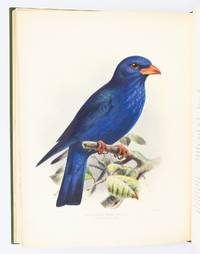
1893réf. CRR2302Farnborough Kent: Published by the Author 1893. FIRST EDITION. 385 x 298 mm. 15 1/4 x 11 5/8". xvi lacking final two leaves of introduction 111 1 pp. Recent dark green quarter morocco over green cloth boards raised bands spine panels with gilt lettering. Housed in a matching green morocco-backed clamshell box lined with velvet by J & S Brockman. CONTAINING 27 HAND-COLORED PLATES each enhanced with gum Arabic by J. G. Kuelemans. Fine Bird Books p. 92; Ayer/Zimmer p.178; Wood p. 324. ◆A couple of plates with very minor foxing or an isolated spot but IN VERY FINE CONDITION inside and out the leaves quite smooth and clean and with vast margins. This is an important and beautifully illustrated work on the Coraciidae a spritely family of birds known for their vibrant plumage and acrobatic aerial displays. Predominantly found in Africa and parts of the near East "rollers" as these birds are commonly known are much admired for their extraordinary coloring ranging from bright blues violets and bright pinks to soft peach and burnt orange. The artist of the present work Dutch illustrator John Gerrard Keulemans 1842-1912 was a much sought-after draughtsman in the world of ornithology. Here he depicts each bird with his usual precision and fine detail and captures a rainbow of shades with richly saturated hues and subtle gradations. Zimmer calls the work a "Thoroughly detailed study of the group with excellent hand-colored plates." The son of a timber merchant Henry Eeles Dresser 1838-1915 travelled widely for his father's business which also afforded him the opportunity to study birds in far-flung regions such as Finland the Baltics and New Brunswick where the company operated a lumber mill. He even travelled to Texas during the Civil War bringing back with him more than 400 species of bird skins from the region. Dresser became one of the leading ornithologists of his day was elected to the British Ornithologists' Union the Linnean Society and the Zoological Society and amassed a formidable collection of skins and eggs. In addition to the present work he wrote another monograph on a related species of birds the monumental multi-volume "History of Birds in Europe" as well as numerous scholarly articles. We are able to price our handsomely presented and quite fine copy advantageously because of the two missing leaves from the introduction. Published by the Author unknown
1893réf. CRR2302Farnborough Kent: Published by the Author 1893. FIRST EDITION. 385 x 298 mm. 15 1/4 x 11 5/8". xvi lacking final two leaves of introduction 111 1 pp. Recent dark green quarter morocco over green cloth boards raised bands spine panels with gilt lettering. Housed in a matching green morocco-backed clamshell box lined with velvet by J & S Brockman. CONTAINING 27 HAND-COLORED PLATES each enhanced with gum Arabic by J. G. Kuelemans. Fine Bird Books p. 92; Ayer/Zimmer p.178; Wood p. 324. ◆A couple of plates with very minor foxing or an isolated spot but IN VERY FINE CONDITION inside and out the leaves quite smooth and clean and with vast margins. This is an important and beautifully illustrated work on the Coraciidae a spritely family of birds known for their vibrant plumage and acrobatic aerial displays. Predominantly found in Africa and parts of the near East "rollers" as these birds are commonly known are much admired for their extraordinary coloring ranging from bright blues violets and bright pinks to soft peach and burnt orange. The artist of the present work Dutch illustrator John Gerrard Keulemans 1842-1912 was a much sought-after draughtsman in the world of ornithology. Here he depicts each bird with his usual precision and fine detail and captures a rainbow of shades with richly saturated hues and subtle gradations. Zimmer calls the work a "Thoroughly detailed study of the group with excellent hand-colored plates." The son of a timber merchant Henry Eeles Dresser 1838-1915 travelled widely for his father's business which also afforded him the opportunity to study birds in far-flung regions such as Finland the Baltics and New Brunswick where the company operated a lumber mill. He even travelled to Texas during the Civil War bringing back with him more than 400 species of bird skins from the region. Dresser became one of the leading ornithologists of his day was elected to the British Ornithologists' Union the Linnean Society and the Zoological Society and amassed a formidable collection of skins and eggs. In addition to the present work he wrote another monograph on a related species of birds the monumental multi-volume "History of Birds in Europe" as well as numerous scholarly articles. We are able to price our handsomely presented and quite fine copy advantageously because of the two missing leaves from the introduction. Published by the Author unknown books
1871In-4 p., 9 volumi (di cui 1 di Supplemento), mz. pelle coeva con ang., dorso a cordoni con filetti e tit. oro, tagli sup. dorati. L'opera, in 8 volumi, pubblicati nel 1871-1881, è cosi' composta: - Vol. 1°: pp. XIII (list of subscribers), III-XLVI,102 (prefatory matter and indices) /// Vol. 2°: pp. (2),VIII,644, con 95 tavv. /// Vol. III: pp. (2),VIII,620, con 86 tavv. /// Vol. 4°: pp. (2),VIII,636, con 92 tavv. di cui 1 (la 262) in b.n. /// Vol. 5°: pp. (2),VIII,668, con 90 tavv. /// Vol. 6°: pp. (2),VIII,708, con 92 tavv. /// Vol. 7°: pp. (2),VIII,660, con 89 tavv. di cui 1 (la 485) in b.n. /// Vol. 8°: pp. (2),VIII,666, con 90 tavv. (la 599 è bis). - Il "Supplement", vol. 9°, pubblicato nel 1895-96, pp. (2),XXV,441, con 89 tavv. Importante e ricercata opera di ornitologia, magnificamente illustrata da complessive 723 tavole litografate di cui: 721 con pregevole coloritura a mano e 2 in b.n. Le bibliografie citano 722 tavv. "Ediz. originale", rara. Cfr. Zimmer,I, p. 177/179: "A very thorough manual of the subject, beautifully illustrated by J.G. Keulemans, Joseph Wolf, E. Neale and others.. Vol. IX was intended to treat only of species not included in the original work, but offers occasional corrections to the original letterpress, also" - Nissen,DIV,267 - The British Museum (Natural History),I, p. 479. Cfr. anche Benezit,VII, p. 774 che dell'artista olandese precisa: "Johannes Gerardus Keulemans (1842-1912), peintre animalier, graveur, illustrateur. Passionné d'histoire naturelle, ornithologue, il représente, selon un graphisme très précis, toutes les sortes d'oiseaux qu'il connait". Benezit,XIV, p. 687, dell'illustratore tedesco Joseph Wolf (1820-1899) così precisa: "Il peignit un grand nombre de tableaux d'oiseaux, s'amusant à les représenter dans les mutations de l'éclairage". Solo nel 9° volume 4 cc. con alone al margine super. bianco, altrimenti bellissimo esemplare.
1801In folio grande (mm. 510 x 330), 2 volumi, elegante legatura in p. pelle coeva, cornice dorata ai piatti, dorso a cordoni con decorazioni di uccelli ai riquadri e tit. oro su due tasselli, tagli dorati, pp. (4),II,153; (4),II,133,(3); con 114 magnifiche tavole a colori che raffigurano, come dice Ronsil, "i piu' belli e i piu' esotici uccelli del mondo" (in ogni tavola veniva stampato a colori il ramo su cui l'uccello sta appollaiato ed il piumaggio; a mano veniva ritoccata a colori la parte principale del corpo). Le illustrazioni comprendono: 24 tavole dedicate agli “uccelli del paradiso”; 15 ai “rolliers”; 17 ai “geais”; 18 ai “toucans”; 24 ai “barbus”; 5 ai “barbus tamatias”; 3 ai “barbacous” e 8 ai “jacamars”. In questa celebrata opera, le tavole furono disegnate da Jacques Barraband, incise da Perée et Gremilliet, stampate a colori da Langlois et Rousset, e superbamente rifinite a mano. L’opera di Jacques Barraband (1768-1809), realizzata per Levaillant, rappresenta il momento più alto della sua carriera d’artista, considerato il miglior disegnatore di ornitologia della sua generazione. Produsse più di 300 bellissimi acquarelli per i libri di Levaillant. Cfr. Zimmer,II, p. 393 - Nissen,IVB, 559 - Ronsil,1780 - Graesse,IV,188 - Brunet,III,1033: “Ouvrage d’une exécution magnifique” - Benezit,I, p. 775. Qualche lieve fiorit. o alone ma complessivam. esemplare ben conservato, con ex-libris di Giovanni Treccani degli Alfieri. "François Levaillant (1753 – 1824), è stato un esploratore, ornitologo e collezionista francese. Nacque a Paramaribo, capitale della Guyana Olandese (l'attuale Suriname), dove suo padre era console. Quando il padre tornò in Europa nel 1763, studiò storia naturale a Metz. Nel 1781 venne inviato per conto della Compagnia olandese delle Indie Orientali nella Provincia del Capo in Sudafrica, dove rimase a raccogliere esemplari fino al 1784. Nella zona effettuò due viaggi, uno ad est del Capo e l'altro a nord del fiume Orange (Gran Namaqualand). Al suo ritorno pubblicò “Voyage dans l'intérieur de l'Afrique” (1790) e “Second voyage dans l'intérieur de l'Afrique, dans les années 1783-85” (1795), che furono tradotti in varie lingue. Pubblicò anche importanti opere di ornitologia quali “Histoire naturelle des oiseaux d'Afrique (1796-1808, 6 voll.) e, assieme a Jacques Barraband, “Histoire naturelle des oiseaux de paradis” (1801-06). Grazie a questi viaggi fu in grado di inviare più di 2000 esemplari di uccelli a Jacob Temminck, che aveva finanziato la spedizione, e che furono studiati dal figlio Coenraad Jacob Temminck ed inclusi nella collezione del Museo di Storia Naturale di Leida (di cui fu il primo Direttore)".