119 risultati
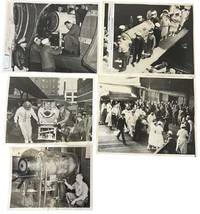
1937rif. 234531937. Iron lung transport press archive documenting the movement of respirator-dependent polio patients through rail terminals ships ramps aircraft hospitals and Coast Guard facilities during the years before the Salk vaccine changed American polio care in 1955. The iron lung developed in 1928 by Philip Drinker and Louis Agassiz Shaw kept patients breathing when polio paralyzed the muscles needed for respiration. Fred B. Snite Jr. appears in several views as the nationally followed Chicago patient who contracted polio in China in 1936 and returned to the United States after a highly publicized 9300-mile medical journey. The group is strongest as a record of medical transport itself: nurses in masks uniformed officers attendants ramps crowds and captioned press slips show how survival could depend on coordinated movement as much as bedside treatment. Photo archive of 5 large silver gelatin press photographs approx 8 x 10 inches Chicago Seattle Port Angeles and related transport locations 1937-1951. Snite's respirator is loaded at a Chicago railroad terminal with his head visible through the front window while men adjust the wheeled carriage; another scene places the iron lung at a ship or dockside ramp surrounded by masked nurses uniformed officers and hospital attendants. A Chicago caption dated February 8 1939 reads "Iron Lung Kid and Bride Entrain for South" identifying Snite and his bride leaving for Miami Florida after their winter vacation. Another verso caption dated June 22 1937 describes his return to Chicago after transport from China where he had been stricken. A January 14 1951 Coast Guard caption identifies an iron lung flown from Seattle to Port Angeles to aid Eldon Tetum a 36-year-old logger stricken with polio. Polio epidemics made the iron lung one of the most visible medical machines of the mid-twentieth century especially before vaccination reduced annual cases after 1955. These scenes connect celebrity medical news to emergency public health logistics showing how mechanical respiration required attendants vehicles terminals aircraft and institutional coordination outside the hospital room. Press stamps pasted captions adhesive staining and surface marks visible on versos; images remain strong and readable. Overall in good condition. unknown books
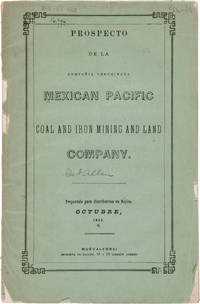
1856rif. 27974Nueva-York: Imprenta de Hallet 1856. Coal Mining in Mexico A Spanish-language prospectus for an American mining and land company on the Pacific coast of Mexico. Original printed wrappers. Rear wrapper detached spine mostly perished library blindstamp on front wrapper and withdrawal stamp on wrapper interior. Foxed. Good overall. SABIN 48572 note. unknown books
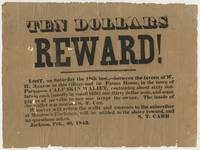
1843rif. BK0115Jackson Michigan 1843. Broadside 7 ¾ x 10 ½ inches. Single sheet printed in black. Old folds with short separations and small losses at several fold intersections and along the edges with general handling wear good overall. An early Jackson Michigan broadside issued by S. T. Carr offering ten dollars for the return of a wallet lost two days earlier on the road between the tavern of W. H. Monroe in Jackson and the Parma House. Carr describes the missing property in some detail: "A CALF-SKIN WALLET containing about sixty dollars in cash mostly in small bills one thirty dollar note and some papers of no value to any one except the owner. The inside of the wallet was marked S. T. Carr." Carr directed that the wallet be returned to him at Monroe's Exchange promising the reward "and no questions asked." Carr and W. H. Munroe appear together again two years later in the early history of Michigan's iron industry. In July 1845 they were among the Jackson men who organized an association to explore the mineral country south of Lake Superior. That fall Carr Munroe Philo M. Everett and E. S. Rockwell traveled north as an exploring party. Michigan mining histories record that Carr and Rockwell working with an Indigenous guide located the iron outcrop that became the Jackson mine; Carr continued the final search for the outcrop alone. The Jackson association subsequently became the Jackson Mining Company one of the earliest enterprises to develop the Marquette Iron Range.1 1 T. B. Brooks "Geological Survey of Michigan. Upper Peninsula 1869-1873 Accompanied by an Atlas of Maps" Legislature of Michigan and Julius Bien 1873 8. . unknown books
1837rif. 30091St. Louis 1837. 36pp folding plate frontis full-page map. Institutional rubberstamps at base of title page verso. Original printed wrappers light rubberstamp discard stamp on front wrapper. Otherwise Very Good. "Missouri Imprints Inventory No. 197 cites only one copy. This tract is probably the first description of Iron mines west of the Mississippi. The Iron Mountains were located in St. Francis and Madison Counties. A proposal is made to make iron rails for a railroad from the mountains to the Mississippi" Decker. AII MO 197 1. 37 Decker 214. Not in Eberstadt Soliday Graff. OCLC indicates a number of institutional copies. unknown books
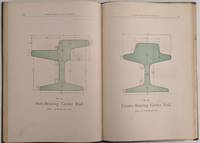
1890rif. 502San Francsico California: Pacific Rolling Mill Company 1890. 8vo. 250 x 170 mm. 10 x 7 inches. 100 pp. plus 4 leaves of ruled paper 2 with measurements in manuscript. Illustrated throughout with simple drawings of parts many stenciled with green wash; one plate folding. Bound in limp cloth covered boards title in gilt on front cover; a cloth binding shows some wear to gilt title two pencil drawings on front endpaper; other a very good sound copy. Straight forward price list of iron bar steel rail rolled and forged metal axles nuts bolts washers and dozens of other metal products. There is no introduction about the history of the firm just images of parts prices and a few lines of text describing specifications for some of the more complicated manufacture items. What distinguishes this rare trade catalogue is the design sense of many of the images and the application of stenciled color to highlight the object. The printed form of the parts are in outline and as one pages through the catalogue the images take on an abstract quality. Metal parts become contoured shapes with form being determined only by the light green wash applied to the physical part of the design. Although unintentional I am sure this late 19th century publication replete with many of the characteristics of period book design exhibits a very modernist feel one that is most unusual in publications of this nature. Although called the 7th edition this is only one of three issues of the PRMC's product guide and price list that is known. Organized in 1867 PRMC grew continuously and by 1892 was producing more than 40 thousand tons of iron and steel. "This giant enterprise is so closely identified with the manufacturing interests of the Pacific Coast that there is scarcely a manufacturing firm or corporation on the Coast that does not depend upon its output. The mills are located at Potrero Point in South San Francisco and cover an immense area" Master Hands. Romaine Guide to American Trade Catalogues p. 200 this edition and one from 1886 both known in only one copy each at California Historical Society. OCLC cites an edition from 1885 in one copy at San Francisco Public Library and this edition 1890 also in only one copy at California H. S. See: Master Hands in the Affairs of the Pacific Coast Historical Biographical and Descriptive. A Resumé of the Builders of Our Material Progress. San Francisco: Western Historical Publishing Company 1892 pp. 260. Pacific Rolling Mill Company unknown books
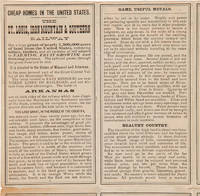
1880rif. 57333Chicago: Rand McNally & Co. ca. 1880. Folding Rand McNally Map and Promotional for Eastern Texas Missouri and Arkansas A scarce promotional for Missouri and Arkansas published by the St. Louis Iron Mountain and Southern Railway featuring a folding map by Rand McNally & Co. The map shows cities rivers railways and geographical features from eastern Texas through Louisiana Arkansas Missouri Mississippi and parts of Illinois Indiana and Alabama. The Iron Mountain Railway owned a large land grant in the central United States but it was not allowed to sell until the railway was completed; now that time had come and they were advertising it heavily. Some of the attractions promoted in the text include wild game hunting including squirrels resources such as zinc and coal good soil river and rail transportation telegraph service "cheap homes in Missouri and Arkansas" and low property taxes. They also exhort the nervous migrant: "This is the time to have decision of character or the opportunity will be lost to you and to your family forever. The strong-hearted Europeans who settled America did not know what they would reap from planting in strange soils and climates. Why should you hesitate about a country peopled an hundred years and well known Have manhood and come." The authors do not limit their reach to the United States either as they make sure to note after listing their prices that "One dollar in American is equal to about four shillings in English money." Also included is a panel of text with a table describing the climate of Little Rock and a list of instructions to railroad agents. The St. Louis Iron Mountain and Southern Railway originally established to deliver iron ore from Iron Mountain Missouri to St. Louis eventually stretched from eastern Texas through Missouri and Arkansas. In 1883 it was acquired by Jay Gould and in the 1900s merged into the Missouri Pacific and later Union Pacific Railroads. The folksong "Iron Mountain Baby" tells the true story of a Civil War veteran who walking along the railroad collecting building materials discovered a baby who had been apparently thrown from the train in a valise. When the child grew older the railway paid for his education. The Iron Mountain Baby's story became popular around the United States and has been recorded in numerous forms throughout the years including the 2014 stage musical adaptation Bright Star written by musician and comedian Steve Martin. Though the Iron Mountain Railway put out a number of such promotionals in the late 1870s and early 1880s they remain rather scarce; OCLC records this edition focusing on Arkansas and Missouri only at Harvard and the University of Arkansas at Mullins. Old folds. Minor tanning. Slight splitting along some folds and a few cross-folds. Very good. unknown books
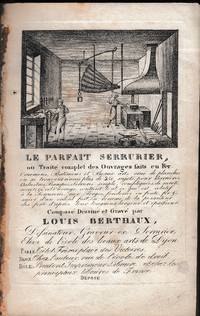
1834rif. 21103Paris: Roret . Dijon chez l'Auteur 1834. Second printing. Original printed wrappers mounted to paper covered boards. Good; covers detached; half title and final blank leaf of the binder reinforced along the gutter with a strip of silk backed tape of indeterminate age. The original printed wrappers have been mounted to paper covered binding board. Awkward repair to a tear into one folding plate no loss. 8vo 2 x 1 - 95 1 - blank 115 plates 2 unnumbered. There is a printed title and engraved title. Author's stamp on the verso of the half-title. Berthaux's book was reprinted several times. The first was 1828 issued with fewer plates 87 and less text. The second printing is revised and expanded. The sections devoted to lock design and construction decorative architectural ornaments and horological wheel-work are the most important. As a handbook there is nothing else like it published in the 19th century. Roret ... Dijon, chez l'Auteur hardcover books
1996rif. 403084California 1996. Hardcover. Near Fine. A Collection of 100 used concert tickets featuring punk new wave and heavy metal bands performing in California from 1983 through 1996. The tickets vary in size from 3” x 2” to 5.25” x 2.5”. All items are near fine with light soiling and a modest amount of creasing except for three torn tickets and 4 tickets stubs from use. The L.A. and Bay Area rock scene started in the late 1970s until new wave and heavy metal bands became the central focus of the 1980s. Some of the bands include: Mötley Crüe Iron Maiden Guns N’ Roses Depeche Mode Fatal Attraction Porno for Pyros Billy Idol Culture Club and others. The tickets span from Los Angeles to San Francisco and cities in between from 26 different venues some of which include The Troubadour Coconut Teaszer The Stone Trocadero Transfer The Metro Cow Palace The Palomino and Filthy McNasty Station. Many of the tickets are bright colors with printed pictures and stamped band logos showing the typographic designs of the time frame. Many bands kicked off their careers in California during this time. Mötley Crüe a popular heavy metal band formed in Los Angeles in 1981 is featured here playing at Oakland stadium on October 10 1987. The band is well known for their heavy make-up shocking clothing high-heeled boots and their abuse of drugs and alcohol. In 1985 the band transitioned to a more glam metal style influencing the heavy metal signature look. Guns N' Roses formed in 1985 in Los Angeles and is featured here playing at the Warfield Theatre on February 5 1988. They are a hard rock band that quickly gained popularity after the release of their debut album “Appetite for Destruction” which has sold over 28 million copies worldwide. The band has been labeled as the "the most dangerous band in the world" due to their rebelliousness and were credited to the rekindling of rock music during a time of dance music and glam metal. 1n 1992 Porno for Pyros formed in Los Angeles as an alternative rock group formed out of Jane’s Addiction. They are featured here playing at the Trocadero Transfer on June 19 1996. Their shows featured props extras and pyrotechnics. The band lasted through the mid-1990s and mixed the sounds of grunge and rock together. In the 1980s California became the melting pot of music genres mixing in punk rock new wave and metal. Certain venues became synonymous with the music genres and bands of that time. The Stone opened in the 1980s and was linked to the Keystone Berkeley and Keystone Palo Alto. It was large enough for a capacity of 700 sold only hard liquor at the bar and attracted an audience with bigger hair bigger shoes and makeup. It featured many local and big name artists in its day and was an important part of the Bay Area rock scene in the 1980s. The Coconut Teaszer operated from the 1980s through the mid-2000s. It hosted bands from all genres and featured a downstairs acoustic bar named “8121”. Sawdust on the dance floor and giant goblets for draft beer were some of the popular trademarks of the venue. One of the notable and peculiar policies of the venue was “no open toe shoes” which was painted on the front door. The Troubadour which is still functioning today opened in 1957. New wave and punk was the main feature for The Troubadour in the late 1970s and early 1980s. Through the 1980’s the venue became synonymous with the heavy metal genre and glam bands during that time. Today The Troubadour is revered as one of Hollywood’s most respected places to see live music. An attractive collection of brightly colored concert tickets featuring popular heavy metal and punk bands from the 1980s through the mid-1990s displaying over a decade of music in California. hardcover books
1717rif. 50277Paris: Guillaume Danet Son-in law of the author 1717. Second edition. Hardcover. Good- to very good condition. Octavo. 197 9pp. 5 folding maps. Original calf with gilt lettering tooling and ruling on spine; raised bands. Decorative endpapers. Title page with copperplate engravings of two hand-colored printed globes and black double-framing California depicted as an island in this and two other maps. Second edition augmented with longitudes and latitudes of major cities. Illustrated headpiece decorative initials and endpieces. All pages with double frames; marginalia. Introduction to geography by the French cartographer and engraver Nicolas de Fer 1646-1720 containing five folding copperplate engraved maps four of them hand-colored. The first showing a general map of the globe with America in one Europe Africa and Australia in the second globe both with North and South Poles. The margins are adorned with hand-colored portraits of significant explorers; Columbus Vespuci Shouten etc. The second map is the only one in black and white. It depicts "La Sphere Artificielle." The third map shows Europe the fourth Asia the Middle-East and Oceania with parts of Europe and Africa and finally North and South America depicted on the fifth. Contains list of cities and catalog of Fer publications at rear. At the age of twelve Fer became an apprentice of the Parisian engraver Louis Spirinx. After the death of Fer's father in 1673 he also was a cartographer Nicolas took over the business specializing in the production atlases geography and cartography-oriented publications. Well connected to the Royal Court Fer advanced to become the official geographer of the Philip V of Spain and Louis XIV of France. His numerous publications are considered artistic rather than accurate. Text in French. Binding rubbed along edges and boards with front joint mostly cracked but holding together. Small plate of previous owner glued to upper inside front cover. Inked and penciled notes on verso of decorative front endpaper. Starting at title page. Some creasing and small closed tears of maps. B/w map with two inch tear reinforced with tape on verso. Map of Europe with four inch closed tear. Map of America also reinforced with three and a half inch paper strip on verso. Page ninety-three with remnants of black glossy paper glued to gutter and part of text some loss of text. Binding in overall good- interior in good to very good condition. Guillaume Danet (Son-in law of the author) hardcover books
1701rif. 23030Paris: Nicolas De Fer 1701. First Edition. Very Good. Ginville Vincent de. Ginville Vincent de. First Edition. Paper size 42.5 cm x 28.5 cm. Plate mark 34 x 22.5 cm. Marginal paper clip stain inked '109' upper right corner some marginal chipping to the paper and old penciled price lower right. A few unobtrusive spots inside the plate marks. Copperplate engraving by Vincent de Ginville with later awfully bright hand color. This map would frame up nicely. There appears to be several versions of this map. The David Rumsey Collection has an example dated on the cartouch 1705 which he notes as being from Nicolas De Fer's Atlas Curieux published later. The Library of Congress has an example of the map offered here with the 1701 date and a separate page with explanations of the map. We don't know where this 1701 example came from separately issued or another atlas. The map highlights locations of Indian villages found by La Salle during his explorations of the coastal areas of the United States. We see the Gulf of Mexico Cap de la Floride and many inland village names. A nice map showing some early history of the southern United States. It includes parts of modern-day Louisiana Mississippi Alabama and Florida as well as the Bahamas and Cuba. Nicolas De Fer unknown books
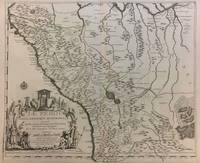
1719rif. 291534Paris 1719. Map. Engraving with original hand outline color. Image measures 19 x 23". Sheet measures 20 x 28". Unusual map of Peru from the early 18th century. Includes part of Ecuador Bolivia and Brazil based on Jesuit activity in the area. Amazon rain forest is visualized with a dynamic design. Cartouche describes the mining industry. Nicolas de Fer 1646-1720 was a prolific cartographer engraver and publisher who took over the family map business from his mother when she retired in 1687. The business flourished and he gained a great reputation in his lifetime and was appointed 'Geographer to the King' in 1690. This map demonstrates his skill and provides a curious yet alluring mixture of history and geography. unknown books
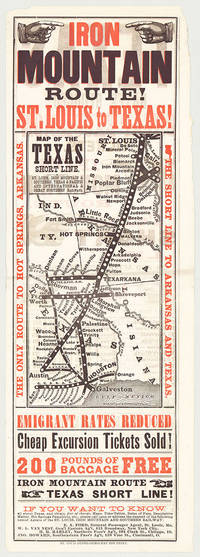
rif. 5718St. Louis: St. Louis Globe-Democrat Job Print; Woodward Tiernan & Hale Map Engr's 1878. Broadsheet with map 20.75" x 6.5" plus margins printed in black and red. Map size 11" x 5". Faded purple stamp of agent Henry H. Hannan. CONDITION: Very good upper-half of right margin rough cut. A scarce and attractive promotional broadsheet with map issued by the St. Louis Iron Mountain & Southern Railway advertising special railway offers to emigrants headed to Texas. This broadsheet announces cheap excursion tickets free baggage up to 200 lbs. and reduced emigrant rates for departures from St. Louis on the Short Line Route which runs through Arkansas into Texas. A table of rates on the verso lists first class and emigrant rates. The Texas Short Line extends from St. Louis Missouri to Galveston and Austin and cuts diagonally across the map with various spurs along the way including intersections the Texas & Pacific R'y and the International & Great Northern R'y. Interested parties seeking assistance information on Texas maps time-tables rates of fare etc. are encouraged to call upon or address the nearest of the railroad's Agents located in Missouri Chicago New York City and Ohio whose names are provided on both recto and verso. The St. Louis Iron Mountain & Southern Railway began selling off land holdings in Arkansas in the mid-1870s and continued to do so into the early twentieth century. OCLC records some twenty maps published by the railroad company promoting land it owned in Arkansas issued during this time period. These lands extended from the northernmost point of the state around Little Rock to the line's southern terminus in Texarkana. The company offered various inducements for settlers deep discounts for putting money down as well as reduced freight should homesteaders wish to transport their belongings via the railway. As demonstrated by the present broadsheet the railroad also capitalized on emigration to Texas. OCLC records only three copies at Yale Princeton and University of Texas at Arlington. St. Louis: St. Louis Globe-Democrat Job Print; Woodward, Tiernan & Hale, Map Engr's, 1878 unknown books
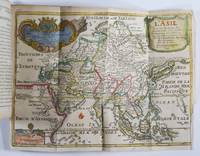
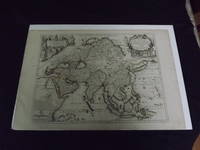
1722rif. biblio10Engraved double page map 28" x 20" wide margins hand colored in outline two uncolored pictorial cartouches. Expert and nearly invisible repairs along centerfold normal aging; about near fine. Impression is bright and clean. Nicholas De Fer 1646-1720 was a highly respected and prolific French cartographer whose maps were valued for their decorative appeal. Around 1690 he was made the geographer to the Dauphin and published his first atlas. He would become geographer to other high-ranking individuals in French and Spanish society. The present map is detailed and attractive map of Asia with a cartouche showing Chinese at the upper left and Indians in the upper right. The map covers a lot of territory showing Arabia and the Persian Empire in the West and Japan in the east but goes as far south as the Isle of Borneo and Java. Part of Eastern Europe is also visible. Library missouri website. books
1868rif. 173873Lille: Imprimerie de L. Danel 1868. Limited to 25 copies. Good overall the silk endpaper has lifted from the corner. 3/4/ black leather with 6 raised bands and gilt title second compartment. Purple silk endpapers and pastedowns. T.e.g. Title-page with large gilt-decorated emblem device above imprint. 3 preliminary leaves 7-97 2 pages mounted portrait. Preliminary states "Recueil des Discours Pronounces sur la Tombe du Baron James De Rothschild et des principaux articles de journaux publiées à l'occasion de sa mort et de ses funéreailles Ce Recuei tire vingt-cinq exemplaires est offert A Madame La Baronne James De Rothschild et a sa famille par le personnel du Chemin de fer du Nord." Includes funeral sermons and obituaries published in Le Temps Journal des debats L'Epoque and other perodicals. The photograph shows the Baron as he appeared in 1864. Worthy of restoration and exceedingly scarce. Worldcat locates 4 copies including 1 in the United States. Imprimerie de L. Danel hardcover books
rif. 31261Early Pennsylvania Iron Industry – Forge Founded by Maj. Gen Arthur St. Clair. The collection contains two ledgers: Johnston Alexander Manuscript Ledger Relating to The Hermitage Furnace Grist Mill and Store in Westmoreland County 1810-1812 Folio 396 manuscript pages 20-page name index entries written neatly in ink bound in contemporary full sheep tooled in blind spine label binding worn hinges starting text in very good clean and legible condition. Johnstons' partial signature is found on the front board. A contemporary manuscript note on the front free endpaper states "Bound for Patterson & Hopkins in Pittsb." This firm was the short-lived Pittsburgh book-selling business conducted by Robert Paterson and John Hopkins which lasted from 1810 until it was dissolved on November 5 1812. The business of this company was continued thenceforth until the end of 1817 under the new firm of Robert & Joseph Patterson. While this firm mostly sold books and stationery and supplied local printshops with paper the two brothers also conducted some small-scale publishing perhaps mostly using the press owned by Silas Engles. Another contemporary manuscript note taking up most of the rear free endpaper states: "Ledger a for A. Johnston Esqr by James Nouman 1810 for Hermitage Furnace" – perhaps Nouman was the binder. The ledger contains accounts for the Hermitage Furnace as well as a grist mill and general store under the management of Alexander Johnston. St. Clair in addition to the Hermitage Furnace also operated "a mill and other property" including a blacksmith shop these were all likely the properties leased by St. Clair about 1806 to Pittsburgh capitalists. The account book contains entries for various castings produced by the furnace bar iron and tools used in production forge hammers et cetera. There are also accounts for Johnstons' own Kingston Furnace the Washington Furnace another Westmoreland County Furnace and the Youngstown Store as well as numerous individuals many of whom were likely Hermitage Furnace workers. The general store accounts may have been an early "company store" for Hermitage workers and nearby farmers. Manuscript Ledger containing Accounts for Alexander Johnston 1805-1850 Narrow folio 236 pages several inlaid items bound in contemporary sheep binding worn and shaken identified as "Ledger F" on front cover Alexander Johnstons ownership on rear cover a number of pages excised at rear the volume was used as a "herbarium" at one point there are stains from plant specimens however the entries are clean and legible. "The iron industry of Pennsylvania took root in the eighteenth century in the southeastern part of the state but as the frontier moved westward ironworks were established not far behind. Furnaces and forges quickly sprang up to supply the agricultural communities with iron products that were badly needed. The spread settlement afforded men of initiative and capital the opportunity of producing iron first for a local market and then in many cases for more distant markets. At the beginning of the nineteenth century frontier conditions still prevailed in many parts of Pennsylvania but the iron industry – at that time a combination of iron manufacture and agriculture – played an important part in the development of the economic life of the state and the nation and in bringing about the change from an agrarian to an industrial civilization. During the first part of the nineteenth century all the iron furnaces in the country were cold-blast furnaces. By the time of the Civil War however technological changes were taking place as can be seen in the use of bituminous and anthracite coal or coke as fuel in many furnaces and in the application of a hot blast instead of a coal one … The blast furnace with its casting house blast house stock house and wooden blowing cylinders or tubs operated by an overshot water wheel or steam engine was an impressive sight in its agricultural setting when in blast. Not far from the plant were the houses of the workers the "mansion house" of the ironmaster the office the stables and the smith shop. Many of these communities also included a forge where pig iron from the blast furnace was heated and hammered into the bars of commerce. … old iron furnaces were part of a busy community where families lived toiled and died …" – Arthur C. Bining. The Hermitage Furnace was the second built in Westmoreland County Pennsylvania. The furnace was built by Major General Arthur St. Clair after he returned from the governorship of Ohio circa 1802-1803. The furnace was built at The Hermitage the onetime home of St. Clair located about two miles northeast of Ligonier on the road leading to Johnstown. St. Clair built the furnace in hopes of restoring his depleted fortune. The furnace was first managed by James Hamilton a prominent Carlisle Pennsylvania lawyer named deputy attorney general of the Western District of Pennsylvania by Thomas Jefferson. Hamilton's name appears several times in the ledger. An advertisement in the November 21 1806 issue of the Farmer's Register published in Greensburg by John M. Snowden taken out by Henry Weaver & Son Greensburg merchants it reads: "Hermitage Furnace in Blast. The subscribers being appointed Agents by General Arthur St. Clair for the sale of his castings generally and for the delivery of castings and stoves for any number of tons in good terms. Samples of the castings and stoves to be seen at their store in Greensburg at any time after the 10th inst." At Hermitage Furnace they were compelled to use a small amount of coal in the blacksmith shop this was packed in sacks and shipped from a mine in Lockport on the Conemaugh River a distance of about 12 miles. This was kept up until about 1807-08 when a great flood which washed away the surface ground near Ligonier exposing the previously unknown Pittsburgh coal seam. Coal banks were opened and they used their own coal instead of Lockport coal. In 1818 when lots were advertised for sale in Ligonier the coal banks a mile or two from the proposed town were used as an inducement to prospective settlers. Shortly after 1806 General St. Clair abandoned the management of the furnace himself and leased it with his mill and some other property to some Pittsburgh investors for about $ 3000.00 per year. St. Clair's creditors were closing in on him and in 1810 the furnace was sold by the sheriff and purchased by James O'Hara. Alexander Johnston prominent iron master and sheriff justice of the peace and treasurer of Westmoreland County must have had a financial interest in the furnace. Johnston was born in Enniskillen County Fermanagh Northern Ireland July 10 1773 he emigrated to America in 1797. He married Elizabeth Freame. The couple then operated a hotel in Greensburg then removed to Pittsburgh where Johnston trained to be an iron master and after along life spent mostly in western Pennsylvania died in Kingston Westmoreland County in 1872. He began work in the iron industry in the late 18th century beginning with his own Kingston Furnace which wasn't a success. The main ledger offered here was kept beginning at the time when St. Clair sold the furnace in 1810. One of the early pages in the ledger lists the times the Hermitage Furnace "blew" "stopt" or "quit." It appears Johnston and others kept the furnace going until at least May 28 1811 when "William Bailey quit managing." The furnace seems to have remained idle following the hard times of the Embargo until 1816 when it was again put into blast by O'Hara and Skully under the management of John Henry Hopkins. Hopkins was not a successful manager and the furnace closed down in 1817 and never operated again. Boucher John N. History of Westmoreland County vol. 1 pp. 445-457 New York: The Lewis Publishing Company 1906 Harman J. Paul Stone-Stack Smelting Furnaces in Westmoreland County Pennsylvania History: A Journal of Mid-Atlantic Studies Vol. 19 No. 2 April 1952 pp. 185-193 https://www.jstor.org/stable/277769302 books
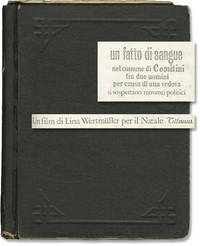
rif. 148341London: Lord Grade 1978. Draft script for the 1978 film here under the working title "Titoli di Testa." Copy belonging to script supervisor Franca Invernizzi with her extensive manuscript annotations on nearly every page and many page versos regarding camera shots takes timing and dialogue. Bound in after the script is an annotated list of scenes and several handwritten pages of Invernizzi's notes. Text in Italian. In 1920s Sicily a capitalist and a socialist vie for the affections of a grief-stricken woman whose husband was killed by a fascist mafioso. The follow-up to director Lina Wertmuller's Oscar-nominated 1976 film "Seven Beauties" and a lyrical formidable film in its own right. Set and shot on location in Sicily. Script: Black faux-leather untitled wrappers. Title page present with credits for director Lina Wertmuller. 326 leaves with last page of text numbered 301. Xerographic duplication rectos only with white undated revision pages throughout. Pages Very Good with some revision pages lightly worn and toned to the edges wrapper Very Good lightly edgeworn with several tape repairs to the spine with perfect binding. List of scenes: 10 leaves with last page numbered 10. Xerographic duplication rectos only. Pages Very Good plus with light edgewear. Lord Grade unknown books
1875rif. 20118New York: J L Mott Iron Works 1875 / 1877. First Editions. The catalog of 1875 is in its original printed limp black cloth gilt stamped publisher's binding; the Supplement is as issued - a printed title wrapper. Both contained within a custom made portfolio with cloth ties. Very good; neatly rebacked; occasional marginal tears; one endpaper with modest chipping at the fore-edge. Folio. 2 132 pp.; Supplement - 8 pp. The catalogs measure appx. 54 x 38 cm. Both are lavishly illustrated throughout; printed on glazed paper. A stunning large format catalog for all kinds of garden ornaments - for public and private use. There are also several pages for stable equipment lamps aquariums garden seating planters etc. Mott was a manufacturer of all kinds of metal goods and plumbing supplies. McKinstry citing only much later printings of smaller catalogs; Romaine p. 258 - citing a much later printing of this garden ornament catalog in the same large format as a "masterpiece". J L Mott Iron Works hardcover books
1883rif. 140940359London: Chapman and Hall 1883. First Edition. Near Fine. First edition first printing of what is widely recognized as one of the first feminist novels. Near Fine with light rubbing to binding pages toned and with occasional instances of light spotting. Finely bound in full black ostrich skin by Sangorski and Sutcliffe mirroring the book's setting on an ostrich farm. At the time of publication the South African ostrich farming industry was rapidly developing to meet a craze for the high demand of ostrich feathers with their weight-price approaching that of gold's. The industry's rise brought about much cruelty and suffering for ostriches and the novel highlights the crossover among the contemporary leading activists of women's rights movement and the champions of animal rights. Published under a male pseudonym of Ralph Iron this was Scheiner's first novel and was met with immediate success. A complex narrative woven around themes of cruelty and restriction set against a colonial backdrop. It's notable for the main female character's handling of themes of love marriage and motherhood while subverting the traditional gender roles female sexuality and intellectual power. Published under a male pseudonym of Ralph Iron this was Scheiner's first novel and was met with immediate success. A complex narrative woven around themes of cruelty and restriction set against a colonial backdrop. It's notable for the main female character's handling of themes of love marriage and motherhood while subverting the traditional gender roles female sexuality and intellectual power. Chapman and Hall unknown books
rif. 156417hardcover. Dediees a Monseigneur le Dauphin par Sontres Humble et tres Obeissant Serviteur et Geographe De Fer. Beautiful double-page engraved title page 4 38 2 60 28pp. This splendid atlas is illustrated with 32 engraved coastal charts including a folding wind chart and a general index chart of France. The double page maps have delicate outline hand coloring. An engraved divisional title page number 26 entitled "Les Costes de la Mer Mediterranee" is the 33rd plate. Short 4to 9.5 x 7.75 inches 17th Century calf well-worn; neatly rebacked; marbled endpapers red edges. Inscription in ink first fly leaf. Paris: Chez le Sr. de Fer dans l'Isle du Palais sur Quay de l'Orloge a la Sphere Royale. Avec Pri. du Roy 1690. Nicolas de Fer 1646-1720 was a prolific cartographer engraver and publisher who took over the family map business from his mother when she retired in 1687. The business flourished and he gained a great reputation in his lifetime and was appointed 'Geographer to the King' in 1690. This original edition the first atlas to bear his name was published in 1690 on the basis of an atlas published in 1634 by order of Cardinal Richelieu by the publisher Tassin who sold his plates in 1644 to Antoine de Fer Nicolas's father. Scarce. unknown books