10 883 résultats
1883réf. 031351New York: G. P. Putnam's Sons 1883. First Edition Thus . No Binding. Fine. Vii 501 Pp. Islington Edition #5 Of 250 Copies With Signature Of Publishers Dated Nov. 5 1883. Never Bound Lacking Covers Pages Securely Held By Cords Etc. Ready For Binding. Pages Fine No Wear No Names Or Marks. G. P. Putnam's Sons unknown
1899réf. 8794East Aurora NY: The Roycrofters 1899. First edition. Hardcover. Very Good Plus. 8 1/2'' x 5 3/4''. 175pp. Body copy set in Old Style Antique. Printed in two colors on Kelmscott handmade paper with initial letters hand drawn. This edition is limited to 970 copies this is copy number 295. Signed by Elbert Hubbard. Bound in full suede with a cover design by W. W. Denslow. The hand-drawn and illumined initial letters were also designed by Denslow. Some spotting to suede covers. Decorated silk paste-downs. The Roycrofters hardcover
1883réf. 181910G P PUTNAMS SONS. Very Good. 1883. Limited Edition. Hardcover. 501 pp; Spine label worn and soiled cloth binding has some minor edge wear at the ends else very nice and clean book block tight and clean a really attractive book Islington edition limited to 275 copies signed by the publisher. ; Signed by Author . G P PUTNAMS SONS hardcover
1911réf. 256155London: J. M. Dent & Sons 1911. Charles E. Brock illustrator. 2 vols. Full green morocco with gilt lettering to spine. Brock Charles E. Charles E. Brock illustrator. 2 vols. J. M. Dent & Sons unknown
1890réf. 248002New York and London: G.P. Putnam's Sons 1890. Part of the Putnam Knickerbocker Nugget series. Ilus. 2 vols. 12mo. Original blue gilt stamped cloth and blure boards. In blue cloth slipcase. Part of the Putnam Knickerbocker Nugget series. Ilus. 2 vols. 12mo. From the library of Sara Delano Roosevelt the mother of FDR with her signature and date of 1891 on top right of both title-pages. Mrs. Roosevelt was a strong-willed woman who took charge of every aspect of raising her only son and she would prove to be a dominating force throughout FDR's life until her death in 1941 just months before the bombing of Pearl Harbor. In the year this book was signed young FDR and his mother began a series of trips to the Rineland spa of Bad Nauheim Germany seeking treatment of his father's ailing heart. G.P. Putnam's Sons unknown
1905réf. 73020New York: G.P. Putnam's Sons 1905. Hardcover. Fine. Reprint. Fine in three-quarter crushed morocco. Signed publisher's binding. Fine. A very attractive volume. G.P. Putnam's Sons hardcover
réf. 046969680X.Ghardcover. Good. Access codes and supplements are not guaranteed with used items. May be an ex-library book. hardcover
réf. B9781169058521New. unknown
réf. B9781016890830Hardback. New. hardcover
réf. 1169058523.Ghardcover. Good. Access codes and supplements are not guaranteed with used items. May be an ex-library book. hardcover
réf. 1016890834.Ghardcover. Good. Access codes and supplements are not guaranteed with used items. May be an ex-library book. hardcover
réf. 042898424X.Ghardcover. Good. Access codes and supplements are not guaranteed with used items. May be an ex-library book. hardcover
réf. 1334432260.Gpaperback. Good. Access codes and supplements are not guaranteed with used items. May be an ex-library book. paperback
réf. 1334900396.Gpaperback. Good. Access codes and supplements are not guaranteed with used items. May be an ex-library book. paperback
réf. 152814662X.Ghardcover. Good. Access codes and supplements are not guaranteed with used items. May be an ex-library book. hardcover
1937réf. 124139New York: Doubleday Doran & Company Inc 1937. First Edition; First Printing. Hardcover. Very Good in boards. Staining on rear panel. Doubleday, Doran & Company , Inc hardcover
réf. 1358238359.Ghardcover. Good. Access codes and supplements are not guaranteed with used items. May be an ex-library book. hardcover
réf. 1024150933.Ghardcover. Good. Access codes and supplements are not guaranteed with used items. May be an ex-library book. hardcover
réf. 1355543509.Ghardcover. Good. Access codes and supplements are not guaranteed with used items. May be an ex-library book. hardcover
1973réf. 3087424The Hague & Paris: Mouton 1973. 210 Seiten. Gr. 8° (22,5-25 cm). Orig.-Leinenband mit goldgeprägtem Rückentitel. [Hardcover / fest gebunden].
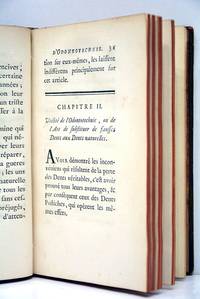
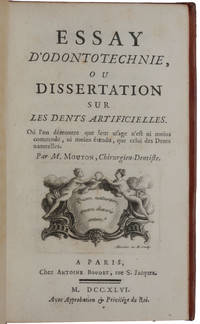
réf. 108521A Paris chez Antoine Boudet 1746. XI. 162 pages. 2 feuillets. 165x105 Cm. Plein veau. Dos à nerfs orné. Tranches rouges. Charnières frottées. Coins et coiffes émoussés. Édition originale rare du premier ouvrage entièrement consacré à la prothèse dentaire jalon essentiel de l'histoire de l'odontologie. Chirurgien-dentiste parisien Claude Mouton développe ici une étude systématique des dents artificielles de leur fabrication de leur mise en place et de leur entretien. L'ouvrage expose les différents procédés de fixation les dentiers à ressort les dents à tenon les transplantations et les replantations dentaires tout en proposant des solutions destinées à restituer la fonction masticatoire aussi bien que l'esthétique du sourire. Il décrit également l'emploi de couronnes d'or parfois revêtues d'émail pour imiter la dent naturelle innovation qui lui vaut une place de premier plan dans l'histoire de la prothèse dentaire. Tampon sur le dernier feuillet. Rousseurs et taches éparses. A Paris, chez Antoine Boudet, 1746. unknown
1746réf. 5166Paris: Antoine Boudet 1746. First edition. First edition rare on the market of "the first specialized book on dental prosthetics" G & M and perhaps the first contribution to what would later be called "cosmetic dentistry." Mouton introduced the use of gold crowns which he enamelled to give them the same appearance as natural teeth. He was the first to speak of artificial teeth fixed to the natural teeth adjoining them by means of springs or clasps. He was also the first to describe successful transplants procedures which gave him great renown not only in France but also in England. . THE FIRST SPECIALIZED BOOK ON DENTAL PROSTHETICS. First edition rare on the market of "the first specialized book on dental prosthetics" G & M and perhaps the first contribution to what would later be called "cosmetic dentistry." "Mouton in 1746 . gave to the light a monograph the first extant on mechanical dentistry. The methods of this author for the most part do not differ from those of Fauchard nevertheless one finds several important innovations in his work. To prevent the further deterioration of teeth already much destroyed and to preserve them some time longer Mouton had recourse to the application of "calottes d'or" that is gold crowns. He used this for the front teeth as well as for the molars but in the former case he had them enamelled to give them the same appearance as natural teeth. Mouton also invented a new method of applying artificial teeth. Up to then the ordinary method had been that of fixing them to the natural teeth by means of threads passed through holes made in the artificial teeth expressly for that purpose. Mouton is the first to speak of artificial teeth fixed to the natural teeth adjoining them by means of springs or clasps. This author relates having carried out several transplantations with perfect success a thing that contributed greatly to his renown not only in France but also in England. He distinguished himself besides by the correction of dental irregularities. Lastly it is to be noted that this author frequently had recourse as a remedy against toothache to the stretching of the dental nerve by means of moving and partially raising the tooth subluxation" Guerini pp. 303-4. Mouton cites only Galen Géraudly and Fauchard and those only rarely. ABPC/RBH lists only two complete copies perhaps the same copy in the last 40 years Ketterer Kunst Doerling May 27 2013 lot 490 €2160; ibid. November 16 2009 lot 267 €2196. Little is known about the life of Claude Mouton. "It is beyond any doubt that he was a contemporary of Pierre Fauchard and studied closely his book Le chirurgien dentiste ou traité des dents Paris 1728. Hoffmann-Axthelm reproduces a Parisian list in which Mouton is named as 'Dentiste du Roi' domiciled in Rue d'Orléans S. Honoré in which Fauchard himself and some other renowned dentists such as Bourdet Jourdain Laudumiay or the Calais and Hervieux ladies appear all of them in the 'Experts' category while only three people are recorded as 'Maistres en Chirurgie'. "In 1746 the Essay d'Odontotechnie ou Dissertation sur les dents artificielles was published by Antoine Boudet's press Rue S. Jacques . it is divided into five chapters . This dissertation Mouton confesses was the fruit of several years' experience but the flame that lit the fuse was actually the help requested by a twenty-two-year-old girl who had lost two upper incisors 'that had been irretrievably undermined by cavities as a result of childbirth.' Though reluctant she was persuaded by one of her friends to accept the presence of strange teeth in her mouth. Mouton made her see the disadvantages of the lack of these teeth and the advantages of replacing them by a skillful hand. The success and uniqueness of the case encouraged Mouton to publish an account of the treatment addressed to the public with a double message: to promote the care of natural teeth and to banish prejudices about the use of false teeth. "The first chapter comprised of 30 pages is entitled: 'Of the inconveniences caused by the lack of teeth .' Mouton points out the inconveniences that arise from the loss of teeth such as alterations in pronunciation especially for public speakers; the contraction of the lips in trying to hide the loss of teeth which can end up becoming a repertoire of grimaces; the escape of saliva through the gap created by the missing teeth; the sinking of the lip at the level of the missing teeth especially the upper ones or of the cheek in the case of lateral loss - a defect for which some try to compensate by carrying a kind of ball in their mouths; and finally the lack of teeth can lead to significant digestive disorders as a result of the inability to grind food properly. Having noted these drawbacks the text now focuses on the explanation of the functions of the teeth mainly masticatory and modulating of the voice not forgetting the aesthetic aspect. Finally Mouton discusses the two plagues of the mouth tartar and cavities dealing at length with the effects of the first on the gingiva and resulting dental mobility. "The second chapter 16 pages long is entitled: 'Utility of dentistry or the art of replacing natural teeth with false teeth'. Mouton recalls that false teeth were known to the ancients appearing in the epigrams of the satirical Roman poet Martialis. Nevertheless he concludes that false teeth must be regarded 'as a modern invention': 'There is nothing that ages like the loss of teeth especially in the anterior part hence it is necessary to exercise the art of returning the teeth to their natural state. For this there is nothing better than to replace the missing teeth with false teeth which experience shows fulfill the same duties as long as they are placed by a good dentist who combining manual skill with the necessary knowledge will avoid the many accidents that ignorance causes every day'. "This is one of the author's obsessions: he is a Dentist with a capital letter but to carry out this kid of treatment the dentist must have special knowledge no matter how much he knows about how to perform the other tasks of his profession. The architect of the mouth has to measure combine reason prevent and always plan three objectives: the adornment the comfort and the duration. He closes this chapter by recounting the case of a woman in whom he had placed false teeth - although another dentist had advised her against them she had been wearing them for four years without any problem. "'Answers to all the difficulties that may arise regarding the use of false teeth' is the title of the third chapter comprising 34 pages. In it Mouton refutes each of the assumptions of the common people that sustain the six most frequent prejudices about the use of artificial teeth: that inserting them is a painful operation; that false teeth can harm others; that they must be removed every time you eat; that they become loose; that despite the wearer's cleanliness the mouth exhales an unpleasant smell; and that they don't last long. Later outside of this main group he mentions other inconveniences suggested by the common people such as the different colour of false teeth their reluctance to wear teeth taken from corpses or the shame of appearing with prostheses after losing their own teeth . Mouton uses these concerns to justify the insertion of a post in the root canal taking into account that the nerve has been destroyed by decay - but if there is still some part of what he calls the 'dental chord' nerve vein and artery remaining he says this could be eliminated by adding cinnamon essence or more quickly some caustic with renders the root insensitive. "The fourth chapter must be considered as the 'central' one in Mouton's book - 'Méchanique des dents artificielles' is its title and it covers all types of dental prostheses as well as their composition. Other issues such as transplantation and reimplantation are also considered. A short introduction again emphasizes that the hand of an expert dentist is necessary - not everyone in the trade is capable. "'Dents à tenon' is the first type of prosthesis. They are the most solid teeth their solidity resulting from the use of a small gold post inserted into the root canal; a single such post is capable of supporting more than one tooth. Teeth tied with threads can be used when no roots are available their stability depending largely on the state of the teeth adjacent to the gap. "Single or double spring dentures are complete dentures. Both the upper and lower ones could be joined to the dental remains of the opposing arch to provide them with stability or in when both are used they could be joined together with the same device all before piercing the bone to pass a thread attached to the prosthesis in order to provide it with stability. Although the patient will suffer some discomfort he will become accustomed to it and may learn to eat with it. "Part natural and part false teeth are another type of prosthesis that repair the lingualization of a tooth by applying an enameled sheet on the buccal aspect. "Natural teeth can be transformed into false teeth. When due to the effect of tartar they fall out the root is cut and the tooth reinserted when there is room; this helps patients who are uncomfortable with carrying anything strange in their mouth. "Teeth racks 'Dents à coulisses' are prostheses with a spring on each side to fit them into the ones adjacent to the gap. "Two very different techniques to repair a dental loss are discussed: transplantation and reimplantation. He notes that the first is often regarded even by the most skilled as impossible even for single-rooted teeth or premolars undoubtedly due to the difficulty in finding an alveolar bed with the same characteristics as the root being transplanted. For success it is necessary that locally the external fibers of the alveolus and the root are found and anastomosed and in general that the 'donor' be in good health. Regarding reimplants performed by his hand he proposes to secure the reimplanted tooth to its neighbours with ligatures although this is not always necessary. And he also proposes as had Fauchard to extract a decayed tooth in order to cut the 'nerve connection' and stop the pain plug it - plunge it - and reimplant it. Finally he talks about the matter of artificial teeth sourced from the animal kingdom although human teeth are often preferable. Among these those of the ox are the most used especially when the nerve is ossified. The hippopotamus and other marine animals and fish are also widely used especially for large pieces. An interesting trick is recommended by the author. It involves covering one of the teeth with a gold cap 'une calotte' so that the other teeth do not contact each other and thus the occlusal wear that occurs due to bruxism would be avoided. "'Of the care required by false teeth' is the fifth and last of the chapters 21 pages long. The instructions and advice to keep artificial teeth in optimal condition are the same as for natural teeth: the usual cleaning of the tongue and false teeth and the removal of tartar if it has already been deposited on them. However he also mentions some tools such as toothpicks abd toothbrushes and also talks about toothpastes recommending avoiding the repeated use of coral due to its extraordinary abrasiveness" Sanz freely translated. Crowley Dental Bibliography 774; Garrison & Morton 3672.2; not in Wellcome. Guerini A History of Dentistry 1909. Sanz El primer tratado de prostodoncia: Essay d'Odontotechnie 1746 de Claude Mouton . 12mo 156 x 95 mm pp. xi i 162 4 with engraved title vignette. Contemporary calf spine richly gilt with red lettering-piece very minor wear to extremities. A very fine copy. Antoine Boudet unknown
réf. 1246248301.Gpaperback. Good. Access codes and supplements are not guaranteed with used items. May be an ex-library book. paperback
réf. 100119629Macmillan and co in12. Sans date. Cartonné.
1954réf. RO60070248J. M. Dent & Sons Ltd - E. P. Dutton & Co.. 1954. In-12. Relié. Bon état, Couv. convenable, Dos satisfaisant, Intérieur frais. 332 pages. Titre doré sur le dos. Annotations en page de garde. Annotations au crayon dans le texte.. . . . Classification Dewey : 420-Langue anglaise. Anglo-saxon