21 893 résultats
réf. 202000467Paris, Gallimard - collection 1000 soleils, 1986 ; in-8, 164 pp., cartonnage de l'éditeur. Très bon état avec sa jaquette.
1931réf. 117581931 P., Les Editions G. Crès et Cie, 1931, 1 vol. in-8 (198 x 145) broché sous couverture rempliée crème imprimée en noir bleuté, de 175 pp. + table et achevé d'imprimer. Rousseurs éparses, en l'état.
réf. 201316420Paris, La renaissance du livre, 2002 ; in-4, 183 pp., cartonnage de l'éditeur. Avec jaquette dédicacé.
réf. 35601416, Paris, Textes et Prétextes, 1939; grand in-8 carré, demi-chagrin rouge, dos lisse, titre dor., couv. ill. et dos en vélin parcheminé conservés, tête dor. (Reliure de l'époque). "PREMIER TIRAGE. 50 bois originaux tirés en camaïeu d'après les compositions de J.G. Daragnès. "" L'émotion, Daragnès la fait sentir, palpiter dans tout ce qu'il interprète. N'en est-il pas de plus cruellement déchirante que celle qui se dégage…de Poil de Carotte? Daragnès nous montre la chétive silhouette du pauvre enfant à la tailler malingre, au visage souffreteux, comme buté dans un silence morne et craintif"". (Mornand, Artistes du Livre 1948). Exemplaire numéroté sur papier Lafuma."
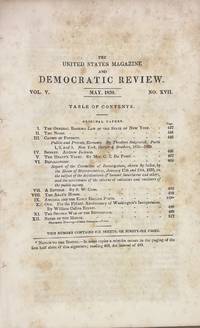
1839réf. 3335Washington D.C.: Langtree & O'Sullivan 1839. First edition. Light foxing throughout. Otherwise in very good condition. First edition. 3 428–520. One of the earliest American reports on the photographic innovations by Daguerre and Talbot. This significant issue of Democratic Review includes one of the earliest American accounts of the pioneering discoveries in photography by Louis Daguerre and William Henry Fox Talbot. The article "Photogenic Drawing" pp. 517–520 offers a detailed overview of Daguerre's daguerreotype process highlighting images such as a view of Paris from the Pont des Arts a crouching Venus statue and a spider magnified under a microscope. However except for the Venus photograph the other images mentioned are now lost. The section on Daguerre draws from Henri Gaucheraud's article published on January 6 1839 in La Gazette de France and Samuel F. B. Morse's report "The Daguerrotipe" from The New-York Observer April 20 1839. The article also covers Talbot's photogenic drawing referencing his "Account of the Processes employed in Photogenic Drawing" presented to The Royal Society in February 1839 and published in The Literary Gazette. This publication captures a critical moment in the early history of photography and its introduction to the American public. . Langtree & O'Sullivan unknown
2002réf. 15339La côte de l’amateur 2002 In-4 relié 27,5 cm. Bon état d’occasion.
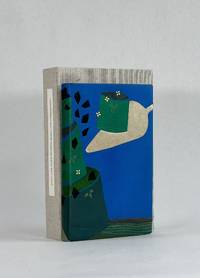
réf. 9573Monterey KY: Larkspur Press 2006. Full Leather. Fine binding. Octavo. 4 36 4 pp. Limited edition number 9 of 75 copies on Somerset Book paper there was also an edition of 500 regular copies. Signed by Wendell Berry at the colophon; additionally noted by Fox the year it was bound. In full goatskin binding with a series of leather onlays tooled in gold and blind all creating a fantastic pictorial binding. Accompanying the binding is a fine paper portfolio with publisher's prospectuses samples and associated material; additionally some templates related to Fox's binding. All housed a custom clamshell by Fox. The text offers a lens into the 19th century view of how a native of region assesses the value of the natural wonders. Berry's commentary at the end of Allen's text brings the troubling viewpoint into a modern context: "The chapter is built upon a division of mind which in our time has become terrifying but which Allen believed to be no more than a simple equation. On the one hand in a sentimentally romantic fashion he was sensitive to the natural life of the area which was then still intact. And on the other hand he seems eager for the destruction of this virgin bounty that so inspired him. I say 'the destruction' and not 'the use' for his language is patently that of an exploiter intent upon 'conquering' nature." A sobering volume that will most surely always remain relevant. Larkspur Press unknown
réf. 201317116Paris, Club 10 15, 1965 ; in-8, 251 pp., cartonnage de l'éditeur. Ouvrage en bon état.
réf. 34113Lausanne, André Gonin, 1953. Gr. in-4°, 208p. en feuilles, sous jaquettes illustrée rempliées, et double chemise et étui.
réf. 200806116Paris, Philippe Lebaud, 1985 ; in-8, 250 pp., broché, couverture illustr. Croyances et recherches sur la vie après la mort.
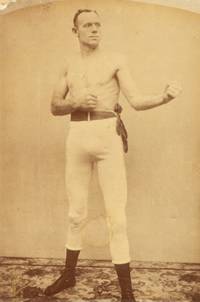
réf. 27343Albumen print photograph cabinet card format 162 x 106 mm mount; the print is embossed at lower left 'Copyright 1893 Richard K. Fox'; removed from an old frame the print and mount have suffered some surface loss around the edges particularly at the bottom margin where Fox's imprint with his Franklin Square New York address has been partially lost; peripheral damage notwithstanding the albumen print remains a strong image with excellent clarity and aside from a small pale water stain around the boxer's knees is in good condition; verso has remnants of old paper backing with early pencilled inscription 'B. Simmons' sic. A rare photograph of Bob Fitzsimmons 1863–1917 generally acknowledged as one of the greatest boxers in the history of the sport. Fitzsimmons was born in England but emigrated with his family to New Zealand as a young boy and spent his teenage years in Timaru. In 1883 at the age of 20 he moved to Sydney New South Wales where he learned his craft and fought his first 27 fights over seven years before heading to America in 1890. During his incredible 24-year career in the States Fitzsimmons enjoyed immense success: he knocked out Jack Dempsey to win the world middleweight championship and later won the world heavyweight title by knocking out Gentleman Jim Corbett. This cabinet card was published in New York in 1893 by Irish-born media magnate Richard Kyle Fox 1846-1922 owner of the sporting publication The Police Gazette. Fox was a boxing fanatic and generous patron of the sport. Trove locates only three photographs of Fitzsimmons all held in the National Library of Australia. From ADB: 'Robert Fitzsimmons 1863-1917 professional boxer and sometime actor was born on 26 May 1863 at Helston Cornwall England twelfth child of James Fitzsimmons policeman but formerly an Irish soldier and his wife Jane née Strongman of Truro. The Fitzsimmons family migrated to Timaru New Zealand in 1872 where James became a veterinary shoeing-smith. Robert and an older brother became blacksmiths. Bob Fitzsimmons was boxing with bare knuckles as an amateur at 15. He first drew attention by knocking out four opponents in one afternoon in an 1880 Timaru tournament staged by Jem Mace the visiting British ring hero. In 1883 he went to Sydney seeking the tutelage of Larry Foley. He enjoyed some success there as a pugilist but mainly supported himself as a blacksmith. On 14 October 1885 he married an English girl Louisa Johns; of their three children a son survived. In eight years in Sydney Fitzsimmons boxed 27 times for 16 wins 4 losses and 7 no-decision bouts. On 12 February 1890 he was knocked out in four rounds by Jim Hall contesting the Australian middleweight championship but had knocked out Hall in one round two days earlier. There is some suggestion that these two results were prearranged. Leaving Sydney for San Francisco United States of America on 16 April 1890 Fitzsimmons won three fights within two months. On 14 January next year at New Orleans he knocked out Jack Dempsey 'The Nonpareil' in fourteen rounds to win the world middleweight championship. His greatest success came on 17 March 1897 at Carson City Nevada when he knocked out James Gentleman Jim Corbett in the fourteenth round with his 'solar plexus punch' to gain the heavyweight championship of the world. Two bouts and two years later he lost this title by knockout to James J. Jeffries and lost a return bout in 1902. A twenty rounds points decision over George Gardner at San Francisco on 25 November 1903 won him the newly recognized world light heavyweight championship which he lost to Jack O'Brien at Philadelphia in 1905. His last championship contest was for the Australian heavyweight title on 27 December 1909 in Sydney where he was knocked out by Bill Lang. He had a further two no-decision bouts in Pennsylvania in 1914 aged 50. In a professional career extending from 1881 to 1914 Fitzsimmons had 81 bouts for 53 wins 11 losses 1 draw 12 no-decisions and 4 exhibitions. His feat winning world titles in three divisions has been equalled only once by Henry Armstrong some forty years later. While powerful in the shoulders and arms Fitzsimmons weighed only 160 lbs. 72 kg was spindly-legged pale and freckled and balding—he was sometimes known as 'Ruby Robert' or the 'Freckled Freak'. In 1893 Fitzsimmons was divorced from his wife and on 24 July at San Francisco married his manager's sister Rose Julian an Australian acrobat who bore him two sons and a daughter. On Rose's death in 1903 he married on 24 July a young actress Julia May Gifford also at San Francisco. They were divorced in 1915 and on 16 March at Newark New Jersey Fitzsimmons wed another actress Temo Ziller of Portland. Like most heavyweight champions of his time Fitzsimmons capitalized on his fame and appeared in several stage plays. His book Physical Culture and Self-Defence Philadelphia was first published in 1901. In the final months of his life he became an evangelist. He died of pneumonia at Chicago on 22 October 1917. Born in Cornwall raised in New Zealand but serving his boxing apprenticeship in Sydney Fitzsimmons is claimed as a British New Zealand or even Australian champion. However before winning a world title he became an American citizen.' unknown
2017réf. 31383Baltimore: Flying Fox Press 2017. Paperback. Fine. Paperback. 1 of 25 copies initialed and numbered by the artist. Linocut of an imaginary serpent-bird printed archivally in dark green ink on tan paper. Printed at PaperBase with Sarah Robbins. Thirty-seven additional copies were printed for the Guild of Book Workers "Bird in Hand" annual collaborative project. Ten percent of each sale will be donated to Bat Conservation International. Size: 8 x 8 inches. PRI/090117. Flying Fox Press paperback books
réf. 202500206Grenoble, Glenat, 1997 ; in-4, 48 pp., cartonnage de l'éditeur. EO tome 6 DL mai 97.
réf. 202500205Grenoble, Glenat, 1993 ; in-4, 50 pp., cartonnage de l'éditeur. EO tome 3 : sans DL ni IMP c 1993.
réf. 202500204Grenoble, Glenat, 1994 ; in-4, 48 pp., cartonnage de l'éditeur. EO tome 4 DL oct 94.
réf. 202500203Grenoble, Glenat, 1996 ; in-4, 50 pp., cartonnage de l'éditeur. EO tome 5 DL mars 96.
réf. 202500195Grenoble, Glenat, 1992 ; in-4, 48 pp., cartonnage de l'éditeur. EO tome 2 ( X92 au 2è plat ) DL sept 92.
réf. 202500194Grenoble, Glenat, 1991 ; in-4, 48 pp., cartonnage de l'éditeur. EO tome 1 (X91 au 2è plat).
réf. 201118852Paris, Glénat, 1994 ; in-4, 47 pp., cartonnage de l'éditeur. EO tome 4 : petit enfoncement sur le rebord du 1 & 4 plat et haut du dos , coter 15 euros mais vendu 10.
réf. 201118851Paris, Glénat, 1993 ; in-4, 48 pp., cartonnage de l'éditeur. EO tome 3.
réf. 201118850Paris, Glénat, 1996 ; in-4, 49 pp., cartonnage de l'éditeur. EO tome 5.
réf. 200914950Grenoble, Glénat, 1996 ; in-4, 49 pp., cartonnage de l'éditeur. Eo tome 5 version en nerderlande.
réf. 200914949Paris, Glénat, 1996 ; in-4, 49 pp., cartonnage de l'éditeur. Eo scotch noir sur le 4 plat sur l'emplacement de l'étiquette restauration coter 25 vendu 15.
1919réf. M12935London:: Macmillan 1919. 1919. 8vo. xxiv 434 pp. Frontis. plates index. Original blind and gilt-stamped navy cloth; spine a bit dulled but a very good copy. Macmillan, 1919. hardcover books
1854réf. 15934np 1854. Stitched caption title as issued. 13 3 blanks pp. Untrimmed and partly uncut foxed Good. The heirs of Caleb Lucas of Lincoln County claim that the executor of his estate Fielding Kenley looted the estate and deprived "his poor and needy relatives" of their inheritance. The brief demonstrates that Kenley forged and falsified documents that appeared to show Lucas's indebtedness to Kenley who then fraudulently distributed estate funds to himself. Not in the standard references. unknown