CHEVALLivre Rare Book
Races chevalines de France.
réf. 18782(1890).

Hugues de Latude · Villefranche de Lauragais, France3 000,00 €
3 062 résultats
1964réf. c230726k022xbvk(Tokyo, probably before 1964; some of them were reprinted in the Olympic-Committee's official Book for the 1964 Olympic Games in Tokyo). 59 sheets of thin untrimmed Japan-paper ('Washi', ca. 32 x 23 cm), each with black-ink brushwork (some vertical, some horizontal) in Toki's famous pictographic manner, most of them monogrammed by the artist; loosely tipped-on slightly larger thin white cardboards (ca. 38 x 26 cm), often as folded double-sheets (unfolded ca. 38 x 52 cm).
réf. 18782(1890).
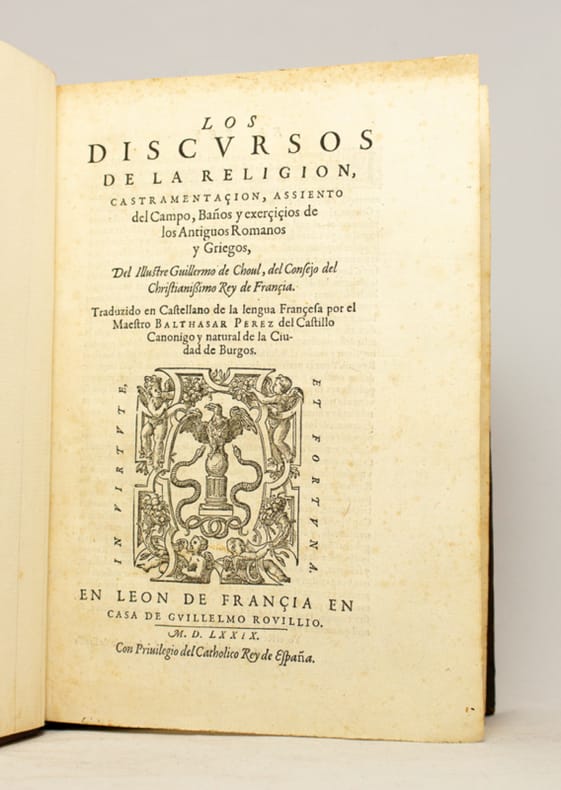
1579réf. 16568En Leon de Françia, en casa de Guillelmo de Rovillio, 1579. In-4 de [8]-488-[44] pages (dernier ff. blanc) [*4;A-Z4; Aa-Zz4; AA-TT4; VV6], pleine basane brune, dos à nerfs orné de filets et fleurons dorés, tranches mouchetées. Reliure du XVIIe siècle.
Seconde Edition. Un volume de format in folio (42x28cm) de 4ff. (titre, dédicace, préface), 318 pp.; 6ff. (tables des chapitres et articles, privilège...). Ouvrage illustré d'un frontispice et de 5 bandeaux de Parrocel; de 24 planches hors texte dont certaines dépliantes par Parrocel ou Coquart pour les planches techniques, le tout gravé sur cuivre. Reliure début 19ème; pleine basane brune, dos à nerfs orné; décor doré, titre doré. Tranches rouges. Epidermures sur les plats; coupes frottées; coins usés. Ouvrage bien relié. Quelques pâles et rares rousseurs dans le texte. Exemplaire en bonne condition. Ex-libris de H. Vieillard, porcelainiers à Bordeaux.
réf. 0590-Bo.J. Kreidelithographie, auf festem cremefarbenem Velin. Darstellungsgröße 32,5:40,3 cm, Blattgröße 41,5:54,5 cm. Literatur: Delteil 92, I (von III). Mit der Adresse von Villain. - Vorzüglicher Abdruck, vollrandig, etwas stockfleckig.
réf. 38730Nuremberg, Wolfgang Moritz Endtern, 1703. In-4°, [24]-223-[5]pages Reliure plein veau d'époque, dos muet à nerfs, avec attaches en soie verte.
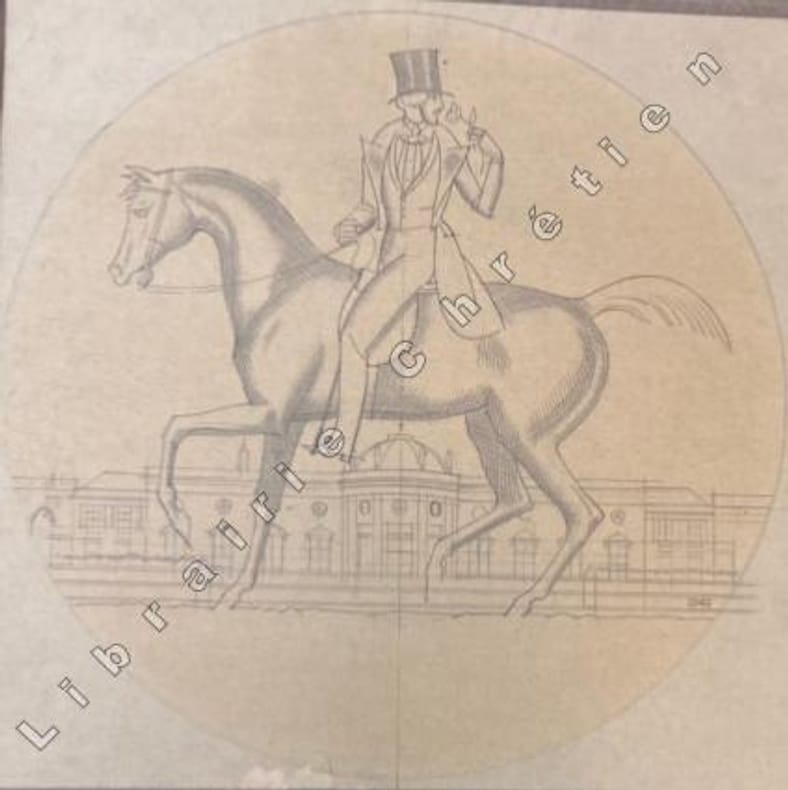
1920réf. 91841920 1 Mine de plomb sur calque contrecollé sur papier, monogrammé en bas à droite, (ca 1920), encadrée.
1646réf. 0054021646 Paris, Charles Du Mesnil, 1646. Trois parties reliées en un volume in-folio (250 X 383 mm) basane brune, encadrement de double filet à froid sur les plats, dos à six nerfs ornés d'une roulette dorée, caissons ornés de fers et fleuron central dorés, titre doré, tranches mouchetées en noir (Reliure de l'époque) ; titre illustré, (2) ff. de dédicace et stances, 23 pages d'"Avis du Sieur de La Broue", 177 pages - 178 pages (dont titre), (1) f. de table - (4) ff. dont titre, 5-105 pages, (3) pages de table et privilège. Dos de la reliure moderne, quelques feuillets uniformément brunis et quelques petites taches brunes dans le corps d'ouvrage.
A Amsterdam, chez Jean Schipper, 1666. Par Messire Antoine de PLUVINEL, son Sous-Gouverneur, Conseiller en son Conseil d'Estat, Chambellan ordinaire, et son Escuyer principal. Lequel respondant a sa Majesté, luy faict remarquer l'excellence de sa Methode, pour réduire les chevaux en peu de temps a l'obeyssance des justes proportions de tous les plus beaux airs et maneiges. Le tout enrichy de grandes figures en taille douce, représentant les vrayes et naïsves actions des hommes et des chevaux en tous les airs, et maneiges, courses de bague, rompre en lice au Quintan, et combattre a l'Espée : ensemble les figures des brides, les plus nécessaires a cet usage, desseignées et gravées par Crispian de Pas. Avec privilège du Roy Très-Chrestien. In-folio demi-basane rouge à coins, dos à 4 nerfs très orné de fleurons dorés. Page de titre, au dos extraict du Privilège du Roy donné à Cristian de Pas le 12 May 1625 et signé Perrochel, deuxième titre dans un superbe encadrement allégorique gravé à pleine page et daté de 1668 + deux pages pour la dédicace au Roy de René de Menou (il manque une page à cette dédicace portant les 12 lignes de la fin du texte signé René de Menou, Charnizay) + 160 pages pour le texte sous forme d'entretien (Le Roy, Pluvinel, Monsieur de Termes, Monsieur Le Grand). Le texte est divisé en deux parties (pages 1 à 57 et pages 58 à 160) chacune débutant par une grande lettrine. S'en suivent 54 planches dépliantes légendées. Les deux dernières représentant des mors portent deux planches chacune. 1 planche de mors semble manquer dans cet exemplaire. Soit un total de 56 sur 58 planches. Les noms des personnages représentés sont cités, les lieux également ( Le Roy, Pluvinel, Mrs. Duc de Bellegarde, Maréchal de Soure, Mrs. du Pre, de Potrincourt, de Belleville, de Soissons, de Patrin, Le Gres, de Fiat, de Benja, de Bellou, d'Harcourt etc. La reliure est un peu frottée avec accroc en haut du dos, on peut signaler quelques rares rousseurs et restaurations du temps sans aucune gravité, l'exemplaire est grand de marges. Antoine de PLUVINEL (1552-1660) : 1er Ecuyer du Roi CHARLES IX, dirige la plus grande Académie équestre de France, aura en charge l'éducation équestre du jeune LOUIS XIII, d'où cet ouvrage. CRISPIAN DE PAS, le Jeune : Graveur Flamand, illustre superbement cet ouvrage. René de MENOU de CHARNIZAY, ami de PLUVINEL, passionné d'équitation, pris en charge cette édition posthume en lui donnant ce titre.
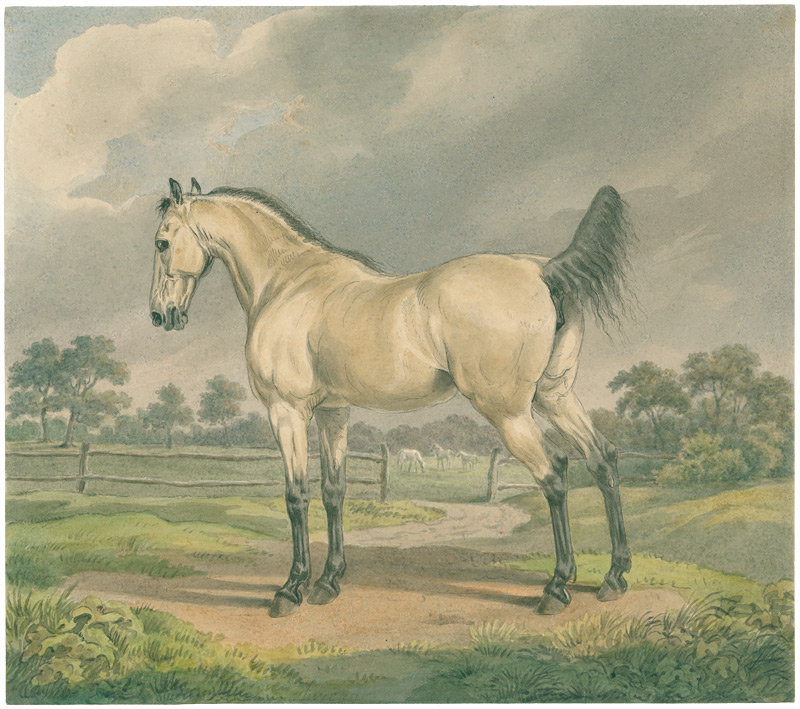
réf. 051-Eo.J. Aquarell und Feder in Schwarz, auf cremefarbenem Velin, verso signiert ?Albrecht Adam?. 20,2:23,2 cm. Verso an den Rändern Reste einer alten Verklebung.
1903réf. F6LCZ7CDMSG7Poissy: Charles Robin 1903. Framed 105 x 205 cm. Large hand-coloured four-sheet plan 90 x 170 cm as assembled. Drawn in pen and ink graphite and watercolour on paper mounted on canvas. Large manuscript plan beautifully drawn in ink and watercolour: a unique witness to Vanderbilt's passion and ambitions. A member of one of America's wealthiest and most prominent families William Kissam Vanderbilt 1849-1920 managed railroads and bred horses. He was one of the founders of The Jockey Club and the owner of a successful racing stable. In 1896 he built the American Horse Exchange at 50th Street Manhattan. In World War II the United States liberty ship SS William K. Vanderbilt was named in his honour.The present impressive manuscript plan represents the horse-racing stable and track at the chateau which Vanderbilt built in 1906 with the help of Henri Guillaume and Pierre Sardou architects. The hippodrome comprised three oval tracks the outer of which was 2400 metres as well as a straight track. A long wall separated the racing areas from the Chateau St. Louis where the Vanderbilts lived called the Chemin Plat now known as Avenue Vanderbilt. When World War I started the racing stables were shut down and eventually sold. Ch[arles] Robin, unknown
1788réf. H47D4T46464Q1788. Amassed over the last fifty years and covering four centuries of relevant material the present collection spans all aspects of the history and development of the breeding of Arabian horses. It comprises within itself many books from the Le Vivier collection: fine press books of racing and thoroughbred literature produced by Eugene Connett's famous Derrydale press as well as numerous important items from the library of Duke Maximilian in Bavaria 1808-88 himself a great enthusiast of Arabic horses. Including items of exceptional rarity such as the rare beautifully illustrated first German edition of Friedrich von Eisenberg's famous riding school 1747 which lauds Arabian horses as "the finest produced by the Orient". Also we here find the early Arabian Horse Registry of America Stud Books and many items also bear presentation inscriptions from the authors Carl Raswan Gladys Brown Edwards etc. The common practice in such a specialized field most of the publications here were issued for a very limited circulation in runs of 1000 or fewer individually-numbered copies. As a reference library for breeding the collection is unparalleled: almost any Arabian horse's forefathers will be found amongst the exhaustive stud books and breeding serials from the 18th to the 20th century from Australia Poland Spain Russia the USA etc. often with accompanying photographs. Perhaps the most famous reference work is the Raswan Index of which only 380 copies were printed and many destroyed by a flood. Raswan became an expert on the Arabian breed through his lengthy trips to the desert where he lived with the Bedouins and learned their language and customs. Several scarce early 20th century works also testify to the Western fascination with the Bedouin and desert roots of the Arabian horse: Homer Davenport's My Quest of the Arabian Horse 1909 and Raswan's The Black Tents of Arabia: My Life Amongst the Bedouins 1935. Alongside modern surveys of the key centres of horse-breeding in the Arab world the early Western classics are also found here in their scarce first editions. French and German authors are also well-represented including the text and first French translation of the Hilyat al-fursân wa-shi'âr ash-shuj'ân an abridgement of Ibn Hudhail's horse treatise prepared around 1400. Finally the owner's collection of notable catalogues and magazines paints a fascinating composite picture of the evolution and heyday of Arabian horse-breeding in the Arab world Poland America and the United Kingdom. Also contained in this magnificent collection are the classic reference works on Arabian and Anglo-Arabian racehorses and their breeding. These standard works and encompassing sets of specialised thoroughbred literature include not only the indispensable guides to horse pedigrees the Racing Calendar General Stud Book Spanish American and Australian Stud Books Bloodstock Breeders' Review and Prior's Register of Thoroughbred Stallions in near-complete runs stretching back as far as the 18th century but also British and international horseracing history and several volumes of exquisite coloured plates. The size and comprehensiveness of the present collection cannot be overstated; it is safe to say that it represents the largest private collection of its kind which has come up for sale in recent decades. Many of the items found here can be located in just a handful of public institutions worldwide. Such items come into the market so rarely and have recently like the Raswan Index and the AHRA Stud Books commanded prices of five figures that it would be impossible to build a comparable collection item-by-item; the volumes here represent a lifetime of serious dedication to the task. Yet the value of such a collection lies not simply in its impressive number of important publications but in the vast amount of practical knowledge contained within. As the introduction to one manual expresses it "The horses shown and described form the foundation ancestry of a major number of breeding programs being propagated today. They appear in every area of endeavour. Yet pictures and facts are not easy to obtain. A knowledge of what has been and is what proved successful and what endured is pertinent to the maintenance of type and quality in the Arabian. Whatever your chosen bloodline this is a worthy study."Illustrated catalogue available upon request. unknown