Horse Capture, Joseph DBiblio.com

3 174 résultats
2001réf. DADAX0816639477Brand: National Museum of American Indian 2001-03-29. First Edition. paperback. New. 8.25x0.50x11.50. Buy with confidence. Excellent Customer Service & Return policy. Brand: National Museum of American Indian paperback
2008réf. DADAX0979866502Brand: The Cookbook Marketplace 2008-06-10. Spi. hardcover. New. 8.50x1.25x9.50. Buy with confidence. Excellent Customer Service & Return policy. Brand: The Cookbook Marketplace hardcover
1996réf. DADAX1569712107Dark Horse Books 1996-10-15. paperback. New. 6.75x0.50x10.50. Buy with confidence. Excellent Customer Service & Return policy. Dark Horse Books paperback
2007réf. SONG0759110948AltaMira Press 2007-08-13. Text is Free of Markings. hardcover. Used: Good. 6.27x1.08x9.27. Buy with confidence. Excellent Customer Service & Return policy. AltaMira Press hardcover
2004réf. SONG1593071884Dark Horse Books 2004-03-16. 1. paperback. Used: Good. 8.75x0.50x11.50. Buy with confidence. Excellent Customer Service & Return policy. Dark Horse Books paperback
1990réf. SONG1569711658Dark Horse Books 1990-09-11. Gph. paperback. Used: Good. 7.50x0.25x10.50. Buy with confidence. Excellent Customer Service & Return policy. Dark Horse Books paperback
2010réf. DADAX116495315XKessinger Publishing 2010-09-10. paperback. New. 9.02x1.17x6.00. Buy with confidence. Excellent Customer Service & Return policy. Kessinger Publishing paperback
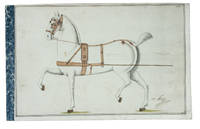
1800réf. F6DFHL01U79OVienna 1800. Oblong small folio 23.5 x 37 cm and 25.5 x 39.5 cm. Volume 1 stab-sewn volume 2 with the leaves mounted on stubs and sewn through the folds each with blue shell-marbled paper wrapped around the spine. In an early 19th-century half tanned sheepskin box in the form of a book Stormont marbled sides metal hook-clasps. With 67 pen-and-ink watercolour and gouache drawings of horses plus stubs of 5 more numbered 1-54 and 75-87 including 1 folding most highlighted with silver and gold all signed each within a black ruled border most trimmed and mounted on blank leaves ca. 1805. With 2 etchings added at the end of volume 1 executed by Friedrich Leopold Bürde and dated 1812. 2 volumes. Unique harness maker's colour-drawn sample book with each drawing depicting a horse in elaborate carriage horse tack. The drawings were executed by Michael Fölsch himself one of the foremost Viennese makers and sellers of luxury tack in the early 19th century to show prospective clients possible designs for their carriage horses. Each drawing is signed by Fölsch as artist. His talent for draughtsmanship and colouring was hitherto unknown and is remarkable for a leather craftsman who probably never received training as a painter. The variety and complexity of the designs and the use of gold and silver is impressive suggesting that such bespoke equipment was intended for the wealthy elite.From the equestrian library of the Imperial stable master Franz Wenzel Schleichart von Wiesenthal ca. 1730-post 1800 with his engraved armorial bookplate upside down on the back of the box. He was a leading figure in a great dynasty of stable masters and horse breakers. Thereafter in the collection of Franz Josef II Fürst von und zu Liechtenstein 1906-1989.With only stubs for 5 of what would have been 72 leaves. A few leaves had torn or nearly torn before they were mounted ca. 1805 but most are in very good condition and the mounting has preserved and protected those that had been damaged. The drawings were clearly made for daily use and show occasional dirt small stains spots or other minor blemishes. ABE CAT Art History ART ARCHITECTURE & PHOTOGRAPHY AUTOGRAPHS DOCUMENTS & MANUSCRIPTS DRAWINGS PRINTS & WATERCOLOURS HORSES HUNTING SPORTS & GAMES Art & Art History Drawings & Watercolours Horses & Horsemanship Manuscripts & Documents hardcover
2013réf. G1616552581I3N00Dark Horse Comics 2013. Hardcover. Good. Pages can have notes/highlighting. Spine may show signs of wear. ~ ThriftBooks: Read More Spend Less.Dust jacket quality is not guaranteed. Dark Horse Comics hardcover
1890réf. 143511890. Gülmez Frères hand-colored photograph of the Sultan's Arabian horse nineteenth century documents Ottoman court ceremonial culture through an imperial horse its elaborate tack and two uniformed attendants in Constantinople. The photographer's stamp identifies Gülmez Frères as "Photographes de S.M.I. le Sultan" recording the studio's connection to the Ottoman court. The photograph also places the group at the Pera Palace Hotel linking an image of imperial service and display with one of Constantinople's best-known late Ottoman hotels. Original nineteenth-century hand-colored photograph image size 7.6 x 9.7 inches. A white horse stands in profile wearing an embellished red and gold saddle and appointments. Its groom wears a corresponding red and gold uniform and holds the horse at its head; beside him stands an aide-de-camp in a green uniform with a sheathed sword. Behind the group a broad carpeted stone staircase decorated with Arabic motifs rises to the open doors of the Pera Palace Hotel. The hand coloring emphasizes the red gold and green of the uniforms and equestrian equipment against the pale horse and masonry. Photographer's stamp on verso reads: "Photographie Apollon. Gulmez Feres Photographes de S.M.I. le Sultan. Succursale vis-a-vis le Pera Palace Hotel. Constantinoples." The photograph preserves specific evidence of late Ottoman equestrian display court dress and the presentation of an imperial horse while the Gülmez Frères stamp identifies both the photographers' claimed court appointment and their branch opposite the Pera Palace Hotel. The combination of hand coloring elaborate saddle equipment uniformed groom and aide-de-camp and identifiable Constantinople setting gives unusually detailed visual documentation of the ceremonial presentation of a horse belonging to the Sultan. Sharp image with hand coloring remaining distinct. Overall very good condition. unknown
1920réf. 144981920. Archive of thirteen photographs ca. 1920s records Russian military officers participating in horse racing and mounted equestrian activity on a circular racetrack. The sequence preserves views of uniformed riders on horseback and documents the place of horsemanship and organized riding within Russian military sporting culture during the early twentieth century. Thirteen vintage photographs each approximately 3.2 x 2.3 inches formerly or currently part of an album. The images show military officers riding horses around a circular track with multiple riders appearing in the racing ground. The officers wear Russian military dress identified in the supplied information as typical of the 1920s. No regiment individual rider precise location photographer or exact date is identified. The photographs record equestrian activity during a period when mounted service remained closely associated with military training and cavalry traditions despite the increasing mechanization of warfare. Their value lies particularly in the sequence of thirteen related views which provides repeated visual evidence of riders horses uniforms and the physical arrangement of the racetrack rather than a single isolated scene. Condition not stated in the supplied description. A compact photographic record of Russian military horsemanship and organized equestrian sport during the early twentieth century. unknown
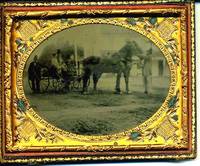
1850réf. 99561850. Horse and carriage ambrotype circa 1850-1859 documents mid-19th century American civilian transportation and rural social life during the decade immediately preceding and encompassing the early Civil War period. The image holds research value for the study of early photographic practice particularly outdoor ambrotype production as well as material culture relating to horse-drawn mobility family presentation and dress in pre-industrial and wartime America. Ambrotypes were typically produced in controlled studio environments due to technical limitations; the presence of an outdoor composition situates this image within a less common subset of early American photography. Quarter plate ambrotype photograph showing a family seated within a horse-drawn carriage accompanied by two large horses with an adult man standing at the front holding the animals. The man wears a broad-brimmed hat consistent with mid-19th century rural or frontier attire. The group is positioned outdoors likely on unpaved ground with no visible studio backdrop emphasizing natural light exposure. The composition centers the carriage and team with human figures arranged to present both transport and family unit simultaneously. The photograph is housed in its original leather presentation case with red velvet interior lining and a decorative copper mat framing the image. The ambrotype process a glass-based photographic technique introduced in the early 1850s produces a unique non-reproducible positive image distinguishing it from later paper-based photographic formats such as cartes de visite. Ambrotypes emerged during a transitional period in photographic history bridging earlier daguerreotype practices and the rise of reproducible paper photography. By the late 1850s and into the Civil War era photographic documentation expanded alongside technological shifts yet outdoor images remained comparatively uncommon due to exposure constraints and equipment limitations. This image contributes to the visual record of civilian life during a period often dominated by military imagery offering insight into transportation clothing and social presentation outside formal studio settings. Light wear to case exterior minor rubbing at edges; interior velvet intact with moderate compression; glass plate and mat remain well-preserved with clear image visibility. Overall very good condition. unknown
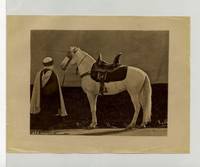
1880réf. 145821880. Colonial Era Vintage original albumen photograph of a Bedouin holding a white horse published circa 1880. Image size: 7" x 9." In this image we can see a Bedouin horseman traditionally dressed in a thoab and kufiyya with igaal. The warrior is approaching his horse from the front. His majestic white steed stands saddled and alert. Overall in very good condition. unknown
1849réf. 144711849. D'Orbigny Charles ed. Dictionnaire Universel d'Histoire Naturelle 1849. Original hand-colored illustration of an Arabian horse published in one of the major French natural history encyclopedias of the nineteenth century. The Arabian horse developed over centuries of selective breeding on the Arabian Peninsula was renowned for its endurance agility and importance in transportation warfare and regional horse breeding. By the nineteenth century Arabian horses had also attracted considerable attention among European naturalists and breeders who studied their physical characteristics and influence on European bloodlines. The illustration belongs to this period of increasing scientific classification and documentation of domestic animal breeds. D'Orbigny Charles ed. Dictionnaire Universel d'Histoire Naturelle. Paris 1849. Original hand-colored lithograph from the illustrated natural history encyclopedia edited by French naturalist Charles d'Orbigny 1806-1876. First-edition publication. Sheet measures approximately 9.5" x 6". The illustration depicts a standing Arabian horse in shades of tan and brown its head turned slightly toward the viewer against a sparsely rendered desert landscape. The horse's upright stance alert expression and carefully delineated musculature emphasize its physical characteristics. Hand coloring distinguishes the variations in the animal's coat and the surrounding terrain. D'Orbigny's Dictionnaire Universel d'Histoire Naturelle was published in multiple volumes during the 1830s and 1840s bringing together contemporary zoological botanical geological and other natural history scholarship. Its illustrated plates accompanied descriptions of animal species and breeds providing visual references for nineteenth-century French natural history education. The Arabian horse illustration records the breed as presented in European scientific publishing in 1849 combining zoological observation with the conventions of hand-colored animal portraiture. In excellent condition. unknown
1788réf. H47D4T46464Q1788. Amassed over the last fifty years and covering four centuries of relevant material the present collection spans all aspects of the history and development of the breeding of Arabian horses. It comprises within itself many books from the Le Vivier collection: fine press books of racing and thoroughbred literature produced by Eugene Connett's famous Derrydale press as well as numerous important items from the library of Duke Maximilian in Bavaria 1808-88 himself a great enthusiast of Arabic horses. Including items of exceptional rarity such as the rare beautifully illustrated first German edition of Friedrich von Eisenberg's famous riding school 1747 which lauds Arabian horses as "the finest produced by the Orient". Also we here find the early Arabian Horse Registry of America Stud Books and many items also bear presentation inscriptions from the authors Carl Raswan Gladys Brown Edwards etc. The common practice in such a specialized field most of the publications here were issued for a very limited circulation in runs of 1000 or fewer individually-numbered copies. As a reference library for breeding the collection is unparalleled: almost any Arabian horse's forefathers will be found amongst the exhaustive stud books and breeding serials from the 18th to the 20th century from Australia Poland Spain Russia the USA etc. often with accompanying photographs. Perhaps the most famous reference work is the Raswan Index of which only 380 copies were printed and many destroyed by a flood. Raswan became an expert on the Arabian breed through his lengthy trips to the desert where he lived with the Bedouins and learned their language and customs. Several scarce early 20th century works also testify to the Western fascination with the Bedouin and desert roots of the Arabian horse: Homer Davenport's My Quest of the Arabian Horse 1909 and Raswan's The Black Tents of Arabia: My Life Amongst the Bedouins 1935. Alongside modern surveys of the key centres of horse-breeding in the Arab world the early Western classics are also found here in their scarce first editions. French and German authors are also well-represented including the text and first French translation of the Hilyat al-fursân wa-shi'âr ash-shuj'ân an abridgement of Ibn Hudhail's horse treatise prepared around 1400. Finally the owner's collection of notable catalogues and magazines paints a fascinating composite picture of the evolution and heyday of Arabian horse-breeding in the Arab world Poland America and the United Kingdom. Also contained in this magnificent collection are the classic reference works on Arabian and Anglo-Arabian racehorses and their breeding. These standard works and encompassing sets of specialised thoroughbred literature include not only the indispensable guides to horse pedigrees the Racing Calendar General Stud Book Spanish American and Australian Stud Books Bloodstock Breeders' Review and Prior's Register of Thoroughbred Stallions in near-complete runs stretching back as far as the 18th century but also British and international horseracing history and several volumes of exquisite coloured plates. The size and comprehensiveness of the present collection cannot be overstated; it is safe to say that it represents the largest private collection of its kind which has come up for sale in recent decades. Many of the items found here can be located in just a handful of public institutions worldwide. Such items come into the market so rarely and have recently like the Raswan Index and the AHRA Stud Books commanded prices of five figures that it would be impossible to build a comparable collection item-by-item; the volumes here represent a lifetime of serious dedication to the task. Yet the value of such a collection lies not simply in its impressive number of important publications but in the vast amount of practical knowledge contained within. As the introduction to one manual expresses it "The horses shown and described form the foundation ancestry of a major number of breeding programs being propagated today. They appear in every area of endeavour. Yet pictures and facts are not easy to obtain. A knowledge of what has been and is what proved successful and what endured is pertinent to the maintenance of type and quality in the Arabian. Whatever your chosen bloodline this is a worthy study."Illustrated catalogue available upon request. unknown
2006réf. DADAX1872119336Brand: Kenilworth Pr 2006-02-06. Revised. paperback. New. 8.00x0.50x9.00. Buy with confidence. Excellent Customer Service & Return policy. Brand: Kenilworth Pr paperback
2004réf. SONG1593071256Dark Horse Books 2004-08-24. paperback. Used: Good. 6.00x0.50x8.75. Buy with confidence. Excellent Customer Service & Return policy. Dark Horse Books paperback
réf. DADAX1910016179Kenilworth Press Ltd 2017-09-21. paperback. New. 9.69x0.83x7.56. Buy with confidence. Excellent Customer Service & Return policy. Kenilworth Press Ltd paperback
réf. DADAX0274399741Wentworth Press 2018-08-01. paperback. New. 6.14x1.87x9.21. Buy with confidence. Excellent Customer Service & Return policy. Wentworth Press paperback
1996réf. 44222Milwaukie Oregon: Dark Horse Books. Near Fine. First Edition; First Printing. Paperback. Simply signed by Harlan on the photo of Harlan Ellison located on the back side of the front cover. Full number line. Grey cover.; 117 pages; Signed by Author . 1996. 1569712107 . Dark Horse Books paperback
réf. B9798823082921Hardback. New. hardcover
réf. A9781345747829Hardback. New. hardcover
réf. 1569710813.Gpaperback. Good. Access codes and supplements are not guaranteed with used items. May be an ex-library book. paperback
2010réf. DADAX1561455571Peachtree Publishing Company 2010-10-05. Reprint. paperback. New. 10.30x0.12x8.50. Buy with confidence. Excellent Customer Service & Return policy. Peachtree Publishing Company paperback
1997réf. DADAX15697125731997-10-01. Gph. paperback. New. 7.00x1.00x10.75. Buy with confidence. Excellent Customer Service & Return policy. paperback