3554 risultati
2011rif. LFA-126749687Un ouvrage de 214 pages, format 255 x 280 mm, illustré, relié toile sous jaquette couleurs, publié en 2011, Editions du Castelet, tirage limté (n° 130/400), bon état (avec un envoi de l'auteur)
in-8°, 317 pp., broche, couverture illustree à rabats. Bel exemplaire. [GE-2]
rif. 110835Yverdon, Imprimerie du Journal d’Yverdon SA 1982, 200x200mm, 107pages, broché. Bel exemplaire.
1964186 pages. Undated. Meet General Custer and the troopers of his Fighting Seventh Cavalry as they match their strength and wits against Sitting Bull and Crazy Horse. Gift greetings upon front endpaper. Contents well-yellowed. Average wear to book. Dust jacket well-worn with several small tears but remains quite functional. Book
1994rif. ABE-17598263900269 IMAGES (N°16-17-18-19-23-25-28-29-30)--7 CM X 3,7 CM-PRESENTATION AVEC CARTONNAGE A FENETRES ET PROTECTION PLASTIQUE AU DOS (AVEC LEGERES TRACES D'HUMIDITE EN COINS)-(E24)
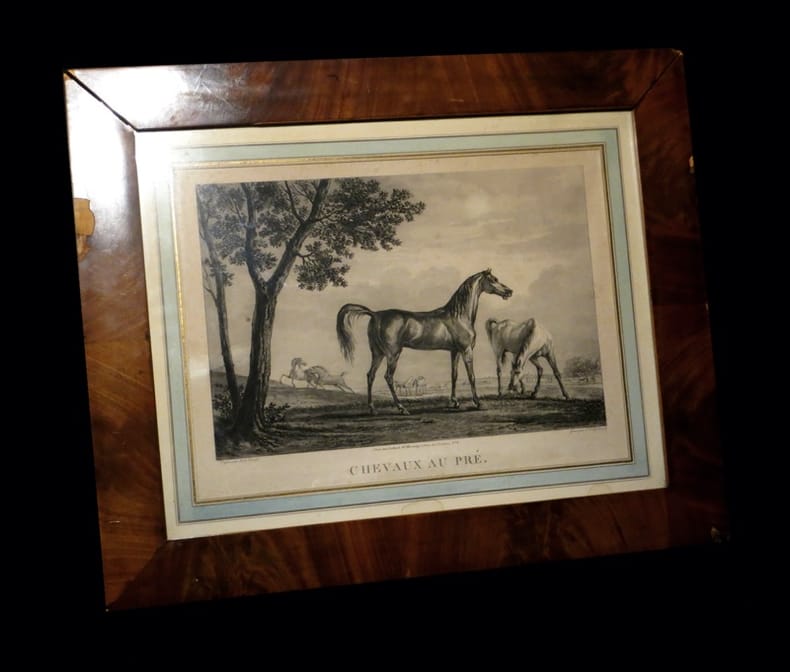
1820rif. 24099A Paris, chez Rolland, s.d. [circa 1800]. Dimensions à vue : 444 x 328 mm + passe-partout + cadre.
1885Very Good English Original dark green cloth bdg. Brief title and "Stirps Arabica Vicit" with a saber and crescent moon gilded on the front board. A very good copy. 4to. (30 x 24 cm). In English. 66 p., 5 engraved plates. First and only edition of this handsome and illustrated book of the first Arabian horses presented by Ottoman Sultan Abdulhamid II, bred by Huntington in North America. Arabian horse breeding in North America properly began with the world tour taken by General Ulysses S. Grant after he served as president of America, it is that in March of 1878 the General and his son Jesse arrived in Istanbul (Constantinople ), after the day the Grants toured the private stables of Sultan Abdul Hamid II are distinctly contradictory. Randolph Huntington was an American horse breeder who demonstrated the possibilities inherent in the Arab horse for the purpose of developing a new breed of saddle and road horses. During his first years on the farm, he bought and sold many colts and fillies as coach horses in New York City. He soon came to recognize the value of the Clay stock in that community which was largely the result of the breeding of a horse called Henry Clay which was brought to the nearby Genesee valley and whose stock was distributed through the valley. On May 31, 1879, there arrived in America two very fine stallions which were presented to General U.S. Grant by the Sultan of the Ottoman Empire. These stallions were named Leopard and Linden Tree. It is generally acknowledged that Linden Tree was a Barb-Arabian while Leopard was a pure Arabian. Prior to the time that these horses arrived in America, the very favorable results from inbreeding to produce typical Clay horses were shown to be practical. After seeing the stallions, Leopard and Linden Tree, Randolph Huntington at once started negotiations to breed three virgin Clay mares to each of these stallions. He hoped thereby to improve the road horse quality of his horses. In the following years, he called them Clay-Arabs. Since Huntington wanted to breed only virgin mares. Leopard was a Seglawi Jedran, desert-bred by the Anazeh, foaled in 1873 and presented by Jedaan Ibn Mheyd of the Fedaan Anazeh to the Turkish governor of Syria. (Some accounts list Ibn Mheyd as the breeder, while Carol Mulder, with typical caution, makes the distinction that we only know he presented the horse) The governor then presented the horse to Abdul Hamid II, who in turn gave him to General Grant.
rif. 189121Paris, 1720-1787 5 pièces in-4, en feuilles.
rif. 605Paris, Librairie Militaire De J. Dumaine, 1874., 639 et 736 pp. In-8, demi-basane verte, dos orné aux fers. Rousseurs
1946Very Good Turkish Paperback. Demy 8vo. (22 x 14 cm). In Turkish. 111, [2] p., 6 numerous b/w plates and 1 plan. A few important works were written on zoology, and in particular horse breeding in the early Republic of Turkey. These books were generally publications that argued that Turkish peasants should be a pioneer in horse breeding in the Anatolian aspect and that the government should support it in economic and social terms. This book was written extensively by Düzgünes, who studied zoology in the USA between 1950-1957. He took lessons from the American professors of his period (M. Lerner, J. Lush et al.) And published his research studies in the field of Poultry Breeding in the A-class science journal (American Poultry Science). Düzgünes, the author of books in the field of Statistics, Genetics, and Animal Breeding, translated the books of his professors in the USA into Turkish and introduced many technical terms related to his subject to Turkish. This book includes six black and white plates showing Turkish horse species and internal organs with a plan showing how to put four mares and a foal in the barn. Very scarce. Not in OCLC.; Turkish National Library 000029336.
1925Very Good Turkish, Ottoman (1500-1928) Paperback. Cr. 8vo. (20 x 14 cm). In Ottoman script. 4 p. Folding trace on cover. Today's organized horse races as today were conducted in Izmir on 23 September 1856 for the first time. In the leadership of Evliyazade Refik Bey and the term's Consul General of England Mr. Patterson, Smyrna Races Club was founded. Izmir races were organized annually on Easter days. S.R.C. races were in their golden ages at the beginning of the 20th century and this ended with the start of 1st World War. Ottoman Jockey Club: The opinions of organizing horse races and breeding by means of jockey club in Turkey was tried to be accomplished but there is no clear knowledge on the actions of this club. According to the directory published in 1909, Grand Vizier Sait Halim Pasha was the president of the Ottoman Jockey Club. Refik Evliyazade started working for regular races to be organized in Istanbul when S.R.C races came to an end with the First World War. As a result of the support by the most powerful person of the era, Enver Pasha, Guild of Cavalryman Horse Riding Club, and Society of Improving Horse Breed were founded in 1913. Choosing Veliefendi as a racetrack coincides with the same era. Bursa Sipahi Ocagi was one of the earliest jockey and horse breeding and racing clubs in Ottoman / Turkish history. This rare booklet includes the regulations of the Bursa Sipahi Ocagi prepared in the Republican period. AH 1341 = AD 1925. Not in Özege.; Not in OCLC. Extremely rare.
19638vo., First Edition thus, with title in gilt and colours, and 2 fine full-page coloured plates of colours; de luxe binding of full navy roan, upper board blocked in gilt, gilt doublures, blue silk endpapers, a near fine copy. The de luxe binding is very scarce.
1917Very Good Turkish, Ottoman (1500-1928) Original cloth bdg. with extra new full leather wrapper in the Ottoman style. Faded on cloth. Some slight stains on several pages. Avery good copy. Roy. 8vo. (24 x 17 cm). In Ottoman script. 11, 18, 228, 4 [...] p., 48 numerous b/w full paged plates. Ihsan Abidin, who completed the "Askerî BaytarMektebi" [I.e. Military Veterinary School] in 1904, was brought to the health and zootechnical professor of this school upon the merger of the Istanbul Military and Civilian Baytar Schools under the name of "Baytar Mekteb-i Alisi". He served as the Undersecretary of the Ministry of Agriculture (1927-1931) and had important services in the field of zootechnics. Ihsan Abidin Bey played an important role in the establishment of Higher Agricultural Institutes, studlands and warehouses. He has signed many articles and more than fifteen books published domestically and in Europe. His the most important book is 'Osmanli atlari' [i.e. The Ottoman horse and horse breeding] including 48 numerous plates and text in 279 pages. In his book, Akinci gives examples from Europe and Africa; He extends to the remotest corners of Asia and talks about the care, feeding, characteristics of horse breeds and emphasizes the importance of horse breeding. Only two copies located in OCLC 984405354.; Not in the Arabian horse bibliography of Boyd & Paul.; TBTK 2831.; Özege 15856.; Not in Kazancigil & Solok (Veterinary bibl.). First and Only Edition.
rif. 27441Dimensions (plaques) : 568 x 463 mm + marges.
1942Very Good Turkish, Ottoman (1500-1928) Papeback. Cr. 8vo. (19 x 14 cm). In Ottoman script. [66] p. Last 3 pages in modern Turkish. Ibrahim Gökçeoglu was an educator, veterinary and author of several book on veterinary such 'Orduda veterinerlik görevleri kilavuzu' [i.e. Guide to veterinary duties in army]. He has provided military veterinary training for many years in the Turkish army and universities. Moreover, he was Ahmet Akçimen was a Turkish veterinary surgeon in the service of Turkish army. Veterinary Faculty in Ankara was moved to Ankara in 1933, and he was one of graduates in 1948. Many members of 'Akçimen' family are known as in service of veterinary medicine in Turkey. Includes his veterinary notes between the dates of 10-18-1942 and 11-30-1942. Among his veterinary notes, it's seen mostly epidemic and non-epidemic animal diseases such anthrax, rabies (hydrophobia), etc. Noted by Akçimen from Gökçeoglu's lessons.Early Republican and first systematical veterinary education period in Turkey. Rare.
rif. 561Bruxelles, Lesigne, s.d. 14 x 22, 303 pp., broché, bon état
rif. 25383Bruxelles, Lesigne, s.d. 14 x 22, 303 pp., 1 grande carte dépliante, broché, bon état.
in-8°, 303 pages, carte des haras et des hippodromesz de Belgique depl. en frontisp., dessins, lettrines, broche, couverture illustree Exemplaire DEDICACE par E. du Bus de Warnaffe. [NV-8]
2000rif. 2090502124600457Nakasu ko seki 2000. Soft Cover. Fine. Number of pages: 503P Number of books: 1 Nakasu ko seki paperback
rif. CZC-8800illustrations de H. Petit Table ( extraits); les écuyers - Saumur - façon de se mettre en selle - de l’arrêt au pas - du pas au trot - le galop - l'obstacle ou la récompense - du cheval - conseils aux maîtres - les robes.. volume in-8, 190x130, relié demi cuir, frottements sur les mors, 311pp. Paris Albin Michel, 1938 ref/126
1893rif. 19819Paris Paul Ollendorf 1893 In-12 271 pp, préface de Pierre Loti, traces de scotch sur les couvertures et à 2 ff, dos absent et débroché
1973rif. 9511973 - broché - Librairie des Champs-Elysées - 1973 - In-4 (28 x 22,5 cm) broché sous jaquette transparente - 135 pages - Très nombreuses illustrations - Ouvrage bilingue français anglais - Sous-titres anglais de Pat Smythe - Titre complet : A cheval ma mie. 400 croquis légendés sur la pratique de l'équitation
1963rif. 32142Paris Librairie Des Champs-Elysées 1963 in-4° 136 pp + 1 ff de table, 4 hors textes couleurs de l'auteur non compris dans la pagination
rif. 684541Librairie Des Champs-Élysées Paris 1961 In-4 broché ( 285 X 225 mm ), de 136 pages, broché sous couverture illustrée. Illustrations de l'auteur. Avec 400 croquis, 4 planches en couleurs hors-texte, dont , et 138 figures in-texte. Très bel exemplaire.Description du cheval : Le harnachement Tenue du cavalier Travail à cheval Travail serré Voltige Entretien du cheval.