3 174 résultats
1917Very Good Turkish, Ottoman (1500-1928) Original cloth bdg. with extra new full leather wrapper in the Ottoman style. Faded on cloth. Some slight stains on several pages. Avery good copy. Roy. 8vo. (24 x 17 cm). In Ottoman script. 11, 18, 228, 4 [...] p., 48 numerous b/w full paged plates. Ihsan Abidin, who completed the "Askerî BaytarMektebi" [I.e. Military Veterinary School] in 1904, was brought to the health and zootechnical professor of this school upon the merger of the Istanbul Military and Civilian Baytar Schools under the name of "Baytar Mekteb-i Alisi". He served as the Undersecretary of the Ministry of Agriculture (1927-1931) and had important services in the field of zootechnics. Ihsan Abidin Bey played an important role in the establishment of Higher Agricultural Institutes, studlands and warehouses. He has signed many articles and more than fifteen books published domestically and in Europe. His the most important book is 'Osmanli atlari' [i.e. The Ottoman horse and horse breeding] including 48 numerous plates and text in 279 pages. In his book, Akinci gives examples from Europe and Africa; He extends to the remotest corners of Asia and talks about the care, feeding, characteristics of horse breeds and emphasizes the importance of horse breeding. Only two copies located in OCLC 984405354.; Not in the Arabian horse bibliography of Boyd & Paul.; TBTK 2831.; Özege 15856.; Not in Kazancigil & Solok (Veterinary bibl.). First and Only Edition.
19638vo., First Edition thus, with title in gilt and colours, and 2 fine full-page coloured plates of colours; de luxe binding of full navy roan, upper board blocked in gilt, gilt doublures, blue silk endpapers, a near fine copy. The de luxe binding is very scarce.
1925Very Good Turkish, Ottoman (1500-1928) Paperback. Cr. 8vo. (20 x 14 cm). In Ottoman script. 4 p. Folding trace on cover. Today's organized horse races as today were conducted in Izmir on 23 September 1856 for the first time. In the leadership of Evliyazade Refik Bey and the term's Consul General of England Mr. Patterson, Smyrna Races Club was founded. Izmir races were organized annually on Easter days. S.R.C. races were in their golden ages at the beginning of the 20th century and this ended with the start of 1st World War. Ottoman Jockey Club: The opinions of organizing horse races and breeding by means of jockey club in Turkey was tried to be accomplished but there is no clear knowledge on the actions of this club. According to the directory published in 1909, Grand Vizier Sait Halim Pasha was the president of the Ottoman Jockey Club. Refik Evliyazade started working for regular races to be organized in Istanbul when S.R.C races came to an end with the First World War. As a result of the support by the most powerful person of the era, Enver Pasha, Guild of Cavalryman Horse Riding Club, and Society of Improving Horse Breed were founded in 1913. Choosing Veliefendi as a racetrack coincides with the same era. Bursa Sipahi Ocagi was one of the earliest jockey and horse breeding and racing clubs in Ottoman / Turkish history. This rare booklet includes the regulations of the Bursa Sipahi Ocagi prepared in the Republican period. AH 1341 = AD 1925. Not in Özege.; Not in OCLC. Extremely rare.
1946Very Good Turkish Paperback. Demy 8vo. (22 x 14 cm). In Turkish. 111, [2] p., 6 numerous b/w plates and 1 plan. A few important works were written on zoology, and in particular horse breeding in the early Republic of Turkey. These books were generally publications that argued that Turkish peasants should be a pioneer in horse breeding in the Anatolian aspect and that the government should support it in economic and social terms. This book was written extensively by Düzgünes, who studied zoology in the USA between 1950-1957. He took lessons from the American professors of his period (M. Lerner, J. Lush et al.) And published his research studies in the field of Poultry Breeding in the A-class science journal (American Poultry Science). Düzgünes, the author of books in the field of Statistics, Genetics, and Animal Breeding, translated the books of his professors in the USA into Turkish and introduced many technical terms related to his subject to Turkish. This book includes six black and white plates showing Turkish horse species and internal organs with a plan showing how to put four mares and a foal in the barn. Very scarce. Not in OCLC.; Turkish National Library 000029336.
réf. 605Paris, Librairie Militaire De J. Dumaine, 1874., 639 et 736 pp. In-8, demi-basane verte, dos orné aux fers. Rousseurs
réf. 189121Paris, 1720-1787 5 pièces in-4, en feuilles.
1885Very Good English Original dark green cloth bdg. Brief title and "Stirps Arabica Vicit" with a saber and crescent moon gilded on the front board. A very good copy. 4to. (30 x 24 cm). In English. 66 p., 5 engraved plates. First and only edition of this handsome and illustrated book of the first Arabian horses presented by Ottoman Sultan Abdulhamid II, bred by Huntington in North America. Arabian horse breeding in North America properly began with the world tour taken by General Ulysses S. Grant after he served as president of America, it is that in March of 1878 the General and his son Jesse arrived in Istanbul (Constantinople ), after the day the Grants toured the private stables of Sultan Abdul Hamid II are distinctly contradictory. Randolph Huntington was an American horse breeder who demonstrated the possibilities inherent in the Arab horse for the purpose of developing a new breed of saddle and road horses. During his first years on the farm, he bought and sold many colts and fillies as coach horses in New York City. He soon came to recognize the value of the Clay stock in that community which was largely the result of the breeding of a horse called Henry Clay which was brought to the nearby Genesee valley and whose stock was distributed through the valley. On May 31, 1879, there arrived in America two very fine stallions which were presented to General U.S. Grant by the Sultan of the Ottoman Empire. These stallions were named Leopard and Linden Tree. It is generally acknowledged that Linden Tree was a Barb-Arabian while Leopard was a pure Arabian. Prior to the time that these horses arrived in America, the very favorable results from inbreeding to produce typical Clay horses were shown to be practical. After seeing the stallions, Leopard and Linden Tree, Randolph Huntington at once started negotiations to breed three virgin Clay mares to each of these stallions. He hoped thereby to improve the road horse quality of his horses. In the following years, he called them Clay-Arabs. Since Huntington wanted to breed only virgin mares. Leopard was a Seglawi Jedran, desert-bred by the Anazeh, foaled in 1873 and presented by Jedaan Ibn Mheyd of the Fedaan Anazeh to the Turkish governor of Syria. (Some accounts list Ibn Mheyd as the breeder, while Carol Mulder, with typical caution, makes the distinction that we only know he presented the horse) The governor then presented the horse to Abdul Hamid II, who in turn gave him to General Grant.
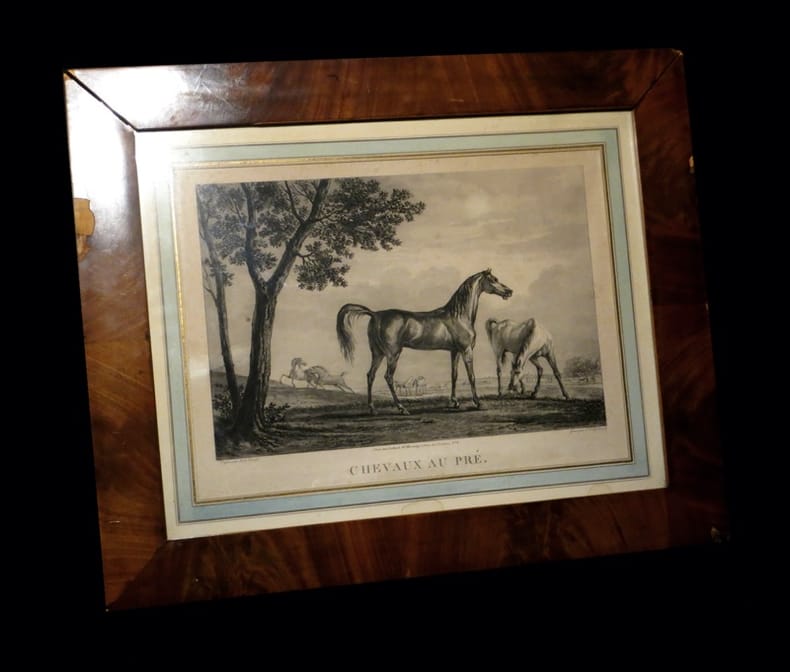
1820réf. 24099A Paris, chez Rolland, s.d. [circa 1800]. Dimensions à vue : 444 x 328 mm + passe-partout + cadre.
1994réf. ABE-17598263900269 IMAGES (N°16-17-18-19-23-25-28-29-30)--7 CM X 3,7 CM-PRESENTATION AVEC CARTONNAGE A FENETRES ET PROTECTION PLASTIQUE AU DOS (AVEC LEGERES TRACES D'HUMIDITE EN COINS)-(E24)
1964186 pages. Undated. Meet General Custer and the troopers of his Fighting Seventh Cavalry as they match their strength and wits against Sitting Bull and Crazy Horse. Gift greetings upon front endpaper. Contents well-yellowed. Average wear to book. Dust jacket well-worn with several small tears but remains quite functional. Book
réf. 110835Yverdon, Imprimerie du Journal d’Yverdon SA 1982, 200x200mm, 107pages, broché. Bel exemplaire.
in-8°, 317 pp., broche, couverture illustree à rabats. Bel exemplaire. [GE-2]
2011réf. CCC-56273. edition du castelet 2011, 9782917478127, sous jaquette, 214 pages, edition numerotesur 400, petits coups sur la couverture interieur tres bon, petit mot perso au crayon a papier sur la page d'avant garde, photos possible
2011réf. LFA-126749687Un ouvrage de 214 pages, format 255 x 280 mm, illustré, relié toile sous jaquette couleurs, publié en 2011, Editions du Castelet, tirage limté (n° 130/400), bon état (avec un envoi de l'auteur)
1964réf. 2090202120409564Haiku kenkyu-sha 1964. Soft Cover. Fine. Number of books: 1 Haiku kenkyu-sha paperback
2003réf. 2090202120201244Japan Racing Association Chukyo Racecourse 2003. Soft Cover. Fine. Volume: 1 Japan Racing Association Chukyo Racecourse paperback
2021réf. 500103904CASA 2021 19 5x27 7x2 4cm. 2021. Broché.
1991réf. qi207Conseil Régional des Pays de la Loire Dos carré collé 1991 In-4 (30x22.5cm), dos carré collé sous couverture rempliée illustrée en couleurs, 158 pages, nombreuses illustrations, plans, cartes ; pliures à la couverture, état correct. Livraison a domicile (La Poste) ou en Mondial Relay sur simple demande.
1991réf. LFA-126721596Revue de 158 pages, format 225 x 300 mm, illustrée, brochée couverture couleurs rempliée, publiée en 1991, bon état
1904réf. 22351Sedan, imprimerie Emile Laroche, 1904 ; petit in-8°, broché, 62 pp., couverture saumon imprimée, 2 croquis in-texte.
réf. 63-5432Poultney Vermont: Iron Horse Antiques Inc. 1977. 8vo. 58 pp. Stapled Wraps Illustrated Very Good. Poultney, Vermont: Iron Horse Antiques, Inc., 1977. paperback
réf. 16446'British Equestrian Team Yo-yogi Village' Tokyo Japan. 23 September to 14 October 1964. 38pp. 8vo. In fair condition lightly aged and worn. In 'Note Book Made of paper Specially prepared in Japan'. On front cover: 'J. GROSE British Equestrian Team Yo-yogi Village Olympic Diary'. Begins on 23 September with flight from London Airport via Bombay. In Hong Kong he dines with 'Algie Lady O'Connor' at Flagstaff House. In the Olympic Village at Yoyogi on 26 September he discusses problems 'in our hut 448' before inspecting 'the Equestrian Centre Baji-Koen'. The main topic is the quarantine exercising area in Karuizawa' which the British French and Australian teams deem 'most unsatisfactory'. Other topics include: 'the arrival of the French horse plane'; an agreement that 'Bob Armstrong should live at stables'; 'the Cocktail Party for the British athletes at the Embassy'; 'the draw for Dressage & Grand Prix Jumping' 'I was unlucky enough to draw us number 1'; training; the stable manager and his staff 'softened up' with a bottle of whisky; the acquisition of tickets and press passes; various meetings. On 28 September Grose has 'a confrontation with MR NOMURA Secretary of the JEF Japanese Equestrian Federation & their titular head with the following result: 'Eventually JEF promised to let us know by noon tomorrow whether Australian & British horses could quarantine here & for how many days It became clear that it was NOT shortage of boxes that bothered them so much as favouring us both at the expense of other nations. In fact they went back on what we thought were the undertakings made yesterday. However the Australians took a tough line promised to inform the Press etc & were seeing the President of the J.O.C. Japanese Olympic Committee this evening. Nomura said Mr Du Bois had passed the quarantine site: I said we had always reserved the right to decide when we got here & saw the relative facilities & had been told we could gallop in quarantine etc etc'. The disagreements are not settled and on 2 October Grose writes: 'Then got urgent message to see Sandy Sandy Duncan. The Australians had issued an extremely rude Press release copy filed about the quarantine & try areas at K. Also heard the French had complained officially.' He finds the opening ceremony 'a fine spectacle with a vast crowd & v. well organised' but adds that 'Most of us did not find it moving as the various contingents did not know whether to be serious or not. A few marched well including our women. Some were unconsciously funny others waved to their friends or waved flags etc. The latter chiefly oriental or non-curtain.' The final entry 14 October is short and ends mid-sentence. At the rear are three pages recording the sale and purchase of tickets with names of parties and amounts paid. The final page of the volume carries 'Accounts' from 25 September to 24 October beginning with '3 Bottles Whisky' to bribe the stable manager and ending with 'Soda Water'. Loosely inserted are two telegrams to Grose in Tokyo from 'Ansell' in London 6 and 21 October 1964; calling cards of Keiji Nomura and J. G. Hasegawa; four Japanese receipts; a pencil autograph draft of a telegram from Grose regarding a disqualification. A final item is a carbon copy of an autograph letter from Grose to 'Jane' dated from Yoyogi Village 4 October 1964 which he describes as a 'situation report for Col Ansell BHS & BSJA' and in which he describes how the team had 'three problems before arrival of horses' followed by 'tedious negotiations' and problems with 'the exercising facilities' which have 'caused quite a stir & you may have read about it in the British Press. They were hopeless. .' 'British Equestrian Team | Yo-yogi Village' [Tokyo, Japan]. 23 September to 14 October 1964. unknown
1889Outside dimensions 14.5" x 10.75". Steam and horse roads indicated. Includes many street names plus lists of prominent buildings, hotels, depots and theatres. Unmarked with light wear and soiling. An attractive vintage copy. Book
1889Outside dimensions 14.5" x 10.75". Steam and horse roads indicated. Includes many street names plus lists of prominent buildings and hotels. Unmarked with light wear and soiling. An attractive vintage copy. Book