[VOITURAGE]Livre Rare Book

3 339 résultats
réf. 189121Paris, 1720-1787 5 pièces in-4, en feuilles.
1885Very Good English Original dark green cloth bdg. Brief title and "Stirps Arabica Vicit" with a saber and crescent moon gilded on the front board. A very good copy. 4to. (30 x 24 cm). In English. 66 p., 5 engraved plates. First and only edition of this handsome and illustrated book of the first Arabian horses presented by Ottoman Sultan Abdulhamid II, bred by Huntington in North America. Arabian horse breeding in North America properly began with the world tour taken by General Ulysses S. Grant after he served as president of America, it is that in March of 1878 the General and his son Jesse arrived in Istanbul (Constantinople ), after the day the Grants toured the private stables of Sultan Abdul Hamid II are distinctly contradictory. Randolph Huntington was an American horse breeder who demonstrated the possibilities inherent in the Arab horse for the purpose of developing a new breed of saddle and road horses. During his first years on the farm, he bought and sold many colts and fillies as coach horses in New York City. He soon came to recognize the value of the Clay stock in that community which was largely the result of the breeding of a horse called Henry Clay which was brought to the nearby Genesee valley and whose stock was distributed through the valley. On May 31, 1879, there arrived in America two very fine stallions which were presented to General U.S. Grant by the Sultan of the Ottoman Empire. These stallions were named Leopard and Linden Tree. It is generally acknowledged that Linden Tree was a Barb-Arabian while Leopard was a pure Arabian. Prior to the time that these horses arrived in America, the very favorable results from inbreeding to produce typical Clay horses were shown to be practical. After seeing the stallions, Leopard and Linden Tree, Randolph Huntington at once started negotiations to breed three virgin Clay mares to each of these stallions. He hoped thereby to improve the road horse quality of his horses. In the following years, he called them Clay-Arabs. Since Huntington wanted to breed only virgin mares. Leopard was a Seglawi Jedran, desert-bred by the Anazeh, foaled in 1873 and presented by Jedaan Ibn Mheyd of the Fedaan Anazeh to the Turkish governor of Syria. (Some accounts list Ibn Mheyd as the breeder, while Carol Mulder, with typical caution, makes the distinction that we only know he presented the horse) The governor then presented the horse to Abdul Hamid II, who in turn gave him to General Grant.
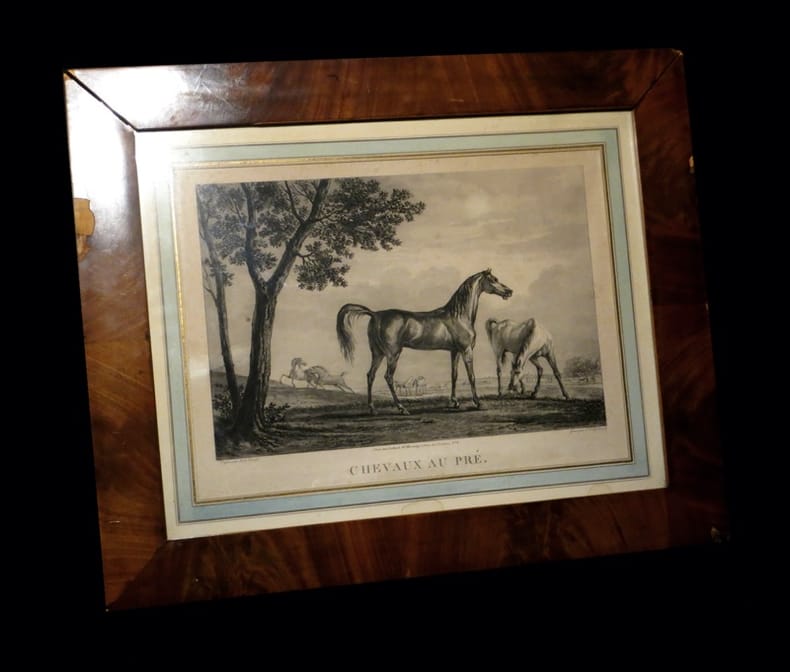
1820réf. 24099A Paris, chez Rolland, s.d. [circa 1800]. Dimensions à vue : 444 x 328 mm + passe-partout + cadre.
1994réf. ABE-17598263900269 IMAGES (N°16-17-18-19-23-25-28-29-30)--7 CM X 3,7 CM-PRESENTATION AVEC CARTONNAGE A FENETRES ET PROTECTION PLASTIQUE AU DOS (AVEC LEGERES TRACES D'HUMIDITE EN COINS)-(E24)
1964186 pages. Undated. Meet General Custer and the troopers of his Fighting Seventh Cavalry as they match their strength and wits against Sitting Bull and Crazy Horse. Gift greetings upon front endpaper. Contents well-yellowed. Average wear to book. Dust jacket well-worn with several small tears but remains quite functional. Book
réf. 110835Yverdon, Imprimerie du Journal d’Yverdon SA 1982, 200x200mm, 107pages, broché. Bel exemplaire.
in-8°, 317 pp., broche, couverture illustree à rabats. Bel exemplaire. [GE-2]
2011réf. CCC-56273. edition du castelet 2011, 9782917478127, sous jaquette, 214 pages, edition numerotesur 400, petits coups sur la couverture interieur tres bon, petit mot perso au crayon a papier sur la page d'avant garde, photos possible
2011réf. LFA-126749687Un ouvrage de 214 pages, format 255 x 280 mm, illustré, relié toile sous jaquette couleurs, publié en 2011, Editions du Castelet, tirage limté (n° 130/400), bon état (avec un envoi de l'auteur)
réf. DADAX1436704669New unknown
réf. DADAX0007323085New unknown
réf. DADAX1938398378New unknown
réf. DADAX157076901XNew unknown
réf. DADAX1468063871New unknown
réf. DADAX1446024032New unknown
1964réf. 2090202120409564Haiku kenkyu-sha 1964. Soft Cover. Fine. Number of books: 1 Haiku kenkyu-sha paperback
2003réf. 2090202120201244Japan Racing Association Chukyo Racecourse 2003. Soft Cover. Fine. Volume: 1 Japan Racing Association Chukyo Racecourse paperback
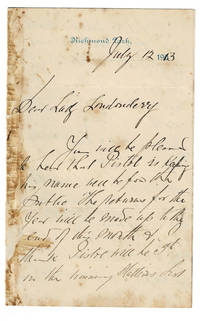
1913réf. 97593Richmond Park South Australia: July 12 1913. 1913. Good. - Approximately 300 words penned on 4 sides of a folded sheet of creamy white paper with each page measuring 8 inches high by 5 inches wide. "Richmond Park" is printed at the top of the cover page. Aldridge has altered the partially printed date from "1903" to "1913". Started on the cover page Aldridge has continued his letter on the last page to then conclude on the inner 2 leaves. Signed "J.H. Aldridge" on the inner leaf. Once apparently mounted along the inner edge with glue or tape there are heavy stains with remnants of glue to the inner edge of the first and last page. There is a tiny tear along the fold with some light brown stains or foxing to all four pages. Good. A RARE LETTER REPLETE WITH HORSE RACING ASSOCIATIONS. Aldridge writes to the Marchioness of Londonderry praising the horse he purchased from her and the Marquis of Londonderry. "You will be pleased to hear Pistol is keeping his name well before the public.I think Pistol will be 5th on the Winning.List in all Australia of course in this State 'South Australia' he is easily 1st.Londonderry by Pistol Antilles won the Broken Hill Cup a few days ago & the Chairman in presenting the cup to the winner referred to the fact that the horse got his name from his Breeder the Marchioness of Londonderry.Pistol is a most prolific father of winners & that is better than one good one & twenty duffers as some sires record. I believe there is only one sire in Australia which has produced more winners this year." He goes on to complain about the season as a whole mentions some "great loss" that she has had and he wishes the Marquis well and that "his illness worries will be settled ere long" Signed "J. H. Aldridge". James Henry "Jim" Aldridge 1849-1929 was a popular and highly respected Australian sportsman. he began his career as a hotelier in Adelaide. He managed the Globe Hotel in Rundle Street a hotel that was popular with sportsmen. He later took charge of the Grand Hotel Broken Hill and the Gresham Hotel. In 1890 with the intent of establishing a stud farm he purchased at a Sydney sale the Stallion Carlyon. Carlyon was to be the lord of the harem so to speak. In addition he purchased a richly bred brood of a half-dozen mares. Sometime between 1888 and 1890 Aldridge purchased Richmond Park in South Australia from its original owner John Chambers. With the Chester horse Carlyon and the stud established Aldridge rapidly became well-known as a breeder. Carlyon and the thoroughbreds he sired at the Richmond Park stud farm made Aldridge's name famous throughout Australian racing circles. Although still able to perform as a stud Carlyon was badly injured in 1905. As it happened however in 1904 Aldridge had purchased Pistol the son of the famous English sire Carbine. Pistol was foaled in 1899 and arrived in South Australia as a five year old. He was purchased from the Marquis of Londonderry for the large sum of 1250 pounds. As a stud Pistol performed into his 26th year and sired winners of more than 641 races out of 1423 competitions. Up until Aldredge's death in 1829 the Pistol progeny had won approximately 200000 pounds in stake money. In atribute after his death the Chairman of the S.A.J.C. South Australian Jockey Club Whitmore Blake Carr "Doc Carr" wrote: "For years Mr. Aldridge has been one of the best widely known and most popular identities of the turf in South Australia and one to whom the sport owed much of its maintenance and stability. When he ran horses he did so for the pure love of the sport and the applause which always attended the success of his colours was a fine tribute by the racing public to the popularity of the owner. He was an exceptionally fine judge of a horse. The gratifying results which have been achieved at Richmond Park making it stand today so high in the list of studs in the Commonwealth was due to his sound judgment and ripe experience." Richmond Park, [South Australia]: July 12, 1913. unknown
réf. DADAX1532193017New unknown
1991réf. qi207Conseil Régional des Pays de la Loire Dos carré collé 1991 In-4 (30x22.5cm), dos carré collé sous couverture rempliée illustrée en couleurs, 158 pages, nombreuses illustrations, plans, cartes ; pliures à la couverture, état correct. Livraison a domicile (La Poste) ou en Mondial Relay sur simple demande.
1991réf. LFA-126721596Revue de 158 pages, format 225 x 300 mm, illustrée, brochée couverture couleurs rempliée, publiée en 1991, bon état
1904réf. 22351Sedan, imprimerie Emile Laroche, 1904 ; petit in-8°, broché, 62 pp., couverture saumon imprimée, 2 croquis in-texte.
réf. 63-5432Poultney Vermont: Iron Horse Antiques Inc. 1977. 8vo. 58 pp. Stapled Wraps Illustrated Very Good. Poultney, Vermont: Iron Horse Antiques, Inc., 1977. paperback
réf. 16446'British Equestrian Team Yo-yogi Village' Tokyo Japan. 23 September to 14 October 1964. 38pp. 8vo. In fair condition lightly aged and worn. In 'Note Book Made of paper Specially prepared in Japan'. On front cover: 'J. GROSE British Equestrian Team Yo-yogi Village Olympic Diary'. Begins on 23 September with flight from London Airport via Bombay. In Hong Kong he dines with 'Algie Lady O'Connor' at Flagstaff House. In the Olympic Village at Yoyogi on 26 September he discusses problems 'in our hut 448' before inspecting 'the Equestrian Centre Baji-Koen'. The main topic is the quarantine exercising area in Karuizawa' which the British French and Australian teams deem 'most unsatisfactory'. Other topics include: 'the arrival of the French horse plane'; an agreement that 'Bob Armstrong should live at stables'; 'the Cocktail Party for the British athletes at the Embassy'; 'the draw for Dressage & Grand Prix Jumping' 'I was unlucky enough to draw us number 1'; training; the stable manager and his staff 'softened up' with a bottle of whisky; the acquisition of tickets and press passes; various meetings. On 28 September Grose has 'a confrontation with MR NOMURA Secretary of the JEF Japanese Equestrian Federation & their titular head with the following result: 'Eventually JEF promised to let us know by noon tomorrow whether Australian & British horses could quarantine here & for how many days It became clear that it was NOT shortage of boxes that bothered them so much as favouring us both at the expense of other nations. In fact they went back on what we thought were the undertakings made yesterday. However the Australians took a tough line promised to inform the Press etc & were seeing the President of the J.O.C. Japanese Olympic Committee this evening. Nomura said Mr Du Bois had passed the quarantine site: I said we had always reserved the right to decide when we got here & saw the relative facilities & had been told we could gallop in quarantine etc etc'. The disagreements are not settled and on 2 October Grose writes: 'Then got urgent message to see Sandy Sandy Duncan. The Australians had issued an extremely rude Press release copy filed about the quarantine & try areas at K. Also heard the French had complained officially.' He finds the opening ceremony 'a fine spectacle with a vast crowd & v. well organised' but adds that 'Most of us did not find it moving as the various contingents did not know whether to be serious or not. A few marched well including our women. Some were unconsciously funny others waved to their friends or waved flags etc. The latter chiefly oriental or non-curtain.' The final entry 14 October is short and ends mid-sentence. At the rear are three pages recording the sale and purchase of tickets with names of parties and amounts paid. The final page of the volume carries 'Accounts' from 25 September to 24 October beginning with '3 Bottles Whisky' to bribe the stable manager and ending with 'Soda Water'. Loosely inserted are two telegrams to Grose in Tokyo from 'Ansell' in London 6 and 21 October 1964; calling cards of Keiji Nomura and J. G. Hasegawa; four Japanese receipts; a pencil autograph draft of a telegram from Grose regarding a disqualification. A final item is a carbon copy of an autograph letter from Grose to 'Jane' dated from Yoyogi Village 4 October 1964 which he describes as a 'situation report for Col Ansell BHS & BSJA' and in which he describes how the team had 'three problems before arrival of horses' followed by 'tedious negotiations' and problems with 'the exercising facilities' which have 'caused quite a stir & you may have read about it in the British Press. They were hopeless. .' 'British Equestrian Team | Yo-yogi Village' [Tokyo, Japan]. 23 September to 14 October 1964. unknown