287 résultats
1909réf. 295380Cambridge at the University Press 1909. Hard Cover. Very Good binding. An attractive First Edition of this fore-runner of one of the most important books of the 19th century.~~Two essays written in 1842 and 1844 in which Darwin’s theory of natural selection is first considered; the 1842 essay was published earlier that year but this is the first appearance in print of the 1844 essay and thus the first appearance of the two essays together. Of note is that “the sketch of 1844 bears on the whole a striking resemblance to the origin of species . even some of the sentences are identical.” DNB Vol. V 1917 p. 526 Darwin himself provides evidence of the high estimate he had formed of the sketch: “A letter exists addressed to his wife in which he made provision in case of his death for the publication of the manuscript . stating that he believes his conclusions to be ‘a considerable step in science’” ibid.~~Large Octavo; in the publisher’s green buckram binding with spine lettered in gilt and beveled edges; xxix 1. 263 pages including the Index; top edge gilt with other edges rough-cut; there is a small and neatly penned name on the front endpaper; with photogravure portrait frontispiece protected with a tissue guard and a facsimile; the spine is just a bit darkened; a previous owner’s signature on the front pastedown. ~~~ DNB Vol V 1917 p. 527. Very Good binding. Cambridge at the University Press unknown books
1868réf. 24571London: John Murray 1868. First Edition second issue. leather_bound. Full tree calf gilt decorated borders marbled endpapers and edges. Very good. 2 Vols. 411 486 pages. 22 x 14 cm. 43 black and white illustrations. Comprehensive Index. Bound without the advertisements. The book's slow progress towards publication was due not only to its size but the author's ill health. "About half of the eight years that elapsed between its commencement and completion were spent on it. The book did not escape adverse criticism: it was said for instance that the public had been patiently waiting for Mr. Darwin's justificatives and that after eight years of expectation all they got was a mass of detail about pigeons rabbits and silkworms. The work contains the first appearance of the phrase 'survival of the fittest' in any of Darwin's works p. 6 of 1st volume. Single erratum in Volume I. FREEMAN 878. NORMAN. 597. Backstrip decorated with gilt florets and gilt lettered spine labels lacking Vol. II label. John Murray books
1872réf. CDAR014London: John Murray 1872 First edition second issue with "htat" misprint on the first line of page 208. One of 7000 copies. Publisher's green cloth with decorative borders in blind to front and rear boards titles and decorations in gilt to spine green endpapers seven Heliotype Plates numbered in Arabic. Very good or better with light wear to spine hinges and corners a bit of toning to spine some spotting to the plates on pages 180 and 264 a few small notes in pencil to a couple pages and a touch of soiling to bottom edge of text block. Overall a solid copy of Darwin's "forgotten masterpiece" with very well-preserved plates. Freeman 1142. The Expression of the Emotions in Man and Animals expands on Darwin's theories raised in On the Origin of Species 1859 and The Descent of Man 1871 arguing that there is an evolutionary explanation for the human expression of emotions. The book was originally intended by Darwin to be a chapter in The Descent of Man but grew until it was necessary to publish the work separately. An influential text in the field of psychology the book has also been described as "a pivotal turning point in the history of book illustration right up there with Alice in Wonderland" The Atlantic. With seven plates of heliotypes that represent various human emotions The Expression of the Emotions was one of the first scientific books to include photographs. These photographs were provided by a handful of photographers and researchers including Guillaume-Benjamin Duchenne Adolph Kindermann George Charles Wallich James Crichton-Browne and Oscar Rejlander. Rejlander contributed nineteen of the thirty photographs in the book including the crying baby photo later dubbed "Ginx's baby" which became incredibly popular in its time. Interestingly Darwin's research for the book prompted him to circulate one of the first scientific questionnaires which he used to gauge people's ability to identify a handful of core emotions. . First Edition. Hard Cover. Very Good. London: John Murray hardcover books
1927réf. 300754London: The Nonesuch Press 1927. First editions. Illustrated in color by Elinor Darwin. 2 vols. Oblong 8vo. Original decorated paper over boards fine copies IN ORIGINAL DUST JACKETS Volume II with loss and Vol. I VG. First editions. Illustrated in color by Elinor Darwin. 2 vols. Oblong 8vo. Dreyfus 27 45 The Nonesuch Press unknown books
réf. MA01D-01222John Murray. Collectible - Acceptable. London: John Murray 1871. 1st edition. Volume 2. 12mo. viii475pp. Illus. Fair book. Binding copy. Crown chipped. Front joint broken. Boards rubbed and edgeworn. Corners frayed. Errata on verso of tiutle page. Binding broken at signature Q. Spine tail slightly dampstained. evolution natural selection heredity Inquire if you need further information. John Murray hardcover books
1871réf. 142676London: John Murray 1871. publisher's green cloth blind stamping on boards gilt on spine. 8vo. publisher's green cloth blind stamping on boards gilt on spine. viii 423 1 16; viii 475 1 16 pages. With Illustrations. Eight Thousand. Two volumes. First edition third printing of this major scientific work by Charles Darwin Freeman 944. With the private stamped ink bookplate of G.A. Tucker on the title page of both volumes. Very minor rubbing to spines and hinges of both volumes moderate rubbing to the head of the spine of volume 2 bumped corners of both volumes gutters starting medium foxing to preliminary pages else a very good set. Publisher's advertisements dated January 1872 at rear of each volume wood-engraved illustrations to text. This two-volume set expands on the core theory of Origin of Species providing an additional four key ideas: human evolution common ancestry sexual selection and human differences. The book helped solidify evolutionary theory as a framework for understanding not just biology but human origins and behavior. Controversially received like Origin of Species before it the word 'evolution' occurs here for the first time in any of Darwin's works. It can be found on page 2 of the first volume. The same with Origin of Species but that is to say before its appearance in the sixth edition printed the following year Freeman p 129. John Murray unknown books
1878réf. 365957New York: D. Appleton and Company 1878. New Edition from the Sixth English Edition with Additions and Corrections. xxi 1 1-458pp. 1 vols. Small 8vo. Publisher's russet cloth blocked in black. Near fine. New Edition from the Sixth English Edition with Additions and Corrections. xxi 1 1-458pp. 1 vols. Small 8vo. "Certainly the most important biological book every written . The sixth edition which is usually regarded as the last appeared in London in February 1872 . It is again extensively revised and contains a new chapter VII. . It is in the edition that the word 'evolution' occurs for the first time. It had been used in THE DESCENT OF MAN in the previous year but not before in this work" Freeman p. 79. The present 1878 edition is the fifth issue of the American edition based on the sixth edition. A lovely copy of an early American edition. Freeman 403 D. Appleton and Company unknown books
1892réf. 48692London: John Murray 1892. Very good plus. Sixth edition "forty-third thousand" overall - and the first to use the term "evolution" to describe the mechanism of natural selection that Darwin introduced in the book. "Evolution" - the word now most associated with THE ORIGIN OF SPECIES - was not used to describe natural selection in the publication until the sixth edition. By then Darwin was well aware that he had a phenomenon on his hands with the title - it was time to widen his audience. The 6th edition was purposefully set in smaller type slimming the book's profile and making it more affordable "I have been told on authority which I can trust that . workmen club together to buy the Origin" Darwin noted of previous editions in correspondence in 1871. It also contains a glossary for the first time making the text more accessible to a non-specialist audience. Appropriately this copy was once owned by James G. Mead whale biologist and longtime curator of marine mammals at the Smithsonian. Mead is a particular proponent of the anatomical study of marine mammals a method of examination that Darwin also favored; THE NEW YORK TIMES notes that Mead's use of this technique "has given scientists a detailed look at species that often can be observed only fleetingly in the wild." A notable edition of an iconic work. 7.5'' x 5''. Publisher's green cloth boards with gilt spine lettering. Floral patterned endpapers of the John Murray monogram. xxii 432 pages including index; folds from page 185 on are unopened. Small owner name to front flyleaf "J. G. Mead" dated Feb. 1972. Small owner name to title page "Jas Probert" dated July 1893. Binding with faint spotting to edges light bumping to corners and spine ends. Light foxing to endpapers. Interior clean. John Murray unknown books
1871réf. 10230London: John Murray 1871. First Edition. Hardcover. Good. First issue of Volume I second issue of Volume II. Complete in two volumes. Good. Green cloth generally rubbed and soiled at the surface and edges. Both volumes bound with forward leans hinges reinforced chipped half-title of Volume I restored with paper backing foxing throughout. Darwin's influential work that furthers his theories about evolution and natural selection. In fact the first issue of this book features Darwin's first use of "evolution. John Murray hardcover books
1888réf. 140943887London: John Murray 1888. Sixth Edition. Near Fine. Sixth edition thirty-fifth thousand. An unusually fresh copy bound in publisher's original green cloth ruled in blind and stamped in gilt with folding lithographic diagram. Near Fine with light wear to cloth small series of spots to the fore edge. A bright and sharp example. John Murray unknown books
1877réf. 6668London: John Murray 1877. First edition. Very Good. Octavo 20 cm; viii 352 32 ads pages. Ads dated March 1877. Original green cloth titled in gilt on spine. Foxing to endleaves and to fore edge else clean and unblemished. In his eye-opening re-appraisal of Darwin's botanical books Oliver Sachs wrote that Darwin's botanical studies were "engines of war great missles of evidence lobbed at the skeptics of his theory of natural seledtion" The River of Consciousness. Sachs observes that the botanical studies are "even more overwhelming" than the author's magnum opus The Origin of Species in its presentation of natural seledtion as the basic fact of evolution. Sachs singles out this work The Different Forms of Flowers on Plants of the Same Species as particularly significant in that it explores the theme of co-evolution between two or more interdependent species such as elongated flowers developing together with insects capable of pollinating them with a long proboscus. John Murray hardcover books
1863réf. 29135Stuttgart: E. Schweizerbart'sche Verlagshandlung und Druckerie 1863. Boards. Very Good. VIII 551 1 blank pages. Plus original albumen photograph of Darwin mounted on thin board inserted before the half title with original tissue guard still present. 8vo. 1/4 leather gilt over marbled boards. Light overall wear to the binding. Bookseller ticket LW Schmidt New York German Bookseller on front pastedown. Lightly browned pages clean internally. A nice copy. Boards. The first German translation of Darwin's "Origin of the Species" was published in 1860 by the same publisher. This edition is notable for the inclusion of an albumen frontispiece of Darwin a very early portrait. Van Wyhe's Complete Photographs of Darwin identifies this portrait as a sitting by Maull & Polyblank from 1857. This image is identified as a variant of that image "1.1. Albumen photograph 15.3x11.5cm uncropped mounted on thick paper. Below image "Phothogr. v. Buchner / Charles Darwin. / E. Schweitzerbart'sche Verlagshandlung in Stuttgart." Frontispiece to Origin 2d ed. in German 1863 F673." If not the first it was certainly among the first albumen images of Darwin to be published in a book. A nice addition to any Darwin collection. The albumen print is by Carl Johann Sigmund Buchner. Literature: Freeman Bibliographical Handlist 2nd edition #673 Van Wyhe's Complete Photographs of Darwin. E. Schweizerbart'sche Verlagshandlung und Druckerie unknown books
1868réf. CDAR012London: John Murray 1868 Two volumes. First edition first issue. One of 1500 copies. Bound in three-quarter contemporary brown calf over red marbled boards spines lettered and decorated in gilt all edges marbled marbled endpapers. A very good set with some wear and rubbing along edges and spines former owner bookplate to front pastedowns some foxing to the first few leaves otherwise clean. Freeman 878. First Edition. Hard Cover. Very Good. London: John Murray hardcover books
1846réf. 371065New York: Harper & Brothers 1846. First American edition. 2 vols. Small 8vo. Publisher's cloth spine chipped with loss wityh blindstamps on title-page from GTS. First American edition. 2 vols. Small 8vo. First American edition of Darwin's important first published book containing the observations and field work that form the basis for On the Origin of Species. "The five years of the voyage were the most important event in Darwin's intellectual life and in the history of biological science. Darwin sailed with no formal scientific training. He returned a hard-headed man of science knowing the importance of evidence almost convinced that species had not always been as they were since the creation but had undergone change. The experiences of his five years in the Beagle how he dealt with them and what they led to built up into a process of epoch-making importance in the history of thought" DSB. Darwin's Journal "his first published book is undoubtedly the most often read" Freeman 31. It is "one of the most interesting records of natural history exploration ever written and is one of the most important for it was on this voyage that Darwin prepared for his lifework ultimately leading to The Origin of Species" Hill I 104-5. First published in 1839 as "the third volume of The Narrative of the Voyages of H.M. Ships Adventure and Beagle edited by Captain Robert Fitzroy. Since then it has changed its name four times so that today it is universally referred to as The Voyage of the Beagle. On its first appearance in its own right also in 1839 it was called Journal of Researches into the Geology and Natural History etc. The second edition of 1845 transposes 'Geology' and 'Natural History'. and the spine title is Naturalist's Voyage" Freeman 32. This first American edition is based on that 1845 second London edition. Issued as Harper's New Miscellany Volumes X and XI. Freeman 16; Sabin 18647 Harper & Brothers unknown books
1876réf. 6383London: John Murray 1876. First edition. Fine. Octavo 20 cm; viii 482 pages. Advertisements for other works of the author on the verso of the title 3-line errata slip tipped in prior to Chapter One. Original cloth. Owner's name in ink and old bookseller notations in pencil on front free endpaper. Else a fine copy in remarkably fresh condition. Reference: Freeman 1249. In his eye-opening re-appraisal of Darwin's botanical books Oliver Sachs wrote that Darwin's botanical studies were "engines of war great missles of evidence lobbed at the skeptics of his theory of natural seledtion" The River of Consciousness. Sachs observes that the botanical studies are "even more overwhelming" than the author's magnum opus The Origin of Species in its presentation of natural seledtion as the basic fact of evolution. John Murray hardcover books
1875réf. 2105008London UK: John Murray 1875. 6th. hardcover. very good. Sixth edition Fifteenth Thousand. Book very good cracking along front and rear gutters some wear previous owner's name on half-title and title page. Housed in provided fold-out case. John Murray unknown books
1832réf. 4893England 1832. Letter written in brown ink on a folded sheet the back leaf containing an address in manuscript with a black wax seal a dragon with a D. The stamp has been cut from the letter without affecting the text. Letter by Francis Darwin announcing the death of his mother. The letter has been addressed to Samuel Tertius Galton in Birmingham the stamp has been cut from the letter without affecting the text. There is a black wax seal a dragon with a D on the verso. The text of the letter reads: My dear Galton /It has pleased God to remove our dearest mother from this world of sin & sorrow. She appeared to be much as usual until 2 o'clock & whilst sitting in her chair by the fire complained of general uneasiness. Sophie & I assisted her to the bed & she expired at 1/4 before 3 oclock in the presence of Dr. Bent & ourselves. She had thought herself so much better lately that Mrs. Hadley & Millicent were both sent home yesterday & the day before. /I hope Violetta will not suffer from this severe shock to us all. You shall hear again in a day or two. /Believe me affectionately yours / Frans S. Darwin. Violetta Darwin was the eldest daughter of Erasmus Darwin from his second marriage to Elizabeth Chandos Pole which took place in 1781. Violetta was married to Samuel Tertius Galton and the mother of Francis Galton. It is therefore likely that the Francis of this letter was one of her four brothers. unknown books
1901réf. 52738London: Jarrold & Sons 1901. First printing. Near fine. First edition advance review copy of this scarce turn-of-the-century primer on Darwinism for "every day people." A popular introduction to evolution by means of natural selection for "the young person the person with little education the person who is not studious the masses in short." Influenced by renowned naturalist Alfred Russel Wallace with whom he became acquainted due to their mutual work in land nationalization projects Ogilvy turned his attention to the still widely misunderstood concept of evolution. Wallace who had already provided the introduction for Ogilvy's THE THIRD FACTOR OF PRODUCTION also reviewed the manuscript for this book. Certainly with his connection to Darwin as "a co-discoverer and friend" he was one of the best possible beta readers for such a text. Ogilvy stresses that this book was written to make the principles of Darwinism accessible to all by making the subject "simple clear and interesting" and avoiding "technicalities and dry structural details" - addressing what he felt was a general misunderstanding of Darwin's findings amongst the population he sought to reach. A contemporary review in the science journal NATURE confirms this referring to a "widespread . ignorance and misapprehension of Darwin's teaching among the general public." Another from THE EXPOSITORY TIMES praises the "blessed simplicity in Mr. Ogilvy's way of presenting the subject." Laid into this copy is a typed letter signed by the publisher sending it to a journal editor for review. OCLC locates only a handful of US holdings and only a few more elsewhere. A gorgeous copy. 7.25'' x 4.75''. Original green cloth with dark green stamped Art-Nouveau design lettered in red to front board and in gilt to spine. Pictorial endpapers. 160 pages. Single typed sheet dated 21 March 1901 and signed "Jarrold Sons" laid in. Boards with touch of wear to extremities. Faint offsetting to endpapers light foxing to edges. Crisp and tight. Jarrold & Sons unknown books
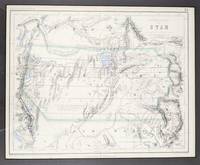
1857réf. 57211London and Edinburgh: John Murray; W. & A. K. Johnston 1857. A well-executed beautifully engraved map. Hand-colored. 16 x 13 inches 25 x 22 inches in mat and frame. Faint vertical center fold line else fine. Wheat 934. Not in Moffat. From the rare Atlas of the United States. 1857 by Rogers and Johnston. This is the only commercial atlas map of its time to show the Utah Territory on a single map and it is in its own right one of the rarest maps of the territory. In addition to county boundaries and information from Fremont's report the map provides a good deal of detail on springs Indians topographical features forts early roads and more. Portions of Nevada Colorado Arizona and New Mexico are included. The first separately printed map of Utah. This map was published at the time of the Utah War 1857-58 and depicts Brigham Young's original view of the large Deseret Territory. Fillmore City is shown as the capitol. The map includes a note from Fremont's report which states "The Great Basin is elevated above the sea between 4000 and 5000 ft. it is surrounded by lofty mountains and is believed to be filled with rivers and lakes which have no communication with the sea deserts and oases which have never been explored and savage tribes which no traveller has seen or described. John Murray; W. & A. K. Johnston unknown books
1869réf. 2002020London: John Murray 1869. 5th. very good. Fifth edition tenth thousand as stated on title page and copyright page. Book very good repair at front and rear gutters. Page 29/30 missing. Comes with custom-made slipcase. John Murray unknown books
1828réf. S13985London:: Printed for the Author; published by Baldwin and Cradock 1828-31. 1828. Four volumes. 8vo. 9.5 inches tall. Vol. I: 2 iv 186 2 pp. 9 plates. Vol. II: ii 200 pp. 6 plates. Vol. III: ii 374 6 pp. 4 plates. Vol. IV: ii 413 1 pp. 4 plates. Original marbled boards with modern half-calf raised bands gilt-stamped spines black leather spine labels marbled endsheets. Small ownership labels of the Lowther Collection. Nice set. CONTAINING THE FIRST PUBLICATIONS OF CHARLES DARWIN. The full edition was issued in 12 volumes. "While at the University of Cambridge the student Charles Darwin became an enthusiastic insect collector. He sent Stephens records of the rarer insects he had captured and was delighted when Illustrations of British entomology gave him credit for capturing insects described in 33 entries quoting his words in all but two of the cases. Darwin recalled in his autobiography "No poet ever felt more delight at seeing his first poem published than I did at seeing in Stephen's Illustrations of British Insects the magic words 'captured by C. Darwin Esq.'" though the closest wording as published actually appeared slightly differently as "captured by the Rev. F. W. Hope and C. Darwin Esq. in North Wales" and "Taken in North Wales by C. Darwin Esq." – Wikip. / The exquisite plates are colored by hand after drawings by Charles M. Curtis 1795-1839 and John Obadiah Westwood 1905-1893 who was among the first entomologists with an academic position at Oxford University. Although he worked on insect classification and diversity for more than sixty years from the publication of Darwin's Origin of Species he never accepted the ideas on evolution. / James Francis Stephens was an English entomologist and naturalist. He was elected fellow of the Linnean Society on 17 February 1815 and of the Zoological Society of London in 1826. From 1815 to 1825 he took a great interest in ornithology and contributed to the work of George Shaw 1751-1813. He was granted leave from office to assist William Elford Leach in 1818 to arrange the insect collection at the British Museum and eventually described as many as 2800 British insect species. In 1833 he was founder of what became the Royal Entomological Society of London. Stephens made a large insect collection that included many specimens. After his death the insect collection was purchased by the British Museum. PROVENANCE: Bruce Lowther 1926-1999 Collection c/o J.T. Barnes 503 Royal Trust Building Victoria B.C. Lowther was a journalist broadcaster author and historian with a particular interest in British Columbia labor history. From 1954-76 he worked as a reporter and columnist for the Victoria Daily Colonist. His collection of books was donated to the Saanich Archives Saanich British Columbia. Printed for the Author; published by Baldwin and Cradock, 1828-31. hardcover books
1868réf. 13360London: John Murray 1868. FIRST EDITION FIRST ISSUE. With several text illustrations. Original publisher's green cloth a few small bumps minor wear to boards; approximately 2 inches of the top of the fly-leaf of both volumes cut out. Generally a very nice set uncut with the presentation bookplate of the University of Southern California Messrs. Milton and Stanley Slotkin in each volume ownership signature on the title to Volume II. First edition first issue of Darwin's great contribution to the descent theory and the foundation on which all later racial-biological research was based. This work expands in detail material that Darwin had intended to include in his Origin. The most novel element in the work is Darwin's hypothesis of pangenesis by which he attempts to explain hereditary resemblance inheritance of acquired characteristics atavism and regeneration. Although proven invalid this theory was nevertheless of prime importance in the history of genetics. "Darwin carried out numerous investigations with pigeons and various plants. He recognized continuous and discontinuous variation; he concluded that crossing tends to keep populations uniform" G&M. John Murray unknown books
1859réf. 1293943London: John Murray 1859. Third Edition. Hardcover. Octavo 429 pages with two fold outs and pages of advertisements. In Good plus condition. Rebacked in green cloth with gilt lettering to spine with original boards and preserved and parts of original spine laid on. Boards show wear along the edges; corners bumped and beginning to fray. Pages are age toned as is typical with some minor spotting mostly at the beginning and on the fold outs. Interior otherwise clean and free of marking. An ex-library copy with usual markings including a bookplate from the Royal Navy on front paste down and faded ink stamp on title page. Darwin's contribution present and corrected on page 268. The first edition of 1849 had a transposition error in Darwin's essay some later states included a corrected text in a rear pocket. The second edition was issued in 1851 with no offprint of Darwin's article. This is the third edition complete. Fold out maps are present with some slight tears to the rear map. Shelved in Case 10. 1293943. Shelved Dupont Bookstore. John Murray hardcover books
1890réf. 97629NY:: D. Appleton and Company. Very Good. 1890s. Hardcover. An incomplete set: 14 of 15 volumes Volume I of The Origin of Species is missing. Animals and Plants Under Domestication two volumes Structure and Distribution of Coral Reefs The Descent of Man and Selection in Relation to Sex Expression of the Emotions in Man and Animals The Different Forms of Flowers on Plants of the Same Species Geological Observations on the Volcanic Islands and Parts of South America Insectivorous Plants The Life and Letters of Charles Darwin two volumes edited by his son Francis Darwin The Power of Movement in Plants The Origin of Species Volume II only The Formation of Vegetable Mould Through the Action of Worms Journal of Researches Into the Natural History and Geology of the Countries Visited During the Voyage of H. M. S. Beagle Round the World. Author's Edition Limited: this set is number 223 of 1000. Octavos half bound in burgundy leather marbled boards raised bands along the spines gilt lettering and design on the spines top edges gilt marbled endpapers illustrations photographs and fold-out maps. Light shelf wear and aging aptly the Insectivorous Plants volume has two small holes at the fore edge of the text block - insect damage one of the volumes has the previous owner's name and address on a front endpage else all volumes are very good. Texts are clean and bindings are sound. . D. Appleton and Company, hardcover books
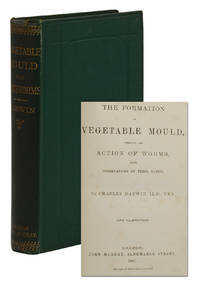
1881réf. 140940727London: John Murray 1881. First Edition. Near Fine. First edition first printing. Bound in publisher's original green cloth with titles stamped in gilt on the spine. Darkening to spine cloth and slight tear at head. Foxing to textblock edge preliminary and terminal sheets. Previous owner name in pencil to front paste down. Darwin's final work published shortly before his death in April 1882. John Murray unknown books