Cuvier, Georges,Biblio.com

1.679 resultados
ref. 16105427-nnew. unknown
ref. 6914326-nnew. unknown
2007ref. STM-9788170416654India: Anmol Publications Pvt. Ltd. 2007. Hardbound. Brand New. Book Condition:- Brand New. Secured Packaging. Fast DeliveryBookseller Inventory # 9788170416654 Anmol Publications Pvt. Ltd. hardcover
1998ref. STM-9788126101160India: Anmol Publications Pvt. Ltd. 1998. Hardbound. Brand New. Book Condition:- Brand New. Secured Packaging. Fast DeliveryBookseller Inventory # 9788126101160 Anmol Publications Pvt. Ltd. hardcover
1998ref. STM-9788126101177India: Anmol Publications Pvt. Ltd. 1998. Hardbound. Brand New. Book Condition:- Brand New. Secured Packaging. Fast DeliveryBookseller Inventory # 9788126101177 Anmol Publications Pvt. Ltd. hardcover
1998ref. STM-9788126101122India: Anmol Publications Pvt. Ltd. 1998. Hardbound. Brand New. Book Condition:- Brand New. Secured Packaging. Fast DeliveryBookseller Inventory # 9788126101122 Anmol Publications Pvt. Ltd. hardcover
1998ref. STM-9788126101153India: Anmol Publications Pvt. Ltd. 1998. Hardbound. Brand New. Book Condition:- Brand New. Secured Packaging. Fast DeliveryBookseller Inventory # 9788126101153 Anmol Publications Pvt. Ltd. hardcover
1998ref. STM-9788126101146India: Anmol Publications Pvt. Ltd. 1998. Hardbound. Brand New. Book Condition:- Brand New. Secured Packaging. Fast DeliveryBookseller Inventory # 9788126101146 Anmol Publications Pvt. Ltd. hardcover
1998ref. STM-9788126101092India: Anmol Publications Pvt. Ltd. 1998. Hardbound. Brand New. Book Condition:- Brand New. Secured Packaging. Fast DeliveryBookseller Inventory # 9788126101092 Anmol Publications Pvt. Ltd. hardcover
1998ref. STM-9788126101115India: Anmol Publications Pvt. Ltd. 1998. Hardbound. Brand New. Book Condition:- Brand New. Secured Packaging. Fast DeliveryBookseller Inventory # 9788126101115 Anmol Publications Pvt. Ltd. hardcover
1851ref. 031567London: William S. Orr & Co. 1851. Book. Illus. by Thomas Landseer. Fine. Full Leather. New Edition. 8vo - over 7¾ - 9¾" tall. Brown leather with gilt edging over boards gold stamped Upper Canada College front and back. Colour frontis 33 additional colour plates by Thomas Landseer with a little offset and 300 b&w line illustrations throughout. Marbled edges sporadic foxing. Prize copy ink inscription to end paper Upper Canada College 1853. From the introduction "The present work is a complete Cuvier as regards the central part of the arrangement; it is not a mere translation but in some respects a new book embodying the original one." Fine copy. William S. Orr & Co. Hardcover
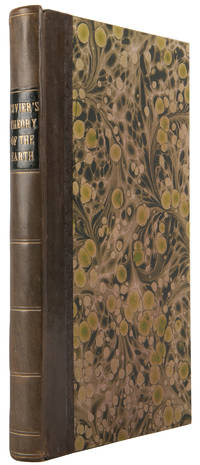
ref. 113163Edinburgh for William Blackwood John Murray & Robert Baldwin 1813. . First English language edition; 8vo 21 x 12.5 cm; engraved frontispiece and 1 plate some toning light spotting and offsetting primarily to the frontispiece titles and plate; recently rebound to style in quarter brown calf black morocco label marbled boards red speckled edges just a little rubbed at the extremities very good condition; 265pp. First English language edition of Cuvier's important essay establishing the role of cyclical geological catastrophes in palaeontology. Naturalist Georges Cuvier 1769-1832 is considered the founding father of both vertebrate zoology and palaeontology. He established the concept of biological extinction on a factual basis was one of the developers of biostraigraphy and was among the first to suggest that reptiles had previously dominated the earth. Cuvier opposed the evolutionary theories of Lamarck and Saint-Hilaire and posited instead that cyclical geological catastrophes caused the creation and destruction of life basing this on evidence of alternating marine and freshwater fossils in the rocks of the Paris basin. But unlike Biblical catastrophism Cuvier's scientifically-based theory incorporated realistic geological timeframes accepted that the events were localised instead of worldwide and brought catastrophes 'within the "Newtonian" system of unchanging natural laws. However obscure the cause of revolutions might be their repetition implied that they formed part of the ordinary course of nature' Rudwick The Meaning of Fossils p131. 'All these ideas were integrated and further developed in the Preliminary Discourse that Cuvier prefixed to his great Researches on the Fossil Bones of Quadrupeds 1812. The attractively written geological essay with which the work began was recognised at once as a work of the highest importance. It was later issued separately as A Discourse on the Revolutions of the Surface of the Globe which went through several editions and was translated into the other main European languages. In this way Cuvier's theory which many years later was give the misleading name of "catastrophism" became widely known and influential among the general reading public as well as among men of science. Cuvier himself rarely used the word "catastrophes" for its overtones of disaster were largely extraneous to his conception of these regular and natural events; he preferred the term "revolutions" for its more Newtonian flavor. Likewise though the editor of the English editions Scottish geologist Robert Jameson 1774-1854 entitled the work Theory of the Earth Cuvier himself always avoided this phrase on account of its associations with the earlier speculative systems he so much deplored' Rudwick p132. This edition is particularly interesting because Jameson added 'lengthy editorial notes' to the text in an attempt to connect Cuvier's catastrophes with the Biblical flood. Using geology to prove the literal truth of the Bible was of much greater concern among British intellectuals than those on the Continent and James's edits led British readers to believe that Cuvier had more interest in this than he did in reality Rudwick pp133-134. Edinburgh, for William Blackwood, John Murray, & Robert Baldwin, 1813. hardcover
1836ref. 29867AB1836. 3 Bände. Bruxelles L. Hauman 1836. 8°. Mit 24 gest. Tafeln. Halbleinenbände der Zeit. Vgl. Nissen 1013 für die erste Ausgabe. - Dritte Ausgabe erschien erstmals 1817 in Paris. - Papier durchgehend gebräunt und stockfleckig. Einbände berieben und bestossen. unknown
1801ref. 23665Kbhvn. 1801. Samt. lidt slidt hldrbd. 12431 pp. samt 7 kobbberstukne foldeplancher. Marginer her og der lidt skjoldede. Første danske oversættelse. unknown
1798ref. 38049Paris Baudouin An 6 1798. 8vo. Contemp. hcalf richly gilt back. Titlelabel with gilt lettering. Corners a bit bumped otherwise fine. XVI710 pp. and 14 engraved plates with many figs. A few scattered brownspots. Printed on good paper. First editiuon of Cuvier's first work on comparative zoology in which he showed the affinities and similarities in the structure of present forms of animals researches which resulted in comparison with older forms and thereby giving the material for other theorists to suggest evolutionary lines and links. Cuvier is considered as the founder of modern palaeontology by this and his later published work "Recherches sur les ossemens fossiles.""Cuvier's first separate work "Tableau.1798" is based on a course of lectures he had delivered at l'Ecole du Pantheon. It wa the first general statement of his naltural classification of the aninal kingdom.He established the four great classes vertebrates molluscs articulates and radiates and classified the animals according to the anatomical structure." Milestones of Science No. 44 - Wood p. 307. unknown
1783ref. 44413Neuchatel Samuel Fauche 1783. 4to. Bound in fine contemp. full sprinckled calf raised bands and richly gilt spine. Wear to head of spine. Without the 2 free endpapers. Halftitle present and with stamps. XXIV367 pp. 2 engraved plates 1 folded. The folded plate depicts his two types of Hair-Hygrometers a. 1 engraved vignette. A fine clean and wide-margined copy. First edition of a fundamental work in Meteorology in which Saussure describes how to construct a hygrometer from human hair that can measure the relative humidity and discussing the principles behind it. Cuvier regarded this book as one of the greatest contributions to science of the eighteenth century."A milestone work in chemistry physics and meteorology which established hygrometry as an exact science. Primarely a geologist who explored and published on the Alps Saussure 1740-1788 was the first to prove that air expands and becomes less dense the more humidity it contains. In these Essais the work offered he describes his experiments with the hair hygrometer of his invention and his theory of the evaporation and hygrometry with their applications to meteorology. he also enunciates his theory of the evaporation of water in hydrogen carbon dioxide and other gases."Neville II p. 427 a."In his essay on the theoretical principles of hygrometry which he conceives as "the art of measuring the absolute quantity of water suspended in the air" De Saussure distinguishes three classes of methods of determining humidity which respectively utilize i observations of changes in the weight dimensions or shape of a hygroscopic body; ii observations of the capacity of the air for taking up water; and iii observations of the quantity of water condensing from the air under given conditions on a cold surface or of the degree of cold necessary to start such an condensation."Wolf "A History of Science Technology & Philosophy in the 18th Century" I p. 326 ff.Partington III 763. - Partington "Breakthroughs" 1783 M - Poggendorff II 755-56. hardcover
1801ref. 795Af det franske ved Gregers Wad. 1.-2.Dee1. K. 1801-03. 2 samt.hldrbd. Rygge lidt slidte. 1243114514 pp. samt 14 foldede kobberst.plancher. Første danske udgave of Cuvier's skelsættende arbejde i den komparative zoologi. unknown
1798ref. 29881Paris Baudouin An 6 1798. 8vo. Nice cont. full mottled calf. Richly gilt back. Light wear to lower part of back and a small hole in leather at lower hinge. Red leather titlelabel. XVI710 pp. and 14 engraved plates with many figs. A large clean copy. First edition of Cuvier’s first work on comparative zoology being one of the foundational texts of modern zoology and comparative anatomy. "Cuvier’s Tableau élémentaire – his first separate work – contains the first general statement of his natural classification of the animal kingdom" Norman. The book thus constitutes the first systematic expression of a theory that would dominate zoological thought in the early nineteenth century. For later theorists it provided the essential morphological basis for tracing evolutionary continuity between extinct and living species. Based on the course of lectures delivered at the École du Panthéon Cuvier’s ”Tableau élémentaire presents for the first time his natural classification of the animal kingdom establishing the four great divisions of the animal world: Vertebrata Mollusca Articulata and Radiata – according to anatomical structure rather than superficial resemblance. It was from these studies of structural affinity between living forms that Cuvier developed the principles of comparative anatomy which in turn laid the groundwork for palaeontology as a scientific discipline. Milestone of Science No. 44 Wood p. 307. hardcover
1817ref. 3707077Paris: Deterville 1817. Some foxing to the plates. Four volumes octavo 15 engraved plates by C.-L. Laurillard a handsome set with all four half-titles in original quarter calf over mottled papered boards gilt double spine labels in red & green. First edition of this germinal work of natural history with three volumes by Cuvier himself and the fourth an important study of insects by his friend and colleague Latreille. Recognised as the father of comparative anatomy Cuvier published widely throughout his lifetime but this was his most famous and influential work and contained the results of all his previous research on the structures of living and fossil animals. It was based upon his vast knowledge of zoological anatomies and in it he applied Linnæus' system of nomenclature and classification to the whole animal kingdom in the process establishing his four great classes: vertebrate molluscous articulate and radiated. Cuvier's work is a benchmark for many reasons not least for the third volume present here which is actually the work of Pierre André Latreille Professor of Entomology at the Paris Museum: Latreille's contribution was not only a significant contribution to his field but he had earlier been heavily involved in characterising the insects collected on the Baudin voyage to Australia and the Pacific. In the present volume Latreille sought to update the foundation work of scholars including Fabricius within Cuvier's framework; as a result Latreille included here many Australian insects including two the 'Rhipcera' and the 'Heleus' noted for the first time. Cuvier born in 1769 was invited by Geoffroy Saint-Hilaire to come to Paris in 1795. He took an appointment at the newly-formed Muséum nationale d'histoire naturelle where he remained until his death from cholera in 1832. He had first publicly canvassed his new quadripartite schema of the animal kingdom in an 1812 presentation to the Academy of Sciences but it was in this work that he first detailed how this proposed division worked in practice. Here each of the classes is discussed in a separate volume with volumes I II and IV by Cuvier himself; his organizations of fish families in particular 'were so soundly based that they have become orders or suborders in present classification' DSB. Throughout his career Cuvier held to the premise of Le Règne Animal that the four branches were fundamentally different and that any similarities between them were due entirely to common functions rather than common ancestry. He did not believe that is that there was any evolutionary adaptation a stance which put him in open conflict with his contemporaries such as Buffon Lamarck and Geoffroy. This led to the famous debate between Cuvier and Geoffroy at the Académie Royale des Sciences in Paris in 1830. Cuvier's towering position in the French natural sciences should be seen in the context of a very cynical view of his ambitions towards intellectual ownership of the science on Freycinet's voyage an idea explored in correspondence between Faujas de Saint Fond and Louis de Freycinet. . Deterville unknown
1819ref. 35267Strasbourg: F.G. Levrault 1819. Fine. F.G. Levrault Strasbourg 1819 12 x 20 cm relié First edition a sequel would appear in 1827 then another until 1832. Contemporary half sheep binding in brown. Smooth spine with fillet and roulette. Yellow edges. Permanent Secretary of the Academy of Sciences it was Cuvier's responsibility to compose these biographies of celebrated scientists who had been members. These were read during public sessions; the first volume brings together the speeches delivered from 1799 to 1810 the second from 1810 to 1819. The work also contains Cuvier's reception speech at the Academy as well as a preface on the future of sciences. F.G. Levrault unknown
1828ref. 21573Paris: Verdière & Lagrange 1828. Fine. Verdière & Lagrange Paris 1828 13.50 x 21.50 cm broché New edition. Some light foxing joints slightly cracked at head and foot. Copy presented in its original wrappers spine sunned with label bearing the author's name title and publication date of the work. Verdière & Lagrange unknown
1839ref. 1018F17Edinburgh: The Proprietor 1839 . First edition. Leather. Very Good. 14" by 10.5". Not Stated. Impressively illustrated with 130 hand coloured animal plates this is the scarce first edition of 'The Edinburgh Journal of Natural History' and 'The Animal Kingdom of Baron Cuvier'. A scarce collection of works with three volumes bound in one. Present here are volumes I and II of the first collected edition of 'The Edinburgh Journal of Natural History and of Physical Sciences'. The work of Scottish naturalist and ornithologist William MacGillivray. With a title page to volume I only lacking the volume II title page. Also present is the first edition of 'The Animal Kingdom of the Baron Cuvier Enlarged and Adapted to the Present State of Zoological Science'. The plates of all three volume are bound to the rear of the work with 130 hand-coloured plates. Collated complete. Rebacked with endpapers renewed. A wonderful study of natural history in the mid 19th century offering both scientific detail and beautiful illustrations. Rebacked in a half calf binding with cloth covered boards and with endpapers renewed. Rubbing to board perimeters and cloth of boards. Internally firmly bound. Pages lightly age toned with light spotting throughout. Significant spotting to plates with significant closed tears to fore edge of three plates. Very Good The Proprietor hardcover
ref. 1011252481.Gpaperback. Good. Access codes and supplements are not guaranteed with used items. May be an ex-library book. paperback
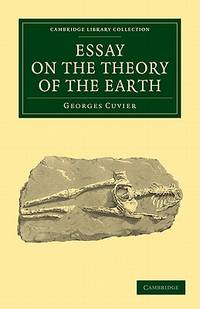
ref. 645355445Cambridge University Press CUP . Papeback. New. pp. 282 Cambridge University Press CUP unknown