4946 risultati
1820rif. 45519(Paris, Crochard, 1820).. No wrappers. Extracted from: Annales de Chimie et de Physique, Par MM. Gay-Lussac et Arago."", Series 2, Tome 13. Pp. 384-409 a. 1 folded engraved plate. The plate with some brownspots.
1820rif. 45519Paris Crochard 1820. No wrappers. Extracted from: Annales de Chimie et de Physique Par MM. Gay-Lussac et Arago." Series 2 Tome 13. Pp. 384-409 a. 1 folded engraved plate. The plate with some brownspots. First French edition of this groundbreaking paper in microscopy and biology. The paper was first published in Italian as "De microscopi cattadiottrici memoria" Modena 1818 and here he explains how by the improved acromatic microscope he was able to observe the circulation of protoplasm in Chara cells. He thereby became immediately famous not only as an optician but also as a microscopic biologist.After improving his microscope "Amici immediately applied his instrument to the study of the circulation of sap in the Chara. The main matters that he clarified were "the dependence of this circulation on the series of chlorophyll grains that the sap flows faster in the cell wall than in the internal cell space that there is no dividing wall between the rising current and the descending current of sap and the possibility of dividing the sap current into two separate circuits by constricting the cell" H. von Mohl.Garrison & Morton: 266. unknown
rif. DADAX0443101302New unknown
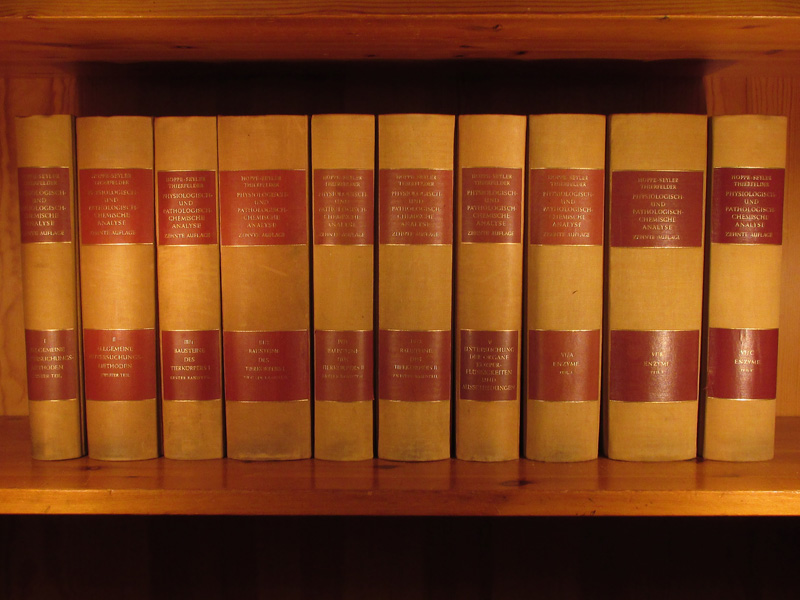
1966rif. HA-16109Berlin, Göttingen, Heidelberg, Springer-Verlag, 1953 - 1966. 10. Auflage. Vollständiges Werk in 6 Bänden (gebunden in 10 Bänden). Hellbraune Original-Ganzleinenbände mit goldgeprägten Rücken- und Deckeltiteln auf roten Schildern. Einschlägiges und traditionsreiches Handbuch zur physiologisch- und pathologisch-chemischen Analyse, das erstmalig 1858 erschien und seitdem Generationen von Biochemikern, Ärzten und Biologen als unentbehrliches Handwerkszeug ihrer Arbeit diente. Die Auflagen erschienen zum Teil in großen Zeitabständen. So vergingen zwischen der neunten (1924) und der hier vorliegenden zehnten - und vorläufig letzten - Auflage nahezu dreißig Jahre. Bd. I: Allgemeine Untersuchungsmethoden. Erster Teil. XI, 762 S. Mit 502 Abbildungen. Bd. II: Allgemeine Untersuchungsmethoden. Zweiter Teil. XVIII, 1086 S. Mit 534 Abbildungen. Bd. III/1 + 2: Bausteine des Tierkörpers I. XV, XV, 2142 S. Mit 120 + 80 Abbildungen. Bd. IV/1 + 2: Bausteine des Tierkörpers II. XIII, XIII, 1891 S. Mit 215 + 96 Abbildungen. Bd. V: Untersuchung der Organe, Körperflüssigkeiten und Ausscheidungen. VIII, 938 S. Mit 44 Abbildungen. Bd. VI/A: Enzyme. Teil A. XVI, 1052 S. Mit 119 Abbildungen. Bd. VI/B: Enzyme. Teil B. XIV, 1282 S. Mit 65 Abbildungen. Bd. VI/C: Enzyme. Teil C. X, 998 S. Mit 68 Abbildungen.
1783In 8°; (2), CXLIX, (2 b.), 320 pp. e (2), 54 pp. Elegante legatura coeva in mezza-pelle maculata con titolo su fascetta di pelle rossa e filetti in oro al dorso. Piatti foderati con bella carta marmorizzata coeva. Tagli rossi. Prima edizione francese tradotta da Jean Senebier (che curò anche la lunga introduzione), della prima opera e prima edizione in assoluto della seconda. Esemplare in ottime condizioni di conservazione. La prima opera è la prima edizione francese (si distingue dalla seconda edita nello stesso anno dal numero di pagine) di questo importante studio del celebre trattato del grande gesuita, biologo e naturalista originario di Scandiano (Reggio-Emilia) Lazzaro Spallanzani (Scandiano, 12 gennaio 1729 – Pavia, 11 febbraio 1799), considerato il "padre scientifico" della fecondazione artificiale e che è ricordato soprattutto per aver confutato la teoria della generazione spontanea con un esperimento che verrà successivamente ripreso e perfezionato da Louis Pasteur. Le sue ricerche di fisologia gastroenterologica furono fondamentali nel dimostrare come il processo digestivo non consista, solo, nella semplice triturazione meccanica del cibo, ma anche in un processo di azione chimica a livello gastrico, necessario per permettere l'assorbimento dei nutrienti. Prandi p. 81: "Traduzione delle esperienze sulla digestione (primo volume delle 'Dissertazioni di fisica animale e vegetabile', Modena, 1780)." GM981 (Italian ed.): "Spallanzani confirmed earlier doctrines of the solvent property of the gastric juice and discovered the action of the saliva in digestion. He stated that gastric juice can act outside the body and can prevent or inhibit putrefaction.". First issued in Italian in 1780, of Spallanzani’s (1729-1799) work on digestion; the first French edition was issued in Geneva in 1783. It was later translated into English (London, 1784, 1789). "Spallanzani confirmed earlier doctrines of the solvent property of the gastric juice and discovered the action of the saliva in digestion. He stated that gastric juice can act outside the body and can prevent or inhibit putrefaction. He obtains gastric juice by tying a sponge on a piece of string, then allowing it to be swallowed." - Garrison and Morton. La seconda opera (che si trova a volte rilegata con la prima per contiguità di argomento e perché di questa è, in qualche modo, una continuazione) è la prima edizione, non comune, di uno studio del il noto scrittore e botanico svizzero Jean Senebier (Ginevra, 6 maggio 1742 – Ginevra, 22 luglio 1809) che in questo lavoro riassume e completa la conoscenza dei meccanismi della digestione. L’opera si avvalse anche del contributo dello stesso Spallanzani. Senebier, botanico di fama mondiale, è conosciuto per essere stato uno dei primi a studiare ed interpretare i processi chimici della fotosintesi clorofilliana. Estremamente interessato all’opera di Spallanzani ne capì e seguì le intuizioni in campo chimico, applicandole e a volte estendendole. Nell’opera qui presentata analizza l’importanza della conoscenza dei meccanismi del succo gastrico in ambito chirurgico. Due prime edizioni in ottime condizioni di conservazione. Rif. Bibl.: per la prima opera ICCU IT\ICCU\PUVE\012056; per la seconda opera ICCU IT\ICCU\PUVE\012071.
rif. DADAX0367444143New unknown
rif. DADAX0367740737New unknown
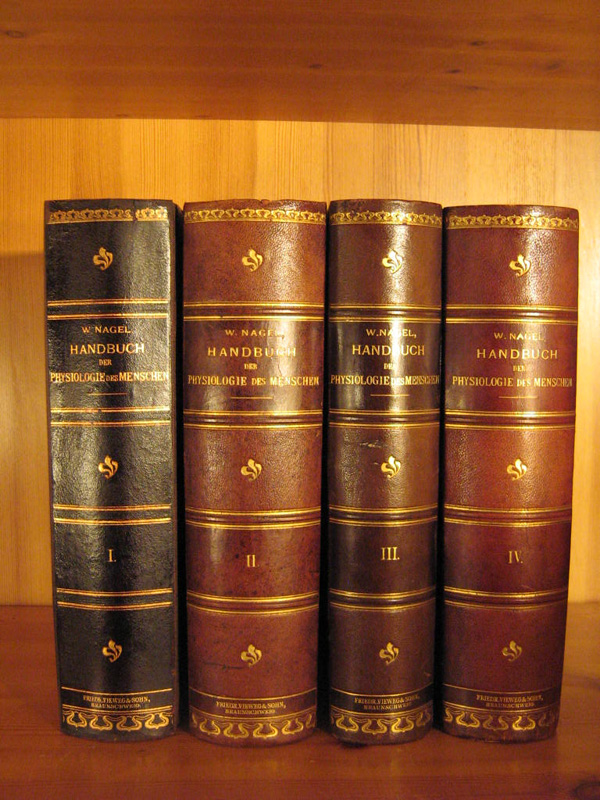
1909rif. SB-11705Braunschweig, Friedrich Vieweg und Sohn, 1905 - 1909. Vollständiges Grundwerk in vier Bänden. Braune Original-Halblederbände mit goldgeprägten Rückentiteln sowie goldgeprägten Ornamentbändern an den Kapitalen. Buchdeckel mit grünen Leinenbezügen und großen Lederecken. Mehrfarbig marmorierter Buchschnitt (Marmorierung bei den Bänden unterschiedlich). Einschlägiges Handbuch und Nachschlagewerk der Physiologie. Der Herausgeber Willibald Nagel wirkte von 1902 an als ordentlicher Professor und Leiter der Sinnesphysiologischen Abteilung des Physiologischen Instituts in Berlin, von 1908 an als ordentlicher Professor an der Universität Rostock. Nagel befaßte sich vor allem mit Sinnesphysiologie und entwickelte verschiedene Apparaturen, so unter anderem den so genannten "Nagel-Vierling" zur Untersuchung der Farbenblindheit sowie die "Nagelschen Farbtäfelchen" zur Farbenblindheitsdiagnose. Gliederung des Werkes: Bd. 1: Physiologie der Atmung, des Kreislaufs und des Stoffwechsels, XIV, 874 S. Bd. 2: Physiologie der Drüsen, Physiologie der inneren Sekretion, der Harn-, Geschlechts- und Verdauungsorgane, XV, 1022 S. Bd. 3: Physiologie der Sinne, XVII, 806 S. Bd. 4: Physiologie des Nerven- und Muskelsystems, XVIII, 992 S. Alle Bände mit zahlreichen eingedruckten Abbildungen und farbigen Tafeln.
rif. DADAX1401814441New unknown
Paris, H. Cousin, 1837, 28 x 22,5 cm., hol. piel, XIV + 439 págs. + (Atlas:) XV págs. + XII láminas grabadas repitiendo las mismas 12 láminas en litografía. (Láminas dibujadas por Martin St. Ange; nuestro ejemplar contiene dichas láminas en dos estados, grabadas por Forget y litografiadas por Benard & Frey).
rif. SONG3540436200Used: Good unknown
rif. 239066in-16, demi-basane noire à coins en percaline, dos lisse orné, tranches marbrées (reliure de l'époque). Un coin abîmé.
1816rif. 1166321816-1817 Paris, Chez Méquignon-Marvis, 1816-1817, deux tomes reliés en 1 volume in-8 de 125x200 mm environ, VI pages, 326 pages-(2) ff. 473 pages. Demi-reliure, dos lisse portant faux-nerfs, titres et tomaisons dorés, plats de papier à la colle rosé, tranches jaspées. Bon état général malgré les menus défauts à signaler : quelques taches d'encre et discrets trous de ver sur le dos, cuir frotté par endroits, second plat partiellement décoloré, mors interne apparent, des mais intérieur frais.
rif. 238666in-16, demi-veau fauve, dos lisse orné de filets dorés (reliure de l'époque). Dos passé et frotté. Rousseurs.
rif. 239008in-16, demi-basane fauve, dos lisse orné (reliure de l'époque). Dos frotté, manques de papier sur les plats, coupes et coins usés. Rousseurs.
rif. 239049in-16, demi-basane brune, dos lisse orné (reliure de l'époque). Coins abîmés. Rousseurs, parfois fortes.
rif. 239050in-16, demi-basane fauve, dos lisse orné (reliure de l'époque). Dos passé et frotté. Coiffes et plats frottés, coins usés. Rousseurs. Tomé 2 au dos.
rif. 239009in-16, demi-basane brune, dos lisse orné à froid (reliure de l'époque). Dos passé et frotté. Plats frottés, manque de papier sur le premier, coins usés. Rousseurs.
1858rif. WOC-1122Ouvrage divisé en l2 leçons (les 11 et 12 traitent du Cheval). 2ème édition. Illustrée de 94 figures et de 6 planches hors texte lithographiées. Paris, Labé, éditeur, Librairie de la Faculté de Médecine & Librairie Militaire, De J. Dumaine, Librairie éditeur de L'Empereur, 1858. In-8 (22x14cm) relié demi chagrin vert d'époque, dos à faux-nerfs et orné. XV,448pp. Très bon état, malgré quelques petites rousseurs, et, petite restauration sur la marge d'une page.
rif. 410P., Baillière, 1878/1879; 2 volumes in 8 reliés en demi-basane marron, dos ornés de filets dorés (reliures de l'époque), T.1 : 32pp., 404pp., 1 planche en couleurs, 45 figures, T.2 : 12pp., 564pp., 3 planches, 5 figures
rif. 2088Paris, Furne et Cie, 1864. Grand in-8°, demi-chagrin fauve, dos là nerfs orné de fers et de filets dorés, double filet d'encadrement, 459 pp. Nouvelle édition illustrée par BERTALL qui avait déjà illustré l'édition publiée par Gabriel de Gonet en 1848. Vicaire 119. Nombreuses illustrations in texte EN PREMIER TIRAGE; 1 frontispice et 6 gravures hors texte serpentées, reprises de l'édition de 1848 TRES BEL EXEMPLAIRE.
rif. 934P., Masson, 1865; un volume in 8 relié en demi-basane rouge, dos orné de filets dorés (reliure de l'époque) (pâles brunissures en bordure du faux-titre), (3), 223pp.
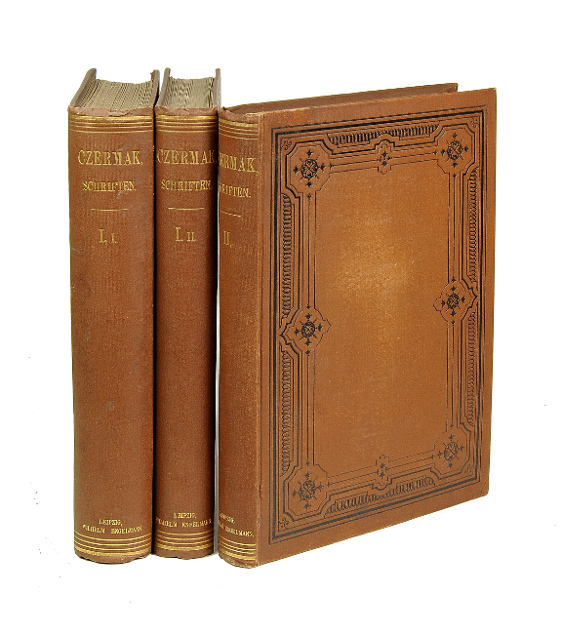
1879rif. 43770Leipzig, Wilhelm Engelmann, 1879. 4°. Mit einem Titelportrait, einer gefalt. Tabelle, 30 tlw. gefalt. lithogr. Tafeln u. zahlr. Textholzstichen. Zus. ca. 1240 S., OLwd.-Bde.
rif. SCI623M1861, J.-B. Baillière et Fils, Paris. Fort volume in-8, relié, demi-basane brune, dos à caissons, titre estampé, XII, 1046pp. 179 figures en noir in texte et une planche dépliante couleurs. Intérieur bon malgré quelques rousseurs. Infimes frottements. Très bel exemplaire dans sa reliure de l'époque.
1885rif. 029117Paris 1885 G. Masson Half-Leather (Hardcover)