THEOPHRASTUS.MareMagnum

19.566 risultati
1644Cm. 37, pp. (20) 1187 (89). Bel frontespizio interamente figurato e centinaia di incisioni xilografiche nel testo raffiguranti varietà di piante e fiori. Solida legatura strettamente coeva in pergamena rigida, dorso a nervi con titoli manoscritti. Qualche naturale brunitura al alcune carte, ma esemplare molto genuino, marginoso ed in ottimo stato di conservazione. Stimata e celebre edizione che presenta il testo latino e greco di questo classico considerato più importante dal punto di vista scientifico-botanico che filologico. Cfr. Nissen, Pritzel, e Choulant.
1828rif. 8180CB8 Bände. Bruxelles, Établissement Encyclographique, 1828–1832. Gr.-4°. 588 von (600) kol. Lithografien (eine Tafel nicht kiloriert). Moderne Halblederbände.
rif. 139061aafBasileae (Basel, Imhof), typis & sumptibus Joh. Rodolphi Im-Hof & Filii, 1767, in-8vo, 1 Bl. + 188 S. + 7 gestoch. Abbildungen auf 6 Falttafeln (Abb. IV und V auf 1 Tafel); gratis beigegeben: 1 Band der deutschen Übers. v. 1960, 255 S.: Naturgeschichte des Pilatusberges. Exlibris Peter E. Obergfell, H.-Pergamentband mit Ecken, Ledertitelschildchen. Schönes Exemplar. / 2) ill. Leinen + O.-Umschlag.
1847In-8 (mm. 235x143), 6 volumi, mz. pelle coeva (con abras.), fregi e titolo oro al dorso (uno restaur.), pp. XXXV,364; 391; 392; 383; 414; 394; con uno straordinario apparato iconografico di ben 600 tavole fuori testo: sono bellissime litografie colorate d’epoca che illustrano la flora medico-farmaceutica, suddivisa per famiglie. L’opera è introdotta da: cenni storici sulla botanica in genere e sulla materia medica vegetale - azione dei medicamenti in genere - dei mezzi per isvelare l’azione dei medicamenti - dose dei medicamenti e modi di somministrarli. “Il piemontese Felice Cassone (1815-1854), illustre botanico e medico, è l’autore di questa importante opera sulle piante medicinali, ciascuna ampiamente descritta in tutte le sue parti, le sue proprietà, le sue applicazioni in medicina, le sue varie denominazioni nelle diverse lingue, ecc. "Edizione originale", raro trovarla completa. Cfr. Nissen,334 - Pritzel,1583 - Cat. British Museum,I, p. 324. Con tracce d’uso; alcune tavole posposte o anteposte (ma opera completa); una pagina di testo restaur. per strappo ma complessivam. esemplare ben conservato.
rif. 32Chez l'Auteur, 4 volumes, demi-maroquin rouge à grains longs et à coins, dos lisses ornés de roulettes et palettes dorées, filets et fleurons dorés.
rif. 47337Paris.Imprimerie Royale.1694.Edition originale.2 vols.in-8.(manque le tome III).Tome I: 562 p.Table des Noms Latins.Table des Noms François.Frontispice gravé par Vermeulen.Tome II:Frontispice par Vermeulen et 233 planches. Veau porphyre aux armes de Louis XIV. sur chaque plat.Dos à 5 nerfs ;caissons ornés de lys et d'une couronne.Belle et rare édition bien qu'incomplète de la dernière partie des planches . Charnières fragiles.
1664rif. 105238BBBasel, Jacob Werenfels, 1664. Folio (38 x 24 cm.). [8] Bl., 663 S.; [2] Bl., S. 665-1316; S. 1317-1529, [66] Bl. mit Holzschnitt-Titelbordüre und ca. 3000, teils kolorierten Textholzschnitten. Blindgeprägtes Schweinsledereinband der Zeit über Holzdeckeln. 3 Teile in 1 Band.
1714In-4 gr. (mm. 336x216), p. pelle bazana coeva, cornici dorate ai piatti, dorso a cordoni con decoraz. e tit. oro su tassello, tagli dorati, pp. (4),XXVI,(2),(8),8,148 (inclusi antiporta figur. con il ritratto dell’A. e il tit. “Icones plantarum..” e il frontesp.), cui fa seguito l’Atlante composto da: antiporta figur. (come quella iniziale) e 334 tavv. inc. in rame che illustrano 1.324 tipi di piante (4 per ogni tav.) + numerose conchiglie raffigurate in 3 tavv. finali. Opera postuma, a cura di Antonio de Jussieu, che comprende oltre 100 specie di piante, qui descritte per la prima volta. "Prima e unica edizione". Cfr. Nissen,80 - Pritzel,423 - Choix de Olschki,VII,9837 - Haller,I,571 - Hunt,432. Bello e fresco esemplare. "Jacques Barrelier (1606-1673), medico francese, si fece domenicano dedicandosi ben presto allo studio della botanica e compì viaggi in Francia, Spagna e Italia. Dell’opera grandiosa, già iniziata a Roma, che si doveva intitolare "Hortus mundi" o "Orbis botanicus", non restano che le tavole (pubblicate postume col titolo "Plantae per Galliam, Hispaniam..", 1714), giacchè un incendio distrusse tutti i suoi manoscritti”. Così Diz. Treccani,II, p. 97.
1825London, James Ridgway, 1825-1830. Royal 8vo. Contemporary green hmorocco. A few minor scratches. Topedge gilt. XX,(224),(3) pp. (Leaves numb. 1-124 + Alphabetical Index). With all 112 engraved plates in beautifull handcolouring. (Plates by J. Hart, M. Hart, W. Hart and Mrs. brown, engraved by S. Watts and Wedell). A few textleaves with faint offsetting from the plates. Plates clean and fine.
1824rif. 30345DB16 Bände. London, Printed for the Author. 1824–1839. 8°. Mit 770 handkolorierten Kupfertafeln von John Curtis. Halblederbände der Zeit.
1739Stockholm, Pet. Momma, 1739. Small 8vo. Preserved in covers of older blindstamped golden paper. Title-page a bit soiled and with old owner's names (one of them crossed out, the other one being Roland Martin). A small restoration to lower blank margin of title-page. Woodcut initial at beginning and woodcut end-vignette. (18) pp.
1714Paris, Steph.Ganeau, 1714. Folio. Bound in one beautiful cont.full mottled calf w. six raised bands, gilt compartments. Hinges, capitals and corners professionally restored. Internally very nice and clean, apart from heavy browning to the smaller woodcut of the second title-page. Engraved title-page, title-page w. woodcut vignette, XXVI, (19), 140 pp., second engraved title-page, and 334 sheets of plates, containing 1327 fine engravings on 334 sheets (being 331 sheets with four engravings on each and three sheets with one large engraving on each all of these are numbered (the engravings on the first 331 sheets are numbered 1-1324) " number 406 has to extras, being 406+ and 406*, number 673 has one extra being 673+, number 674 has one extra, being 674+, numbers 826, 827 and 828 are collected on one engraving, and numbers 1076 and 1256 (would have been within the plates that consist of four engravings each) are omitted), complete. All of the first 331 sheets consist of four illustration, and most of them are made as four separate engravings, but some of them are made frofrom just two engravings, but still depicting four illustrations of axactly the same measure as the rest.
1838Jena, A.Schmidt, 1838-40. 4to. Bound in 2 later hcalf. 10, 128, 158 pp. and 277 very nice handcoloured engr.plates (of 285,8 plts.lacking in vol.II). Textpages with some brownspottings, esp.in vol.II. Plates fine.
1824rif. 71329Parisiis Paris: Treuttel et Würtz 1824. First edition. Leather Bound. Very Good. Octavo 21 cm 1/4 green leather with bluish-green and black speckled paper over boards. On spines in gilt: "A. De Candolle. Prodromus." Extremities rubbed to varying degrees. "Conservatoire Botanique Ville de Genève" ink stamp on the title pages. Pages lightly foxed however occasionally the foxing is more pronounced. Periodic neat brief contemporary markings and manuscript notations in the text of the first half of the volumes these markings are quite unobtrusive consist primarily of x's or dashes and do not distract from the text. Markings most abundant in volumes 1 and 2. Marks all but completely disappear in the second half of the volumes. Stitching visible in the inside margins every now and then. Very infrequent staining to the pages. Pp. 85-92 in volume 3 are hanging on by a thread. Else bindings very tight and sturdy. With indexes at the rear of each volume but not containing the index that was issued in 1874. Known as "The Prodromus" this is Candolle's monumental descriptive classification of all heretofore known seed plants. Augustin Pyramus de Candolle prepared the first seven volumes of "Prodromus Systematis Naturalis Regni Vegetabilis" with his son Alphonso completing the work with the help of various authors. Swiss botanist Augustin Pyramus de Candolle 1778-1841 is often described as one the greatest Swiss botanists of the early nineteenth-century. He is known for establishing scientific structural criteria for determining natural relations among plant genera. After Charles Darwin introduced the principles of organic evolution Candolle's criteria furnished the empirical foundation for a modern evolutionary history of plants. In his writings he argued that plant anatomy not physiology must be the only basis of classification for which he coined the term taxonomy. In addition to being credited with supplanting Linnaean classification Candolle is also remembered for pioneering the study of phytogeography the biogeography of plants. Treuttel et Würtz unknown
1824rif. 71329Parisiis Paris: Treuttel et Würtz 1824. First edition. Leather Bound. Very Good. Octavo 21 cm 1/4 green leather with bluish-green and black speckled paper over boards. On spines in gilt: "A. De Candolle. Prodromus." Extremities rubbed to varying degrees. "Conservatoire Botanique Ville de Genève" ink stamp on the title pages. Pages lightly foxed however occasionally the foxing is more pronounced. Periodic neat brief contemporary markings and manuscript notations in the text of the first half of the volumes these markings are quite unobtrusive consist primarily of x's or dashes and do not distract from the text. Markings most abundant in volumes 1 and 2. Marks all but completely disappear in the second half of the volumes. Stitching visible in the inside margins every now and then. Very infrequent staining to the pages. Pp. 85-92 in volume 3 are hanging on by a thread. Else bindings very tight and sturdy. With indexes at the rear of each volume but not containing the index that was issued in 1874. Known as "The Prodromus" this is Candolle's monumental descriptive classification of all heretofore known seed plants. Augustin Pyramus de Candolle prepared the first seven volumes of "Prodromus Systematis Naturalis Regni Vegetabilis" with his son Alphonso completing the work with the help of various authors. Swiss botanist Augustin Pyramus de Candolle 1778-1841 is often described as one the greatest Swiss botanists of the early nineteenth-century. He is known for establishing scientific structural criteria for determining natural relations among plant genera. After Charles Darwin introduced the principles of organic evolution Candolle's criteria furnished the empirical foundation for a modern evolutionary history of plants. In his writings he argued that plant anatomy not physiology must be the only basis of classification for which he coined the term taxonomy. In addition to being credited with supplanting Linnaean classification Candolle is also remembered for pioneering the study of phytogeography the biogeography of plants. Treuttel et Würtz unknown books
1739rif. 50984Stockholm, Pet. Momma, 1739. Small 8vo. Preserved in covers of older blindstamped golden paper. Title-page a bit soiled and with old owner's names (one of them crossed out, the other one being Roland Martin). A small restoration to lower blank margin of title-page. Woodcut initial at beginning and woodcut end-vignette. (18) pp.
1714rif. 38383Paris, Steph.Ganeau, 1714. Folio. Bound in one beautiful cont.full mottled calf w. six raised bands, gilt compartments. Hinges, capitals and corners professionally restored. Internally very nice and clean, apart from heavy browning to the smaller woodcut of the second title-page. Engraved title-page, title-page w. woodcut vignette, XXVI, (19), 140 pp., second engraved title-page, and 334 sheets of plates, containing 1327 fine engravings on 334 sheets (being 331 sheets with four engravings on each and three sheets with one large engraving on each all of these are numbered (the engravings on the first 331 sheets are numbered 1-1324)" number 406 has to extras, being 406+ and 406*, number 673 has one extra being 673+, number 674 has one extra, being 674+, numbers 826, 827 and 828 are collected on one engraving, and numbers 1076 and 1256 (would have been within the plates that consist of four engravings each) are omitted), complete. All of the first 331 sheets consist of four illustration, and most of them are made as four separate engravings, but some of them are made frofrom just two engravings, but still depicting four illustrations of axactly the same measure as the rest.
1838rif. 1768Jena, A.Schmidt, 1838-40. 4to. Bound in 2 later hcalf. 10, 128, 158 pp. and 277 very nice handcoloured engr.plates (of 285,8 plts.lacking in vol.II). Textpages with some brownspottings, esp.in vol.II. Plates fine.
2006Eichstätt, Universitätsbibliothek Eichstätt-Ingolstadt, SJ II 2892-2894. Basilius Besler (Norimberga, 1561–1629) farmacista e botanico tedesco, ha realizzato l’erbario per il vescovo di Eichstätt, in Baviera Johann Konrad von Gemmingen. Facsimile in tre volumi (44x52 cm.) : volume primo 134 tavole dedicate alla Primavera; volume secondo 127 tavole dedicate all’Estate; volume terzo 106 tavole dedicate all’Autunno, all’Inverno e una parte all’Estate. Le piante, rappresentate nelle tavole, seguono la fioritura stagionale. Commentario (29x38 cm.; pagine 286)) curato da : W. Dressendörfer, A. Menghini, D. Contin, K. Littger, W.D. Muller Jahncke. Testo in italiano, inglese e tedesco. Leggio in plexiglass. Edizione limitata a 1450 copie.
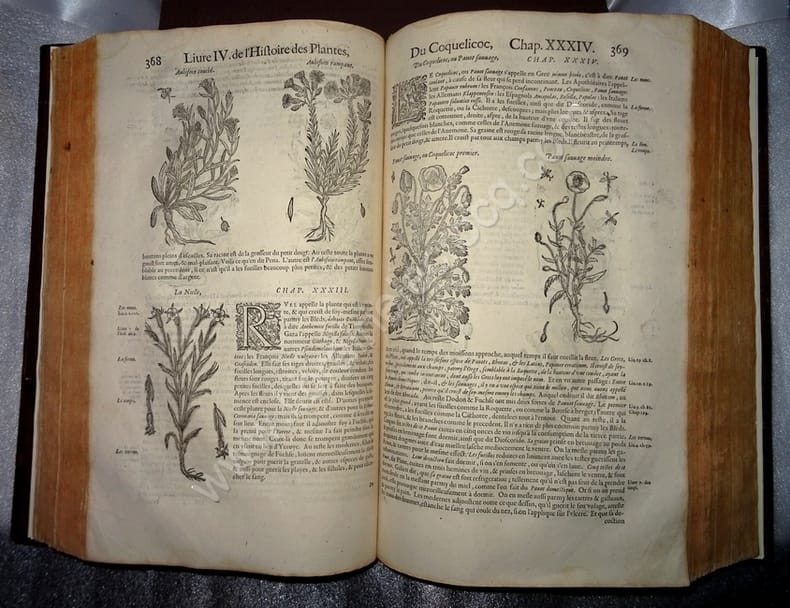
rif. 15584,Lyon, Guillaume Rouille 1615, (1)ff., 960pp., (18)ff. + (59)ff., 758pp., (15)ff. pp., 2 vol. in folio reliés : Sortie latine de la Bibliotheque de Me Jacques Dalechamps puis faite Françoise par Me Jean Des Moulins, Medecins très-fameux de leur Siecle, ou sont pourtraites et descriptes infinies plantes par les noms propres de diverses Nations, leurs especes, forme, origine, saison, temperament naturel et vertus convenables a la Medecine, avec un indice contenu au commencement du second tome tres utile et tres necessaire pour monstrer les proprietez des Simples, et donner guerison a toutes les parties du corps humain. Ensemble les tables des noms en diverses langues . Pleine basane brune, dos à 6 nerfs ornés de fleurons dorés, pièces de titre et de tomaison en maroquin rouge et vert, tranches rouges (les dos sont récents mais ont été refaits dans l'esprit de la reliure originale), légères traces d'humidité anciennes marginales en haut de l'ouvrage, restauration à la page de titre du tome 2 avec manque partielle de la marque d'imprimeur, page de titre du tome 1 remontée. Cet ouvrage célèbre est illustré de 2731 gravures sur bois, d'un beau tirage, il est divisé en 18 livres : Description et portraits de tous les Arbres qui croissent aux forêts sans être plantés; de tous les Arbrisseaux qui croissent de leur bon gré parmi les haies et buissons; des Arbres qui croissent dans les vergers; des Blés et Légumes, et autres Herbes croissant pêle mêle avec les blés; des Herbes potagères et autres qui croissent dans les jardins; des Plantes qui portent des Ombelles; des Plantes qui sont recommandées à raison de leurs belles fleurs; des Plantes odorantes; des Plantes bulbeuses; des Plantes purgatives; des Plantes vénéneuses. Première édition française la plus complète (l'édition latine fut publiée en 1586). Bel exemplaire bien complet.
1586In Folio (cm. 3) piena pergamena coeva, volumi, 2, cc.nn. 5, pp. 1095; 1097-1922, cc. 34 di Index, pp. 36 di Appendix, (2). Testate, capilettera e fregi incisi e centinaia di belle incisioni xilografiche. Frontesp. in rosso e nero con marca tipografica. Aloni e restauro ai soli frontesp. alcune leggere bruniture peraltro buon esemplare fresco e marginoso. L'A. fu medico, botanico ed erudito e questa è stata l'opera botanica più completa del suo tempo, portato a termine da Giovanni Des Moulins (Molinaeus) che ne curò pure una traduzione francese; e fu il primo a descrivere la flora della regione di Lione, illustrato con immagini di piante in gran parte derivate dal precedente lavoro di Pierandrea Mattioli ( 1501-1578) impreziosite da figure di insetti e fiori.
1877SMITH JAMES EDWARD - SOWERBY JAMES (E ALTRI) English Botany; Or, Coloured Figures of British Plants. THIRD EDITION, Edited by John T. Boswell Syme ... The popular portion by Mrs Lankester ... London, G. Bell and Sons 1877/1886, 12 grossi volumi in 8° grande, mezza pelle coeva con punte, titoli e scomparti ai dorsi. Opera monumentale sorretta da un incredibile apparato iconografico composto da 1922 tavole in colore del pittore James Sowerby, apparato che ha contribuito in maniera determinante a rendere famosa questa opera tanto che viene comunemente chiamata "Sowerby botany", anche se non va dimenticato che il curatore, John Boswell, aveva incaricato altri disegnatori e pittori. LEnglish Botany è uno strumento di didattica e di informazione sui metodi di coltivazione e sulla varia floricoltura del XIX secolo. La divisione in classe, ordine, genere e specie è comunque per ogni pianta precisa, ampia e scientifica: abbondano i particolari nella descrizione, nelle misure e nella nomenclatura. Lindice in lingua latina comprende la specificazione in specie, sottospecie e sinonimi. Qualche giallitura ma opera completa e ben conservata, solo leggerissima usura alle consistenti legature Buono (Good) .
1897rif. 11049ABAarau, Verlag von Emil Wirz, 1897. Quer-folio (ca. 240 x 340 mm). Vortitel, Titelblatt, Vorwort, 100 S., 100 Tafeln in Chromolithographie, (1) Bl. (Inhaltsverzeihnis), (24) S. mit Schlusswort und Erklärungen.D Orig. Leinenbände mit Goldprägung.
1650rif. 8237CB3 Bände. Yverdon 1650-1651. Folio. (4) Bl., 601 (recte 595) S., 440 (recte 438) S., 9 S. Index; (4) Bl., 1074 (recte 1086) S., (6) Bl. Index; (4) Bl., 212 S., 882 (recte 881) S., 1 weisses Bl., 12 S. Index. Mit 3 gestochenen Titeln und 3577 Holzschnitten im Text. Lederbände der Zeit.
1834rif. 8116CB16 Bände. London, Bradbury & Evans, Whitefriars, 1834–1849. 8°. Mit 717 kolorierten Tafeln (Bände 1–4 Kupfertafeln – Bände 5–16 Lithografien) + 2 kol. Pläne, 1 kol. Tafel (Geräte) und 1 schw.-w. Tafel. Halblederbände der Zeit mit dreis. Goldschnitt.