Went F.W. e redattori di LIFE.MareMagnum

1965(Codice CU/9884) In 4° (28 cm) 192 pp. Con molte foto e disegni anche a colori. Bibliografia, indici. Cartone editoriale, ottimo. ~~~ SPEDIZIONE IN ITALIA SEMPRE TRACCIATA
1798Hannover, bev des Gebrüdern Hahn, 1798. Fascicule in/4 à grandes marges en couverture d’attente, 6 planches aquarellées du temps, 30 p. 1f. Feuillets et planches en excellent état. Belle fraîcheur des coloris. L’ensemble des fascicules édités de 1798 à 1823, comptait 162 planches colorées. Pritzel 11158. Les présentes planches représentent : Erica Taxifolia, Erica Plukenetii interupta, erica laniflora Schmidt, eric strigosa ait, erica spicata, erica bergiana.
1854Hannover, Hahnii, 1854, in-8, legatura editoriale in mezza tela (qualche consunzione sui piatti in cartone), pp. XIV, [2], 68. Prima edizione.
1957In 8° tela edit sovracoperta pp 231. Foreword by Melville Bell Grosvenor Painting by Else Bostelmann.
1935réf. 4041CBBerlin-Schildow, Falken-Verlag Erich Sicker, o.J. (um 1935). 8°. 125 (1) S. Mit 49 Abb. im Text und mehreren Tabellen. Illustr. Orig.-Broschur (leicht berieben und bestossen, Rücken verblichen und fleckig). = "Falken-Bücherei", Band 25.
1935réf. 4041CBBerlin-Schildow, Falken-Verlag Erich Sicker, o.J. (um 1935). 8°. 125 (1) S. Mit 49 Abb. im Text und mehreren Tabellen. Illustr. Orig.-Broschur + Wichtig: Für unsere Kunden in der EU erfolgt der Versand alle 14 Tage verzollt ab Deutschland / Postbank-Konto in Deutschland vorhanden + (leicht berieben und bestossen, Rücken verblichen und fleckig). = "Falken-Bücherei", Band 25.
1989réf. BF351221989 315 p., 129 figures, paperbound. Leiden Botanical Series, Volume 12. New copy.
réf. 65745aafBern, H. Huber, 1952, gr. in-8vo, 135 S., ill. + 2 Abb., Original-Broschüre.
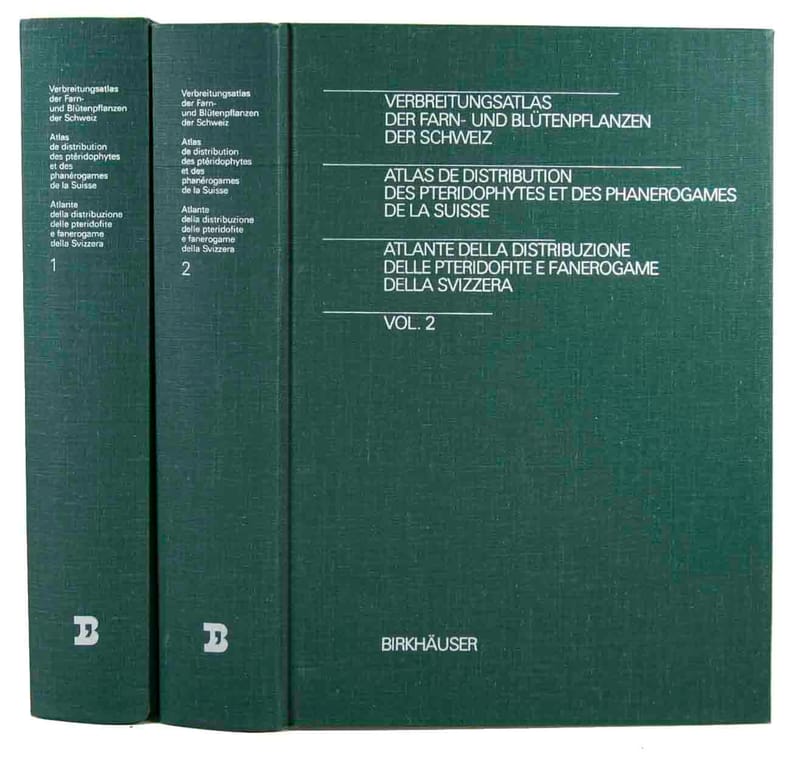
réf. 63479aafBasel, Birkhäuser, 1982, in-4to, 716 S., ill. / 698 S., ill., mit ca. 2572 Karten, Original-Leinenband, Schuber.
1912Stuttgart, (1912 c.a) 8vo brossura con copertina illustrata, pp.89 con 42 fig. n.t. e una tav. f.t.
8vo. Vol. 1: pp. viii,191, 206 illus. in text, index; vol. 2: pp. iv,226, 119 illus. in text, index. Plain old half cloth, orig. printed front cover mounted. Stamp on title-pages, trace of dried plant on a few pages at the end of vol. 1, a few other marks of use. - Mostly anatomy and physiology. Volume 1 is third, vol. 2 fifth edition. Scarce.
1957réf. BM383361957 478 p., 254 figures, cloth. Library stamps.
1961réf. RO20058403WEIZMAN SCIENCE PRESS OF ISRAEL. 1961. In-8. Broché. Bon état, Couv. légèrement passée, Dos satisfaisant, Intérieur frais. 355 pages. Nombreuses illustrations, photos et quelques cartes en noir et blanc dans le texte et en planches hors-texte. Ouvrage en anglais.. . . . Classification Dewey : 580-Botanique
1936Firenze, 1936, pp. 110/141 con fig. e ill. fotografiche, in fascicolo completo di "Bulletin de la Silva Mediterranea".
réf. 74120aaf(Leipzig & Wiebaden), Insel, 1960, 31.5 x 23.5 cm. (35 x 44.5), Die Herausgabe dieser prächtigen Pflanzenholzschnitte wurden bereits 1938 durch Anton Kippenberg veranlasst. Fritz Arnold druckte die ersten 48 Holzschnitte noch während des Krieges, aus der er nicht zurück kam. 1947 druckte Weisz selbst, das Werk wurde 1960 durch den Insel Verlag verlegt. O.-Umschlag + 1 handkolorierte Original-Holzschnitt.
réf. 52897Konigstein, 1959, grand in 8° broché, 64 pages ; jquette illustrée.
réf. 138465aafZürich, Ingo von Oppersdorff Verlag, 1978, in-Folio, 4 Bl. (Kollophon, 2 Bl. Text u. Tafelbeschreibung + 1 Blatt mit 16 s/w. Abb. d. Tafeln + 16 farbigen Tafeln, jeweils in Papier-Umschlag mit Titel, (numm. 1 bis 16), planches non reliées dans un cartable en toile verte. Lanières.
1866réf. BG077791866 61 p., 4 col. (1 folded) lithographed pls, disbound (no covers). Unopened copy. Published in: Sitzungsberichte der Kaiserlichen Akademie der Wissenschaften. Last page in photocopy.
1864réf. BG111021864 36 p., 3 col. lithographed pls, disbound (front cover of journal present). Unopened copy. Published in: Sitzungsberichte der Kaiserlichen Akademie der Wissenschaften.
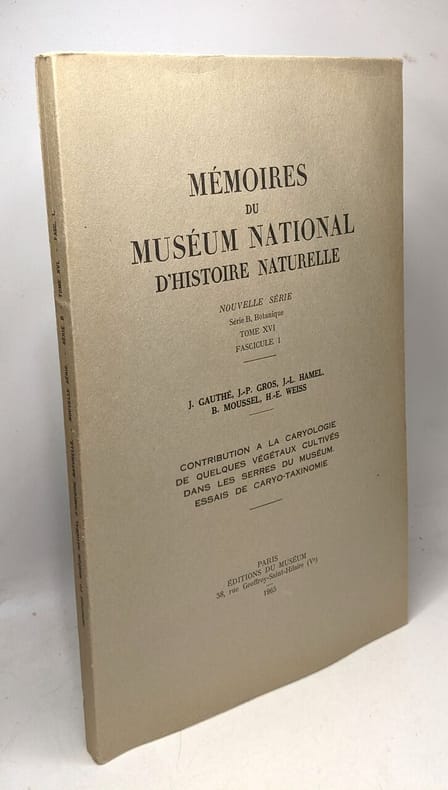
1965réf. 100127448Éditions du Muséum / Paris 1965 in4. 1965. Broché.
1903(London, 1903), estratto (stralcio) con copertina posticcia muta muta, pp. 217/235 con quattro tavole lit. - !! ATTENZIONE !!: Con il termine estratto (o stralcio) intendiamo riferirci ad un fascicolo contenente un articolo, completo in se, sia che esso sia stato stampato a parte utilizzando la stessa composizione sia che provenga direttamente da una rivista. Le pagine sono indicate come "da/a", ad esempio: 229/231 significa che il testo è composto da tre pagine. Quando la rivista di provenienza non viene indicata é perché ci è sconosciuta. - !! ATTENTION !!: : NOT A BOOK : “extract” or “excerpt” means simply a few pages, original nonetheless, printed in a magazine. Pages are indicated as in "from” “to", for example: 229/231 means the text comprises three pages (229, 230 and 231). If the magazine that contained the pages is not mentioned, it is because it is unknown to us.
1892(London, 1892), estratto (stralcio) con copertina posticcia muta muta, pp. 243/254 con due tavole lit. - !! ATTENZIONE !!: Con il termine estratto (o stralcio) intendiamo riferirci ad un fascicolo contenente un articolo, completo in se, sia che esso sia stato stampato a parte utilizzando la stessa composizione sia che provenga direttamente da una rivista. Le pagine sono indicate come "da/a", ad esempio: 229/231 significa che il testo è composto da tre pagine. Quando la rivista di provenienza non viene indicata é perché ci è sconosciuta. - !! ATTENTION !!: : NOT A BOOK : “extract” or “excerpt” means simply a few pages, original nonetheless, printed in a magazine. Pages are indicated as in "from” “to", for example: 229/231 means the text comprises three pages (229, 230 and 231). If the magazine that contained the pages is not mentioned, it is because it is unknown to us.
1772(Lipsia, Gleditsch, 1772) estratto con copertina posticcia muta, pp. 708/713 - !! ATTENZIONE !!: Con il termine estratto (o stralcio) intendiamo riferirci ad un fascicolo contenente un articolo di rivista, sia che esso sia stato stampato a parte utilizzando la stessa composizione sia che provenga direttamente da una rivista. Le pagine sono indicate come "da/a", ad esempio: 229/231 significa che il testo è composto da tre pagine. Quando la rivista di provenienza non viene indicata é perchè ci è sconosciuta. - !! ATTENTION !!: : NOT A BOOK : “estratto” or “stralcio” means simply a few pages, original nonetheless, printed in a magazine. Pages are indicated as in "from” “to", for example: 229/231 means the text comprises three pages (229, 230 and 231). If the magazine that contained the pages is not mentioned, it is because it is unknown to us.
1734Stampa botanica dalla monumentale opera di Johann Wilhelm Weinmann Phytanthoza Iconographia, sive conspectus aliquot millium, tam indigenarum quam exoticarum, ex quatuor mundi partibus... plantarum, arborum, fruticum, florum, fructuum, fungorum, &c . pubblicata a Regensburg tra il 1734 e il 1745. Mezzotinto con bella coloratura coeva, in ottimo stato di conservazione. Johann Wilhelm Weinmann era un influente speziale, farmacista e botanico di Ratisbona (Regensburg), in Germania. Il suo background è evidente nella composizione e nello stile degli studi botanici in quest'opera, che sono allo stesso tempo scientifici o erboristici e meravigliosamente decorativi. Ha usato la tecnica del mezzatinto per ottenere sottili variazioni tonali di foglie e petali di fiori. Molte delle superbe tavole di questo importante florilegio sono incise su disegni dell'eminente artista botanico Georg Dionysus Ehret, l'influenza dominante nell'arte botanica durante il XVIII secolo. Ehret nacque a Heidelberg, in Germania, e si formò come giardiniere. Divenne il protégé del Margravio di Baden-Durlach, che lo assunse per progettare i giardini della città e del palazzo a Karlsruhe e fare dipinti dei suoi fiori. Dopo aver lasciato l'impiego del Margravio, si trasferì a Ratisbona, dove incontrò Johann Wilhelm Weinmann, e fu ingaggiato per produrre i disegni che per la Phythanoza Iconographia. Bibliografia: Pritzel, Georg August. Thesaurus Literaturae Botanicae Omnium Gentium. Milan: 1950; Blunt, Wilfred, rev. by Stearn, William T. The Art of Botanical Illustration. Woodbridge, Suffolk, England: Antique Collectors Club, 1994. pp. 25, 154-55, 159-166, 181; Dunthorne, Gordon. Flower and Fruit Prints of the 18th and Early 19th Centuries. Their History, Makers and Uses, with a Catalogue Raisonne of the Works in Which They are Found. Washington, D.C.: Published by the Author, 1938. Botanical print from Johann Wilhelm Weinmann’s monumental work Phytanthoza Iconographia, sive conspectus aliquot millium, tam indigenarum quam exoticarum, ex quatuor mundi partibus… plantarum, arborum, fruticum, florum, fructuum, fungorum, &c . published in Regensburg 1734-1745. Mezzotint with fine original colouring, good condition. Johann Wilhelm Weinmann was an influential apothecary, pharmacist and botanist in Regensburg, Germany. His background is evident in the composition and style of the botanical studies in this work, which are at once scientific or herbal and beautifully decorative as well. He used mezzotint to achieve subtle tonal variations of leaves and flower petals. Many of the superb plates of this important florilegium are engraved after drawings by the eminent botanical artist Georg Dionysus Ehret, the dominant influence in botanical art during the 18th century. Ehret was born in Heidelberg, Germany, and trained as a gardener. He became the protégé of the Margrave of Baden-Durlach, who hired him to design town and palace gardens at Karlsruhe and make paintings of his flowers. After leaving the Margrave’s employ, relocated in Regensburg, where he met Johann Wilhelm Weinmann, and was engaged to produced drawings for Phythanoza Iconographia. References: Pritzel, Georg August. Thesaurus Literaturae Botanicae Omnium Gentium. Milan: 1950; Blunt, Wilfred, rev. by Stearn, William T. The Art of Botanical Illustration. Woodbridge, Suffolk, England: Antique Collectors Club, 1994. pp. 25, 154-55, 159-166, 181; Dunthorne, Gordon. Flower and Fruit Prints of the 18th and Early 19th Centuries. Their History, Makers and Uses, with a Catalogue Raisonne of the Works in Which They are Found. Washington, D.C.: Published by the Author, 1938.
1734Stampa botanica dalla monumentale opera di Johann Wilhelm Weinmann Phytanthoza Iconographia, sive conspectus aliquot millium, tam indigenarum quam exoticarum, ex quatuor mundi partibus... plantarum, arborum, fruticum, florum, fructuum, fungorum, &c . pubblicata a Regensburg tra il 1734 e il 1745. Mezzotinto con bella coloratura coeva, in ottimo stato di conservazione. Johann Wilhelm Weinmann era un influente speziale, farmacista e botanico di Ratisbona (Regensburg), in Germania. Il suo background è evidente nella composizione e nello stile degli studi botanici in quest'opera, che sono allo stesso tempo scientifici o erboristici e meravigliosamente decorativi. Ha usato la tecnica del mezzatinto per ottenere sottili variazioni tonali di foglie e petali di fiori. Molte delle superbe tavole di questo importante florilegio sono incise su disegni dell'eminente artista botanico Georg Dionysus Ehret, l'influenza dominante nell'arte botanica durante il XVIII secolo. Ehret nacque a Heidelberg, in Germania, e si formò come giardiniere. Divenne il protégé del Margravio di Baden-Durlach, che lo assunse per progettare i giardini della città e del palazzo a Karlsruhe e fare dipinti dei suoi fiori. Dopo aver lasciato l'impiego del Margravio, si trasferì a Ratisbona, dove incontrò Johann Wilhelm Weinmann, e fu ingaggiato per produrre i disegni che per la Phythanoza Iconographia. Bibliografia: Pritzel, Georg August. Thesaurus Literaturae Botanicae Omnium Gentium. Milan: 1950; Blunt, Wilfred, rev. by Stearn, William T. The Art of Botanical Illustration. Woodbridge, Suffolk, England: Antique Collectors Club, 1994. pp. 25, 154-55, 159-166, 181; Dunthorne, Gordon. Flower and Fruit Prints of the 18th and Early 19th Centuries. Their History, Makers and Uses, with a Catalogue Raisonne of the Works in Which They are Found. Washington, D.C.: Published by the Author, 1938. Botanical print from Johann Wilhelm Weinmann’s monumental work Phytanthoza Iconographia, sive conspectus aliquot millium, tam indigenarum quam exoticarum, ex quatuor mundi partibus… plantarum, arborum, fruticum, florum, fructuum, fungorum, &c . published in Regensburg 1734-1745. Mezzotint with fine original colouring, good condition. Johann Wilhelm Weinmann was an influential apothecary, pharmacist and botanist in Regensburg, Germany. His background is evident in the composition and style of the botanical studies in this work, which are at once scientific or herbal and beautifully decorative as well. He used mezzotint to achieve subtle tonal variations of leaves and flower petals. Many of the superb plates of this important florilegium are engraved after drawings by the eminent botanical artist Georg Dionysus Ehret, the dominant influence in botanical art during the 18th century. Ehret was born in Heidelberg, Germany, and trained as a gardener. He became the protégé of the Margrave of Baden-Durlach, who hired him to design town and palace gardens at Karlsruhe and make paintings of his flowers. After leaving the Margrave’s employ, relocated in Regensburg, where he met Johann Wilhelm Weinmann, and was engaged to produced drawings for Phythanoza Iconographia. References: Pritzel, Georg August. Thesaurus Literaturae Botanicae Omnium Gentium. Milan: 1950; Blunt, Wilfred, rev. by Stearn, William T. The Art of Botanical Illustration. Woodbridge, Suffolk, England: Antique Collectors Club, 1994. pp. 25, 154-55, 159-166, 181; Dunthorne, Gordon. Flower and Fruit Prints of the 18th and Early 19th Centuries. Their History, Makers and Uses, with a Catalogue Raisonne of the Works in Which They are Found. Washington, D.C.: Published by the Author, 1938.