LE PRIEUR.Livre Rare Book

5 041 résultats
1784réf. 11982A Tempé, Et se trouve à Paris, chez Moutard, 1784. In-8 de 1 feuillet blanc, IV-43 pp., 19 planches dont 3 dépliantes, basane racinée, doublée de toile de Jouy au ballon, dos lisse orné de fers au ballon, pièce de titre rouge, tête dorée, non rogné (reliure ancienne).
réf. 97533Gand, Imprimerie à vapeur, F. Meyer-Van Loo, 1885-1886-1887, 3 premiers volumes parus, in-folio de 360x265 mm environ, tome I : 103 pages avec planches sous serpentes, numérotées de I à XLVIII, sous serpentes, avec la couverture de la première livraison conservée - tome II, soit 12 livraisons : 102 pages avec planches sous serpentes numérotées de XLIX à XCVI, couvertures des fascicules conservées - tome III, soit 12 livraisons : 102 pages avec planches sous serpentes numérotées de XCVII à CXLIV, couvertures des fascicules conservées, demi chagrin à coins noir, dos à nerfs portant tires et date dorés, ornés de fleurons et filets dorés, gardes marbrées, tranches de tête dorée. Quelques rousseurs, cuir frotté, coiffes arasées sur le tome I, traces blanches sur les plats, complet des 144 planches.
First edition, folio (340 x 230 mm), xii, [2], 187, [1]pp., with half-title, engraved frontispiece portrait of the author, title printed in red and black with large engraved vignette, 2 folding plans of the Garden, 50 engraved botanical plates by Cosimo Mogalli after drawings by Tilli, alphabetically arranged with one to four specimens to a plate, cont. calf, neatly rebacked, a nice copy with the text and plates being bright and fresh. First edition of an important record of the botanical garden at Pisa which was founded around 1543 and was one of the finest and earliest gardens in Europe. Hunt notes that the alphabetical list of plants in this work is "one of the most important of the eighteenth century, and the volume memorializes the garden for all time." Hunt II, 457; Nissen BBI, 1967; Pritzel, 9356.
réf. 211165Paris, Imprimerie de François-Ambroise Didot l'aîné, 1782 in-4, 144 pp., maroquin vieux-rouge, dos à nerfs orné de filets, guirlandes et doubles caissons dorés, encadrement de triple filet doré sur les plats, tortillon doré sur les coupes, tranches dorées, double guirlande dorée en encadrement sur les contreplats, gardes doublées de tabis azur (Derome le jeune).
First edition, folio (330 x 210 mm), 3 parts in one, [2], 36; [4], 70; [4], 87, [5]pp., three separate title-pages within border of type ornaments, 39 engraved folding plates of fruits, all with bright contemporary hand-colouring, several related notes in ink to front free-endpaper, cont. half calf, paper covered boards (peeled away from upper cover), uncut. Johann Hermann Knoop (1700-1769), carried out much of his botanical research whilst curator of the gardens of Princess Maria Louisa in Leeuwarden. He broke new ground in the study of fruit varieties and he is regarded as the father of pomology. The first two part are devoted to the kitchen garden, the first part is illustrated with 20 splendid full-page engraved plates with hand-colouring, 12 are apples, 8 of pears, all showing several varieties, each labelled with its time of ripening, many for species now lost. The second has 19 engraved plates with contemporary hand-colouring showing peaches, plums, cherries, berries, etc. Part three is devoted to the cultivation of the garden and was issued un-illustrated. The fruit monographs are among the earliest books on the subject to be illustrated with coloured plates. Knoop himself made the original drawings, which were engraved by Jan C. Philips (1700-1773) or Jacob Folkema (1692-1767). Landwehr, Dutch Books with Coloured Plates, 88 (I) & 92 (II); Nissen, 1078 (I) & 1077 (II); Pritzel, 4754-4755.
1820réf. 110146Paris, L’Auteur, impr. De l’Imprimerie de Lebégue, rue des Rats, N° 14 1820 In-folio 44,5 x 29,5 cm. Reliure postérieure fin XIXe siècle, demi-chagrin havane, dos à nerfs encadrés de filets dorés, pièce de titre maroquin grenat, 56 pp. de texte suivies de 57 planches lithographiées par Motte, Bernard et Langlumé d’après Thouin, numérotés 1 à 57 dont une planche non numérotée entre les planches 25 & 26. Nerfs légèrement frottés, petites rousseurs marginales sur la dernière planche, sinon ensemble d’une grande fraîcheur. Bel exemplaire d’un ouvrage d’une relative rareté.
réf. 98059Paris C. L. F. Panckoucke 1814-1820 8 vol. relié 7 tomes en 8 vol. in-8, reliés demi-basane marbrée havane à coins, dos lisses ornés de frises et fleurons dorés, pièces de titre (reliure de l'époque), XVI + 209, (4) + 236, 265, 266, (4) + 280, 271, 199 et VIII + 278 + (6) + 174 + 3 pp. (mors un peu fragiles aux tomes 1, 4 et 6, étiquettes de cote aux dos). Edition originale illustrée de 2 tableaux dépliants et 424 planches botaniques en couleurs dessinées par Ernestine Panckoucke et Pierre-Jean-François Turpin. Les 6 volumes de Flore médicale, comprenant 350 notices classées par ordre alphabétique, sont complétés par deux volumes de l'Essai d'une iconographie élémentaire et philosophique des végétaux par Turpin et Poiret. Bel ensemble complet de cette fameuse iconographie botanique, avec les planches sous serpentes d'une grande fraîcheur.
réf. 98059Paris C. L. F. Panckoucke 1814-1820 8 vol. relié 7 tomes en 8 vol. in-8, reliés demi-basane marbrée havane à coins, dos lisses ornés de frises et fleurons dorés, pièces de titre (reliure de l'époque), XVI + 209, (4) + 236, 265, 266, (4) + 280, 271, 199 et VIII + 278 + (6) + 174 + 3 pp. (mors un peu fragiles aux tomes 1, 4 et 6, étiquettes de cote aux dos). Edition originale illustrée de 2 tableaux dépliants et 424 planches botaniques en couleurs dessinées par Ernestine Panckoucke et Pierre-Jean-François Turpin. Les 6 volumes de Flore médicale, comprenant 350 notices classées par ordre alphabétique, sont complétés par deux volumes de l'Essai d'une iconographie élémentaire et philosophique des végétaux par Turpin et Poiret. Bel ensemble complet de cette fameuse iconographie botanique, avec les planches sous serpentes d'une grande fraîcheur.
1818réf. 21571London, Diggens pour Ackermann, 1818 ; petit in-4°, demi-veau vert foncé, dos à nerfs décoré de fleurons à froid et de palettes, filets et titre dorés, roulette décorative à froid d’une part et d’autre du dos (reliure romantique de l’époque) ; VIII, 106, [4] pp. et 27 planches hors-texte très finement aquarellées, avec les plans.
1976réf. 65396Braunschweig, Éditions Schmücking, 1976. Qu.-Fol. Mit 10 sign. farb. Orig.-Kaltnadelradierungen von Zoran Music. 64 S., 2 Bll. (inkl. Radierungen), Lose Bogen in OUmschlag, transparentem Umschlag u. OLwd.-Kassette.
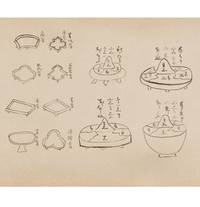
1796réf. 108121796. Approx. 40 brush & ink drawings in black & white. Scroll 180 x 1440 mm. central core roller. At end in rough trans.: “Many generations of SÅami bonsan 100 rules & styles. Extremely secret. All the information passed down by mouth is listed here. Handle this information with great care and keep it close. Given by Ishioka Seisaku 石岡正朔 in September 1796 to ZuihÅken no Yahiroko 瑞芳軒之八尋å.” Bonsan miniature mountain gardens is a sub-category of bonkei 盆景 tray-garden landscapes. Created to fit into small containers good bonsan convey the texture color and form of natural mountainous scenery. These small tray or pot landscapes have their origins in 10th-century China. The text in our scroll is a distillation of the teachings of SÅami ShinsÅ 相阿彌真相 1472-1525 painter art critic and artistic adviser to the Ashikaga shoguns in Kyoto master of the tea and incense ceremonies and landscape gardener. He established rules for and a school SÅami ryu of garden design and flower arrangement as well as the rules and styles for bonsan. “As a landscape gardener he designed two of the most celebrated Zen temple gardens in Japan: the RyÅan Temple garden in Kyoto an outstanding example of kare sansui a dry landscape technique in which combinations of stones and sand are used to suggest mountains and water; and the Daisei-in garden a miniature reproduction of a natural landscape also in the kare sansui style. It is believed that he also planned the garden of the famed Silver Pavilion Ginkaku Temple in Kyoto the villa built by his major patron Ashikaga Yoshimasa.”–Encycl. Brit. online. The author begins by extolling the pleasures of bonsan and offers advice on how to observe and enjoy them. He continues with descriptions of the materials used miniature trees sand rocks etc. seasonal variations the kinds of trays square rectangular circular and colors red white blue yellow brown and black and advice on where how and when to display them. The text also discusses the styles created over the centuries and famous sites that could be replicated on the trays. All of this is finely illustrated in a series of about 40 fine black & white brush drawings illustrating the many varieties of bonsan design. Ishioka was a resident of Kyoto and gave instruction on creating miniature gardens. He left another manuscript on miniature gardening see WorldCat 1451711637. In fine condition. Some worming mostly marginal. Preserved in a modern wooden box. unknown
1796réf. 108121796. Approx. 40 brush & ink drawings in black & white. Scroll 180 x 1440 mm. central core roller. At end in rough trans.: “Many generations of SÅami bonsan 100 rules & styles. Extremely secret. All the information passed down by mouth is listed here. Handle this information with great care and keep it close. Given by Ishioka Seisaku 石岡正朔 in September 1796 to ZuihÅken no Yahiroko 瑞芳軒之八尋å.” Bonsan miniature mountain gardens is a sub-category of bonkei 盆景 tray-garden landscapes. Created to fit into small containers good bonsan convey the texture color and form of natural mountainous scenery. These small tray or pot landscapes have their origins in 10th-century China. The text in our scroll is a distillation of the teachings of SÅami ShinsÅ 相阿彌真相 1472-1525 painter art critic and artistic adviser to the Ashikaga shoguns in Kyoto master of the tea and incense ceremonies and landscape gardener. He established rules for and a school SÅami ryu of garden design and flower arrangement as well as the rules and styles for bonsan. “As a landscape gardener he designed two of the most celebrated Zen temple gardens in Japan: the RyÅan Temple garden in Kyoto an outstanding example of kare sansui a dry landscape technique in which combinations of stones and sand are used to suggest mountains and water; and the Daisei-in garden a miniature reproduction of a natural landscape also in the kare sansui style. It is believed that he also planned the garden of the famed Silver Pavilion Ginkaku Temple in Kyoto the villa built by his major patron Ashikaga Yoshimasa.”–Encycl. Brit. online. The author begins by extolling the pleasures of bonsan and offers advice on how to observe and enjoy them. He continues with descriptions of the materials used miniature trees sand rocks etc. seasonal variations the kinds of trays square rectangular circular and colors red white blue yellow brown and black and advice on where how and when to display them. The text also discusses the styles created over the centuries and famous sites that could be replicated on the trays. All of this is finely illustrated in a series of about 40 fine black & white brush drawings illustrating the many varieties of bonsan design. Ishioka was a resident of Kyoto and gave instruction on creating miniature gardens. He left another manuscript on miniature gardening see WorldCat 1451711637. In fine condition. Some worming mostly marginal. Preserved in a modern wooden box. unknown books
réf. 245255Beloeil, De l'Imprimerie de Charles de ----, 1781, in-8, (6)-150 pp., texte dans un encadrement gravé, demi-basane fauve,dos lisse, filets dorés, pièce de titre de maroquin rouge (reliure de l'époque). Dos refait.
1737réf. 16756Paris, Charles-Antoine Jombert, 1737-1738. 2 volumes in-4° de [10]-XVI-198-[2]; VI-[1]-180 pages plein veau havane moucheté de noir, dos à nerfs aux filets estampés à froid, pièce de titre et de tomaison en maroquin rouge, superlibris "Le Duc de Nivernois" frappé aux plats, double filet doré aux coupes, roulette dorée aux chasses, tranches rouges.
1658In -4°, due parti in un volume, antiporta figurata incisa, due tavole incise a piena pagina di cui una con ritratto dell’autore. Testo corredato da centinaia di vignette, testatine, iniziali e finalini istoriati calcografici; diverse illustrazioni incise (I) legato con “Poesie liriche toscane”, inc. di Giovanni Battista Bonacina, Etienne Picart su disegni di Gregorio Tomasini; legatura in piena pergamena coeva semirigida, fioriture e lievi macchie di umidità e bruniture su alcune carte (in particolare pp. 89-92), segni di restauro su alcune carte. Molto raro, questo libro è uno degli esempi più impressionanti della produzione barocca italiana: sconosciuto ai compilatori della Bibliografia Romana: Boffito nomina il primo frontespizio inciso come registrato da Le Blanc, ma aggiunge che per loro un esemplare sarebbe stato introvabile. Prima edizione delle due opere, rilegate assieme e pubblicate postume, probabilmente è un omaggio a Cesarini stampato in tiratura limitata. L’autore è un cugino di Federico Cesi, studioso di legge e filosofia e appassionato di astronomia e matematica. Amico di Galileo e membro dell’Accademia dei Lincei, sollecitò Galileo a scrivere Il Sggiatore. I versi qui contenuti sono dedicati ciascuno a personaggi illustri dell’epoca (molti di loro membri dell’Accademia). Rossetti 1824 Very rare, this is one of the most impressive examples of Italian baroque book production: It was not known to the compilers of the Bibliografia Romana: Boffito mentions the first engraved title page as registered by Le Blanc, but it adds “We couldn’t find the edition”. First edition of the two works, issued together and posthumously published, with a life of the author included. This was probably a memorial to Cesarini published in a small number of copies. The author was a cousin of Count Federico Cesi and, after studies in law and philosophy, developed a passionate interest in mathematics and astronomy. He was friend of Galileo and Ciampoli and a member of the Accademia dei Lincei. He went on to urge Galileo to write Il Saggiatore. The verses here contained, latin and italian, are each dedicated to a notable contemporary (many of these were members of the Accademia).
1989réf. L557Bibliothèque des Arts Décoratifs, 1989, 170 p.