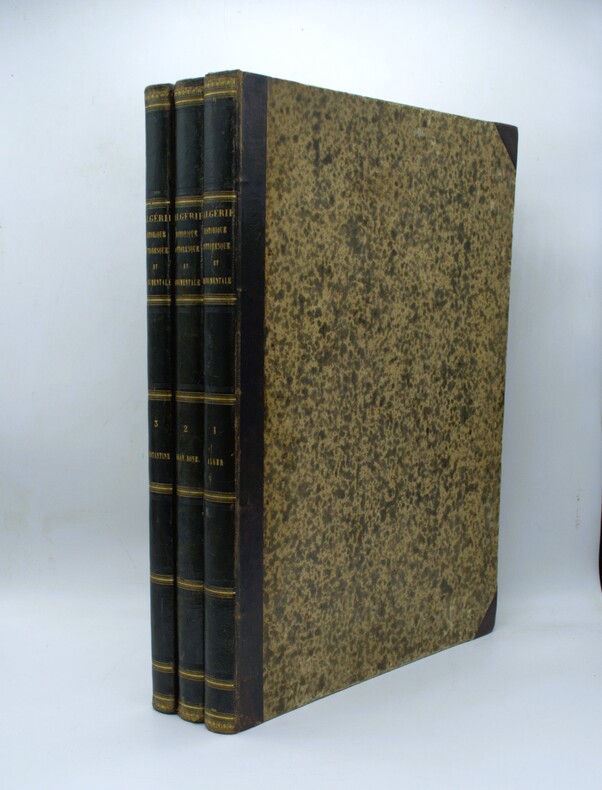
BERBRUGGER (Louis-Adrien).Livre Rare Book
3984 risultati
1843rif. PHO-2292Paris, Chez J. Delahaye Éditeur, 1843. Cinq parties reliées en 3 volumes in-folio demi basane brune à coins, dos lisse cloisonné de filets or, titre doré (Koenig). Quelques planches roussies, comme toujours, petites rousseurs.
First and only edition. Title-page (with large lithographed image of a country house) plus one hundred gorgeous lithographs by Victor Petit, each depicting a a country house or related structure, such as a gazebo, belvedere, pavillion, etc. COMPLETE. Printed on very fine bright white wove paper. Aside from being an architectural and art-historical document of the first order of importance, this set of lithographs is a work of great artistic merit and beauty. Folio. LOOSE AS ISSUED IN THE ORIGINAL PRINTED CLOTH-BACKED BOARD PORTFOLIO, WITH CLOTH TIES. Portfolio case a bit worn but still solid. Plates FINE AND BRIGHT. An incredibly fresh set. Rare and important.
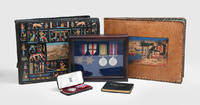
1940rif. 1690571940-43. Fine photographs of North Africa and the Middle East A British airman's substantial archive comprising photographs autographs ephemera and medals. A skilled photographer Jack Leslie Lees 1912-1980 was a leading aircraftman at the RAF's Air Ministry Experimental Station AMES Number 235 a British radar unit employed in Wadi El Natrun Egypt and Tobruk Libya where they suffered German attack in 1942. His personal archives hold extensive records of his military service and activities on leave between 1940 and 1943. The photographs portray Lees and other soldiers during their free moments and in battle as well as everyday scenes at the base and outside. He photographed Aboukir Alexandria including the zoo Cairo and Mersa Matrouh the site of several battles. In 1941 he was in Tobruk where he photographed as always everyday scenes and interesting buildings and documented the siege; he was also in Derna and Benghazi. Lees was especially fond of Jerusalem where he visited and photographed the holy sites. The first album opens with a Certificate of Pilgrimage with a chip of rock from the Grotto from Lees's visit to the Holy Sepulchre in Jerusalem issued signed and stamped in Greek by Archimandrite Kyriakos; Lees also kept a memento with the leaf of a tree from the Garden of Gethsemane. The albums include fine views of Beirut's cityscape and other areas of Lebanon where he visited ruins and the Jezzine waterfalls as well as of Syria with several Roman sites and a coastal town perhaps Latakia or Tartus. The autographs and sketches in his pocket book were jotted down by British soldiers; one in Russian calls Lees "a comrade met in Tel-Aviv". Together 5 items: landscape folio brown camel leather album 325 x 345 mm with tooled and hand-coloured pictorial scene long-stitched with thick leather strip green silk pastedowns one with pasted broadsheet 15 stiff black card leaves tissue guards 224 photographs c. 61 x 87 mm mostly gelatine silver prints with ink caption at head of some leaves; landscape folio black leather 250 x 320 mm with tooled both covers and hand-coloured front cover only pictorial scene and Egyptian hieroglyphs long-stitched with a lace 30 stiff black card leaves 411 photographs c.61 x 87 mm of which 3 inserted loosely and 5 hand-coloured mostly gelatine silver prints occasional captions in white pen; an oblong octavo leatherette autograph book 90 x 110 mm upper cover gilt-lettered label of Oriental Philatelic House B. Hagopian Cairo on front pastedown 96 pages with autographs dedications and sketches in ink to 34 pages the remainder blank; a wooden display case 200 x 250 mm with velvet lining glazed containing four medals Atlantic Star Africa Star with North Africa 1942-43 bar Defence Medal and War Medal; and a leather flip case 125 x 55 mm with velvet lining containing one Imperial Service Medal. Extremities occasionally a trifle rubbed: very good examples. hardcover
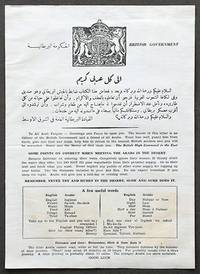
1940rif. 170773London: British High Command in the East c. 1940-43. Greetings and Peace be upon you A rare chit for RAF pilots to carry during the North Africa Campaign 1940-3 in case of being lost or captured. Written for the benefit of British personnel in the field the focus is simple and concise. The first paragraph in English and Arabic presents a simple greeting asking for hospitality. The following gives points of conduct such as "remove footwear before entering their tents" and "do not expect breakfast if you sleep the night. Arabs will give you a mid-day or evening meal". A word list includes translations of "friend" "food" "tired" and "enemy". We have encountered two other issues: one slightly simplified British issue and an American issue carried by all pilots and crewmen of the Twelfth Air Force with a message from President Roosevelt instead of the British High Command in the East. Single sheet 244 x 173 mm text in Arabic and English on recto only vignette of the Great Seal of the Realm at head backed on coarse linen and mounted on black card within white card mount all on laminate board presented in dark oak frame with conservation acrylic glazing 353 x 280 mm. Minor foxing sometime folded. A very good example of a fragile publication. "Notes for Communicating with Arabs" IBCC Digital Archive document 25543. unknown
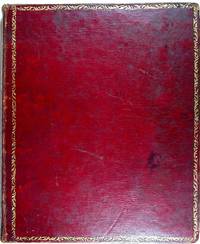
1814rif. 2677Hunthill House Scotland 1814. 4to 230 x 185 mm. 10 233 4 pp. Written in an italic hand in English with occasional corrections or additions in a different hand on wove paper watermarked Budgen & Wilmott / 1812. Four unnumbered pages of French text at front and four at back the latter dated 27 May 1814 in a different hand apparently the author's on different paper with no visible watermark. Very good; some occasional spotting. Contemporary red straight-grained morocco gilt edges scuffed and scraped joints strained head of spine chipped. A first-hand unpublished memoir by a French army officer of the terrible Peninsular War. The narrator was one of few survivors of the surrender of French forces after the Battle of Bailén in July 1808. The background to this event was Napoleon's attempt to complete the isolation of England from the continent by sending a French army into the Iberian Peninsula to seize the coast of Portugal and occupy Spain. Napoleon later referred to the Peninsular War characterized by appalling cruelty on both sides as the 'Spanish ulcer'; it was to be one of the primary factors in his downfall. Although written in a matter-of-fact tone the details of this memoir are searing. General Pierre Dupont de l'Étang was charged with securing French control of the major cities in Spain. Dupont's 20000 men had initial success but as they penetrated deeper into Spain they faced increasing resistance. The present diary traces the route and experiences of Dupont's army to its furthest point of penetration into Spain: Córdoba. There after a particularly bloody and cruel occupation the army was forced to withdraw and was soon overwhelmed. Dupont surrendered his army at Bailén. Originally promised safe passage most of the French were slaughtered immediately after their surrender. The start of the Peninsular War marks the commencement of the memoir written by H. de Montvaillant an officer from Montpellier who was serving in the second Corps d'Observation of the Gironde placed under the direction of General Dupont. Although the starting date of the campaign is generally accepted as March 1808 by Montvaillant's account the French had already occupied the town of Vittoria 50 miles west of Pamplona by Dec. 22 1807. By January 9 1808 French troops had advanced to south of Burgos heading toward Valladolid. At every stopover small detachments were left behind to guard the roads thereby diminishing the strength of the army as it travelled. Spanish guerrilla activity took a toll on the troops; so much so that the author records that the troops had to "redouble our vigilance and take measures the most severe ever adapted to ensure our safety" p. 58. On Feb. 16 they entered Medina del Campo on their way to Madrid. Montvaillant records his impressions of the city its palaces and inhabitants. Toledo was the next destination where he notes a visit to the palace library and the suppression of an uprising led by monks. By the end of May the French had occupied Consuegra and entered La Carolina in Andalusia. It is at this point that the narrative takes on an ominous tone. About to enter Seville Montvaillant notes a change in circumstances in the countryside and the inhabitants. The population is abandoning villages and fleeing. He records that the senior officers assumed that the army would only be harassed by small bands of "brigands" p. 84 a far cry from the massive insurgency that it encountered: "We learned that the insurgents each day gathered strength and that the Junta of Seville was determined to stop us in our march. The following days we got to the little town Baylen Bailén in whose plains two months afterwards our destiny was decided" p. 86. The French attacked and sacked the city of Córdoba: "Neither tears promises or humble supplications could arrest the thirst for pillage." p. 89; discipline was nonexistent and the drunkenness and looting continued for eight days. Soon after Montvaillant is ordered back to the village of Alcolea not far from Bailén to guard a bridge crossing. While there he discovers the slaughter of the French sick and wounded who had been left along the line of march while the main body of General Dupont's troops had taken Córdoba. The army had moved back to Andujar near Bailén and encamped. Montvaillant records that the general staff soon realized that the French were now outnumbered and that the opposition had organized itself. Dupont's army was isolated without hope of reinforcement or re-supply defending a garrison at the village of Andújar situated on a flat plain in the scorching sun. The narrative is now of troop dispositions losses tactical mistakes errors of the general staff and increasing difficulties. Dupont's surrender came on July 20 1808. The officers were segregated from the defeated army before being escorted supposedly to France. Most of the remaining army was slaughtered within days. Montvaillant records the details of his months-long "death march" southwards to the coast finally arriving at Jerez de la Frontera near Cádiz to await embarkation to France. This never occurred. The officers' captors kept them in Jerez having discovered that the ruling Junta of Seville had abrogated the surrender treaty and that the inhabitants were waiting to massacre the French on their approach to Cádiz. Montvaillant now fills his account with anecdotes of captivity and of the officers' horrendous treatment at the hands of their escorts and guards. He is unclear as to exact dates but it seems that the French captives were held at Jerez until mid-December before being hastily driven aboard ships to sail for the Balearic Islands p. 141. A severe storm intervened and they were blown off course to Africa finally coming to port at Gibraltar; several days later they were already back in Andalusia at Málaga. Then after more storms and much sailing they finally made the Balearics where they were exiled to the desert island of Cabrera. There some 4400 surviving men and officers were forced to survive as best they could p. 148. Almost 250 officers were collected from this exile after a month and taken to the capital Palma. Imprisoned there though in better conditions than previously this group of officers waited; nearly half would be massacred during a riot and assault on the prison by the inhabitants of Palma. By March 1809 only 140 of the original 250 rescued officers were alive and were returned to Cabrera where the living conditions were desperate pp. 155-165. Despite this the officers were able to conjure up distractions. There is an account of theater productions dances and the jealousy and bickering among those playing female roles in these performances. Montvaillant comments that the theatrical chronicle of Cabrera would make quite a book. Eventually the officers were placed aboard an English ship. On August 4 when they were off Cape Palos near Cartagena there were rumors of a prisoner exchange which again did not occur. After several weeks aboard the English ship Montvalliant and his companions were disembarked at Portsmouth. He continued on to Salisbury then embarked again for Leith en route to his final destination in Scotland Jedburgh where he remained in exile until the accession of Louis XVIII in 1814. The text is written in an occasionally stilted English. Eight pages of notes in French by the author are inserted four at the beginning using wax seals to insert the bifolium and four at the end dated May 27 1814. The French preface consists of a romanticized fictionalized account of the author's Scottish sojourn including a temptress fairy and concluding with the author's promise to never forget his friends in Scotland. The English text is preceded by the title-leaf and a one-page dedicatory poem introduced by a statement that these "`Recollections' in an English Garb are presented by the sincerest of Friends to the Author" and dated Hunt Hill 1 January 1814. The first of the four final pages in French provides some information about the history of the manuscript the remaining pages contain literary notes including translations into French of poems by Robert Burns and Sir Walter Scott. According to these comments the diary was originally written in French and was translated into English by the narrator's benefactors in Jedburgh. During his years of exile Montvaillant had befriended a well-off family Rutherford the owners of nearby Hunthill House to whose three young daughters he became deeply attached. Without them he claims he would not have survived the loneliness of his exile. To pay them homage and in acknowledgement of his gratitude he dedicated his memoir to them. His friends retained the original French version as a valued keepsake of their friend and an engrossing biographical narrative and presented him with this translation which he brought back to France planning to render it anew into French to share with his family and close friends. The annotations in the text appear to be the author's. He emphasizes that he plans to keep the manuscript unpublished; perhaps the memories were too painful. unknown books
Signed, without inscription, by both authors upon half-title page. [xiv], 382 pages. Footnotes. Index. "Offers an utterly persuasive prophecy about a new American era that will begin just after the millennium." - dust jacket. Yellow high-lighting to eight pages. Light overall wear. Binding tight. Dust jacket now preserved in archival-grade Brodart. Today, Neil Howe applies the Strauss-Howe generational theory with consulting companies he founded with Strauss, who passed away in 2007. Book
rif. 162183(Hanau), (1813-1814) 40 x 55,5 cm, Gouache sur papier contrecollée, cadre de bois.
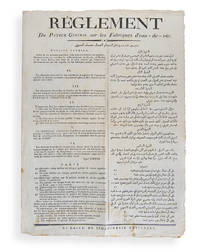
rif. 123044Cairo Egypt Impprimerie Nationale c. 1800. . Single broadside printed in parallel French and Arabic text 460 x 325 mm; type-set printed in dual French and Arabic presented in two columns leaf with wide margins uncut a little creased at outer edges and with fold lines along central horizontal and vertical folds light water-staining to lower edge overall very good condition. Napoleon Bonaparte's Egypt Campaign in 1798 lead to the establishment of the first printing press on the African continent preceding the well-known Egyptian Bulaq Press established by Muhammad Ali Pasha al-Mas'ud by over two decades. The press was predominantly formed to print proclamations and official statements in French with Arabic translations that were often poorly translated and rife with grammatical error for use as political propaganda for Napoleon's campaign in Egypt. The single-sheet documents were meant to be wall mounted and therefore are ephemeral in nature with very few copies surviving. The present example is a rare proclamation announcing the new tarifs and laws relating to the production of liquor in Egypt under Napoleonic rule. It was issued by Martin-Roch-Xavier Estève 1772-1852 the paymaster of Napoleon's Armée de l'Orient and contains six articles regulating the production and introducing tarifs of liquor production in the region. The broadside notes that distilleries need to be registered and needed to clearly distinguish themselves with large 'Fabrique d'Eau de Vie' lettering there is a stipulation that frequent inspections would be made and that the finished product needed to have a minimum of 18 percent alcohol content per volume. The raw materials listed in the proclamation include five qualities of fresh dates dried dates figs and raisins. Very scarce: No other copies located not in the Bibliotheque Nationale de France or any records showing in OCLC. Cairo, Egypt, Impprimerie Nationale, c. 1800. unknown
1814rif. PHO-2347Paris, Chez Audibert, Michaud, Eymery, 1814, 4 éditions en 1 volume in-8 (20,5x13cm), 2ff.-174-1f-11pp. (prospectus)/96pp./112pp./2ff.xii-334pp.-2ff., basane époque raciné, dos lisse orné avec pièce de titre, tranches jaspées. Petites épidermures, accrocs à la coiffe supérieure, carte déchirée sans manque.