NORTH AFRICA CAMPAIGNBiblio.com
4682 risultati
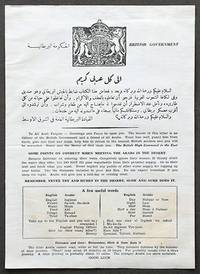
1940rif. 170773London: British High Command in the East c. 1940-43. Greetings and Peace be upon you A rare chit for RAF pilots to carry during the North Africa Campaign 1940-3 in case of being lost or captured. Written for the benefit of British personnel in the field the focus is simple and concise. The first paragraph in English and Arabic presents a simple greeting asking for hospitality. The following gives points of conduct such as "remove footwear before entering their tents" and "do not expect breakfast if you sleep the night. Arabs will give you a mid-day or evening meal". A word list includes translations of "friend" "food" "tired" and "enemy". We have encountered two other issues: one slightly simplified British issue and an American issue carried by all pilots and crewmen of the Twelfth Air Force with a message from President Roosevelt instead of the British High Command in the East. Single sheet 244 x 173 mm text in Arabic and English on recto only vignette of the Great Seal of the Realm at head backed on coarse linen and mounted on black card within white card mount all on laminate board presented in dark oak frame with conservation acrylic glazing 353 x 280 mm. Minor foxing sometime folded. A very good example of a fragile publication. "Notes for Communicating with Arabs" IBCC Digital Archive document 25543. unknown
rif. 125605London circa 1958-1981. . 27 loose flyers pamphlets and booklets and 1 poster 50 x 38 cm. Some creasing toning and spotting occasional short closed tears poster unused overall very good condition. A fantastic collection of twenty-four ephemeral flyers and pamphlets and one poster tracing the history of the Campaign for Nuclear Disarmament and its splinter group the Committee of 100 during the 1950s and 60s. Including a rare mimeographed publication by Spies for Peace on RSG 6; an unused Committee of 100 poster; an early flyer on the origin and meaning of the CND logo and the first ceramic badges; a booklet of talks by prominent women activists including Iris Murdoch; and a booklet illustrated by photomontage artist Peter Kennard. The Campaign for Nuclear Disarmament was founded in 1957 and remains one of the largest and most influential anti-nuclear activist groups in the world. From the beginning it attracted the support of numerous public figures and its striking logo became the internationally recognised 'peace sign'. The CND's most significant activity during the 1950s and 60s was its annual march from the Atomic Weapons Research Establishment at Aldermaston to London. After a period of decline during the late 1960s and 70s when attention shifted to the Vietnam War the organisation saw a revival in the early 80s in response to US missiles being deployed in Britain. The most significant CND items in this collection are: 1. 'Britain and the Bomb: The Fallacy of Nuclear Defense' a twenty-page pamphlet by playwright and Labour MP Benn W. Levy 1900-1973 published in 1959. 2. Pottery badge flyer. The 'peace sign' was designed by artist and CND member Gerald Holtham 1914-1985 and was initially distributed in the form of white and black ceramic badges made by designer Eric Austen 1922-1999. This flyer explains the origin and meaning of the symbol. 3. Advice to Marchers flyers for the 1961 and 1963 Aldermaston marches both a single sheet folded once. These provide details of the route and activities do's and dont's and recommended clothing and supplies. 4. Women Ask Why: An Intelligent Woman's Guide to Nuclear Disarmament' containing the text of three talks by novelist Iris Murdoch 'Morality and the Bomb' developmental biologist and IVF pioneer Anne McLaren 'Genetic Effects of Radiation' and archaeologist and peace activist Jacquetta Hawkes 'The Way Out'. The talks were presented at the Methodist Central Hall in Westminster on January 15th 1962. 5. An attractively designed flyer with geometric decoration advertising the Easter March of 1966 and which could be used to request more information by post. 6. 'No Nuclear Weapons' by Peter Kennard and Ric Sissons published by Pluto Press in 1981. This forty-four page booklet is extensively illustrated by photomontage artist Peter Kennard 1949 - including his famous 'Haywain with Cruise Missiles' based on Turner's The Hay Wain. The Committee of 100 was a splinter group of the CND founded by Bertrand Russell and other organisation leaders to engage in non-violent civil disobedience as a compliment the CND's non-confrontational approach. It quickly became successful and the first event was a sit-down demonstration at the Ministry of Defence on February 18th 1961 in which several thousand people took part. But debts internal conflict heavy-handed police action and the shifting of focus to other causes took a toll. In 1962 the national organisation disbanded in favour of regional groups of which the London branch was the most active. Russell resigned in 1963 and the committee as a whole was wound down in 1968. The most significant Committee of 100 items in this collection are: 7. Mimeographed hand-out dated February 11 1961 providing details and advice for the Committee's first action on February 18th 1961. It explains that 'the number of people pledged to participate in the sit-down. totalled 2040 by this morning. Pledges are still being received at a rate of 40-50 per day and a large and effective protest is now assured.' Participants are advised to contact their local news outlets and to put up posters accommodation is available at the Stoke Newington Society of Friends Meeting House and advice is given on how to deal with police and press on the day. 8. 'Anti-Polaris demonstration 18th Feb' flyer advertising the first action which is take place 'about the time that the U.S. depot ship carrying Polaris Missiles is expected to arrive in the Clyde'. The demonstrators 'intended to serve notice on the Government that they can no longer stand aside whilst preparations are being made for the destruction of mankind'. Speakers are to be Bertrand Russell art historian Herbert Read and poet Hugh McDiarmid. Strikingly designed and incorporating the CND logo. 9. 'Legal Briefing for all Demonstrators' for the action on February 18th 1961 single sheet folded once. A detailed explanation of the procedure for arrests and potential charges and penalties for participation. 10. 'The Policy of the Committee of 100' single sheet flyer. An early undated flyer explaining the Committee's aims and principles. 11. 'Committee of 100 Announces a Public Assembly in Parliament Square' single sheet folded once. This flyer advertises the Committee's second major action a sit-down assembly in Parliament Square. With advice for the day and illustrated with photographs of the February 18 event including a large crowd with Parliament in the background and Bertrand Russell and Reverend Michael Scott seated on the ground. 12. Large flyer single sheet folded once describing the Committee's purpose its first three actions and the response of the authorities and stating that the next demonstration is planned for December 9th 1961. The cover of this striking publication is a black and white photograph of a protester being dragged from Trafalgar Square. 13. 'Mass Resistance Saturday 9th December 1961' single sheet folded once. This flyer advertises the Committee's fourth action the simultaneous blocking of the NATO base at Wethersfield USAF headquarters at Ruislip and the strategic bomber base at Brize Norton with demonstrations in Cardiff Bristol Yorkshire and Manchester. It was at this point that the authorities began taking the organisation very seriously. Its office was raided and six members arrested and jailed for conspiracy though the police refused to arrest Bertrand Russell when he put himself forward. 14. 'Air Ministry: Mass Sit-Down 7000 Strong' single sheet of yellow paper printed in black. After the arrest of the 'Wethersfield Six' many activists felt that mass civil disobedience had failed to accomplish the group's aims or change public opinion and support began to dwindle. This flyer was distributed to advertise a 1962 demonstration that was to take place on September 9th but had to be called off due to lack of participants. 15. Poster for a 'Public Assembly Richmond Terrace Air Ministry September 23 3pm'. This poster printed in red and green on white advertises the assembly planned to replace the cancelled sit-down protest. 16. 'Danger! Official Secret: RSG-6' by Spies for Peace published on Good Friday 1963. Just off the normal Aldermaston march route was a secret government complex RSG 6. Regional Seats of Government were part of civil defense planning designed to support government continuity in the event of nuclear attack and their existence was revealed by a group of Committee activists calling themselves Spies for Peace led by Peter Cadogan 1921-2007. During the 1963 march Spies for Peace proposed a breakaway from the main route to demonstrate at RSG 6. This six-leaf mimeographed hand-out describes in great detail the role of the facility with a room-by-room plan of its layout and a map showing how to reach it from the march. The introduction states that 4000 copies were printed and a number sent to prominent politicians government officials such as the head of MI5 and other activists. Also part of this group are three publications from outside the CND and Committee. A Socialist Labour League booklet titled 'CND and Politics' by G. Gale; 'Nuclear Testing and Disarmament' by the United States Information Service and 'Freedom from War' by The United States Department of State. London, circa 1958-1981. hardcover
1997Signed, without inscription, by both authors upon half-title page. [xiv], 382 pages. Footnotes. Index. "Offers an utterly persuasive prophecy about a new American era that will begin just after the millennium." - dust jacket. Yellow high-lighting to eight pages. Light overall wear. Binding tight. Dust jacket now preserved in archival-grade Brodart. Today, Neil Howe applies the Strauss-Howe generational theory with consulting companies he founded with Strauss, who passed away in 2007. Book
rif. 162183(Hanau), (1813-1814) 40 x 55,5 cm, Gouache sur papier contrecollée, cadre de bois.
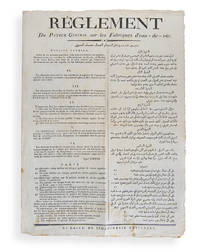
rif. 123044Cairo Egypt Impprimerie Nationale c. 1800. . Single broadside printed in parallel French and Arabic text 460 x 325 mm; type-set printed in dual French and Arabic presented in two columns leaf with wide margins uncut a little creased at outer edges and with fold lines along central horizontal and vertical folds light water-staining to lower edge overall very good condition. Napoleon Bonaparte's Egypt Campaign in 1798 lead to the establishment of the first printing press on the African continent preceding the well-known Egyptian Bulaq Press established by Muhammad Ali Pasha al-Mas'ud by over two decades. The press was predominantly formed to print proclamations and official statements in French with Arabic translations that were often poorly translated and rife with grammatical error for use as political propaganda for Napoleon's campaign in Egypt. The single-sheet documents were meant to be wall mounted and therefore are ephemeral in nature with very few copies surviving. The present example is a rare proclamation announcing the new tarifs and laws relating to the production of liquor in Egypt under Napoleonic rule. It was issued by Martin-Roch-Xavier Estève 1772-1852 the paymaster of Napoleon's Armée de l'Orient and contains six articles regulating the production and introducing tarifs of liquor production in the region. The broadside notes that distilleries need to be registered and needed to clearly distinguish themselves with large 'Fabrique d'Eau de Vie' lettering there is a stipulation that frequent inspections would be made and that the finished product needed to have a minimum of 18 percent alcohol content per volume. The raw materials listed in the proclamation include five qualities of fresh dates dried dates figs and raisins. Very scarce: No other copies located not in the Bibliotheque Nationale de France or any records showing in OCLC. Cairo, Egypt, Impprimerie Nationale, c. 1800. unknown
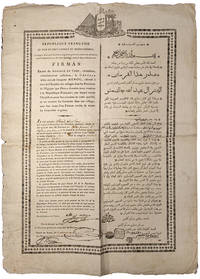
rif. 112453Cairo dated '30 Aug' and 1215 AH 1800 AD. . Single broadside printed in parallel French and Arabic text with manuscript additions in Arabic and French type-set printed in dual French and Arabic presented in two columns framed within a wood-block printed border with a Napoleonic engraving at the top leaf with wide margins uncut a little creased at outer edges and with fold lines along central horizontal and vertical folds small annotation in Arabic to verso overall very good condition. Dimensions; 630 x 450mm 24¾ x 17¾ inches. Napoleon Bonaparte's Egypt campaign in 1798 lead to the establishment of the first printing press on the African continent preceding the well-known Egyptian Bulaq Press established by Muhammad Ali Pasha al-Mas'ud by over two decades. The press was predominantly formed to print proclamations and official statements in French with Arabic translations that were often poorly translated and rife with grammatical error for use as political propaganda for Napoleon's campaign in Egypt. The present example is a rare ephemeral broadside being a 'firman' legal proclamation announcing to the provinces of Egypt that Abd'ullah Jacques Menou is the General en Chief to the Republique Francaise. No other copies have been located. Jacques-François de Menou Baron of Boussay later known as Abdallah de Menou 3 September 1750 13 August 1810 was a French statesman and general of Napoleon during the French Revolutionary Wars most noted for his role in the Egyptian Campaign conducted between 1798 and 1801. In 1798 Menou commanded one of the five divisions of the Armée d'Orient in Napoleon's campaign of Egypt. After the assassination of Jean-Baptiste Kléber 14 June 1800 Menou succeeded him at the head of Egypt as general in chief. He was not as popular as Kléber and lacked support from the other officers. He married the daughter of a rich Egyptian Zubaidah bint Muhammad El Bawwab converted to Islam and was renamed Abdallah. In March 1801 Menou commanded the French expeditionary force sent to repel British forces landing at La Muiron however the French were defeated and Menou withdrew to Alexandria where he surrendered following the Siege of Alexandria on 30 August 1801. Menou was permitted then to evacuate the remaining French forces but handed over the infamous Rosetta Stone in exchange the discovery of which had been reported to him by Captain Pierre-François Bouchard and a monumental descovery that became a vital key to understanding the lost language of hieroglyphics. Cairo, dated '30 Aug' and 1215 AH (1800 AD). unknown
1814rif. PHO-2347Paris, Chez Audibert, Michaud, Eymery, 1814, 4 éditions en 1 volume in-8 (20,5x13cm), 2ff.-174-1f-11pp. (prospectus)/96pp./112pp./2ff.xii-334pp.-2ff., basane époque raciné, dos lisse orné avec pièce de titre, tranches jaspées. Petites épidermures, accrocs à la coiffe supérieure, carte déchirée sans manque.