1 847 résultats
1953réf. 028824Lausanne Clairefontaine 1953 in-4, broché, couverture illustrée rempliée, 80 pp. (couverture légèrement salie en bordure). 4 illustrations à pleine page par Loris. Édition originale de ces chansons mises en musique par Christiane Verger avec le fac-similé de toutes les partitions. Tirage limité. Bel exemplaire.
réf. 48279Lausanne : La Guilde du Livre, 1953. Un volume 28,5x22cm broché sous couverture illustrée et rempliée, 81 pages des textes de Prévert, suivies des partitions par Christiane Verger, avec 6 dessins hors texte de Fabien Loris. Joint une partition en feuilles de 4 pages de Fabien Loris et Christiane Verger (1950). Très bon état.
1953réf. 93726Lausanne: Editions Clairefontaine 1953. First ed. Hardcover. Very good with slight external wear. See photos. Octavo in blue paper-backed illus boards; approx 30p unpaged profusely illus in color. Two-page musical score incuded. Beautifully illustrated! Editions Clairefontaine hardcover
2011réf. Q-1930580746Luminary Media Group 2011-07-01. Paperback. New. New. In shrink wrap. Looks like an interesting title! Luminary Media Group paperback
réf. 10802Lausanne. Editions Clairefontaine. 1953. In-4° broché. Couverture rempliée, illustrée. 81 pages. E.O. Tirage numéroté hors commerce.
réf. 4614Lausanne, la Guilde du livre, 1953. In-4 broché, couverture illustrée. Quelques petits frottements à la couverture.
réf. 110301Paris, Académie des Inscriptions et Belles-Lettres 2021, 245x160mm, X - 304pages, broché. Exemplaire à l'état de neuf.
1977réf. R260113248SOLAR. 1977. In-12. Broché. Bon état, Couv. convenable, Dos satisfaisant, Intérieur frais. 91 pages. Premier plat illustré en couleurs. Nombreuses illustrations et photos en couleurs dans et hors texte.. . . . Classification Dewey : 636-Elevage
1977réf. 100156435Solar 1977 in12. 1977. Broché.
2021réf. __3110730820De Gruyter 2021. Hardcover. New. 500 pages. 9.45x6.69x9.61 inches. De Gruyter hardcover
2019réf. 2-6202135808EAE 2019. Paperback. New. Spanish language. 8.66x5.91x0.87 inches. EAE paperback
2012réf. Q-0632057254Blackwell Publishers 2012-03-26. hardcover. New. In shrink wrap. Looks like an interesting title! Blackwell Publishers hardcover
2012réf. 1125557593New York: Orchard Books Scholastic Inc 2012. Book. Very Good. Hardcover. 4to - over 9¾ - 12" tall. unpaginated 9 pop-up pages Cover design by Chelsea Donaldson. Interior design by Jessica Tice-Gilbert.Requires LR44 or AG13 button cell battery for some functions.present and working Brief text and pop-up illustrations explore the characters places and technologies of the Star Wars movies. . Orchard Books, Scholastic Inc Hardcover
1959réf. 21397Tours GiBERT-Clarey 1959 In Quarto Exemplaire avec envoi et un dessin original représentant le Chateau de Vou en Lochois à Pleine page, Exemplaire imprimé spécialement , 138 pp préface de Maurice Sieklucki
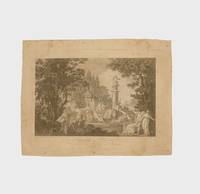
1796réf. 373398New York 1796. Broadside text in English and French in two columns. 12-1/4x8 inches. Silked and inlaid to a larger sheet very toned extraneous fold at the bottom area of loss at the top largely affecting the title in French. Broadside text in English and French in two columns. 12-1/4x8 inches. A broadside prospectus for a noted allegorical print celebrating the American Revolution. We locate only two known examples of this broadside John Carter Brown Library and Winterthur Museum. The print first published in 1796 and then again with the addition of extensive descriptive text in 1798 used classical iconography to illustrate America's victory in the American Revolution with the gods led by Minerva with the American eagle on her aegis paying honor to American heroes and laying waste to the concepts and persons of monarchy. As a French veteran of the American Revolution and transatlantic witness to the French Revolution it is perhaps unsurprising that the artist Renault would choose such subject matter for this dramatic piece. Reilly describes the print and its features in detail: An allegory of liberty flourishing and monarchy and tyranny in decline. In a wooded grove Minerva with a shield bearing the arms of the United States and a flag emblazoned with stars pours libations on an altar fire. Beside her are three female figures. The first Plenty holds a torch to a pile of titles of nobility crowns scepters and other attributes of monarchy. Justice holds a sword and scales and Peace an olive branch. Behind them is a small pyramid on a pedestal inscribed with the names: Hancock Warren Sullivan Putnam Scamel Barber Green Laurens Wooster Mercer and Poor. Two urns on the monument are labeled "B. Franklin" and "Montgomery." To the right is a column surmounted by a seated nude Liberty figure holding a wreath. Below it stands a cherub with a scroll with the words 'Allons enfans de la Patrie.' an open book labeled 'The Rights of Man' a staff and liberty cap and a flag. Behind is a mountainous landscape and town. In the lower right foreground stands another group including a king about to stab himself several other monarchs cringing and a standing woman. In the lower left stand an aged classical priest and a writhing mutilated hydra appear. Not much is known about Renault or Verger beyond their production of this print. Bristol B9805; ESTC W38987 unknown
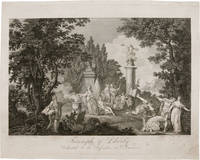
1796réf. 373692New York 1796. Engraved print. 14-1/2x20-1/2 inches plate size. Heavily toned creased through the image short edge tears. Engraved print. 14-1/2x20-1/2 inches plate size. A noted allegorical print celebrating the American Revolution. The print first published in 1796 and then again with the addition of extensive descriptive text in 1798 used classical iconography to illustrate America's victory in the American Revolution with the gods led by Minerva with the American eagle on her aegis paying honor to American heroes and laying waste to the concepts and persons of monarchy. As a French veteran of the American Revolution and transatlantic witness to the French Revolution it is perhaps unsurprising that the artist Renault would choose such subject matter for this dramatic piece. Reilly describes the print and its features in detail: "An allegory of liberty flourishing and monarchy and tyranny in decline. In a wooded grove Minerva with a shield bearing the arms of the United States and a flag emblazoned with stars pours libations on an altar fire. Beside her are three female figures. The first Plenty holds a torch to a pile of titles of nobility crowns scepters and other attributes of monarchy. Justice holds a sword and scales and Peace an olive branch. Behind them is a small pyramid on a pedestal inscribed with the names: Hancock Warren Sullivan Putnam Scamel Barber Green Laurens Wooster Mercer and Poor. Two urns on the monument are labeled "B. Franklin" and "Montgomery." To the right is a column surmounted by a seated nude Liberty figure holding a wreath. Below it stands a cherub with a scroll with the words 'Allons enfans de la Patrie.' an open book labeled 'The Rights of Man' a staff and liberty cap and a flag. Behind is a mountainous landscape and town. In the lower right foreground stands another group including a king about to stab himself several other monarchs cringing and a standing woman. In the lower left stand an aged classical priest and a writhing mutilated hydra appear. "Stauffer describes an impression the 1798 edition with re-engraved title and imprint accompanied by the following text: 'By a Column raised to Liberty is a Monument sacred to the memory of the American Heroes fallen in defence of their Country. While Liberty is Crowning them America uder sic the figure of Minerva sacrifices to their Manes and a Priest of that Deity sings their glorious actions. The Hydra of Despotism mortally wounded by those great men expires in frightful convulsions. Peace and Justice hand in hand join with America in her homage to Liberty. Plenty reclining on her emblematical Horn reposes on American ground. The Genius of Liberty points out the declaration of Independence and a Book of the American Constitution. From the dreadful Sight a group of Kings turn away with horror and dismay.'" Not much is known about Renault or Verger beyond their production of this print. unknown
1796réf. 65977New York: D.F. Launy 1796. Attractive Allegorical Engraving Depicting Democracy's Victory over Monarchism An attractive and elaborate allegorical engraving celebrating American independence drawn by French-American artist John-Francis Renault and engraved by Peter Verger both known almost exclusively for the present print. The print first published in 1796 and then again with the addition of extensive descriptive text in 1798 uses Classical iconography to illustrate America's victory with the gods led by Minerva with the American eagle on her aegis paying honor to American heroes and laying waste to the concepts and persons of monarchy. As a French veteran of the American Revolution and transatlantic witness to the French Revolution it is perhaps unsurprising that Renault would choose such subject matter for this dramatic piece. Reilly describes the print and its features in detail: "An allegory of liberty flourishing and monarchy and tyranny in decline. In a wooded grove Minerva with a shield bearing the arms of the United States and a flag emblazoned with stars pours libations on an altar fire. Beside her are three female figures. The first Plenty holds a torch to a pile of titles of nobility crowns scepters and other attributes of monarchy. Justice holds a sword and scales and Peace an olive branch. Behind them is a small pyramid on a pedestal inscribed with the names: Hancock Warren Sullivan Putnam Scamel Barber Green Laurens Wooster Mercer and Poor. Two urns on the monument are labeled "B. Franklin" and "Montgomery." To the right is a column surmounted by a seated nude Liberty figure holding a wreath. Below it stands a cherub with a scroll with the words 'Allons enfans de la Patrie.' an open book labeled 'The Rights of Man' a staff and liberty cap and a flag. Behind is a mountainous landscape and town. In the lower right foreground stands another group including a king about to stab himself several other monarchs cringing and a standing woman. In the lower left stand an aged classical priest and a writhing mutilated hydra appear. "Stauffer describes an impression the 1798 edition with re-engraved title and imprint accompanied by the following text: 'By a Column raised to Liberty is a Monument sacred to the memory of the American Heroes fallen in defence of their Country. While Liberty is Crowning them America uder sic the figure of Minerva sacrifices to their Manes and a Priest of that Deity sings their glorious actions. The Hydra of Despotism mortally wounded by those great men expires in frightful convulsions. Peace and Justice hand in hand join with America in her homage to Liberty. Plenty reclining on her emblematical Horn reposes on American ground. The Genius of Liberty points out the declaration of Independence and a Book of the American Constitution. From the dreadful Sight a group of Kings turn away with horror and dismay.'" Not much is known about Renault or Verger beyond their production of this print. Describing the former as an "Allegorical & historical painter" Falk writes that "Renault claimed to have been at the Battle of Yorktown in 1781 as assistant secretary to Count de Grasse and Engineer to the French Army. His 'Triumph of Liberty' was advertised in NYC in 1795 by D.F. Launy and again in 1797 by Renault and Verger. In 1819 he published an engraving of the British officers surrendering their arms to Washington at Yorktown describing himself as a U.S. Citizen." Falk has little to add respecting Verger except that "He was associated with John Francis Renault in the publication of the latter's 'Triumph of Liberty' print" and that he was "Active in NYC from 1795-97; Paris in 1806." OCLC locates copies of the first edition of this print at the Society of the Cincinnati American Antiquarian Society and Massachusetts Historical Society. We locate further copies at the Library of Congress and Yale Art Gallery. A rare and dramatic allegorical print published on the twentieth anniversary of the Declaration of Independence. Light tanning and soiling some pale dampstains to lower margin just into lower part of image. Very good. REILLY 1796-1. STAUFFER 3344. FOWBLE 322. FALK WHO WAS WHO IN AMERICAN ART pp.2742 3403. OCLC 768299108. unknown
1796réf. 373398New York 1796. Broadside text in English and French in two columns. 12-1/4x8 inches. Silked and inlaid to a larger sheet very toned extraneous fold at the bottom area of loss at the top largely affecting the title in French. Broadside text in English and French in two columns. 12-1/4x8 inches. A broadside prospectus for a noted allegorical print celebrating the American Revolution. We locate only two known examples of this broadside John Carter Brown Library and Winterthur Museum. The print first published in 1796 and then again with the addition of extensive descriptive text in 1798 used classical iconography to illustrate America's victory in the American Revolution with the gods led by Minerva with the American eagle on her aegis paying honor to American heroes and laying waste to the concepts and persons of monarchy. As a French veteran of the American Revolution and transatlantic witness to the French Revolution it is perhaps unsurprising that the artist Renault would choose such subject matter for this dramatic piece. Reilly describes the print and its features in detail: An allegory of liberty flourishing and monarchy and tyranny in decline. In a wooded grove Minerva with a shield bearing the arms of the United States and a flag emblazoned with stars pours libations on an altar fire. Beside her are three female figures. The first Plenty holds a torch to a pile of titles of nobility crowns scepters and other attributes of monarchy. Justice holds a sword and scales and Peace an olive branch. Behind them is a small pyramid on a pedestal inscribed with the names: Hancock Warren Sullivan Putnam Scamel Barber Green Laurens Wooster Mercer and Poor. Two urns on the monument are labeled "B. Franklin" and "Montgomery." To the right is a column surmounted by a seated nude Liberty figure holding a wreath. Below it stands a cherub with a scroll with the words 'Allons enfans de la Patrie.' an open book labeled 'The Rights of Man' a staff and liberty cap and a flag. Behind is a mountainous landscape and town. In the lower right foreground stands another group including a king about to stab himself several other monarchs cringing and a standing woman. In the lower left stand an aged classical priest and a writhing mutilated hydra appear. Not much is known about Renault or Verger beyond their production of this print. Bristol B9805; ESTC W38987 unknown books
1796réf. 373692New York 1796. Engraved print. 14-1/2x20-1/2 inches plate size. Heavily toned creased through the image short edge tears. Engraved print. 14-1/2x20-1/2 inches plate size. A noted allegorical print celebrating the American Revolution. The print first published in 1796 and then again with the addition of extensive descriptive text in 1798 used classical iconography to illustrate America's victory in the American Revolution with the gods led by Minerva with the American eagle on her aegis paying honor to American heroes and laying waste to the concepts and persons of monarchy. As a French veteran of the American Revolution and transatlantic witness to the French Revolution it is perhaps unsurprising that the artist Renault would choose such subject matter for this dramatic piece. Reilly describes the print and its features in detail: "An allegory of liberty flourishing and monarchy and tyranny in decline. In a wooded grove Minerva with a shield bearing the arms of the United States and a flag emblazoned with stars pours libations on an altar fire. Beside her are three female figures. The first Plenty holds a torch to a pile of titles of nobility crowns scepters and other attributes of monarchy. Justice holds a sword and scales and Peace an olive branch. Behind them is a small pyramid on a pedestal inscribed with the names: Hancock Warren Sullivan Putnam Scamel Barber Green Laurens Wooster Mercer and Poor. Two urns on the monument are labeled "B. Franklin" and "Montgomery." To the right is a column surmounted by a seated nude Liberty figure holding a wreath. Below it stands a cherub with a scroll with the words 'Allons enfans de la Patrie.' an open book labeled 'The Rights of Man' a staff and liberty cap and a flag. Behind is a mountainous landscape and town. In the lower right foreground stands another group including a king about to stab himself several other monarchs cringing and a standing woman. In the lower left stand an aged classical priest and a writhing mutilated hydra appear. "Stauffer describes an impression the 1798 edition with re-engraved title and imprint accompanied by the following text: 'By a Column raised to Liberty is a Monument sacred to the memory of the American Heroes fallen in defence of their Country. While Liberty is Crowning them America uder sic the figure of Minerva sacrifices to their Manes and a Priest of that Deity sings their glorious actions. The Hydra of Despotism mortally wounded by those great men expires in frightful convulsions. Peace and Justice hand in hand join with America in her homage to Liberty. Plenty reclining on her emblematical Horn reposes on American ground. The Genius of Liberty points out the declaration of Independence and a Book of the American Constitution. From the dreadful Sight a group of Kings turn away with horror and dismay.'" Not much is known about Renault or Verger beyond their production of this print. unknown books
1796réf. 65977New York: D.F. Launy 1796. Attractive Allegorical Engraving Depicting Democracy's Victory over Monarchism An attractive and elaborate allegorical engraving celebrating American independence drawn by French-American artist John-Francis Renault and engraved by Peter Verger both known almost exclusively for the present print. The print first published in 1796 and then again with the addition of extensive descriptive text in 1798 uses Classical iconography to illustrate America's victory with the gods led by Minerva with the American eagle on her aegis paying honor to American heroes and laying waste to the concepts and persons of monarchy. As a French veteran of the American Revolution and transatlantic witness to the French Revolution it is perhaps unsurprising that Renault would choose such subject matter for this dramatic piece. Reilly describes the print and its features in detail: "An allegory of liberty flourishing and monarchy and tyranny in decline. In a wooded grove Minerva with a shield bearing the arms of the United States and a flag emblazoned with stars pours libations on an altar fire. Beside her are three female figures. The first Plenty holds a torch to a pile of titles of nobility crowns scepters and other attributes of monarchy. Justice holds a sword and scales and Peace an olive branch. Behind them is a small pyramid on a pedestal inscribed with the names: Hancock Warren Sullivan Putnam Scamel Barber Green Laurens Wooster Mercer and Poor. Two urns on the monument are labeled "B. Franklin" and "Montgomery." To the right is a column surmounted by a seated nude Liberty figure holding a wreath. Below it stands a cherub with a scroll with the words 'Allons enfans de la Patrie.' an open book labeled 'The Rights of Man' a staff and liberty cap and a flag. Behind is a mountainous landscape and town. In the lower right foreground stands another group including a king about to stab himself several other monarchs cringing and a standing woman. In the lower left stand an aged classical priest and a writhing mutilated hydra appear. "Stauffer describes an impression the 1798 edition with re-engraved title and imprint accompanied by the following text: 'By a Column raised to Liberty is a Monument sacred to the memory of the American Heroes fallen in defence of their Country. While Liberty is Crowning them America uder sic the figure of Minerva sacrifices to their Manes and a Priest of that Deity sings their glorious actions. The Hydra of Despotism mortally wounded by those great men expires in frightful convulsions. Peace and Justice hand in hand join with America in her homage to Liberty. Plenty reclining on her emblematical Horn reposes on American ground. The Genius of Liberty points out the declaration of Independence and a Book of the American Constitution. From the dreadful Sight a group of Kings turn away with horror and dismay.'" Not much is known about Renault or Verger beyond their production of this print. Describing the former as an "Allegorical & historical painter" Falk writes that "Renault claimed to have been at the Battle of Yorktown in 1781 as assistant secretary to Count de Grasse and Engineer to the French Army. His 'Triumph of Liberty' was advertised in NYC in 1795 by D.F. Launy and again in 1797 by Renault and Verger. In 1819 he published an engraving of the British officers surrendering their arms to Washington at Yorktown describing himself as a U.S. Citizen." Falk has little to add respecting Verger except that "He was associated with John Francis Renault in the publication of the latter's 'Triumph of Liberty' print" and that he was "Active in NYC from 1795-97; Paris in 1806." OCLC locates copies of the first edition of this print at the Society of the Cincinnati American Antiquarian Society and Massachusetts Historical Society. We locate further copies at the Library of Congress and Yale Art Gallery. A rare and dramatic allegorical print published on the twentieth anniversary of the Declaration of Independence. Light tanning and soiling some pale dampstains to lower margin just into lower part of image. Very good. REILLY 1796-1. STAUFFER 3344. FOWBLE 322. FALK WHO WAS WHO IN AMERICAN ART pp.2742 3403. OCLC 768299108. unknown books
réf. 0267682409.Ghardcover. Good. Access codes and supplements are not guaranteed with used items. May be an ex-library book. hardcover
réf. 1331993733.Gpaperback. Good. Access codes and supplements are not guaranteed with used items. May be an ex-library book. paperback
réf. 6663956-nnew. unknown
réf. 6663956like new. unknown
1843réf. 3033London T. Richards for the Percy Society 1843