159 résultats
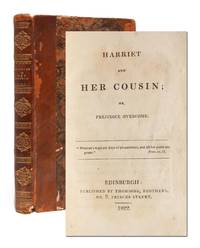
1822réf. 5548Edinburgh: Thomsons Brothers 1822. First edition. Contemporary half calf over marbled boards with gilt to spine. Measuring 140 x 80mm and collating complete including frontis and publisher's catalogue to rear: vii 1 blank 199 1 errata 8 1 blank. A Near Fine copy with some scuffing to boards and joints and small chip to foot of spine. Contemporary ownership inscription to front endpaper: "Margaret Jane Palliser. Dublin 1824." A scarce work of juvenile fiction aimed at young women it is unrecorded in OCLC and Sadleir though there is mention of a later 1824 "fourth edition" and an American edition from 1827. Simple on its surface each new chapter of Harriet and Her Cousin unfolds a new layer of prejudice that all too commonly prevents young women from finding meaningful connections with each other. Raised in a rural religious household young Harriet has a spiritual awakening that leaves her soul altered. More excited about the world and the people around her and more capable of subtle observations she undertakes a journey to Edinburgh both to visit her soon-to-be-wed best friend Maria as well as to visit her grandfather and cousin Julia. On arrival Harriet is shocked by Julia's coldness and initially assumes it is prejudice against her own Christianity. Introduced to the sparkling and accomplished ladies of Julia's circle she then begins to suspect it is prejudice against her simple country nature. Only over time does Julia feel comfortable opening up to Harriet about her loneliness -- an isolation born out of the high society expectations that women reserve warm feelings and engage instead in gossip back-biting and flirtations that make them untrustworthy. As she has witnessed Harriet's refusal to conform to these behaviors Julia bonds with Harriet as an intimate friend capable of deep and meaningful conversation. Indeed Harriet learns that even with her awakened spirituality she too has much to learn about dismantling her own prejudices. Thomsons Brothers unknown books
1946réf. 560415Napoli / Roma: Gaspare Casella Editore / De Luigi Editore 1946. Softcover. Very Good. Nos. 1-18 in 15 issues i.e. three double issues. Slim octavos. Text in Italian. Printed wrappers paper still supple. Owner's signature of author and critic Michele Cantarella a leading anti-fascist Italian expatriate on the cover of one issue and three issues with a bit of pencilled marginal bracketing by him. Modest toning wear and soil a few tiny tears at the spine ends the first five issues with the pages somewhat toned and occasional very light foxing mostly confined to the first and last leaves a nice very good or better run of this somewhat delicate Italian literary magazine that featured two publishers and three editors during this time period. Of particular note is the inclusion of "Angoscia" "Anguish" later known as "Anguish in the Barracks" in issue 16 a very early possibly the earliest published story by Italo Calvino predating his first book by two years. The final issue prints a "Referendum" of four questions for poets about their work and claim that they have already received responses from Eugenio Montale Cesare Pavesi Corrado Alvaro and others and will begin publishing their responses in the next issue but the magazine ceased publication with No. 17/18. A well-preserved set of a cheaply wartime- printed magazine. Gaspare Casella Editore / De Luigi Editore unknown books
1868réf. 2210931868. 1 vols. 12mo. Disbound. Wear. 1 vols. 12mo. unknown books
1918réf. 316669London: Macmillan 1918. hardcover. fine. Rackham Arthur. Illustrated by Rackham with 16 color plates each with lettered tissue guard; 41 black & white drawings in the text. 2 limitation ix 1 blank 341pp. Thick 4to elegantly rebound in full burgundy morocco with ornate floral gilt tooling on the covers and spine; inner dentelles and marbled doublures and endpapers; uncut edges t.e.g. London: Macmillan & Co. 1918. A fine copy of one of the more obscure Rackham titles in a beautiful binding. Edition de Luxe. Number 400 of 500 copies signed by Rackham on the limitation page. Latimore & Haskell 48; Riall 132. Macmillan unknown books
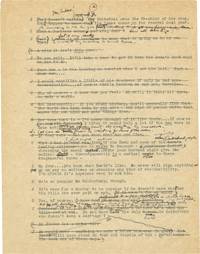
1938réf. 163880N.p.: N.p. 1938. James Hilton's typescript draft screenplay for the 1939 film an adaptation of his own 1937 novel the only such adaptation he ever completed. With the author's profuse manuscript ink annotations as well as many pages executed entirely in manuscript ink throughout. Included is a privately commissioned essay by Hilton scholar Kurt Kausler detailing both the history of Hilton's work on the film an analysis and a breakdown of the manuscript. Almost certainly Hilton's first corrected manuscript screenplay for the film. After Jack Warner raised concerns about the script being too long screenwriter Milton Krims was employed to clean up and shorten it-though in the end Hilton received sole credit as screenwriter. A man hires an Austrian governess and both are suspected of murder when his wife is discovered to be dead. 123 leaves a gathering demonstrating the author's method his attention to detail and his extreme frugality with the use of paper the last most likely due to wartime shortages. The script consists of a ribbon copy typescript leaves on both onionskin and paper stock with manuscript emendations on virtually every page in many cases both recto and verso with some leaves executed on the versos of unrelated previous work by Hilton b leaves consisting entirely of text executed in manuscript ink c hand-cut partial leaves and d a handful of later Xerographically duplicated facsimiles of Hilton's original annotated typescript leaves. Included is a very detailed analysis of the manuscript as well as the events surrounding its creation along with a detailed breakdown of the manuscript elements. Hilton's manuscript leaves Very Good to Fine quite supple and well preserved. Housed in a modern white three-ring binder. Leaves individually held in modern mylar page protectors. N.p. unknown books
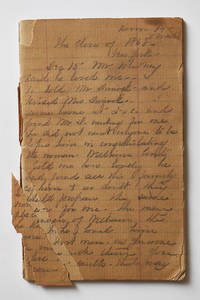
1864réf. 221802Rome 1864. 260 pp. written in ink on versos and rectos with 14 pictures engravings etc. some captioned in her hand. Included are some sheets in other hands in French and German. 1 vols. 8vo. Disbound with water damage. 260 pp. written in ink on versos and rectos with 14 pictures engravings etc. some captioned in her hand. Included are some sheets in other hands in French and German. 1 vols. 8vo. Flora Payne was a Cleveland heiress whose marriage to William Collins Whitney three years after this diary was written formed the basis of one of America's legendary families. Flora Payne herself "was an anomaly among the young ladies of her time. At eighteen she had betaken herself from Cleveland to Cambridge Massachusetts to attend the seminary for young ladies that was being conducted there by Professor Agassiz the naturalist . Flora had traveled widely abroad even to places such as North Africa with which few sophisticated New Yorkers of William Whitney's circle had firsthand acquaintance . " - Kahn JOCK p. 11. unknown books
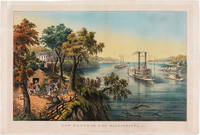
1868réf. 62595New York: Currier & Ives 1868. Scene of African-American Life on the Mississippi During Reconstruction by an Important Woman Artist An excellent Currier & Ives Mississippi River scene created just a few years after the Civil War after an original illustration by the important and prolific artist Frances Palmer. Though ostensibly presented as a nostalgic representation of the South a modern interpretation might conclude that it demonstrates a new sense of freedom and independence felt by formerly enslaved people in the first few years of Reconstruction. This image also demonstrates a simple but poignant and even uncomfortable truth about how life on the Mississippi River is contingent upon external circumstances most notably the whims of the weather. Low Water portrays former slaves dancing merrily outside their cabin with the plantation house in the deep background as the great steamship Robert E. Lee and another riverboat roar down the river. The Lee passes by a small barge on which sits a cabin labeled "Grocery." The water here is indeed low sitting several feet below the top of the riverbank. The sense of celebration among the African-American subjects is palpable. The lithograph is signed "J.M.I. Del." in the image indicating that James Ives drew the lithograph from Palmer's original artwork. The illustration for this Currier & Ives print was created by the important artist Frances Flora Bond Palmer. Palmer 1812-1876 was the first woman in the United States to work as a professional artist and to make a living with her art. She produced more Currier & Ives prints than any other artist. Known as Fanny she was according to Gloria Deák "the foremost woman lithographer of her time." Born and raised in England by a cultivated family she was already an accomplished painter and lithographer when she came to America in 1844 at which time she exhibited two works at the National Academy of Design. By 1849 she was working for Currier producing landscapes and still lifes lithographing these prints herself usually after her own sketches. She worked for Currier & Ives from 1849 into the 1870s bringing in much needed income for her family and producing about 200 of the company's best scenes and landscapes. Palmer was one of the most important and prolific artists and lithographers ever employed by Nathaniel Currier and she gave important assistance to Charles Currier in inventing a superior lithographic crayon. This Mississippi River scene is one the most popular pictures among the thirty-plus Mississippi River lithographs produced by the company. "In 1868 three years after the Civil War ended James Ives who had found Palmer to be an excellent collaborator on his visions of broad symbolic images of American life worked with her on eight large important lithographs.Among them is a pair of lithographs - 'High Water' in the Mississippi and Low Water in the Mississippi - this time portraying the mighty river's fickle moods. The subject was particularly timely because Southern levees had been destroyed during the war and serious flooding had occurred in 1862 1865 and 1867" - Rubinstein. Rubinstein notes that the Currier & Ives audience had always enjoyed scenes of natural disasters and of the Mississippi River but goes on to find significant allegorical content in the image depicted in Low Water as well as noting significant changes between Palmer's original artwork and the published lithograph: "Low Water a peaceful scene of the river at low tide shows a group of brightly dressed African American adults and children dancing and playing the banjo in front of their cabin while white owners of the plantation house stroll about their land.Scholars have critiqued Palmer's presentation in Low Water of childlike African Americans enjoying their lives on the old plantation - reminiscent of the 'Sambo' minstrel show character. In fact Low Water demonstrates how the heavy hand of her employers affected her work. Palmer had originally drawn a fully developed pencil study for Low Water in the Mississippi in which two shirt-sleeved African American men are ferrying three white men to the other side of the river while a group of well-dressed white people seated at leisure in front of the plantation mansion enjoy the view. For the final lithograph however someone perhaps James Ives who signed his name as the lithographer on the print had removed the hard-working black boatmen and substituted the usual minstrel show clichés.Low Water suggested that everyone would be better off if freed black people went peacefully back to work for their former masters instead of demanding their own land or trying to vote and run for office." A fantastic Currier & Ives handcolored lithograph which was originally intended as a companion piece to "High Water" in the Mississippi. Toning in the margins from previous matting. Closed marginal tears a few intruding into the image repaired on verso and with no loss of image. Very good overall with excellent visual appeal. Charlotte Streifer Rubinstein Fanny Palmer: The Life and Works of a Currier & Ives Artist Syracuse NY 2018 item 3-77A pp.144-45 203. PETERS CURRIER & IVES pp.110-16; items 3944 3946. CURRIER & IVES: CATALOGUE RAISONNÉ 3057 4149. CONNINGHAM 2819 3824. GALE 3057 4150. DEÃK PICTURING AMERICA 647 ref. unknown books
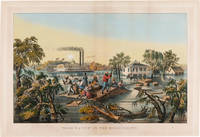
1868réf. 62593New York: Currier & Ives 1868. Scene of African-American Life on the Mississippi During Reconstruction by an Important Woman Artist An excellent Currier & Ives Mississippi River scene created just a few years after the Civil War after an original illustration by the important and prolific artist Frances Palmer. Though ostensibly presented as a nostalgic representation of the South a modern interpretation might conclude that it demonstrates a new sense of freedom and independence felt by formerly enslaved people in the first few years of Reconstruction. This image also demonstrates a simple but poignant and even uncomfortable truth about how life on the Mississippi River is contingent upon external circumstances most notably the whims of the weather. "High Water in the Mississippi presents a scene of a Mississippi River flood in which several former slaves sit atop the roof of a house among the flotsam and jetsam two of the men with long poles trying to recover furniture floating in the river. One man tries to rescue a mule struggling in the water. A plantation house stands in the background with two White residents waving at the large steamship Stonewall Jackson which chugs by in the background. The lithograph is signed "J.M.I. Del." in the image indicating that James Ives drew the lithograph from Palmer's original artwork. The illustration for this Currier & Ives print was created by the important artist Frances Flora Bond Palmer. Palmer 1812–76 was the first woman in the United States to work as a professional artist and to make a living with her art. She produced more Currier & Ives prints than any other artist. Known as Fanny she was according to Gloria Deák "the foremost woman lithographer of her time." Born and raised in England by a cultivated family she was already an accomplished painter and lithographer when she came to America in 1844 at which time she exhibited two works at the National Academy of Design. By 1849 she was working for Currier producing landscapes and still lifes lithographing these prints herself usually after her own sketches. She worked for Currier & Ives from 1849 into the 1870s bringing in much needed income for her family and producing about 200 of the company's best scenes and landscapes. Palmer was one of the most important and prolific artists and lithographers ever employed by Nathaniel Currier and she gave important assistance to Charles Currier in inventing a superior lithographic crayon. This Mississippi River scene is one the most popular pictures among the thirty-plus Mississippi River lithographs produced by the company. "In 1868 three years after the Civil War ended James Ives who had found Palmer to be an excellent collaborator on his visions of broad symbolic images of American life worked with her on eight large important lithographs.Among them is a pair of lithographs - 'High Water' in the Mississippi and Low Water in the Mississippi - this time portraying the mighty river's fickle moods. The subject was particularly timely because Southern levees had been destroyed during the war and serious flooding had occurred in 1862 1865 and 1867" - Rubinstein. Rubinstein notes that the Currier & Ives audience had always enjoyed scenes of natural disasters but goes on to find significant allegorical content in the images depicted in "High Water" and Low Water: "Now in the Reconstruction period instead of focusing on the North's victory both black and white Southerners are seen bravely struggling to recover from the aftermath of a great flood the Civil War.Abolitionists and Radical Republicans could read 'High Water' as a poignant image of newly freed slaves struggling to salvage something for their future the 'forty acres and a mule' promised to them by General Grant but rescinded by President Johnson but to white Southerners and to many Northerners as well Low Water suggested that everyone would be better off if freed black people went peacefully back to work for their former masters instead of demanding their own land or trying to vote and run for office." A fantastic Currier & Ives handcolored lithograph which was originally intended as a companion piece to Low Water in the Mississippi. Toning in the margins from previous matting. Some very light surface wear. Overall very good plus with excellent visual appeal. Charlotte Streifer Rubinstein Fanny Palmer: The Life and Works of a Currier & Ives Artist Syracuse NY 2018 item 3-59 pp.144-45 203. PETERS CURRIER & IVES pp.110-16; items 3944 3946. CURRIER & IVES: CATALOGUE RAISONNÉ 3057 4149. CONNINGHAM 2819 3824. GALE 3057 4150. DEÃK PICTURING AMERICA 647 ref. unknown books
1863réf. 57141New York: Currier & Ives 1863. Hand-colored lithograph approx. 30¼" x 22" by sight; fine example with strong coloring; attractively matted and in a curly maple frame. Currier & Ives New Best Fifty no. 23; Reilly Currier & Ives A Catalogue Raisonné Detroit 1984 pp. 737 758; no. 7326. Provenance: from the collection of the Minnesota railroad tycoon James J. Hill Saint Paul Minnesota. One of Currier & Ives most famous and dramatic images depicting the steamboat Princess as firewood is loaded onto the ship to power its steam engines. The artist Frances Flora Bond Palmer 1812-1876 often referred to as Fanny Palmer was an English artist who became successful in the United States as a lithographer for Currier and Ives between 1849-1868. She is credited with producing around two hundred lithographs for them during this time. Currier & Ives unknown books