(Flora Danica)Biblio.com

14.155 risultati
rif. 76167Kiøbenhavn Nicolaus Møller 1761 1766 - 1810. Folio. Tittelbl. trykket i rødt og sort. 1440 håndkolorerte kobberstikk. Dansk tekst. Bundet i 8 samt. marmorerte kalveskinnbd. med 6 oppøyde bind. Skinn tittelfelter i rødt og grønt. Rik ryggdekor i gull. Noen få plansjer feilbundet. Blåstempel på tittelbl. Glorup Godsbibliotek. . unknown
1918rif. 1549851918. The original artwork for the frontispiece Published within Flora Annie Steel's English Fairy Tales in 1918. This fine watercolour accompanies the tale of "Mr and Mrs Vinegar" the "worthy couple" who "lived in a glass pickle-jar". It was originally reproduced as the frontispiece and is one of the 16 colour plates. Hamilton in his biography of the artist notes that the publishers paid Rackham an advance of £1000 for English Fairy Tales and as an indication of his growing status as an illustrator this was "the largest he had yet received". Reviewing the book in the New York Tribune Willis Fletcher Johnson stated that "never. shall we hope to see more perfect pictures of scenes in childhood's histories than these of Mr Rackham's". Original drawing 295 x 255 mm on card 312 x 262 mm laid down on board fine ink and watercolour signed "Arthur Rackham" lower left mounted framed and glazed framed size 450 x 407 mm. Fine and unfaded. James Hamilton Arthur Rackham: a life with illustration 1990 p. 128; Willis Fletcher Johnson "Good Books for Young Readers" New York Tribune 16 November 1918 p. 8. Exhibited: Sheffield City Art Gallery December 1979 - April 1980 item 47. unknown
1819rif. 8322Wien, Strauss, 1819. 13 S. 80 größtenteils kolorierte (vereinzelt auch in Farben gedruckte) Kupfertafeln. Fol. HLdr. der Zeit mit Rückentitel (etw. fleckig und beschabt).
rif. 122804Copenhagen Nicolaus Møller 1761-1877. Folio. With 3120 engraved plates. Plate 2941-3060 in part 50 & 51 and nomenclator not present. Finely bound in contemporary half calf. Occasional foxing. Four plates in supplement volume damaged with loss. . Near complete copy of the greatest work of Scandinavian flora. Published over a period of 122 years and covers plants of Denmark Norway Greenland Iceland The Faroe Islands Northern Germany and some Swedish flora. unknown
rif. 79272Copenhagen Nicolaus Møller 1761 1766 - 1782. Folio. 900 engraved and handcoloured plates. Contents: Volume I. Part I-III. 1761-1766. Tab. I-CLXXX. Volume II. Part IV-VI. 1766-1767. Tab. CLXXXI-CCCLX. Volume III. Part VII-IX. 1768-1770. Tab. CCCLXI-DXL. Volume IV. Part X-XII. 1771-1777. Tab. DXLI-DCCXX. Volume V. Part XIII-XV.1778-1782. Tab. DCCXXI-DCCCC. Contemporary full calf. Red labels. Gilt spines. Rebacked. Danish text. . unknown
1820rif. 18284slnd. 1820 In-folio 55 x 36 cm. sous chemise toilée à recouvrements. Un descriptif manuscrit se trouve dans un encadrement au bas de chaque planche. La numérotation des planches en rouge correspondant à une table se trouvant au début de l'ensemble. Quelques pâles rousseurs éparses, plus soutenues pour une dizaine de planche avec lég. gondoles en pied, quelques marges poussiéreuses et petites hum. en tête. Une planche plus gravement atteinte forte hum. angulaire. Exceptionnel ensemble de très belle exécution, datant de la première moitié du XIXe siècle.
1863rif. 57141New York: Currier & Ives 1863. Hand-colored lithograph approx. 30¼" x 22" by sight; fine example with strong coloring; attractively matted and in a curly maple frame. Currier & Ives New Best Fifty no. 23; Reilly Currier & Ives A Catalogue Raisonné Detroit 1984 pp. 737 758; no. 7326. Provenance: from the collection of the Minnesota railroad tycoon James J. Hill Saint Paul Minnesota. One of Currier & Ives most famous and dramatic images depicting the steamboat Princess as firewood is loaded onto the ship to power its steam engines. The artist Frances Flora Bond Palmer 1812-1876 often referred to as Fanny Palmer was an English artist who became successful in the United States as a lithographer for Currier and Ives between 1849-1868. She is credited with producing around two hundred lithographs for them during this time. Currier & Ives unknown
1863rif. 57141New York: Currier & Ives 1863. Hand-colored lithograph approx. 30¼" x 22" by sight; fine example with strong coloring; attractively matted and in a curly maple frame. Currier & Ives New Best Fifty no. 23; Reilly Currier & Ives A Catalogue Raisonné Detroit 1984 pp. 737 758; no. 7326. Provenance: from the collection of the Minnesota railroad tycoon James J. Hill Saint Paul Minnesota. One of Currier & Ives most famous and dramatic images depicting the steamboat Princess as firewood is loaded onto the ship to power its steam engines. The artist Frances Flora Bond Palmer 1812-1876 often referred to as Fanny Palmer was an English artist who became successful in the United States as a lithographer for Currier and Ives between 1849-1868. She is credited with producing around two hundred lithographs for them during this time. Currier & Ives unknown books
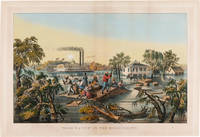
1868rif. 62593New York: Currier & Ives 1868. Scene of African-American Life on the Mississippi During Reconstruction by an Important Woman Artist An excellent Currier & Ives Mississippi River scene created just a few years after the Civil War after an original illustration by the important and prolific artist Frances Palmer. Though ostensibly presented as a nostalgic representation of the South a modern interpretation might conclude that it demonstrates a new sense of freedom and independence felt by formerly enslaved people in the first few years of Reconstruction. This image also demonstrates a simple but poignant and even uncomfortable truth about how life on the Mississippi River is contingent upon external circumstances most notably the whims of the weather. "High Water in the Mississippi presents a scene of a Mississippi River flood in which several former slaves sit atop the roof of a house among the flotsam and jetsam two of the men with long poles trying to recover furniture floating in the river. One man tries to rescue a mule struggling in the water. A plantation house stands in the background with two White residents waving at the large steamship Stonewall Jackson which chugs by in the background. The lithograph is signed "J.M.I. Del." in the image indicating that James Ives drew the lithograph from Palmer's original artwork. The illustration for this Currier & Ives print was created by the important artist Frances Flora Bond Palmer. Palmer 1812–76 was the first woman in the United States to work as a professional artist and to make a living with her art. She produced more Currier & Ives prints than any other artist. Known as Fanny she was according to Gloria Deák "the foremost woman lithographer of her time." Born and raised in England by a cultivated family she was already an accomplished painter and lithographer when she came to America in 1844 at which time she exhibited two works at the National Academy of Design. By 1849 she was working for Currier producing landscapes and still lifes lithographing these prints herself usually after her own sketches. She worked for Currier & Ives from 1849 into the 1870s bringing in much needed income for her family and producing about 200 of the company's best scenes and landscapes. Palmer was one of the most important and prolific artists and lithographers ever employed by Nathaniel Currier and she gave important assistance to Charles Currier in inventing a superior lithographic crayon. This Mississippi River scene is one the most popular pictures among the thirty-plus Mississippi River lithographs produced by the company. "In 1868 three years after the Civil War ended James Ives who had found Palmer to be an excellent collaborator on his visions of broad symbolic images of American life worked with her on eight large important lithographs.Among them is a pair of lithographs - 'High Water' in the Mississippi and Low Water in the Mississippi - this time portraying the mighty river's fickle moods. The subject was particularly timely because Southern levees had been destroyed during the war and serious flooding had occurred in 1862 1865 and 1867" - Rubinstein. Rubinstein notes that the Currier & Ives audience had always enjoyed scenes of natural disasters but goes on to find significant allegorical content in the images depicted in "High Water" and Low Water: "Now in the Reconstruction period instead of focusing on the North's victory both black and white Southerners are seen bravely struggling to recover from the aftermath of a great flood the Civil War.Abolitionists and Radical Republicans could read 'High Water' as a poignant image of newly freed slaves struggling to salvage something for their future the 'forty acres and a mule' promised to them by General Grant but rescinded by President Johnson but to white Southerners and to many Northerners as well Low Water suggested that everyone would be better off if freed black people went peacefully back to work for their former masters instead of demanding their own land or trying to vote and run for office." A fantastic Currier & Ives handcolored lithograph which was originally intended as a companion piece to Low Water in the Mississippi. Toning in the margins from previous matting. Some very light surface wear. Overall very good plus with excellent visual appeal. Charlotte Streifer Rubinstein Fanny Palmer: The Life and Works of a Currier & Ives Artist Syracuse NY 2018 item 3-59 pp.144-45 203. PETERS CURRIER & IVES pp.110-16; items 3944 3946. CURRIER & IVES: CATALOGUE RAISONNÉ 3057 4149. CONNINGHAM 2819 3824. GALE 3057 4150. DEÃK PICTURING AMERICA 647 ref. unknown
1868rif. 62593New York: Currier & Ives 1868. Scene of African-American Life on the Mississippi During Reconstruction by an Important Woman Artist An excellent Currier & Ives Mississippi River scene created just a few years after the Civil War after an original illustration by the important and prolific artist Frances Palmer. Though ostensibly presented as a nostalgic representation of the South a modern interpretation might conclude that it demonstrates a new sense of freedom and independence felt by formerly enslaved people in the first few years of Reconstruction. This image also demonstrates a simple but poignant and even uncomfortable truth about how life on the Mississippi River is contingent upon external circumstances most notably the whims of the weather. "High Water in the Mississippi presents a scene of a Mississippi River flood in which several former slaves sit atop the roof of a house among the flotsam and jetsam two of the men with long poles trying to recover furniture floating in the river. One man tries to rescue a mule struggling in the water. A plantation house stands in the background with two White residents waving at the large steamship Stonewall Jackson which chugs by in the background. The lithograph is signed "J.M.I. Del." in the image indicating that James Ives drew the lithograph from Palmer's original artwork. The illustration for this Currier & Ives print was created by the important artist Frances Flora Bond Palmer. Palmer 1812–76 was the first woman in the United States to work as a professional artist and to make a living with her art. She produced more Currier & Ives prints than any other artist. Known as Fanny she was according to Gloria Deák "the foremost woman lithographer of her time." Born and raised in England by a cultivated family she was already an accomplished painter and lithographer when she came to America in 1844 at which time she exhibited two works at the National Academy of Design. By 1849 she was working for Currier producing landscapes and still lifes lithographing these prints herself usually after her own sketches. She worked for Currier & Ives from 1849 into the 1870s bringing in much needed income for her family and producing about 200 of the company's best scenes and landscapes. Palmer was one of the most important and prolific artists and lithographers ever employed by Nathaniel Currier and she gave important assistance to Charles Currier in inventing a superior lithographic crayon. This Mississippi River scene is one the most popular pictures among the thirty-plus Mississippi River lithographs produced by the company. "In 1868 three years after the Civil War ended James Ives who had found Palmer to be an excellent collaborator on his visions of broad symbolic images of American life worked with her on eight large important lithographs.Among them is a pair of lithographs - 'High Water' in the Mississippi and Low Water in the Mississippi - this time portraying the mighty river's fickle moods. The subject was particularly timely because Southern levees had been destroyed during the war and serious flooding had occurred in 1862 1865 and 1867" - Rubinstein. Rubinstein notes that the Currier & Ives audience had always enjoyed scenes of natural disasters but goes on to find significant allegorical content in the images depicted in "High Water" and Low Water: "Now in the Reconstruction period instead of focusing on the North's victory both black and white Southerners are seen bravely struggling to recover from the aftermath of a great flood the Civil War.Abolitionists and Radical Republicans could read 'High Water' as a poignant image of newly freed slaves struggling to salvage something for their future the 'forty acres and a mule' promised to them by General Grant but rescinded by President Johnson but to white Southerners and to many Northerners as well Low Water suggested that everyone would be better off if freed black people went peacefully back to work for their former masters instead of demanding their own land or trying to vote and run for office." A fantastic Currier & Ives handcolored lithograph which was originally intended as a companion piece to Low Water in the Mississippi. Toning in the margins from previous matting. Some very light surface wear. Overall very good plus with excellent visual appeal. Charlotte Streifer Rubinstein Fanny Palmer: The Life and Works of a Currier & Ives Artist Syracuse NY 2018 item 3-59 pp.144-45 203. PETERS CURRIER & IVES pp.110-16; items 3944 3946. CURRIER & IVES: CATALOGUE RAISONNÉ 3057 4149. CONNINGHAM 2819 3824. GALE 3057 4150. DEÃK PICTURING AMERICA 647 ref. unknown books
rif. 12555Paris, Fortin, Masson et Cie / L. Guérin et Cie, [1836 - 1849] & 1870. 37 volumes in-4 (20 pour le Règne animal, 17 pour le Règne végétal) en reliure uniforme, demi-chagrin bordeaux à coins, dos à 4 nerfs ornés de filets, encadrements, titre et tomaison dorés, doubles filets dorés sur les plats, têtes dorées, gardes de papier moiré.
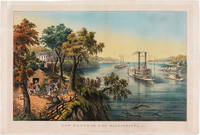
1868rif. 62595New York: Currier & Ives 1868. Scene of African-American Life on the Mississippi During Reconstruction by an Important Woman Artist An excellent Currier & Ives Mississippi River scene created just a few years after the Civil War after an original illustration by the important and prolific artist Frances Palmer. Though ostensibly presented as a nostalgic representation of the South a modern interpretation might conclude that it demonstrates a new sense of freedom and independence felt by formerly enslaved people in the first few years of Reconstruction. This image also demonstrates a simple but poignant and even uncomfortable truth about how life on the Mississippi River is contingent upon external circumstances most notably the whims of the weather. Low Water portrays former slaves dancing merrily outside their cabin with the plantation house in the deep background as the great steamship Robert E. Lee and another riverboat roar down the river. The Lee passes by a small barge on which sits a cabin labeled "Grocery." The water here is indeed low sitting several feet below the top of the riverbank. The sense of celebration among the African-American subjects is palpable. The lithograph is signed "J.M.I. Del." in the image indicating that James Ives drew the lithograph from Palmer's original artwork. The illustration for this Currier & Ives print was created by the important artist Frances Flora Bond Palmer. Palmer 1812-1876 was the first woman in the United States to work as a professional artist and to make a living with her art. She produced more Currier & Ives prints than any other artist. Known as Fanny she was according to Gloria Deák "the foremost woman lithographer of her time." Born and raised in England by a cultivated family she was already an accomplished painter and lithographer when she came to America in 1844 at which time she exhibited two works at the National Academy of Design. By 1849 she was working for Currier producing landscapes and still lifes lithographing these prints herself usually after her own sketches. She worked for Currier & Ives from 1849 into the 1870s bringing in much needed income for her family and producing about 200 of the company's best scenes and landscapes. Palmer was one of the most important and prolific artists and lithographers ever employed by Nathaniel Currier and she gave important assistance to Charles Currier in inventing a superior lithographic crayon. This Mississippi River scene is one the most popular pictures among the thirty-plus Mississippi River lithographs produced by the company. "In 1868 three years after the Civil War ended James Ives who had found Palmer to be an excellent collaborator on his visions of broad symbolic images of American life worked with her on eight large important lithographs.Among them is a pair of lithographs - 'High Water' in the Mississippi and Low Water in the Mississippi - this time portraying the mighty river's fickle moods. The subject was particularly timely because Southern levees had been destroyed during the war and serious flooding had occurred in 1862 1865 and 1867" - Rubinstein. Rubinstein notes that the Currier & Ives audience had always enjoyed scenes of natural disasters and of the Mississippi River but goes on to find significant allegorical content in the image depicted in Low Water as well as noting significant changes between Palmer's original artwork and the published lithograph: "Low Water a peaceful scene of the river at low tide shows a group of brightly dressed African American adults and children dancing and playing the banjo in front of their cabin while white owners of the plantation house stroll about their land.Scholars have critiqued Palmer's presentation in Low Water of childlike African Americans enjoying their lives on the old plantation - reminiscent of the 'Sambo' minstrel show character. In fact Low Water demonstrates how the heavy hand of her employers affected her work. Palmer had originally drawn a fully developed pencil study for Low Water in the Mississippi in which two shirt-sleeved African American men are ferrying three white men to the other side of the river while a group of well-dressed white people seated at leisure in front of the plantation mansion enjoy the view. For the final lithograph however someone perhaps James Ives who signed his name as the lithographer on the print had removed the hard-working black boatmen and substituted the usual minstrel show clichés.Low Water suggested that everyone would be better off if freed black people went peacefully back to work for their former masters instead of demanding their own land or trying to vote and run for office." A fantastic Currier & Ives handcolored lithograph which was originally intended as a companion piece to "High Water" in the Mississippi. Toning in the margins from previous matting. Closed marginal tears a few intruding into the image repaired on verso and with no loss of image. Very good overall with excellent visual appeal. Charlotte Streifer Rubinstein Fanny Palmer: The Life and Works of a Currier & Ives Artist Syracuse NY 2018 item 3-77A pp.144-45 203. PETERS CURRIER & IVES pp.110-16; items 3944 3946. CURRIER & IVES: CATALOGUE RAISONNÉ 3057 4149. CONNINGHAM 2819 3824. GALE 3057 4150. DEÃK PICTURING AMERICA 647 ref. unknown
1868rif. 62595New York: Currier & Ives 1868. Scene of African-American Life on the Mississippi During Reconstruction by an Important Woman Artist An excellent Currier & Ives Mississippi River scene created just a few years after the Civil War after an original illustration by the important and prolific artist Frances Palmer. Though ostensibly presented as a nostalgic representation of the South a modern interpretation might conclude that it demonstrates a new sense of freedom and independence felt by formerly enslaved people in the first few years of Reconstruction. This image also demonstrates a simple but poignant and even uncomfortable truth about how life on the Mississippi River is contingent upon external circumstances most notably the whims of the weather. Low Water portrays former slaves dancing merrily outside their cabin with the plantation house in the deep background as the great steamship Robert E. Lee and another riverboat roar down the river. The Lee passes by a small barge on which sits a cabin labeled "Grocery." The water here is indeed low sitting several feet below the top of the riverbank. The sense of celebration among the African-American subjects is palpable. The lithograph is signed "J.M.I. Del." in the image indicating that James Ives drew the lithograph from Palmer's original artwork. The illustration for this Currier & Ives print was created by the important artist Frances Flora Bond Palmer. Palmer 1812-1876 was the first woman in the United States to work as a professional artist and to make a living with her art. She produced more Currier & Ives prints than any other artist. Known as Fanny she was according to Gloria Deák "the foremost woman lithographer of her time." Born and raised in England by a cultivated family she was already an accomplished painter and lithographer when she came to America in 1844 at which time she exhibited two works at the National Academy of Design. By 1849 she was working for Currier producing landscapes and still lifes lithographing these prints herself usually after her own sketches. She worked for Currier & Ives from 1849 into the 1870s bringing in much needed income for her family and producing about 200 of the company's best scenes and landscapes. Palmer was one of the most important and prolific artists and lithographers ever employed by Nathaniel Currier and she gave important assistance to Charles Currier in inventing a superior lithographic crayon. This Mississippi River scene is one the most popular pictures among the thirty-plus Mississippi River lithographs produced by the company. "In 1868 three years after the Civil War ended James Ives who had found Palmer to be an excellent collaborator on his visions of broad symbolic images of American life worked with her on eight large important lithographs.Among them is a pair of lithographs - 'High Water' in the Mississippi and Low Water in the Mississippi - this time portraying the mighty river's fickle moods. The subject was particularly timely because Southern levees had been destroyed during the war and serious flooding had occurred in 1862 1865 and 1867" - Rubinstein. Rubinstein notes that the Currier & Ives audience had always enjoyed scenes of natural disasters and of the Mississippi River but goes on to find significant allegorical content in the image depicted in Low Water as well as noting significant changes between Palmer's original artwork and the published lithograph: "Low Water a peaceful scene of the river at low tide shows a group of brightly dressed African American adults and children dancing and playing the banjo in front of their cabin while white owners of the plantation house stroll about their land.Scholars have critiqued Palmer's presentation in Low Water of childlike African Americans enjoying their lives on the old plantation - reminiscent of the 'Sambo' minstrel show character. In fact Low Water demonstrates how the heavy hand of her employers affected her work. Palmer had originally drawn a fully developed pencil study for Low Water in the Mississippi in which two shirt-sleeved African American men are ferrying three white men to the other side of the river while a group of well-dressed white people seated at leisure in front of the plantation mansion enjoy the view. For the final lithograph however someone perhaps James Ives who signed his name as the lithographer on the print had removed the hard-working black boatmen and substituted the usual minstrel show clichés.Low Water suggested that everyone would be better off if freed black people went peacefully back to work for their former masters instead of demanding their own land or trying to vote and run for office." A fantastic Currier & Ives handcolored lithograph which was originally intended as a companion piece to "High Water" in the Mississippi. Toning in the margins from previous matting. Closed marginal tears a few intruding into the image repaired on verso and with no loss of image. Very good overall with excellent visual appeal. Charlotte Streifer Rubinstein Fanny Palmer: The Life and Works of a Currier & Ives Artist Syracuse NY 2018 item 3-77A pp.144-45 203. PETERS CURRIER & IVES pp.110-16; items 3944 3946. CURRIER & IVES: CATALOGUE RAISONNÉ 3057 4149. CONNINGHAM 2819 3824. GALE 3057 4150. DEÃK PICTURING AMERICA 647 ref. unknown books
1676rif. 305344ABAmsterdam, Marcus Doornick, (1676). 4°. 2 Bll., 224 S., Titelkupfer mit allegorischer Ansicht, 2 Kupfer mit Gartenansichten, 13 Kupfer mit 26 Abbildungen von Pflanzen und Früchten, 16 Kupfer mit 32 Gartenplänen. Original-Lederband d. Zt. (Einband ber. u. best., Vors. fehlt, 1 Bl. lose, insgesamt guter Druck).
1864rif. 221802Rome 1864. 260 pp. written in ink on versos and rectos with 14 pictures engravings etc. some captioned in her hand. Included are some sheets in other hands in French and German. 1 vols. 8vo. Disbound with water damage. 260 pp. written in ink on versos and rectos with 14 pictures engravings etc. some captioned in her hand. Included are some sheets in other hands in French and German. 1 vols. 8vo. Flora Payne was a Cleveland heiress whose marriage to William Collins Whitney three years after this diary was written formed the basis of one of America's legendary families. Flora Payne herself "was an anomaly among the young ladies of her time. At eighteen she had betaken herself from Cleveland to Cambridge Massachusetts to attend the seminary for young ladies that was being conducted there by Professor Agassiz the naturalist . Flora had traveled widely abroad even to places such as North Africa with which few sophisticated New Yorkers of William Whitney's circle had firsthand acquaintance . " - Kahn JOCK p. 11. unknown
1864rif. 221802Rome 1864. 260 pp. written in ink on versos and rectos with 14 pictures engravings etc. some captioned in her hand. Included are some sheets in other hands in French and German. 1 vols. 8vo. Disbound with water damage. 260 pp. written in ink on versos and rectos with 14 pictures engravings etc. some captioned in her hand. Included are some sheets in other hands in French and German. 1 vols. 8vo. Flora Payne was a Cleveland heiress whose marriage to William Collins Whitney three years after this diary was written formed the basis of one of America's legendary families. Flora Payne herself "was an anomaly among the young ladies of her time. At eighteen she had betaken herself from Cleveland to Cambridge Massachusetts to attend the seminary for young ladies that was being conducted there by Professor Agassiz the naturalist . Flora had traveled widely abroad even to places such as North Africa with which few sophisticated New Yorkers of William Whitney's circle had firsthand acquaintance . " - Kahn JOCK p. 11. unknown books
1761rif. 56742Kopenhagen Nicolaus Møller 1761 1766-1770. Folio. 37 x 25 cm. Indbundet i 3 samtidige ensartede hldrbd. Rygforgyldning med blomsterstempler i rygfelterne. Forgyldt titeletiket på rygge. 2 kapitæler slidte med lidt skindtab. Lettere slidspor på rygge. Med 3 titelblade trykt i rødt og sort hvert hefte med heftetitelblad samt indholdsfortegnelse fra 8-10 sider samt 537 af 540 kobberstukne plancher- ikke kolorerede. I første bind mangler 3 plancher: No. 112 113 og 139. De 3 titelblade med tab af nederste venstre hjørne kun lidt papirtab. Tekstblade og plancher rene og friske med kun ganske få mindre brunpletter. Originaltrykket af Flora Danicas 3 første bind = planche I-DXL i ukoloreret stand med de tyske titel- og hefteblade. De enkelte 9 fascikler er dateret 1761-70 1763. Titelbladene of fascikelhefterne til Flora Danica udkom på tre sprog: dansk latin og tysk. Her i den tyske version.First edition of the 3 first volumes of Flora Danica with the title-pages in German. With 537 of 540 engraved plates in the uncoloured version.Carl Christensen II 2c. - Bibl. Danica II190. - Hunt594. - Pritzel6799. - Nissen2249. unknown
1761rif. 56742Kopenhagen, Nicolaus Møller, (1761) 1766-1770. Folio. (37 x 25 cm.). Indbundet i 3 samtidige ensartede hldrbd. Rygforgyldning med blomsterstempler i rygfelterne. Forgyldt titeletiket på rygge. 2 kapitæler slidte med lidt skindtab. Lettere slidspor på rygge. Med 3 titelblade trykt i rødt og sort, hvert hefte med heftetitelblad samt indholdsfortegnelse (fra 8-10 sider) samt 537 (af 540) kobberstukne plancher- ikke kolorerede. (I første bind mangler 3 plancher: No. 112, 113 og 139). De 3 titelblade med tab af nederste venstre hjørne (kun lidt papirtab). Tekstblade og plancher rene og friske med kun ganske få mindre brunpletter.
1903rif. 056888Sociology And Social Research 1938 Dorris Shelton Still 1939 John Day 1942 John Day Circa 1960 Synergy Books 1989 Correspondence 1987-1996 1903. 1st Edition . Hardcover. Near Fine. Original Photographs 1903-1922 Including Many Negatives Most Annotated Copies Of Photographs Most Annotated Original Documents Newspaper Clippings Books By And About Him 1912-2004 Etc. . Archive Of Photographs And Correspondence In Tibet By Albert Leroy Shelton "Als" Medical Missionary In Tibet 1903-1922. The Archive Contains 6 First Printings Of Books By Or About Him 1912-2004 A Paper "A Bibliographic Essay On American Missionaries To The Tibetans Prior To 1950" 1998 With Related Correspondence From William Martin Also Shelton's 146 Photographs 1903-1922 Of Which 85 Are Annotated In White Ink One Photograph Printing Plate Zinc Of Als And His Wife Flora And Two Daughters Dorothy And Dorris All Of Which Accompanied Him 7 Sets Of Reprint Sheets With 2 Photos Per Sheet Also With One Original Photo And One Original Negative 3 Annotated Negatives 10" X 8" Plus Three Photos On One Sheet 10" X8" 3 Negatives Annotated On Wrapping Paper And On Original Annotated On Reverse 34 Photos 7"X5" Of Which 26 Negatives And 8 Proofs All Annotated On Envelopes And With Transmittal Letter From Dr. William Hardy 1987 47 Large Copies Of Photographs 14" X 10 7/8" With Pencil Annotations On Reverse Signed "J.B. Fine Scenes Of Tibetan People And Group Activities And Buildings Including One Annotated "Remains Of Tibetan Murdered By Chinese- Boiled To Death In A Large Cauldron- Bones Scattered To Be Scavenged By The Dogs- J.B." Computer Printouts 6 Pp And 10 Pp With Chronology Of Als'S Life About 44 Letters To And From Als And His Wife Flora Beal Shelton 1903-1922 With Details Of Events And How They Were Impacted In Particular By The 1918 Fighting Between The Tibetan Armies And The Chinese Armies A Letter From The British "Bengal Secretariat" Inventorying His Effects After His Death 1922 And Another Long List Of Items Purchased From The Estate By Dr. Hardy And Two Long Newsletters About The Continuing Ministry In Tibet Which Are Undated But 1920'S Two 6 And 8 Pp Copies Of Letters From The Morse'S October And November 1922 Describing Dr. Shelton'S Death In Detail And Current Events Since 2Nd Page Of Original Letter From Flora Describing Events Just Prior To Departure For Tibet 1903 71 Pp Clipping File Of Newspaper Reports And 1903-1922 By Sheltons And Others Pasted Into A Book With Loose Notes By Daughter Dorris. Also A Large Format 51 Pp. Scrapbook Of Ephemera And Newspaper Reports From Before And After His Death With Letters From John D. Rockefeller And An Aide To Als 1920 Regarding Purchase Of Art For $1000 The Majority Of His Art Was Sold To The Newark Museum To Form The Bulk Of Their Important Tibetan Art Collection Official Letters To Or About Him Regarding His Being Taken Hostage The Als Death Certificate By Dr. Hardy Photocopy Of The Dalai Lama'S Pass/Permit For Als'S Last Trip And Memorial Service Brochures Also Two Additional Original Photographs Of Shelton And 4 Original Photographs Dated 1907 One Of Which Shows The Stone Bridge Which Was Then The Boundary Of Tibet. An Archive Of Material About Her Father Her Own Experiences In Tibet Etc. By His Other Daughter Dorris Shelton Still Is Available Separately As Are Manuscripts Of His Wife'S Unpublished Novel And An Early Draft Of Her Unpublished Memoir Of Her Own Experiences There Together With A Photocopy Of A Later And Much Longer Draft. Sociology And Social Research (1938), Dorris Shelton Still (1939), John Day (1942), John Day (Circa 1960), Synergy Books (1989), hardcover
1832rif. 12847Chez l’auteur, 1828 1832 3 volumes in-4 demi-basane, dos lisse orné de filets noir & or, pièces de titre et de tomaison, VIII- 528 planches hors-texte couleurs, ch. 1 à 528 sur 544 accompagnées de leur notices. Il manque les 17 dernières livraisons. Les 6 tomes sont réunis en 3 volumes, mais les titres portent : Tome premier 1828, second 1829, troisième 1830. Quelques rousseurs, légères pour les planches. Bon exemplaire.
1785In folio (mm. 400x253), 3 volumi (2 di testo in 1 tomo + Atlante di tavole). Il testo, in p. pergamena antica, tit. oro su tassello al dorso (picc. manc. al bordo super.), tagli rossi, pp. (8),XIX,344; (4),366,XXIV,(2). Ornano i 3 frontespizi una grande e bella vignetta inc. in rame e nel primo volume è contenuto un ritratto di Vittorio Amedeo III Re di Sardegna, cui e' dedicata l'opera, inc. in rame da I.B. Stagnon. L'Atlante, in p. pergamena moderna, tit. oro su tassello al dorso, tagli rossi, pp. (4),XIV di descrizione, 1 c.b., raccoglie 92 bellissime tavole disegnate da Francesco Peiroleri (è questa la grafia del nome adottato dal celebre erborista pittore nella prima tavola e nelle sue lettere all’Allioni) e incise in rame da suo figlio Pietro. La tavola n. 1 è dedicata alla nomenclatura botanica ed alla classificazione propria di Allioni; le altre contengono 228 disegni di piante nuove o rare. "Edizione originale e unica" di questa celebrata opera. Cfr. Nissen BBI 18 - Pritzel,108 - Brunet,I,190. Solo nel 1° vol. pesante alone su 6 cc. (cm. 8x10) e lieve su altre, altrimenti esemplare ben conservato. Il vol. di tavole in ottimo stato. "Carlo Allioni (Torino 1728-1804), conseguita la laurea in medicina nel 1747, si dedicò all'esercizio della professione e a studi scientifici, medici e botanici, proseguiti per tutta la vita. Gli studi botanici culminarono nell'opera massima "Flora Pedemontana", con la descriz. di circa 3000 piante, molte delle quali descritte per la prima volta. La poderosa opera, tuttora fondamentale per lo studio della flora piemontese, poneva l'A. tra i massimi botanici d'Europa, procurandogli l'appellativo di "Linneo Piemontese”". Così Diz. Biografico degli Italiani,II,504.
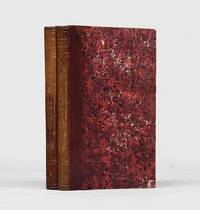
1838rif. 167701Paris: Ladvocat 1838. The most important French socialist-feminist of the 1830s and 1840s Second edition published the same year as the first of the radical philosopher's only novel vividly articulating her goal of social revolution through female emancipation. Méphis is uncommonly met with; we trace only one previous auction listing for any edition. The philosophy of Flora Tristan 1803-1844 linked the nascent socialist theories of class struggles with the contested position of women in contemporary society. Following the mixed reception of her previous political works in Méphis she employs the conventions of the novel to visualise her conception of social reform. The work centres on the titular protagonist's relationships with two aristocratic women and the tensions implicit therein - both in his proletariat origins and in the broader patriarchal conventions weighing on them. Tristan draws several "vivid evocations of feminist role models" Cross & Gray p. 2 thereby winning the novel "a secure place in French Romantic literature" Puech quoted in Cross & Gray p. 2. The work gained further notoriety due to the events surrounding its publication. In 1838 Tristan's estranged husband - a failed artist enraged by her literary success - shot her in the street in broad daylight. Miraculously she was not seriously injured and the resulting trial boosted her sales considerably. Tristan's socialist-feminist philosophy anticipates several aspects of Marx and Engels: she most notably coined the term "Workers of the world unite" a full five years before they deployed it in the Communist Manifesto. She is consequently considered "the most important French socialist-feminist of the 1830s and 1840s" Collins & Weil-Sayre p. 229. The second volume includes two of Tristan's articles on the history of western art which had formerly appeared in L'Artiste. 2 vols octavo 209 x 131 mm pp. iv vii 1 365 1; pp. iv 390 2. Wood-engraved vignette to title pages. Contemporary red quarter sheep spines lettered ruled and elaborately decorated in gilt red marbled sides marbled endpapers edges sprinkled black blue silk bookmarkers. Moderate rubbing faint sunning to spines light sporadic foxing and marginal damp staining to contents: a very good copy. Marie M. Collins and Sylvie Weil-Sayre "Flora Tristan: Forgotten Feminist and Socialist" Nineteenth-Century French Studies vol. 1 no. 4 1973; Màire Cross and Tim Gray The Feminism of Flora Tristan 1992. unknown
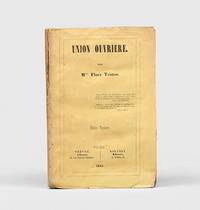
1843rif. 150437Paris: Prévot and Rouanet 1843. Coining the slogan "workers of the world unite!" five years before the Communist Manifesto First edition of the revolutionary French socialist's most famous work urging the working class to unite a call for international emancipation which appeared five years before the Communist Manifesto. Tristan is "perhaps the most celebrated of all 19th-century French feminists" Moses p. 107. Tristan's struggles as both the poverty-stricken illegitimate daughter of a Peruvian noble and as the wife of a violently abusive husband forced her to travel at various points in her life to England as a ladies' companion and Peru in the hopes of re-establishing her family ties. Upon returning to Paris in 1835 Tristan fought her husband André Chazal for custody of her two surviving children and succeeded in regards to her daughter. It was not until 1836 after Chazal shot Tristan that she was granted legal separation and the right to take back the name Tristan. Both as respite from and because of this domestic turmoil Tristan became enthusiastically involved in a number of feminist and socialist groups and activities - she published pamphlets on female immigration petitioned in favour of divorce and for the abolishment of capital punishment attended meetings of the Gazette des femmes group and engaged with the utopian socialism of the Fourierists. "In Union ouvrière Tristan rallies the French working class urging them to create a national organization that would be financed by subscriptions from the twenty-five million workers. She believed that any change among the working class must be initiated by the workers themselves: 'Now the day has come when one must act and it is up to you and only you to act in the interest of your own cause'. Despite her call to action Tristan maintained a firm stance against violence and called only for passive resistance; she believed that destructive acts would only heighten workers' problems. She tried to enlist the bourgeoisie in her plan on the basis that it would help prevent begging and theft. The second part of Tristan's crusade was her attempt to improve the position of women within the workplace and society. She argued that all classes of women should participate in the Workers' Union to lobby simultaneously for feminism and socialism. Her third chapter entitled 'Why I Mention Women' aims to establish continuity between the desires of the workers and those of women" Orlando. Unable to find a publisher willing to print the unorthodox tract she funded the book's publication herself through donations from friends acquaintances and public appeal. From these donations 14000 copies of this first edition were printed stated as "Edition populaire" which she sold for 50 centimes each. In Lyons the fundraising efforts of her working-class followers underwrote a further printing of 10000 copies. Such circulation was very high for the time: the print run of the Communist Manifesto in 1848 by contrast was 2000 copies. "Increasing scholarly attention is revealing her as a pivotal figure in the shift from early nineteenth-century utopian to Marxist economic socialism. Her insistence on the inextricability of class and gender oppression makes her a foundational socialist feminist theorist" ibid. Duodecimo. Uncut in original yellow wrappers printed in black. Housed in quarter calf chemise and slipcase. Slight split to front joint but holding wrappers and contents clean a very good well-preserved copy. Claire Goldberg Moses French Feminism in the Nineteenth Century 1984. unknown
1978rif. 66661978 Editions Le Jardin de Flore, illustrations de Fernand Pouillon, 1978, 145 p."Le 10 em ouvrage édité par le Jardin de Flore , tirage limité à 150 exemplaires sur vergé Richard de Bas avec une suite de gravures réservées à l'auteur" . Exemplaire no 74. Parfait état dans un coffret sous un emboitage cuir . Avec sa suite de gravures.
1938rif. 163880N.p.: N.p. 1938. James Hilton's typescript draft screenplay for the 1939 film an adaptation of his own 1937 novel the only such adaptation he ever completed. With the author's profuse manuscript ink annotations as well as many pages executed entirely in manuscript ink throughout. Included is a privately commissioned essay by Hilton scholar Kurt Kausler detailing both the history of Hilton's work on the film an analysis and a breakdown of the manuscript. Almost certainly Hilton's first corrected manuscript screenplay for the film. After Jack Warner raised concerns about the script being too long screenwriter Milton Krims was employed to clean up and shorten it-though in the end Hilton received sole credit as screenwriter. A man hires an Austrian governess and both are suspected of murder when his wife is discovered to be dead. 123 leaves a gathering demonstrating the author's method his attention to detail and his extreme frugality with the use of paper the last most likely due to wartime shortages. The script consists of a ribbon copy typescript leaves on both onionskin and paper stock with manuscript emendations on virtually every page in many cases both recto and verso with some leaves executed on the versos of unrelated previous work by Hilton b leaves consisting entirely of text executed in manuscript ink c hand-cut partial leaves and d a handful of later Xerographically duplicated facsimiles of Hilton's original annotated typescript leaves. Included is a very detailed analysis of the manuscript as well as the events surrounding its creation along with a detailed breakdown of the manuscript elements. Hilton's manuscript leaves Very Good to Fine quite supple and well preserved. Housed in a modern white three-ring binder. Leaves individually held in modern mylar page protectors. N.p. unknown