Best.-Nr. 206957Paris, Baudouin, (1790) in-8, 4 pp., en feuilles.
Best.-Nr. 206416Paris, Impr. de la Commission de l'Instruction publique, (An II) in-8, 10 pp., en feuilles. Quelques mouillures claires.
Best.-Nr. 203976Paris, Imprimerie nationale, An III in-8, 4 pp., dérelié.
Best.-Nr. 171060S.l., (1790) in-8, 28 pp.
Best.-Nr. 206228Bordeaux, Impr. du club du café national, s.d. in-8, 4 pp., dérelié.
Best.-Nr. 205835Paris, Imprimerie de Thomassin, An 5 in-8, 22 pp., en feuilles.
Best.-Nr. 170167Paris, Imprimerie Royale, 1791 44 x 35,
1911Very Good Greek, Modern (post 1453) Original wrappers. Large 8vo. (21 x 16 cm). In Greek (Modern). 21 p. First and only edition of this exceedingly rare and one of the earliest church regulations of the Greek Orthodox community of Attalia [Antalya]. Attalia was not a large urban center or major trading hub, but neither was the Greek Community marginal, and it was well integrated into the regional economy. It was different from other areas in Asia Minor due to a combination of factors ranging between demography, geography, local Orthodox leadership, and the city's social milieu. In contrast to the West-coast cities and many villages in Asia Minor with Orthodox majorities, Attalia's population was only about one-third Orthodox. The main area of difference in Antalya was the Community leadership, which was key to the maintenance of cordial relationships between Christians and Muslims, and the secular and ecclesiastical elements of Orthodox leadership in Antalya tended to cooperate for collective benefit. Throughout this period, a local elite managed to control education and other Community institutions, perpetuating an identity that was compatible with the local Ottoman context. In this last period, the Greek Community printed several books and tractates including a brief history of Antalya and this "regulation book" in the Meli Printing House, which was the only printing house of the Greek Community in Antalya. Only one institutional copy is located in OCLC 1030075331 (Suna Kiraç Library of the Koç University).
Best.-Nr. 204625Paris, s.d. in-4, 7 pp., dérelié.
Best.-Nr. 206730Paris, Impr. Nationale, 1790 in-8, 16 pp., broché.
Best.-Nr. 205820S.l.n.d. (1788) in-8, 8 pp., en feuilles. Papier froissé.
Best.-Nr. 205819S.l.n.d. in-8, 4 pp., en feuilles.
Best.-Nr. 225979Paris, Chez Baudouin., (1790) in-8, 4 pp., dérelié.
Best.-Nr. 166100Paris, Vve Hérissant, 1790 in-4, 18 pp., dérelié. Page de faux titre détachée.
Best.-Nr. 205871Paris, 1790 in-8, 19 pp., broché.
Best.-Nr. 11923- Lyon, Imprimerie Waltener Et C. In-12°, broché, couverture souple élégante titrée en noir, tranche muette, 46 pages.
1749Best.-Nr. 108541749 Paris, Cavelier, 1749 ( Tome 1), A la Compagnie des Libraires associés, 1727 ( Tomes 2 à 5); 5 volumes in-12°, plein veau marbré époque, dos à nerfs orné et doré, titre et tomaison dorés sur 2 étiquettes de maroquin, tranches rouges. Illustré de blasons dans le texte. Différence d'édition entre le 1er volume et les 4 suivants. Différence de reliures entre le 1er volume de 1749 et des autres de 1727. Dos des Tomes 2, 3, 4 frottés et épidermés, avec manques à 3 coiffes, plats épidermés. Tome 1 en bon état, au tome 5 plats frottés avec très petit manque de cuir en queue à la charnière supérieure; manque étiquette de titre du tome 3.
Best.-Nr. 18058Modena, eredi di Bart. Soliani, (1787). (2), 3-7, (1), 221, (1) pp. 8vo. Modern half calf, spine with raised bands and gilt lettering. Kress, Italian Economic Literature, 562; Einaudi 4757; McCulloch, p. 306; not in Goldsmiths; Mattioli, as part of the Scrittori Classici ..... but no separate edition. First edition. Ludovico Ricci (1742-1799) was born near Modena. He held different posts chiefly connected with charity organisations and taxation. The above work is a valuable monograph, full of historic and scientific statistics. The economic problem of the administration of charity forced itself on governments and Ricci studied the problem for Modena. His study far surpasses the limits of a monograph relating solely to a small state. He treats the problem of the reform of the charity institutions from a rational and systematic point of view. He shows the economic disadvantages of an improved system of public charity, that it tends to the increase of beggary and of the numbers of the poor. Those poor only who are unable to work should be relieved, those who are able to work should be helped solely by work being procured for them. Ricci's views on population are theoretically interesting: he has been called a precursor of Malthus, but, though he touches on the population question, he regards it from a different point of view from Malthus, and more closely approaches modern scientific conclusions (Palgrave, iii, pp. 309-310). 'Remarkable for being one of the first works published in Italy, in which the utility of such institutions was called in question' (McCulloch). - Somewhat spotted.
Best.-Nr. 17893Londres, 1776. (2), viii, 308 pp. 8vo. Contemporary marbled calf, spine gilt in compartments with label and gilt lettering, lightly shaved, corners somewhat bumped. Goldsmiths 11518; INED 3188 (1831 edition); Martin & Walter 24430; Higgs 6537 (for the first and second edition). Second, revised, enlarged and corrected edition. Philosophical and political study on despotism and its effects it pretents to refute the theories of Rousseau while the author in reality attacks straight forward the government. Still to the point remains his remark that: 'La nation finit toujours par être plus puissante que le tyran lorsque le pouvoir arbitraire parvenu à son dernier délire a dissous tous les liens de l'opinion et épuisé les ressources que la terre offre à ceux qui la cultivent en liberté. Ainsi les hommes se vengent tôt ou tard.' 'Dans cet insolent libelle, intitulé Essai sur le Despotisme, sous couleur de réfuter les théories de Jean-Jacques sur la bonté naturelle de l'homme, l'auteur s'attaquait de front aux pouvoirs' (Duc de Castries, Mirabeau, p. 105). Important work proclaiming democratic ideas and openly attacking despotism: 'Après cette vue philosophique générale, l'ouvrage s'attaquait seulement au 'despotisme d'un seul'' (Duc de Castries, op.cit.) - With the errata at the end of page 308.
1889Best.-Nr. 47.118Madrid: Biblioteca Económica Filosófica 1889. 1ª ed. Rústica. 10x15. Biblioteca Económica Filosófica, paperback
1883Best.-Nr. 47.119Madrid: Fernando Fé 1883. 1ª ed. Rústica. 12.5x20. Fernando Fé paperback
1894Best.-Nr. 47.123Madrid: Biblioteca Económica Filosófica LXVII 1894. 1ª ed. Rústica. 10.5x15. Biblioteca Económica Filosófica LXVII paperback
Best.-Nr. 17894A Paris, 1776. (2), 155, (1) pp. 8vo. Contemporary marbled calf, spine gilt in compartments, gilt lettering. Kress 7193; not in Goldsmiths; not in Einaudi; this edition not in INED; Camus 1566; Peinot, Livres Condamnés, i, p. 43 (with wrong date). Third edition, published in the same year as the first edition, the other two having only 48 and 72 pages respectively. Pierre-François Boncerf, French writer on agrarian subjects. While a clerk in the ministry of finance under Turgot he published a pamphlet, Les inconvénients des droits féodaux. According to Palgrave the work was published with the consent of Turgot. In it he attacked the contemporary system of feudal dues as ruinous to those who pay them, of little advantage to its benificiaries and contrary to the principles of freedom. The solemn condemnation of the pamphlet by the parlement of Paris, which the king vetoed, and the ensuing controversy in the press, in which Voltaire took a prominent part, established Boncerf's reputation and resulted in the translation of the work into many European languages. The pages 70-end contain the relevant texts by Montesquieu. The work was first published anonymously, a second edition was published with the pseudonym M. Francaleu.
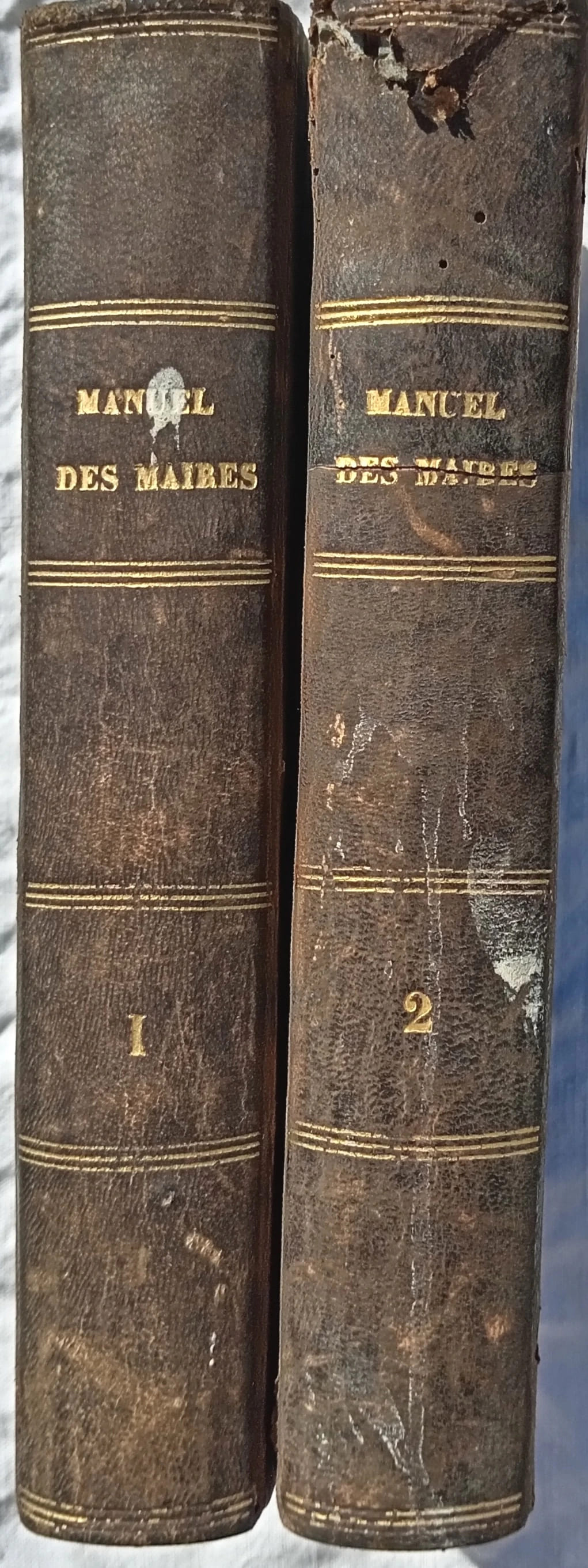
1808Best.-Nr. C055Manuel alphabétique des maires, de leurs adjoints et des commissaires de police, (Contenant le texte ou l'analyse des lois et réglemens relatifs à leurs fonctions jusqu'au mois de juin 1808, avec les formules des différens actes, et des instructions particulières sur leurs attributions respectives; ouvrage également utile aux membres des conseils municipaux, des bureaux de bienfaiseance, des commissions administratives des hospices, etc. par l'auteur du dictionnaire forestier). Garnery Libraire - Paris, quatrième édition, 1808 2 tomes - complets 2 vol, in-8 (12,8 cm X 19,8 cm), 614 pp + 564 pp, reliure demi cuir, dos lisse, titre doré sur le dos.
19804 vol.: 536 p., qq. fig.; 392 p., nbr. ill.; 423 p., qq. fig. et 554 p., nbr. ill. Sommaire sur demande. Inv. 19407.