Radziwill, Princess CatherineBiblio.com

1919réf. 736j0954Boston: Small Maynard & Company Publishers. Good. 1919. First Edition. Hardcover. "The facts presented in the following pages may perhaps not be accepted without surprise and wonder as to their authenticity. The world at large has not yet quite appreciated the full extent of the secret intrigues which were carried on in the former German Empire before and during WWI that was to break its might and destroy it. And yet the whole fabric of German politics was built on these intrigues. From the time that Bismarck instituted his famous Bureau of Espionage these machinations were steadily going on throught the whole of Europe and in America as well and it seems desirable that the activity of this bureau in its nefarious work in Russia be exposed." - page 1. 8 293 pp. Frontispiece photo of Trotzky and Lenine marshalling their forces for revolt plus eight additional black and white plates. Moderate wear to maroon cloth lettered and decorated in gilt. Binding sound. Prior owner's name neatly upon front free endpaper otherwise contents clean and unmarked. No dust jacket presumably as issued. A sound vintage copy. Smele 1107. ; 8vo; 0 pages . Small, Maynard & Company Publishers hardcover
1963réf. 169H5079Princeton New Jersey: D. Van Nostrand Company Inc. Very Good in Good dust jacket. 1963. First Edition. Hardcover. x 361 pages. Index. Footnotes. "An analysis of the causes of the great American depression which began in 1929." - dust jacket. Murray Rothbard 1926-1995 was a prominent American economist libertarian and adherent of the Austrian School. Gift greetings upon front free endpaper otherwise book clean and bright with light wear to publisher's red cloth. Binding tight. Average wear to dust jacket now preserved in archival-grade Brodart. A quality first edition copy of this profound and most timely treatise which contends that "crises and depressions are caused not by the free market economy of capitalism but by government intervention in that economy - by credit expansion cheap interest rates the propping up of wage rates." - dust jacket.; 8vo - over 7¾" - 9¾" tall; Great Depression - United States Austrian School of Economics Ludwig Von Mises Business Cycles Laissez-Faire Capitalism Government intervention . D. Van Nostrand Company, Inc. hardcover
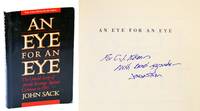
1995réf. 222j2811USA: BasicBooks Inc. Good No dust jacket as issued. First Paperback Edition. Paperback. Signed and inscribed by author upon half-title. "When I wrote this book I hadn't guessed that people would call it a monstrous lie. A lot of it after all had been fact-checked by three major magazines and a paper whose editor said 'It may be the most accurate story in the history of American journalism.' A lot had been fact-checked by 60 Minutes which found eight eyewitnesses who I hadn't and 1580 death certificates signed by a Jewish commandant" - p. vii-viii. "Tells for the first time the full story of what happened at the end of WWII when the Russians recruited hundreds of Jewish victims of Nazi terror to run concentration camps for Germans in Poland." - back cover. "John Sack 1930-2004 was an American literary journalist and war correspondent. He was the only journalist to cover each American war over half a century." - Wikipedia. First printed in hardcover in 1993. 252 p. Index. List of Sources. Prior owner's name atop table of contents. Neat red underlining to approximately 21 pages. Average wear. A rare signed example of this controversial work.; 8vo; Signed by Author . 1995. 0465022154 . BasicBooks Inc. paperback
1922réf. 441j1306London: Chapman & Hall Ltd. Good with no dust jacket. 1922. First British Edition. Hardcover. "The revolutionary unrest which to-day afflicts the entire world goes far deeper than is generally supposed. Its root-cause is not Russian Bolshevik propaganda nor the late war nor the French Revolution but a process of racial impoverishment which destroyed the great civilizations of the past and which threatens to destroy our own. In light of recent biological discoveries confirmed and amplified by investigations in other fields of science especially psychology all political and social problems need to be re-examined. Such a re-examination of one of these problems - the problem of social revolution - has been attempted in the present book." - Preface. "Lothrop Stoddard 1883-1950 was an American historian journalist and political scientist. He wrote several books advocating eugenics white supremacy Nordicism and scientific racism. His books were once widely read both inside and outside the United States. This book introduced the term Untermensch the German translation of 'Under-man' into Nazi conceptions of race. As a journalist he spent time in Germany during the first months of World War II where he interviewed several prominent Nazi officials." - Wikipedia. xiii 255 pp. Index. Moderate wear to original camel cloth. Original paper spine label present. Binding intact. Moderate foxing to edges and minimally to contents. No dust jacket. A sound first edition example of this influential work. Weems p. 94. ; 8vo . Chapman & Hall Ltd. hardcover
1945réf. 214h5790New York: Didier Publishers. Good in Fair dust jacket. 1945. Hardcover. "The story of the writer's experiences in the Nazi concentration camp of Sachsenhausen. Here was the experimental laboratory where the Nazis perfected the techniques in extermination later applied to victims from all over Europe. It was also the training ground for the personnel recruited from the dregs of Germany's prisons. Shows how human fortitude ingenuity mutual loyalty and the will to live can enable men to survive unbelievable degradation; or if they must die to die like men." - dust jacket. iv 284 pp. Black and white reproduction of the Alien's Order 1920 which caused the author to be expelled to Berlin after he had escaped to England. "The impact of your memoir is terrific. I think this book is an achievement equalling Zola's J'Accuse." - Manfred George Editor. "We ought to have these stories preserved. The whole race suffers when such things happen." - Pearl Buck Nobel laureate. Book clean and unmarked with average wear to publisher's red cloth. Binding sound. Above-average wear to dust jacket now preserved in archival-grade Brodart. A sound copy of this important account. Kehr & Langmaid 6239 Weiner Library Cat. 7 1819. ; 8vo 8" - 9" tall . Didier, Publishers hardcover
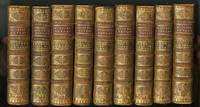
1604réf. 045016Paris: Ambrosium & Hieronymum Drouart 1604. Second Edition. Hardcover Full Leather. Very Good Condition. 5 volumes bound in 9 in contemporary calf. Worn at the edges and corners spines a little dry but intact and attractive overall. Volume 1 with a single title page some copies were apparently bound with a second title page noting Estienne the publisher of the Folio edition. Old bookplates inside covers ownership marks and stamps to titles and first pages occasionally trimmed a little close on the top edge just touching the running title scattered minor pencil marks light dampstain to the corners of a section of vol vii but otherwise clean and a very good set overall. This is the second edition of Thou's history published 1604-1608 and the first octavo edition. It was published just after the Folio edition a few months after for the first volumes and almost simultaneously thereafter. The first two octavo volumes corresponding to the first folio volume and printed in 1604 identified here as Pars I and Partis Primae Tomus II is bound in four volumes as is the second volume published in two octavo volumes in 1606 and corresponding to the Folio volume also published in 1606. They are identified as Tomus Secundi Pars Prima and Tomi Secundi Pars altera. The final volume identified as Libri VI is bound in one and published in 1608 the Folio edition was published in 1607-8. Because Thou was editing and changing his systems of identification as he published the books the naming system is a little odd - this final volume follows the third and fourth octavo volumes and not the first two in how it is numbered. 1005pp index; 1013 index; 958 index; 886 index; 501 privilege index. Kinser pages 10-20. Graesse VII 147. Thou's history is one of the great monuments of Renaissance history and in its scientific factual take on events was much more a work of the enlightenment than the counter-reformation. As a result and despite some minor changes from the first edition all of the later books dealing with the wars of religion and other topics ended up on the Index Librorum Prohibitorum in 1609. A 1620 edition collected all of the history and added Thou's Mémoires. Size: Octavo 8vo. 9-volume set complete. Quantity Available: 1. Shipped Weight: 2-3 kilos. Category: History; Antiquarian & Rare. Inventory No: 045016. Ambrosium & Hieronymum Drouart hardcover
1933réf. 237j1305Berlin Germany: Jakow Trachtenberg Verlag. Very Good with No dust jacket as issued. 1933. First Edition. Hardcover. "I myself am not German but a foreigner. Because of this I feel it is my duty to stand up for the honour of the country which has given me hospitality for the past fourteen years. I must state expressly that I am doing this of my own accord and will carry this action through without the influence of any official or private initiative. The material I have collected here will convince every honest and well-meaning person abroad that the agitation regarding the alleged acts of atrocity in Germany may very well lead in the end to genuine acts of this kind for the unscrupulous instigators of this lying propaganda are plainly out to bring on a new war. But at the same time the book should prove that the German Jews themselves regard the atrocity propaganda as lies and are eager to oppose it with every means in their power and to inform those abroad of the real truth." - Preface. A compilation of statements attributed to a wide variety of sources including Chancellor Hitler Vice-Chancellor von Papen Baron von Neurath Captain Göring Dr. Goebbels The Federation of Jewish Soldiers Who Fought At The Front The Israelite-Sephardic Society of Berlin The Committee of the Berlin Jewish Community The Prussian Federation of Orthodox Synagogue Communities Halberstadt The Israelite Community in Dresden The Saxon Federation of Israelite Communities and many more. Presumably published in response to the anti-Nazi boycott initiated in March of 1933 due in part to the efforts of Samuel Untermyer. 4-142 pp. 25.7 x 19.8cm. Contents very clean tight and unmarked. Moderate external wear and foxing. A well-preserved example. Kehr & Langmaid 3546 Weiner Library Catalogue Series 7 #1106.; Sm 4to . Jakow Trachtenberg Verlag hardcover
1730réf. 043619Paris: Jacques Vincent 1730. First Edition. Hardcover Full Leather. Good Condition. 5 volumes in contemporary gilt calf worn dry hinges and joints split boards attached but precariously in a few cases. Scattered browning internally and occasional creased pages spine labels bookplates and old embossed theological library stamps to title but generally clean and unmarked otherwise. 36 plates many folding and 4 maps hand colored in outline. Published 1730-1745. Size: Folio. 5-volume set complete. Quantity Available: 1. Shipped Weight: Over 3 kilos. Category: History; Antiquarian & Rare. Inventory No: 043619. Jacques Vincent hardcover
1960réf. 735h5502New York: Columbia University Press. Good. 1960. First Edition. Hardcover. "Historiography has quite neglected the romantic and fascinating history of the underground and free-professing Jews in colonial Brazil who formed the earliest Jewish community in America and became the "Jewish Pilgrim Fathers" of New York as well as of Jamaica Barbados and other Jewish communities in the Caribbean area. The present work is an effort to fill this gap." - Preface. Wiznitzer was president of the Brazilian Jewish Institute of Historical Research and a frequent contributor to learned journals. pp. x 227. Footnotes. Index. List of works cited. Personalia. Black and white reproductions of historic documents. Frontispiece illustration of Isaac Aboab Da Fonseca 1605-93 the first rabbi in the New World. Moderate wear to original navy blue cloth brightly lettered in gilt upon backstrip. Binding sound. Prior owner's bookplate and small bookseller tag inside front board. Photo/bio of author affixed to recto of front free endpaper. Blind stamp prior owner name and date upon title page. Foxing in vicinity of endpapers and lightly to edges. Includes new replica dust jacket in glossy new archival-grade protection. A sound example of this important work.; 8vo - over 7¾" - 9¾" tall; Brazil - Jews - History Marranos - Brazil . Columbia University Press hardcover
1938réf. 222j2739New York: Longmans Green & Company. Good in Fair dust jacket. 1938. First Edition. Hardcover. This book was banned by the British in Palestine. Stated first edition. "Outlines the historic background leading to the famous Balfour Declaration of 1917 which put England on the side of aiding the Jews in setting up a national state in Palestine and airs the amazing circumstances under which the terms of the Mandate for Palestine have been from time to time altered or re-interpreted. It is a complete indictment of the course which the Mandatory has followed and recites in startling detail the reasons behind the various riots and disturbances which have convulsed the Holy Land from the advent of the British Administration up to the present date." - dust jacket. "The book is full of political dynamite - in its documented indictment of the British camarilla which in betraying the Jewish nation is betraying the British nation as well and in its unsparing exposure of self-deluded Zionist leadership." - Eugene Lyons. xiv 2 612 p. Extensive footnotes selected bibliography glossary and index. Two-colour endpaper maps of The Jewish National Home and Arab Territories of the Present Day. Contents very clean tight and unmarked. Average wear to original blue cloth. Above-average wear to the rare unclipped dust jacket now in glossy new archival-grade protection. A sound first edition example. ; Dust Jacket Design; 8vo . Longmans, Green & Company hardcover
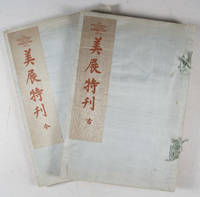
1929réf. 41261上海市 Shanghai: æ£è—社 Zheng yi she 1929. Second edition. Softcover. poor to vg-. Folios. Approx. 15x10". Unpaginated. "Modern" volume with 3 preliminary pages of index and 8 pages of prologue. "Ancient" volume with 2 pages of prologue and 1 page of index at the front. Grey patterned cloth portfolio with black lettering over a white label on the front cover. Light blue-grey silk wrappers with light blue string-tied bindings. Red lettering in English and Chinese over a tan silk label on the front covers. This is the "November 1929" printing. The work is an exhibition catalog from The National Fine Arts Exhibition held in Shanghai in April of 1929 which was organized by the Ministry of Education of the Republic of China headed at the time by Cai Yuanpei. It is considered the first Chinese fine arts exhibition in modern history. The exhibition was a monumental retrospective with more than 2000 pieces of art from throughout Chinese history starting from the Five Dynasties period the 10th century up through the contemporary period. The event brought together the work of countless Chinese artists photographers and architects and also included the work of six Japanese artists. The catalog includes some 400 pieces of the artwork featured in the exhibition divided into a "modern" volume and an "ancient" volume. The artwork is printed in b/w offset photographic reproductions and collotypes. Also included in the "ancient" volume are seven works in color with both Chinese and English language titles on protective tissue guards a few of which are beautifully printed color lithographs. The "modern" volume contains a printed calligraphic prologue written in by Cai Yuanpei. The "ancient" volume includes works from some artists as The Four Wangs Wu and Yun from Qing Dynasty Four Monks of the Early Qing Dynasty Bada Shanren Shitao Hong Ren and Kun Can Lan Ying and Gong Xian. The "modern" volume contains works from Zhang Daqian Qi Baishi Wu Hufan Liu Haisu and Lin Fengmian among many others. Both volumes contains extensive indexes of the artwork. Text in Chinese. Portfolio with boards broken but present. Wrappers with some light smudges and scratches and a few minor creases. Some sunning along the top and bottom edges of the covers. Interiors with sunning to the edges and a few sporadic minor smudges. Images mostly unaffected. Portfolio in poor wrappers in good interiors in very good- condition overall. æ£è—社 (Zheng yi she) unknown
1954réf. 12810Baltimore 1954. 17 leaves illustrated with twenty-seven original photographs most in corner mounts and numerous ephemeral items and periodical clippings. Folio. Original black cloth embossed in blind on front cover with titles and decoration in gilt string-tied. Moderate chipping to edges of leaves text leaves tanned and somewhat fragile several leaves detached. Good condition. An informative photographically-illustrated and annotated scrapbook assembled at Morgan State College now university in Baltimore in the Eisenhower years and documenting the campus activities of the Omega Psi Phi fraternity. The compiler is not identified but was surely a member of the fraternity. Most of the photographs shoe Lambados Club members engaged in pledge activities capturing pledges holding light bulbs while standing in heavy topcoats at various campus locations posing in formations while dressed in matching suits and berets while holding canes and placards identifying the subjects as "Dog No. 1" "Dog No. 2" and so forth and chanting as they march a cross campus in close single file while dressed identically in white oxfords khaki pants white tennis sweaters dangling chains and dark-billed caps. Other photos depict pledges at a Morgan State-Howard football game with "The ques of Howard & Morgan singing at halftime." The ephemeral items include tickets invitations ribbons programs broadsides a gold & purple patch and more. These items include a manuscript copy of a Rudyard Kipling's poem "If" that pledges were expected to memorize a "Summons" to appear at a party in New York City a ticket for an event called "Lamp Leap" programs for memorial services a group of clippings photos and other material featuring "Big Brothers" who became successful in the military politics and sports and two large broadsides. Respectively the latter two items advertise a charity benefit aboard the "Omega Showboat" actually the S.S. Robert Fulton with music by Don Wilson and His Orchestra measuring 14 x 19 inches and a chapter-sponsored "Bi-Annual Skating Party at the Coliseum" measuring 14 x 11 inches. A wonderful record providing a rare peek into African-American Greek life within one of the Divine Nine at a Baltimore HBCU in the mid-1950s. unknown books
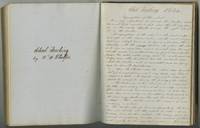
1849réf. List3731Albany New York 1849. Notebook measuring 7 ¾ x 10 ½ inches. 124pp filled out totaling appx. 49000 words. With two loose essays 7pp. Front cover detached with wear especially to edges and spine; good. Contents excellent. Overall very good. A notebook containing transcriptions of lectures by Profs. William F. Phelps Silas Bown and William W. Clark of the New York State Normal School now SUNY Albany. The three professors were graduates of the school's first class in 1846 and became professors there upon graduating. The notebook is highlighted by ten pages of notes documenting Phelps' extensive and detailed lecture on schoolteaching. The lecture dates to early in Phelps' career shortly after his own graduation; the educational pioneer would go on to preside over a number of normal schools and the American Normal School Association found the National Education Association serve as vice-president of the first International Conference of Educators and author textbooks and manuals for teaching. The lecture is titled "Organization of the school" and is divided into sixteen sections covering different aspects of teaching. He opens: "The organization of the school is the most important step in the teacher's duties and the most important and critical time in his life as a teacher; this is especially with the young teacher. He enters the school as it were an apprentice and is to work upon the most delicate material without having first learned his trade . the material upon which the teacher acts is immortal and an injury done to it will last forever." Teaching for Phelps had to involve more than just "taking up a reading book and calling out a class and hearing them read around then commanding them to take their seats" and repeating the same process with every subject-especially for a new teacher on his first day. He lays out his preferred first-day procedure-an introduction by the trustees then a short speech followed by a "little song" or "amusing or instructive anecdote"-but emphasizes that "The spirit of kindness should be breathed forth in every sentence; nor should he forget to speak kindly to those he meets in the streets." He then turns to the classification of students with short exams on the various subjects along with careful attention to the students so "that you may learn their habits" again emphasizing the teacher's attitude towards his pupils: "He should learn the names of the scholars as soon as possible; for it is very disagreeable not to be able to call the name of a scholar when you wish to speak to him. Never call a boy Mr. or a girl Miss; for you miss it every time you Miss your school-girls it will make them grow too fast." Next Phelps makes suggestions for getting one's preferred textbooks adopted. One can appeal to the trustees and then to the parents and then if this fails the teacher can follow Phelps' scheme of purchasing the preferred books himself lending them out for free and "exciting a deep interest in their lessons": "The parents will soon begin to wonder at the change that has taken place in their children once they could not persuade them to look at their books but now they do nothing but study. You will thus wake up the parents to a sense of the utility of the books". Parents according to Phelps also need to be convinced that a longer lesson is not necessarily a better one: "If the teacher gives them long lessons and thus runs them through . they call him a smart man." However a short lesson is easier to learn and well-learned lessons "will soon cause the objections of parents to give way". His other advice concerns seating arrangements-"according to size if you are a lover of symmetry"-how to dismiss students for recess and tracking and managing absences and tardies which he states should mainly be managed by making the lessons interesting and the classroom pleasant. He closes by describing how the teacher ought to enact "a missionary spirit": "Let the first two or three weeks of your school be spent in visiting the parents in the district and becoming acquainted with them and giving them an opportunity of becoming acquainted with you. . Do not forget to talk to them about their children. Show them that you are laboring for the good of those children - that you love them and wish to do them all the good in your power. If you have the teacher's spirit they will soon find it out . If you possess the art of being agreeable in private conversation and in addition to this exercise true politeness in all occations sic you will never have any trouble in finding a pleasant boarding place. And when you do go there you will find as good a living as you want and the pies and sweet cake will be on hand. You will also be able to teach the parents many things . and then you may consider your school as 'Thoroughly Organized'." One imagines that Phelps' meticulous lecture with its emphases on kindness and making schooling enjoyable for students and parents was quite inspiring to the soon-to-be teacher; the practices he outlines set the foundation for his future career. Bowen's lectures cover rhetoric and composition-especially focusing on good taste defined as "the power of receiving pleasure from the beautiful of nature or art"-and Clark's cover chemistry natural philosophy and electricity. Throughout there are interesting comments that expose the professors' underlying philosophies and thus approaches to teaching: for instance Bowen comments that "Persons by nature are differently constituted some naturally possessing a more refined taste than others" and Clark states that "All knowledge is acquired through the senses" and that "Natural History is not a science" but mere classification. The notebook also includes a short lecture on music a transcription of a chapter of Charles Babbage's Ninth Bridgewater Treatise and two short apparently original essays one on technological progress and the other on wisdom. Of interest to historians of education and of the early days of SUNY Albany. books
1719réf. 5206Madrid: M R de Murga 1719. First Edition second state - plates numbered. Contemporary limp vellum. Good; old ink stain to p. 74 has resulted in the loss of a few letters; some margins close but complete; binding worn; text block beginning to split. 4to. There is an engraved title frontis. with four saints engraved portrait and 39 engraved plates. A sought after book in which the author departs from usual forms of calligraphic art and presents it as a geometrical science. It is the first Spanish writing manual listed in the Hofer catalog. Harvard has two copies both defective. The copy offered here is according to Palau Hofer and others complete with the maximum number of plates. Palau suggests that early issues of the book may have fewer plates. The author was an orphan born in 1663 raised by the schoolmaster of his native town Mostoles. He was to become famous as a creative and inventive and favored member of the court as well as a didactic writer on art a mathematician architect and instructor of fencing. An impressive work with plates illustrating the laying out of dials and the mathematical basis for various letter forms. This resulted in a lengthy and detailed text that is most uncommon for this kind of book. The engraving throughout is elaborate and elegant. Only one plate is signed by the engraver Juan Bernabe Palomino; Cotarelo assigns all the engraving to him. The state results from the fact that the plates are numbered consecutively - Harvard has a defective copy without the numbering. What is of special interest is the crucial significance see Corbeto of such books and especially Aznar de Polanco on the early development of punchcutting in Spain during the formative mid-eighteenth century. The in depth analysis of the ' letra grifa ' - a cursive type - is directly attributed to Aznar de Polanco. Hofer Coll. # 137; Palau # 21133; Cotarelo y Mori I pp. 134 - '40; see Corbeto The Library v. 10 #3 esp. pp. 286 - 289. [M R de Murga] hardcover books
1929réf. 41261上海市 Shanghai: æ£è—社 Zheng yi she 1929. Second edition. Softcover. poor to vg-. Folios. Approx. 15x10". Unpaginated. "Modern" volume with 3 preliminary pages of index and 8 pages of prologue. "Ancient" volume with 2 pages of prologue and 1 page of index at the front. Grey patterned cloth portfolio with black lettering over a white label on the front cover. Light blue-grey silk wrappers with light blue string-tied bindings. Red lettering in English and Chinese over a tan silk label on the front covers. This is the "November 1929" printing. The work is an exhibition catalog from The National Fine Arts Exhibition held in Shanghai in April of 1929 which was organized by the Ministry of Education of the Republic of China headed at the time by Cai Yuanpei. It is considered the first Chinese fine arts exhibition in modern history. The exhibition was a monumental retrospective with more than 2000 pieces of art from throughout Chinese history starting from the Five Dynasties period the 10th century up through the contemporary period. The event brought together the work of countless Chinese artists photographers and architects and also included the work of six Japanese artists. The catalog includes some 400 pieces of the artwork featured in the exhibition divided into a "modern" volume and an "ancient" volume. The artwork is printed in b/w offset photographic reproductions and collotypes. Also included in the "ancient" volume are seven works in color with both Chinese and English language titles on protective tissue guards a few of which are beautifully printed color lithographs. The "modern" volume contains a printed calligraphic prologue written in by Cai Yuanpei. The "ancient" volume includes works from some artists as The Four Wangs Wu and Yun from Qing Dynasty Four Monks of the Early Qing Dynasty Bada Shanren Shitao Hong Ren and Kun Can Lan Ying and Gong Xian. The "modern" volume contains works from Zhang Daqian Qi Baishi Wu Hufan Liu Haisu and Lin Fengmian among many others. Both volumes contains extensive indexes of the artwork. Text in Chinese. Portfolio with boards broken but present. Wrappers with some light smudges and scratches and a few minor creases. Some sunning along the top and bottom edges of the covers. Interiors with sunning to the edges and a few sporadic minor smudges. Images mostly unaffected. Portfolio in poor wrappers in good interiors in very good- condition overall. æ£è—社 (Zheng yi she) unknown books
réf. Z1-S-031-02547Higher Education Quality Council. Used - Good. Worn cover. Ships from UK in 48 hours or less usually same day. Your purchase helps support Sri Lankan Children's Charity 'The Rainbow Centre'. Ex-library so some stamps and wear but in good overall condition. 100% money back guarantee. We are a world class secondhand bookstore based in Hertfordshire United Kingdom and specialize in high quality textbooks across an enormous variety of subjects. We aim to provide a vast range of textbooks rare and collectible books at a great price. Our donations to The Rainbow Centre have helped provide an education and a safe haven to hundreds of children who live in appalling conditions. We provide a 100% money back guarantee and are dedicated to providing our customers with the highest standards of service in the bookselling industry. Higher Education Quality Council unknown
1919réf. 59006401Washington: U.S. War Department - General Staff G-3 1919. Bound in one half brown leather over gray boards. five raised bands gilt still bright. Tabs for 93 divisions from 1917-1918 with 4-5 pp. per division. Lists no. of enlisted men officers headquarters generals casualties etc. Exceedingly rare. Approximately 400 leaves. Contains charts no maps in this volume. States Copy No. 41. First Edition. Hard Cover. Very Good /No Jacket. 4to - over 9¾" - 12" tall. U.S. War Department - General Staff G-3 Hardcover
1919réf. 59006401Washington: U.S. War Department - General Staff G-3 1919. Bound in one half brown leather over gray boards. five raised bands gilt still bright. Tabs for 93 divisions from 1917-1918 with 4-5 pp. per division. Lists no. of enlisted men officers headquarters generals casualties etc. Exceedingly rare. Approximately 400 leaves. Contains charts no maps in this volume. States Copy No. 41. First Edition. Hard Cover. Very Good /No Jacket. 4to - over 9¾" - 12" tall. U.S. War Department - General Staff G-3 Hardcover books
1977réf. 2091502135202172Hara shobo 1977. Soft Cover. Fine. Number of books: 9 Hara shobo paperback
1936réf. 2279148Wishart Books Ltd 1936. This is an ex-library book and may have the usual library/used-book markings inside.This book has hardback covers. In poor condition suitable as a reading copy. No dust jacket. Please note the Image in this listing is a stock photo and may not match the covers of the actual item700grams ISBN: Wishart Books Ltd hardcover
2001réf. 2083002117401043Matsuno Shoten Reprint Edition Popular Edition 2001. Soft Cover. Fine. The book is in fine condition. Matsuno Shoten Reprint Edition (Popular Edition) paperback
réf. 637434360The McGraw-Hill Company . Hardback. New. 11th Edition The McGraw-Hill Company hardcover
1982réf. mon0000581160ACACE 1982T. paperback. Good. in x in x in. Ex-library book usual markings. Well read with some wear but still very useable. ACACE paperback
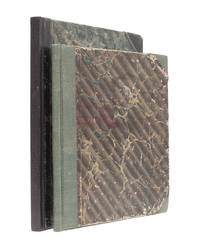
1890réf. 5955Kutztown PA 1890. Quarter roan over marbled boards measuring 8 x 6.25 inches and comprised of 73 pages of manuscript text including a mixture of notes passed between friends on the verso of the final leaf and on the rear pastedown. Spine largely perished with boards and textblock held together by cords. Several leaves neatly excised towards rear. Containing notes from Fannie Hottenstein's courses in teacher training the present volumes offer researchers a range of study topics including the history of pedagogy and women's increasingly visible place in American education; the book also is a valuable resource for examining how educated young women were thinking through their own lives and roles -- as individuals and as a generation. Trained in one of the most educationally progressive states at the time Fannie Hottenstein was one of a generation of women who could more widely dream about and pursue more independent lives than their matriarchs. Historically Pennsylvania had been a vanguard for public and progressive education. "In his 1830 address to the state legislature Governor George Wold championed the cause of universal public education" as a scaffold for "the security and stability of the individual privileges we have inherited from our ancestors" Explore History. Before the decade was over "more than 1000 local school districts under a single statewide system of instruction" had been founded working to regularize "educational standards curriculum and instructional credentials" in tandem with the 1857 Normal School Act which founded "a network of ten state academies to prepare public school teachers" Explore History. Fannie attended one of these preparing for a career in education that would give her a new level of social and economic independence. Much of Fannie's notebook reflects the kind of rigorous work required to teach middle and high school students. Contents include for example three pages of facts on basic Botany; fifteen pages on the practice of Logic in writing and debate including an extensive section on presenting proper Opposition accompanied by text book page numbers; and five pages on pedagogical methods for helping students develop curiosity and drive it forward into productive study. There are additional fairly staid essay samples on topics such as Influence and Gentleness. Yet it is in the thirteen page essay We Girls that sparks of Fannie's individuality ambition and independence show. In it she reveals how much contact she has had with the period's literature on women's rights and suffrage; she shows her familiarity with anti-feminist arguments in opposition to women like her; and she powerfully expresses her hopes not only for her generation but the ones that follow. Fannie opens: "It is a recognized fact that the degree of civilization of every nation is marked by the social position of woman. Indeed one of the most prominent features of the progress of civilization is her gradual elevation in society and the clear perception and recognition of her rights. In the earlier ages of the world when the sphere of her influence was bounded by the narrow prejudices of the opposite sex her happiness as well as her mental improvement and social rank depended more on what was done for her at the hands of men than on what she could do for herself. All this is changed now." Fannie praises the hard-won changes women accomplished in accessing education and job training; and she touts how many opportunities are available for women to dream about and pursue. This does not mean she's unaware of the challenges that continue -- particularly from men. "We have to contend with the prejudice sometimes entertained against us that our highest destiny in life is to be a pretty piece of furniture in a handsome parlor. Men who entertain this notion we girls must always urge to get their furniture somewhere else." To those who accuse women of being too emotional and insufficiently intellectual she also has a response. "Our aim must be to develop and perfect our entire nature mental social and moral" she argues. Only by embracing both thinking and feeling as strengths can any individual -- man or women she contends -- succeed. Women are in a unique position to embrace both. A truly rich document which also includes brief notes among Fannie and her friends about their flirtations and recent purchases of accessories at the end gives insight into the development of a young woman who would go on to live what she preached. According to the US Census of 1900 Fannie remained single and lived in a boarding house working as an office stenographer. unknown
1870réf. 3389United Kingdom 1870. Geography notebook of Mary Barker: Quarter black roan over marbled boards measuring 9 x 7 inches. Comprised of a calligraphic title and frontis plus 59 hand drawn-and-colored maps done by a young woman in her first three years of teacher training. Throughout Mary annotates on the margins which year and term she is in and occasionally notes that the map was drawn "From Memory"; and each map has penciled corrections and assessments. with Geography notebook of Allison Jane Gillespy: Quarter cloth over marbled boards. Calligraphic title page and 35 intricately hand drawn maps from the British Empire Europe and the Middle East. A pairing of beautiful and research-worthy notebooks documenting teacher training in the late nineteenth century as well as providing a look into how geographies changed across time and how British educators were being trained to perceive and educate the young about other parts of the world and how they connected to the British empire. With nearly 100 pages combined the notebooks offer scholars important comparative opportunities and means for better understanding the rising number of women educators and authors publishing works that engaged geography and international cultures during the Victorian era. "The Wesleyan Methodists had a school for ministers' daughters at Trinity Hall Southport.which admitted both boarders and day girls.to educate ministers daughters and train teachers" Roach. Pupil teacher programs like the one Mary Barker was enrolled in had become a popular method of producing teachers at a time when the public's access to education expanded and the demand for instructors was at a high. Such programs functioned like an apprentice system taking a senior pupil typically thirteen years old and putting her in a five year assistantship to her own instructor. Pupil teachers typically took on responsibility for teaching lower classes observing their superiors educate the more advanced students and completing their own educations. By the 1870s these programs had become standardized to ensure proper preparation for instructors Robinson. Mary's maps trace this process. As she moved from her first to her third year in this notebook the quality and care she puts into her work improves. Her handwriting and attention to detail matures. And her assessments move from Fair to Good and Very Good. Maps in the notebook include nearby locales such as Ireland Scotland and the British Isles as a whole; European nations including Sweden Norway and Prussia as well as eastern Europe and Russia. Mary also maps out "Arabia" and the "Chinese Empire" as well as "Further India" revealing a wide array of changing borders and shifting cultural attitudes. While Allison does not leave any marker of her class age or school the level of intricacy in her maps suggests she was a senior student or finished instructor. These appear to be fair copies not done from memory but prepared as examples for students or as teaching aids. Together the two provide a comparative opportunity to study the history and politics of mapping nineteenth century girls' education pedagogy and pedagogical training and geography. unknown