72.843 risultati
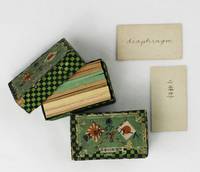
1935rif. 6332Japan 1935. Very good. Approximately one hundred cards in two boxes cards measuring approximately 1 x 2 inches. Boxes slightly worn a little splitting along folds but still holding firm. Cards clean and fresh on various colors of stock. An attractive and unusual set of hand-written vocabulary flash cards designed to assist Japanese students learning English. Each card features an English word on one side with the Japanese translation on the reverse. The cards sold under the name Victory Cards are presented in charming and petite period boxes. Each box bears the bold illustration of both the national flag and the Rising Sun flag flanking a helmeted soldier at the center -- an image that reflects the militarist atmosphere of the time. Words included here are from the letters C and D with selections such as "coroner" "conspectus" "contraception" "convolute" "diaphragm" "deteriorate" "depot" "dexterity" and "diagonal" among others. unknown books
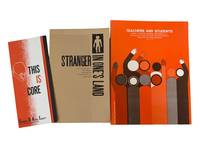
1961rif. 238151961. Mexican American education and civil rights archive circa 1961 to 1973 documenting the expansion of American civil rights work from organized nonviolent confrontation of racial discrimination to federal investigation of unequal treatment within public institutions. The group begins with a Congress of Racial Equality pamphlet explaining the sit in the "standing line" and CORE's system of local direct action then moves to two U.S. Commission on Civil Rights publications addressing Mexican American civil rights and educational inequality. Three pamphlets and booklets issued by the Congress of Racial Equality and the U.S. Commission on Civil Rights New York and Washington D.C. circa 1961 to 1973. 1 Congress of Racial Equality. This Is CORE. New York: Congress of Racial Equality circa 1961. Folding illustrated pamphlet issued from CORE's 38 Park Row headquarters explaining the organization's philosophy and practical methods of nonviolent direct action. The text identifies CORE as a pioneer in applying Gandhian nonviolence to discrimination in hotels swimming pools barber shops restaurants and other public accommodations and describes student sit ins that began in February 1960 and spread through southern communities. Illustrated sections explain "THE SIT-IN" and "THE STANDING LINE" the latter a technique in which CORE members remained in line behind Black patrons refused service preventing the establishment from simply continuing business around them. The pamphlet also explains local chapter organization National CORE financing and the planning required before public demonstrations. 2 U.S. Commission on Civil Rights. Stranger in One's Land. Washington D.C.: U.S. Government Printing Office May 1970. Clearinghouse Publication No. 19. Federal civil rights publication devoted to the status of Mexican Americans issued at the beginning of a decade in which the Commission increasingly examined discrimination against Mexican American communities as a distinct civil rights question rather than treating American racial inequality solely through a Black and white framework. Its title defines the central contradiction investigated by the Commission: Mexican Americans encountering discriminatory treatment within the country of their citizenship and residence. 3 U.S. Commission on Civil Rights. Teachers and Students: Differences in Teacher Interaction With Mexican American and Anglo Students. Report V Mexican American Education Study. Washington D.C.: U.S. Government Printing Office March 1973. A systematic federal study of classroom behavior based on direct observation and interviews in 429 classrooms in California New Mexico and Texas. The Commission organized its findings around six disparities: teacher praise and encouragement; teacher acceptance and use of student ideas; positive teacher response; teacher questioning; noncriticizing teacher talk; and the amount of student speaking. Its transmittal letter states that Mexican American students were "neglected in comparison to Anglo students" that teachers praised or encouraged Anglo children "considerably more often" built on Anglo students' ideas more frequently and directed questions to Mexican American pupils less often. The report concludes that Mexican American children consequently spoke significantly less in the classroom and argues that these patterns reflected the educational system's failure to adapt its programs to Mexican American students. These publications record a change in the evidentiary language of the civil rights movement. CORE's pamphlet teaches activists how to force visible racial barriers into public confrontation through disciplined collective action; by 1973 the Commission on Civil Rights was identifying discrimination that could operate without a posted prohibition or formally segregated classroom. Teachers and Students makes that shift measurable by analyzing the ordinary exchanges through which teachers distributed attention encouragement questions and opportunities to speak. Its findings locate inequality within routine institutional behavior extending the question of equal educational opportunity beyond enrollment and access to what happened after Mexican American children entered the classroom. The two Commission publications also belong to a broader federal effort during the Chicano movement era to document Mexican American exclusion in the Southwest at the same moment that activists were challenging school segregation unequal resources language policies and institutional discrimination. Light handling wear and minor edge rubbing to wrappers; scattered toning with interiors clean and legible. Overall very good condition. A compact documentary sequence tracing civil rights strategy from direct action against explicit racial exclusion to federal measurement of unequal treatment experienced by Mexican American students inside American public schools. unknown books
1960rif. 232671960. Drug education pamphlets issued across the late twentieth century recording the shift from the publicization of recreational drug use in the 1960s into the broader drug crisis language of the crack era and the AIDS years when intoxication dependency overdose and injection risk became central subjects of school and public health. These pamphlets reduce a wide range of drugs into a simple public warning system meant for students parents and other non-specialist readers. They sort marijuana stimulants depressants narcotics hallucinogens and inhalants into clear categories translate drug culture into recognizable slang and everyday terms and stress the bodily psychological legal and social consequences of use. Archive of 13 educational drug safety pamphlets. 1960s-1990s chiefly 1980s. United States. Multi-page folded and staple-bound pamphlets ranging from 2.5" x 8" to 5.25" x 8.5" including seven color-coded Channing L. Bete drug-class pamphlets which include slang terms for each category and their side affects; a foldout Drug Abuse Products Reference Chart; a Pharmaceutical Manufacturers Association identification folder; and six additional educational pieces on prescription drugs marijuana and drug-abuse identification with references for educators and parents identifying "the effects of drug abuse" and "how to identify the user." Across these pieces the public view of drugs after the counterculture era's focuses on the long term affects of usage with language centered on dependency traffic injury social incompetence arrest and health deterioration with cocaine heroin and injectable drug use entering a climate already shaped by crack panic and by heightened fear surrounding blood-borne disease in the AIDS years. Prescription medicine abuse is not separated from illicit consumption here with tranquilizers barbiturates methaqualone diet pills and doctor-prescribed drugs appearing in the same educational field as heroin and crack. Minor creasing and toning; overall very good condition. This archive traces the broader American perspective shift on drugs from deviant recreation to public health and safety. unknown books
1930rif. 234181930. African American family photo album documenting Black education childhood and family life likely Cleveland Ohio from 1930 through the early 1940s. During the 1930s Cleveland's Black population grew with families who had come north through the Great Migration seeking industrial work schools churches and opportunities unavailable or highly restricted in much of the South. In northern cities Black children often entered public schools that were not segregated by state law but were still subject to housing discrimination neighborhood boundaries and unequal municipal investment. This album records a Black family's schooling as a visible marker of progress respectability and aspiration during the Depression and early wartime years. Album of 55 silver gelatin photographs ranging from small portrait prints to larger mounted school class photos. Cleveland Ohio and surrounding area 1930s-early 1940s. Children and teenagers appear in formal school portraits with printed or handwritten "School Days" captions including a boy seated at a desk behind a 1930 marker young men in ties and suit jackets dated 1936 and girls in patterned dresses with white collars dated 1939-40 and 1940-41. A large class portrait gathers several dozen Black schoolchildren against a brick wall with boys in suits and ties standing beside girls in dresses blouses and school stockings. Family and community scenes expand the educational record into domestic life: siblings pose close together in a studio portrait children stand in yards and fields women pose near houses and fences young men appear in sharp double-breasted suits and brimmed hats and an adult man leans against a polished 1930s automobile. Outdoor scenes include well-dressed family members at rocky overlooks roadside paths and residential yards suggesting weekend travel neighborhood visiting and leisure alongside the formal school record. The album presents school portraits as part of a larger Black family chronology that follows children from infancy through adolescence and early adulthood. The repeated school-year dating gives the album unusual clarity as a record of Black educational aspiration in Depression-era Cleveland where families used dress portraiture and school milestones to mark social mobility despite employment discrimination and redlining. Album leaves show chipping adhesive staining losses where prints have been removed fading toning and handling wear; mounted images generally remain legible with several strong portraits. Overall in good condition. A strong collection of images documenting African American education Great Migration family life childhood and Black urban experience in Ohio. unknown books
1943rif. 222181943. African American Civil Rights Charles S. Johnson. Race Relations: A Monthly Summary of Events and Trends in Race Relations. Volume I 1943-1944. New York: Negro Universities Press. Race Relations a monthly digest compiled under the direction of for the Department of Records and Research at Fisk University. This is 1969 reprint of all the i1943-44 ssues Volume I in hardcover. 320 pages. 8vo. Bound in black buckram with gilt spine lettering issued without dust jacket. Originally published during the height of World War II this series offers a real-time primary source window into the structural racism employment struggles military segregation and anti-Black violence that shaped the lives of African Americans during the war years. Each issue includes rigorously documented news briefs on industrial disputes urban migration housing discrimination race riots lynchings and political and social movements offering critical insight into federal policy failures and local resistance. The publication draws from an extensive range of wire services and local press coverage including the Associated Negro Press ANP General Press GP and Office of War Information OWI and organizes content into recurring thematic sections like "The Social Front" "The Industrial Front" and "The Political Front." Volume I begins with the August 1943 issue Volume 1 Number 1 and runs through 1944 preserving crucial early reporting on wartime labor disputes Jim Crow segregation in the armed forces and civil rights efforts emerging across northern cities. It serves as a critical tool for understanding how Black scholars and journalists documented the mechanisms of racial oppression and resistance in real time. Pages bright and clean. Binding sound. No markings. Overall very good condition. unknown books
1927rif. 224901927. U.S. Department of the Interior Office of Indian Affairs. Group of eight bulletins issued 1927-1928 documenting federal Indian education and cultural policy systems in the United States during the interwar period. The material documents the system of government-directed Native American assimilation and education through officially distributed bulletins revealing how federal agencies structured narratives around Indigenous identity labor domestic life and citizenship. These publications demonstrate the process by which the Office of Indian Affairs disseminated standardized cultural and educational messaging often through institutions such as Indian boarding schools and federally aligned presses providing primary-source evidence for the study of U.S. assimilation policy Indigenous education systems and state-controlled cultural representation. U.S. Department of the Interior Office of Indian Affairs. Education of the Indians. Washington D.C.: Department of the Interior 1927; Indian Art and Industries. Chilocco OK: Indian Print Shop Chilocco Indian Agricultural School 1927; The American Indian in the World War. Department of the Interior 1927; Indian Home Life: Part I-The Past Part II-The Present. Lawrence KS: Haskell Institute 1927; Primitive Agriculture of the Indians. Chilocco OK: Indian Print Shop 1928; Bibliography of Indian Legends. Chemawa OR: Salem Indian School 1928; United States Indians: Historical References. Chemawa OR: United States Indian School 1928; Indian Missions of the United States. Phoenix AZ: The Native American Press 1928. Eight staple-bound pamphlets each measuring approximately 9 x 5.5 inches and ranging from 4 to 16 pages. The bulletins include photographic illustrations instructional texts and compiled references addressing topics such as classroom instruction traditional and adapted crafts military service in World War I domestic life comparisons between pre-reservation and reservation contexts agricultural practices and bibliographic listings of Indigenous oral traditions. Several publications were printed at Native-run or government-operated institutions including Chilocco Indian Agricultural School Haskell Institute and Chemawa Indian School indicating the use of these sites as production centers for federally approved content. Visual and textual content emphasizes instruction classification and comparison often framing Indigenous practices within narratives of modernization and integration. Issued during a period of intensified federal oversight of Native communities these bulletins illustrate the mechanisms of U.S. Indian policy as it operated through education print culture and institutional networks. The materials show how government agencies coordinated messaging across multiple regions using schools and presses to circulate interpretations of Indigenous culture aligned with assimilationist objectives. At the same time the inclusion of topics such as oral traditions and traditional agriculture provides evidence of selective cultural documentation within these frameworks. The archive supports research into federal Indian policy boarding school systems print dissemination networks and the intersection of education and cultural control in the early twentieth century. Toning faint marks and general wear to wrappers all text remains legible and intact; overall good to very good condition. A coherent group offering direct evidence of federal educational and cultural policy directed at Native American communities in the 1920s. unknown books
1968rif. 224131968. African American Education Chernow Fred and Carol. Reading Exercises in Negro History. Elizabethtown PA: The Continental Press Inc. 1968. Educational programs designed to support mid-20th century classroom instruction in African American history and literacy comprising of 3 programs; Reading Exercises in Negro History Volumes 1 and 2 along with the rare companion Teacher's Guide. This series is explicitly designed for elementary-level readers with content written at a fourth-grade level and focused on biographical narratives of Black achievement across fields such as science government literature education and civil rights. Each volume includes illustrated reading selections followed by multiple-choice comprehension questions and vocabulary drills intended to foster critical thinking and independent learning. Each measure 8.25" x 11" and have 12-63 pages. Volume 1 profiles figures such as Robert Sengstacke Abbott Marian Anderson W.E.B. Du Bois Katherine Dunham Langston Hughes Thurgood Marshall Gordon Parks and Carter G. Woodson. The volume opens with a structured guide "To the Teacher" noting that "Reading Exercises in Negro History presents short biographical sketches of famous American Negroes" and is intended both to train students for standardized reading tests and to "point up the success of individuals in overcoming obstacles and the contributions Negroes have made to American and world culture." The accompanying Teacher's Guide provides teaching strategies suggested discussion questions answer keys vocabulary aids and interdisciplinary correlations to maximize classroom effectiveness. Notably it explains that the reading series helps students struggling with written formats common to testing emphasizing the importance of understanding word meaning in context. The volumes were co-authored by Fred B. Chernow then Assistant Principal for the Board of Education City of New York and Carol Chernow both of whom were active in educational publishing and curriculum development. The inclusion of this history-based literacy tool in 1968 a year marked by the assassination of Martin Luther King Jr. and the expansion of Black Studies programs reflects broader shifts in educational philosophy and curriculum reform following the Civil Rights Movement. An important pedagogical artifact from the integration era this archive offers insight into how Black history was being introduced to primary classrooms in the late 1960s. Some dog eared corners and minor wear to covers and original library stamps. Teacher's Guide has fragile binding. Text and pages clean. Overall very good condition. A leading elementary educational guide in Black studies during the Civil Rights era. unknown books
1920rif. 219091920. Unknown photographers photograph archive circa 1900-1938 documenting women's participation in medical and dental education during the early twentieth century. The depicts students in classroom laboratory and clinical environments providing primary-source visual evidence for the study of women's entry into professional medical training. The photographs show women positioned within predominantly male cohorts as well as in specialized training environments illustrating both their limited representation and increasing presence in medical institutions during this period. Archive comprises six photographs including real photo postcards and press images depicting medical and dental students across multiple locations including Philadelphia Chicago New York City and an Armenian institution or community. A circa 1900 matted class photograph shows approximately twenty male students and a single woman posed in a classroom with anatomical charts. A 1923 real photo postcard from the Northern Illinois College of Ophthalmology similarly includes one woman among a large group of male students. A 1932 photograph with Armenian inscription depicts a group of predominantly female obstetrics students in graduation formation. A 1934 New York University Medical School image shows students in an operating theater with a woman present among male peers. A 1938 press photograph identifies Evelyn Swanson a Northwestern University dental student engaged in halitosis research accompanied by a printed caption. Another press photograph from 1928 shows Mary Markiecez identified as a Latvian medical student at the Woman's Medical College of Pennsylvania using a microscope in a laboratory setting. These photographs document a transitional period in which women gained increased though still limited access to formal medical education following suffrage and into the interwar years. The contrast between early images showing isolated female presence and later photographs depicting women in specialized or majority-female training environments reflects broader institutional changes in education and professionalization. The inclusion of named individuals and international students further situates the archive within expanding opportunities for women across national and social boundaries. Light wear and minor handling marks; overall good to very good condition. A focused visual record of women's integration into medical and scientific training in the early twentieth century. unknown books
1875rif. 219541875. Feminism and Women's RightsEarly Women's Education Three House Commons bills on women's education 1875-1911. London: House of Commons Printing Office 1875 1910 1911. First printings. This archive charts incremental but foundational legal reforms to ensure British women's access to university education teaching professions and public educational funding across the late 19th and early 20th centuries. Each bill represents a distinct moment in the evolving struggle for gender parity in education from admission to universities to protection against workplace discrimination for married women. 1 Universities Scotland Degrees to Women Bill No. 6. A Bill to Remove Doubts as to the Powers of the Universities of Scotland to Admit Women as Students and to Grant Degrees to Women. Ordered to be printed 8 February 1875. Prepared and brought in by Mr. Cowper-Temple Mr. Russell Gurney Mr. Orr Ewing and Dr. Cameron. This early bill was designed to eliminate ambiguities in existing law that obstructed women's access to higher education in Scotland. It explicitly authorized the admission of women to universities and the awarding of degrees citing the earlier 1858 Act that governed Scottish university operations. The bill's clarity and precision reflect Parliament's growing engagement with women's academic rights. Four pages. Toning and faint pencil note to upper corner. Very good. 2 Education Girls Bill No. 70. A Bill to Extend the Duties and Powers of Educational Authorities with Regard to the Training of Girls. Ordered to be printed 14 March 1910. Presented by Sir Charles McLaren supported by Mr. Atherley-Jones Mr. J.M. Robertson Mr. Snowden and Mr. Theodore Taylor. This substantive legislative effort addressed gender inequality in employment and access to education. It proposed barring dismissal of female teachers upon marriage mandating that publicly funded institutions provide equal access to women and reallocating endowments for equitable gender distribution. Sections also provided for training in domestic arts and midwifery. Eight pages total including title and memorandum. Light crease to margin; near fine. 3 Education Girls Bill No. 153. A Bill to Give Better Educational Facilities to Women. Ordered to be printed 3 April 1911. Presented by Mr. Snowden supported by Mr. Atherley-Jones Mr. J.M. Robertson and Mr. Theodore Taylor. This later iteration reaffirms and slightly refines the provisions of the 1910 bill. It reiterates non-discrimination against married women teachers reasserts the equal access requirement for institutions and funding and continues the support for domestic arts and midwifery education under the 1902 Act. The bill's expanded language reflects the increasing integration of feminist principles into public educational policy. Eight pages total. Crisp and clean with only minor toning; near fine. Paper lightly toned with light edge wear as expected. Overall very good to near fine condition. A critical collection of original legislative printings representing England and Scotland's shifting stances on gender equality in education and employment. unknown books
1965rif. 221061965. EducationIntegration Los Angeles public school panoramic photographs 1965-1968 showcasing racial integration and diversity in East Los Angeles during the Civil Rights era. Created at a time of expanding desegregation efforts and increased visibility of Chicano and Sansei Japanese identity in urban California the images provide direct visual evidence of multiracial student populations in a major West Coast school system. Three panoramic silver gelatin photographs showing Hollenbeck Junior High School Classes of 1965 and 1967 and Roosevelt High School Class of 1968. Los Angeles California 1965-1968. The large-format images measuring between 25 x 8 inches and 28 x 8 inches present hundreds of students arranged in traditional panoramic format on school grounds. The Roosevelt High School Class of 1968 photograph includes a visibly diverse cohort of Latino Black Asian American and white students in graduation attire distributed throughout the composition without apparent segregation by race. The Hollenbeck Junior High photographs similarly depict multiethnic student groups with period dress including uniform-style dresses collared shirts ties and sweaters. The versos of the 1965 and 1967 Hollenbeck prints contain numerous handwritten inscriptions from classmates including signatures and messages such as "Good luck in the B-10" and other personal notes. The presence of Spanish surnames including Roberta Noriega situates the photographs within the predominantly Mexican American community of East Los Angeles and documents peer networks within that setting. These photographs correspond to a period preceding the 1968 East Los Angeles student walkouts when Mexican American students protested educational inequality making them materially relevant to the study of pre-activist conditions within these schools. The integrated compositions and inscriptions together document both institutional structure and interpersonal relationships offering layered evidence of how students experienced race identity and belonging within public education. Light surface creasing and minor soiling to versos; images remain sharp with strong contrast and minor edge wear no losses. Overall very good condition. A visual record of multiracial student life in East Los Angeles. unknown books
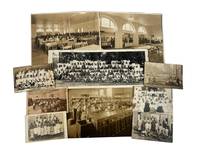
1900rif. 204981900. African American school and youth education photographs dating from the early twentieth century through the 1940s document the institutional development of Black education during the era of segregation in the United States. The images record students and teachers in grade schools college classrooms and organized youth programs illustrating the growth of African American educational networks after emancipation and during the Jim Crow period. Schools for Black students expanded rapidly in the late nineteenth and early twentieth centuries through church sponsorship philanthropic support and the establishment of historically Black colleges and secondary schools. These photographs preserve visual evidence of that educational infrastructure showing black children adolescents and college students engaged in academic and community life. Archive contains 10 photographs consisting of six real photo postcards and four larger silver gelatin prints dating approximately from the 1910s through 1940. Four postcards depict grade school classes including Jacksonville Colored School circa 1910s Douglass School of Moselle Missouri photographed in 1915 a class labeled "7B Grade School #63" dated June 1929 and another group of Black children assembled outside a wooden schoolhouse. Two additional postcards document older students: one shows high school girls seated on the steps of a brick school building and another depicts a 1922 classroom gathering at Wiley College in Marshall Texas. The Wiley College postcard carries a printed message on the verso describing the institution as "a college 'of the Negroes for the Negroes by the Negroes'" followed by commentary emphasizing the educational development of African Americans in the decades after slavery and inviting viewers to consider the college as evidence of that progress. Four silver gelatin prints expand the archive's documentation of African American educational and youth environments. A panoramic photograph records YMCA Camp Osceola in August 1940 a summer camp for predominantly Black boys where counselors wear jerseys from institutions including Seton Hall Princeton High School Somerville High School and West Chester. Another photograph shows a summer school chemistry class credited in blindstamp to "The Photographic Division C. M. Battey Instructor Tuskegee Institute Alabama" accompanied by a caption explaining that teachers seeking certification in Domestic Science were required to take chemistry. Battey was an early twentieth century African American photographer associated with Tuskegee Institute and known for portrait work of figures such as W. E. B. Du Bois and Frederick Douglass. Two additional photographs depict a dining hall serving young African American women likely associated with an Atlanta educational institution during the 1940s. Photographs range from approximately 5.5 × 3.5 inches to a panoramic print measuring about 14 × 5.5 inches with several mounted on cardstock. Minor toning light creasing and some mount wear or small areas of mount loss appear on several prints while the photographic images remain clear. Very good condition overall and a substantial visual record of African American educational life during the segregation era. unknown books
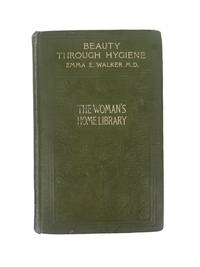
1905rif. 206671905. Women in Science Walker Emma E. Beauty Through Hygiene: Common Sense Ways to Health for Girls. New York: A.S. Barnes & Company. First edition second printing 1905. Part of the Woman's Home Library. Edited by Margaret Sangster. Illustrated throughout. 8vo 306 pages. Original green cloth boards with embossed ornamentation and cream font on the cover and spine. Written by Emma E. Walker M.D. a female physician and member of the New York Academy of Medicine who published several women and girl's health guides. Beauty Through Hygiene is a guide to health and hygiene for girls discussing sports and exercise including exercises in housework weight complexion care of skin and hair care during menstruation remedies and for common ailments and illnesses. Emma Elizabeth Walker received her A.B. from Smith College in 1887 and earned an M.D. from Johns Hopkins University in 1898. Later that year she opened her medical practice in New York City. Walker authored Beauty through Hygiene 1905 "Pretty Girl Questions" in Ladies Home Journal and many articles and pamphlets for both popular and medical audiences. She lectured widely on the topics of personal and social hygiene and was a member of numerous medical and professional organizations. Ex-library with spine label interior pastedown and pocket. Minor general fading and staining to the covers. Cloth scuffed and worn along the extremities and hinges. Walker's journals mainly focus on the ailments that primarily affect women where most male physicians had improperly diagnosed or treated making her guides a historically and contextually important field of study. unknown books
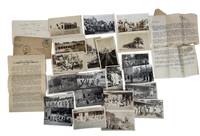
1941rif. 209861941. Gregson Anita. A.P. Mission City School archive 1941-1942 documenting girls' education missionary activity and community life in Ambala Punjab during World War II. This material records daily instruction social interaction and local conditions within a mission-run school for girls alongside written correspondence and institutional reporting that situate the school within wartime pressures and colonial India's educational landscape. The archive provides direct evidence of classroom practices gendered education and the integration of local families into school environments as well as the impact of global conflict on regional communities. Archive comprises 21 original black and white and sepia photographs one typed letter and one annual report. Photographs measuring approximately 2" x 3" to 3" x 5" frequently bear handwritten or typed captions on the verso likely by Anita Gregson identifying subjects and activities. Images show groups of schoolgirls engaged in classroom exercises and outdoor instruction including one scene of students constructing a ground map of India to illustrate agricultural production. Another photograph depicts a semicircle of young children seated outdoors during a lesson with their teacher identified as Miss Atmaran and a veiled mother observing her burkha partially drawn back. Additional images document craft instruction including girls weaving coconut palm leaves into fans and producing woven ties on frames. Musical activity is also present with students playing instruments. Beyond the school photographs depict village life in Punjab including oxen operating a water-drawing mechanism children gathered around a missionary playing a ukulele and a merchant carrying goods suspended from a yoke. The accompanying letter dated June 14 1942 from Gregson to a correspondent in New York references World War II noting international observances and local enlistment: "The young men in our Indian community are continuing to sign up for the army navy and air force." The annual report for the 1941-1942 school year details wartime financial strain fundraising efforts and instructional programs including an adult literacy course for women teaching reading writing and arithmetic. Created while India functioned as part of the British Empire during World War II these materials document the intersection of missionary education wartime mobilization and local social life. The inclusion of adult literacy instruction for women reflects ongoing efforts to expand female education under colonial conditions while the letter and report connect the school directly to global conflict and its local consequences. Light wear and minor fading to photographs; handling wear present. Letter on thin paper with tears and fragility consistent with wartime materials poor to fair condition; remaining materials overall very good condition. This archive provides a concentrated visual and textual record of girls' education and community experience in wartime Punjab. unknown books
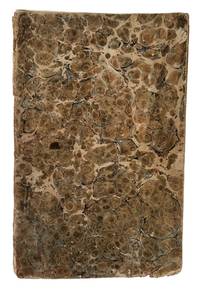
1849rif. 196951849. Wismer Henry. 19th-Century Handwritten Arithmetic Notebook from Pennsylvania is an 1849 to 1850 student manuscript documenting practical mathematics education in rural antebellum Pennsylvania. Completed in Plumstead the notebook records the arithmetic skills taught for commerce bookkeeping household accounting and everyday calculation during a period of expanding market activity. Its value lies in the student-produced evidence of how numerical instruction was practiced on the page with lessons arranged through headings worked examples and repeated computations rather than printed textbook exposition. Wismer Henry. 19th-Century Handwritten Arithmetic Notebook from Pennsylvania. Plumstead Pennsylvania 1849-1850. Manuscript arithmetic notebook 72 handwritten pages approximately 12" x 7½". The title page is inscribed "Addition of Federal Money" and the leaves are organized with subject headings followed by handwritten calculations. Topics include "Addition of Federal Money" "Addition and Subtraction of Decimal Fractions" "Simple Interest" "Compound multiplication" and related exercises showing the practical curriculum expected of a Pennsylvania student preparing to use arithmetic in trade finance and daily life. Several word problems connect classroom numeracy to ordinary social and economic situations including an age calculation beginning "Henry was born on the 20th of the 6th month June 1789 and Charles on the 18th day of the 2nd month February 1828" and a commercial problem involving corn bought and sold by the bushel. Dampstaining and foxing throughout; handwriting remains clear and legible on all pages. Overall very good. A substantial student manuscript preserving the methods subjects and practical applications of mid-nineteenth-century Pennsylvania arithmetic education. unknown books
1841rif. 197091841. Pennsylvania Mathematic Education 19th-Century Handwritten Arithmetic Notebook from Bucks County Pennsylvania. Manuscript arithmetic notebook comprising 48 handwritten pages approximately 12 × 7½ inches executed by Isaac Fluck of Bucks County Pennsylvania between December 1841 and 1842. Fluck was born in 1826 making him approximately sixteen years old when he compiled these pages during his high-school education. The volume is systematically organized with clear subject headings at the top of each leaf - such as "English Money" "Cloth Measure" "Addition of Federal Money" and "Compound Division" - followed by worked examples written computations and applied problem sets. A recurring emphasis on conversions measurements and multi-step arithmetic underscores the practical education valued in mid-nineteenth-century America. The notebook is distinguished by its preservation of authentic word problems that illustrate how mathematical instruction was tied to everyday concerns. One problem asks the learner to "Subtract 36 acres 2 rods from 900 acres 3 rods 16 perches" while another records multi-digit subtraction including "Subtract fifteen thousand five hundred and nine from twenty thousand six hundred and fifty four." Other entries show Fluck reducing long measures - from leagues to miles and furlongs to poles - and calculating "simple subtraction" with large numbers evidencing both the student's increasing confidence and the curriculum's emphasis on real-world numeracy. The alternating use of black and blue ink throughout the notebook as well as the range of topics addressed indicates ongoing study over months rather than a single session. The breadth of lessons - from federal money and cloth measure to compound multiplication and time calculations - reflects the type of math education offered in preparatory schools of the period. As a student-produced manuscript this notebook offers rare primary evidence of arithmetic pedagogy prior to the widespread adoption of printed textbooks and demonstrates how young Americans were trained in the mathematical skills necessary for commerce trade and measurement in a rapidly developing nation. For institutional collections it provides direct insight into the intellectual life of a teenage student in pre-Civil War Pennsylvania and the material culture of learning in the antebellum United States. Condition: The notebook's covers are detached and some dampstaining and foxing throughout otherwise very good condition. unknown books
1808rif. 197171808. Weidner Samuel. Early 19th-Century Barter Arithmetic Notebook of Samuel Weidner of Bucks County Pennsylvania is an 1808 to 1829 manuscript documenting practical mathematics education and commercial calculation in the early Republic. Begun when Weidner was about seventeen and continued intermittently into adulthood the notebook records arithmetic as a working intellectual skill tied to trade currency conversion profit and loss partnership accounting and barter exchange. Its long span provides unusually direct evidence of how one Pennsylvania student preserved and revisited mathematical rules across the transition from schooling to adult use. Weidner Samuel. Early 19th-Century Barter Arithmetic Notebook of Samuel Weidner of Bucks County Pennsylvania. Bucks County Pennsylvania 1808-1829. Manuscript arithmetic notebook 62 handwritten pages approximately 12" x 7½". The notebook is organized into titled lessons including "Loss and Gain" "Fellowship" and "Exchange" each followed by manuscript definitions rules and worked examples. Under "Loss and Gain" Weidner writes "Loss and Gain is a method of computing the profits or loss on the purchase or sale of goods" and connects the rule to "Barter." In "Fellowship" he defines the subject as "the rule for adjusting the several quota of the loss or gain of any joint adventure of a bankruptcy effect" adding that "the sum of the several shares must equal the whole gain or loss." The "Exchange" section addresses conversion between monetary units through the "rule of three" while long division examples include extended problems such as "1265.50 divided by 165191.02" and "2000 divided by 6840912." The notebook records the commercial orientation of early nineteenth-century arithmetic instruction in rural Pennsylvania where mathematical study prepared students for market transactions bookkeeping shared ventures debt and practical financial reckoning. Light soiling and handling wear consistent with a working manuscript; handwriting remains clear and legible throughout all 62 pages. Overall very good. A substantial Bucks County student manuscript preserving the rules examples and applied logic of early American commercial arithmetic over more than two decades. unknown books
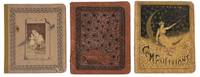
1880rif. 196981880. Fraister Belle. Iowa Schoolgirl Handwritten Notebook Archive documents the classroom work of a late nineteenth-century Iowa girl preserving evidence of women's education through manuscript exercises in history English penmanship grammar and arithmetic. The notebooks show how a schoolgirl practiced factual recall moral phrasing written style and practical calculation during a period when secondary education for girls increasingly prepared students for teaching clerical work and public intellectual participation as well as domestic life. The material provides direct evidence of everyday pedagogy handwriting discipline and curriculum formation in Iowa between 1880 and 1890. Iowa 1880-1890. Archive of 3 handwritten school notebooks belonging to Belle Fraister totaling 146 pages many blank in decorated pictorial wrappers; notebooks measure approximately 8" x 7" and 8" x 7½". The notebooks contain written work in history English penmanship and arithmetic with one history section summarizing states through structured categories such as time cause place and people. For Georgia Fraister writes "Time - 1733" "Cause - Refuge for the poor and persecuted" "Place - Savannah" "People - English" and notes "1752 - Geogia became the first Royal Province." Other pages show repeated penmanship practice including the phrases "Promise little but do much" and "Union is strength" calligraphic stroke exercises and grammar notes on pronunciation inflection pitch synonyms and related language study. One notebook includes a small newspaper clipping on the death of John G. Saxe with a brief handwritten biographical note beneath it. All notebooks bear stamps from the original stationery store. 1 Fraister Belle. History Notebook. Iowa 1880-1890. Contains structured state-history summaries including entries for Georgia organized by date motive for settlement location and people showing classroom methods for memorizing colonial and state history. 2 Fraister Belle. Penmanship Notebook. Iowa 1880-1890. Includes repeated letters words phrases and calligraphic strokes documenting handwriting instruction as both practical skill and moral exercise through maxims such as "Promise little but do much" and "Union is strength." 3 Fraister Belle. English and Arithmetic Notebook. Iowa 1880-1890. Contains notes on grammar pronunciation inflection pitch synonyms arithmetic and a clipped notice with a manuscript biography of John G. Saxe showing the combination of language study numeracy and literary awareness in Fraister's schoolwork. Decorated wrappers with light handling wear; interior pages generally legible; many pages blank as noted. Overall very good. A compact manuscript archive documenting the subjects methods and written discipline of girls' education in late nineteenth-century Iowa. unknown books
1928rif. 189221928. Women's Education Diploma for female student at the Crouse-Irving Hospital School of Nursing. Syracuse NY. 18 October 1928. Kept in black cloth folder with gilt lettering that measures 6.5" x 4." Diploma certificate is awarded to "Louise Lowe McKeehan" and bears gold seal and school insignia. There are signatures from the President Board of Trustees the Superintendent of Hospital the Principal School of Nursing and the President of Staff which validate this document. Founded in 1887 by a group of women the Syracuse Training School for Nurses was the first hospital in the area that would admit women and children. This diploma is evidence of the school's long history of furthering women's education. Very good condition. unknown books
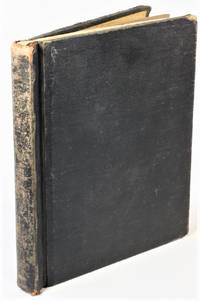
1926rif. 189771926. Women's Education Elliott Vida Coe. The Social Role and Function Family as Analyzed in the Teachings of Confucius and Confucianism. Minneapolis: The University of Minnesota 1926. 97 pages of typed text. Wrapped in solid black cloth hardcovers. The title page notes that this is "A thesis submitted to the Graduate Faculty of the University of Minnesota by Vida Coe Elliott In Partial Fulfillment of the Requirements For the Degree of Master of Arts". Penciled ownership inscription by "Vida Elliott" on the front end paper. In her thesis Elliott analyzes the function of family in relation to the teachings of Confucius. She postulates that "One function of the family is the perpetuation of the race but if the race is carried on in an unwholesome way it will not be long before that race will cease to exist and another race will take its place". As a result she asserts that "The Chinese people foresaw this problem even before the time of Confucius they enacted eugenic laws in order that their race might prosper". To support her hypothesis she interweaves examples of Confucian teachings in comparison to family structures in America. Fading and chipping to the front and back cover and wear to the spine. Signs of wear to the manuscript's edges not affecting text. A compelling thesis intersecting Confucianism and eugenics overall in very good condition. unknown books
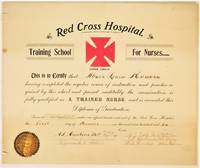
1906rif. 188971906. Women's Education Red Cross Training School for Nurses Diploma of Graduation. 1 December 1906 Minnesota. 14" x 17." Thick cardboard diploma bearing gilt seal and Red Cross "Semper Fidelis" logo. Reads "This is to certify that Maria Louisa Hamann having completed the regular course of instruction and practice required by this school and passes creditably the examination is fully qualified as a trained nurse and is awarded this diploma of graduation." Also included are six autograph signatures of various faculty validating the document. Some chipping at sides not affecting text. Otherwise in very good condition. unknown books
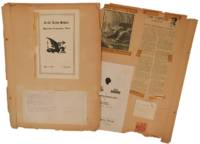
1942rif. 190201942. Women's Education Young Boston woman's personal unbound scrapbook archive with information about her Brown University scholarship. 10 oversize pages unbound each 16" x 12" pages decorated with 27 pieces of ephemera and 5 silver gelatin photographs. No covers Circa 1940s. These pieces belong to one Lois Paradise a high school senior in 1946 who attended Boston's Girls Latin School during a turbulent period in American history. She collected mementos from various points during her final year documenting everything from her Red Cross Home Nursing certification cards to opera handbills. She pasted in a column by Ernie Pyle about World War II as well as various class songs and poems. Lois received a prestigious full tuition scholarship to Brown University's Pembroke College; the notification letters are pasted beside an announcement in her local paper. Also included are newspaper clippings acknowledging her friends' acceptances to Boston University and Radcliffe. The photographs paint a vibrant picture of Lois' social life. Her friends dress up cradling baby dolls and stuffed animals; they stand shoulder to shoulder and grin at the camera. An inscription reads: "Baby day." Quite a few entries are accompanied with such captions usually providing brief identifications of place date and event. Very interesting archive of a young girl making her way in World War II -era America. Unbound edges are uneven. Missing some pieces of ephemeraand a few loose. Overall fair to good condition. unknown books
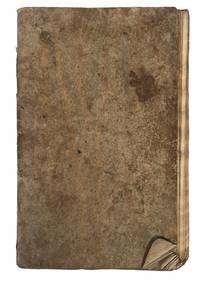
1810rif. 186861810. Wilson James. Arithmetic manuscript notebook 1810 documenting mathematical instruction and student practice in post-Revolutionary New England with direct relevance to the study of early American education numeracy and manuscript culture. The volume opens with a formal definition "Arithmetic is the art of computing by numbers." followed by systematic lessons covering numeration addition subtraction multiplication and division and extending into applied topics such as "Division of vulgar fractions" "The Rule of Three" and "Reduction of decimals." These subjects reflect the practical mathematical training expected of students in the early Republic where arithmetic supported commerce land measurement and everyday economic activity. The notebook also includes dated personal notation-"Bowdain February the 13th 1810. Tuesday morning the sky being clear."-anchoring the work within a specific time and place and illustrating how formal instruction intersected with lived experience in a rural educational setting. Wilson James. Arithmetic. Bowdoin Maine February 1810. Manuscript notebook comprising 56 handwritten pages measuring approximately 12 x 7.5 inches written entirely in ink with carefully structured headings such as "Reduction" and "Reduction continued" followed by worked examples and ruled numerical columns. The volume demonstrates a methodical approach to instruction through repetition and extended problem sets reflecting pedagogical practices prior to the widespread use of standardized textbooks. The consistent penmanship and organization indicate sustained use as a working instructional text rather than a presentation copy. Manuscript of 56 pages with dampstaining and foxing to the front cover and first leaves with occasional marginal staining; all text remains legible and the structure intact; overall good to very good condition. A student-produced primary source documenting arithmetic education and daily life in early nineteenth-century New England. unknown books
1920rif. 192341920. Original Vintage Photograph from June 1920 of a group of young scientists including a young woman doing a dissection of a human skeletal cadaver. Black and white silver gelatin photograph. 7" x 5" photograph on 8" x 10" board. Captioned "June 1920" on verso. It is likely that this coeducational group are medical students with one older man in glasses seeming to be their instructor. In the background we can see a variety of anatomical drawings as well as bones preserved in liquid in a glass case. The students wear white lab coats except for the female student who is wearing a white gown. While women had entered the nursing profession in large numbers during the 19th century there were still very few female doctors in 1920 making this photo a depiction of a rather uncommon scene. There is a horizontal crack along the upper part of the board which is holding but delicate. The photo itself has a very small closed tear and a small blue smudge in the bottom left corner but is in very good condition overall. unknown books
rif. 1887819th Century Archive of 23 School Merit Awards. These illustrated cards were each given to students as tokens of congratulations and scholastic achievement or good behavior. Sizes range from 3.5" x 2.5" to larger at 9" x 6.5." These small tokens of congratulation given to students for good behavior and scholastic accomplishments have been utilized by teachers for generations in America. The practice was most popular during the nineteenth century when printing techniques evolved to make this form of reward easily available. Rewards of merit in addition to being examples of a nineteenth century classroom tool reveal the progress of printing in America as well as the priorities of educators of the time. Illustrations include snowy scenes nature landscapes children churches flowers and birds. Many of them are signed with the student' names. Beautiful archive in very good condition. unknown books
rif. 18870Large archive of 61 School Merit Awards and other late 19th Century cards. Each card sizes range from 2.5" x 1.5" to 5" x 2.5." These small illustrated cards were given to students as tokens of congratulations and scholastic achievement. Illustrations include snowy scenes nature landscapes children dogs flowers and birds. Rewards of merit in addition to being examples of a nineteenth century classroom tool reveal the progress of printing in America as well as the priorities of educators of the time. Illustrations include snowy scenes nature landscapes children churches flowers and birds. Many of them are signed with the student' names. Beautiful archive in very good condition. A few of these cards were given in condolence to grieving relatives of a deceased loved one but the vast majority were for School Merit Awards. Beautiful and in very good condition. unknown books