72 657 résultats
1804réf. 167591804. This January 1804 session laws volume preserves the enacted statutes of the Massachusetts General Court including the original incorporation of Bradford Academy an institution that became one of the earliest centers of advanced education in the Commonwealth and a foundational site in the history of women's education in New England. Printed under legislative authority the volume opens with the formal constitutional language "BE it enacted by the Senate and House of Representatives in General Court assembled" situating the text within the statutory framework established by the 1780 Massachusetts Constitution. Among its enactments is the charter establishing Bradford Academy later recognized as the third oldest post-secondary institution in Massachusetts after Harvard University and Williams College. Initially admitting both male and female students at a time when advanced instruction for women remained severely restricted Bradford evolved by 1836 into the first all-female academy in Massachusetts marking a significant development in the institutionalization of women's academic training in the early republic. Acts and Laws. January 12 1804 Session. Boston 1804. Pamphlet volume identified as Vol. 14 of 17 for the legislative session. The title page bears the Commonwealth device and the heading "IN THE YEAR OF OUR LORD 1804" followed by Chapter I "An act in addition to an act entitled 'An act to incorporate John Codman and others into a company by the name of The Suffolk Insurance Company.'" The volume includes commercial financial and educational incorporation statutes enacted during the session. Pamphlet format. Beyond its educational significance the volume documents the expanding legal infrastructure of early American corporate and civic development. Incorporation acts for insurance companies academies and other enterprises reflect Massachusetts' position as a commercial and maritime center in the Federalist era when legislative charters served as the primary mechanism for authorizing financial institutions educational foundations and public improvements. The Bradford Academy act is particularly notable for embedding coeducational authorization within state law at a formative moment in the republic's institutional growth. Early session law pamphlets preserve statutory language prior to later codification and revision offering direct evidence of legislative intent and institutional formation. Edge wear; scattered foxing; small tears along fore-edge; text complete and legible; overall good plus condition. A significant early republic legal printing linking state incorporation practice to the emergence of formalized educational access for women in Massachusetts. unknown books
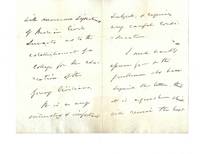
1864réf. 160811864. Wood Charles later 1st Viscount Halifax. Autograph Letter Signed to H. Reckitts 1864 addresses the continuing development of British educational administration in India during Wood's tenure as Secretary of State for India. Wood had earlier set out an extensive program for education in the 1854 document subsequently known as Wood's Despatch recommending provincial education departments universities modeled on British institutions support for public and private schools and the use of Indian languages in provincial curricula. Written a decade later this letter concerns a proposal for a college intended to educate young members of the Indian Civil Service and records Wood's direct consideration of another institution connected with the administration of British India. Wood Charles. Autograph Letter Signed to H. Reckitts. Balmoral September 5 1864. 4 pages. Wood reports that Algernon West had forwarded "the printed letter with numerous signatures of Indian Civil Servants as to the establishment of a College for the education of the young Civilians." He describes the proposal as "a very interesting and important subject" requiring "very careful attention" and assures Reckitts that it "will receive the best attention which the members of the Indian Council and I myself can give to it." The letter documents the route by which a proposal supported by serving Indian Civil Servants reached the Secretary of State and his council showing consultation between colonial administrators and the metropolitan office responsible for Indian government. Wood's 1854 Despatch had recommended the creation of education departments in the provinces and the establishment of universities in major Indian cities; universities at Calcutta Bombay and Madras opened in 1857 with later institutions established in Punjab in 1882 and Allahabad in 1887. This 1864 letter places Wood within the continuing administrative work of developing educational institutions after those initial reforms specifically in relation to the training of British civil servants charged with governing India. Condition was not provided in the supplied description. unknown books
1946réf. 162531946. Original photograph captioned "Prof Smith and his German Class" 1946 records eighteen African American students studying German at Wiley College during the first summer after the end of World War II. Founded in Marshall Texas in 1873 by the Freedmen's Aid Society of the Methodist Episcopal Church to provide Black students access to higher education Wiley developed under segregation as a liberal arts institution serving African American students in Texas and beyond. The photograph documents that academic work through a specific course instructor and student group rather than a ceremonial or athletic event while the names written on the verso preserve the identities of fifteen members of the class. Original silver gelatin photograph 5 x 6¾ inches. Eighteen students stand with Professor Smith on an outdoor flight of steps. The printed caption at the lower center reads "Prof Smith and his German Class." Inscriptions in black ink on the verso identify the group as "Summer Class of 1946" at "Wiley College" followed by Professor Smith's name and the names of fifteen students. One male student positioned at left in the second-to-last row wears a U.S. Army T-shirt a visible connection to military service or military culture during the first postwar summer; the photograph alone does not establish whether he was a veteran. The date places the class within a consequential year for Black higher education in Texas. In 1946 Wiley graduate Heman Marion Sweatt challenged his exclusion from the University of Texas School of Law beginning the litigation that culminated in Sweatt v. Painter and challenged segregated graduate education in the state. Wiley itself had been educating Black students since Reconstruction and awarded its first Bachelor of Arts degree in 1888. Minor handling dents and light soiling to verso; very good condition. The contemporary captions and fifteen student identifications make this a particularly specific record of classroom life at an HBCU in the immediate aftermath of World War II. unknown books
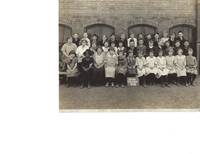
1923réf. 153851923. Harvey School fifth-grade class photograph 1923 records an African American girl seated among approximately two dozen classmates in an apparently racially integrated urban school group. Made thirty-one years before Brown v. Board of Education the image provides visual evidence of a Black child attending school alongside white classmates during a period when racial segregation remained lawful in American public education. The photograph alone does not establish Harvey School's admissions policy or the circumstances under which the class was integrated but the presence of the student within the fifth-grade group makes the image pertinent to the history of African American education and local practices of school integration before Brown. Original sepia-toned gelatin silver photograph 1923 approximately 8 x 6 inches. Approximately two dozen students are arranged in rows for a formal class portrait. An African American girl wearing a large hair bow sits in the front row among her classmates. A placard placed on the floor at the center of the group reads: "Harvey School 5th Grade in 1923." The school's location is not identified in the supplied information. The photograph predates the Supreme Court's 1954 decision in Brown v. Board of Education by three decades. Brown held that state-sanctioned racial segregation in public schools violated the Fourteenth Amendment and rejected the "separate but equal" doctrine in public education. Because educational segregation varied by state municipality and school district before 1954 the specific local circumstances represented by this 1923 class cannot be determined without identifying Harvey School and its location. Very good condition. A precisely dated classroom portrait preserving direct visual evidence of an African American child within a predominantly white fifth-grade class in 1923. unknown books
1813réf. 150361813. Women's education materials 1813-1926 document the lived experience of female schooling across the nineteenth and early twentieth centuries including seminary training scientific study and political awareness prior to national suffrage. The grouping places early republic religious education alongside mid-nineteenth-century academic instruction and late nineteenth-century political consciousness concluding with a twentieth-century pedagogical lecture directed toward women teachers. Together the materials capture women's direct engagement with intellectual scientific and civic life through personal correspondence and formal educational discourse. Four items 1813-1926 consisting of three Autograph Letters Signed and one printed pamphlet. 1 Hillner Louis. Autograph Letter Signed in response to guardian of Eliza Climer. Bethlehem April 22 1813. Two letters on one sheet including a request from Climer's guardian for her removal from the Bethlehem Female Seminary and Hillner's reply noting that she "lamented and wept" at the prospect of leaving and petitioned to remain which he supports as "for her best" if permitted to continue her studies. 2 Hemstreet Eloise. Autograph Letter Signed to her mother 1854. Letter describing her school as "the best of schools and one of the edens of the earth" with specific reference to scientific instruction and anticipation of viewing "the eclipse through the telescope" indicating active participation in astronomy. 3 Unidentified student. Autograph Letter Signed. Western Female Seminary Oxford Ohio October 19 1879. Letter discussing recent gubernatorial elections and public political discourse stating "The principal topic here for the last week has been the election.It will be so nice to be at home next Presidential Election" documenting student engagement with electoral politics prior to the ratification of the Nineteenth Amendment. 4 Gould Frederick J. Why Educate Chesterfield: National Union of Women Teachers 1926. Printed pamphlet of a lecture delivered before women educators advocating intellectual breadth beyond rote instruction declaring "Education must no longer bend over the desk and cramp its soul into spelling writing and sums.It must live in and live by and live for great ideas." Female seminaries in the early nineteenth century including Bethlehem Female Seminary operated within religious institutional frameworks that emphasized moral discipline alongside academic study while mid-century curricula increasingly incorporated scientific subjects such as astronomy. By the late nineteenth century women students were actively observing and discussing electoral politics despite lacking formal voting rights indicating participation in public discourse prior to the ratification of the Nineteenth Amendment to the United States Constitution. Gould's 1926 lecture reflects interwar educational reform movements that advocated broader intellectual development for both teachers and students. Minor fold lines and light handling wear to manuscript letters; pamphlet with slight edge wear and light toning; text throughout clear and legible; overall very good condition. A chronologically layered grouping demonstrating continuity and change in women's educational experience from early seminary culture to modern pedagogical theory. unknown books
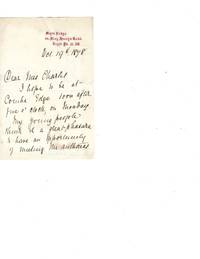
1874réf. 160221874. Buss Frances Mary autograph letter signed to Elizabeth Rundle Charles records a personal exchange between a leading campaigner for British girls' secondary education and the author of The Chronicles of the Schönberg Cotta Family. Founder of the North London Collegiate School in 1850 Buss developed an academically demanding curriculum and supported external examinations that could demonstrate girls' capacity for advanced study; North London Collegiate pupils later prepared for University of London and Cambridge examinations. Her letter to Charles provides a more personal record of that educational work through Buss's pupils whom she describes as eager to meet an author whose writing they knew. Buss Frances Mary. October 19 no year. Autograph letter signed to Elizabeth Rundle Charles. Two sides 8vo. Myre Lodge 89 King Henry's Road Regent's Park. Buss hopes to be "at Combe Edge soon after five o'clock" and tells Charles "My young people think it a great pleasure to have an opportunity of meeting the authoress of the Schonberg Cotta family." She also writes that she is deeply touched "to hear your kind expressions about the two persons dearest in life to me!" The recipient Elizabeth Rundle Charles was the author of The Chronicles of the Schönberg Cotta Family a historical novel centered on Martin Luther and the Reformation. Buss's reference to "my young people" connects the correspondence directly with her work as a headmistress and records her pupils' engagement with a contemporary woman writer. Buss's educational career belonged to the nineteenth-century campaign to establish academically rigorous secondary schooling for girls and to secure their access to the examinations and higher education increasingly available to men. The University of London admitted women to degrees on equal terms with men in 1878 while North London Collegiate students were among the girls prepared for university examinations during Buss's headship. The letter documents the literary culture surrounding Buss's pupils through their anticipated meeting with Charles rather than addressing educational reform directly. Small tear repaired; otherwise condition not further specified. A personal letter linking Frances Mary Buss's school circle with a prominent nineteenth-century woman author and the reading interests of her pupils. unknown books
1916réf. 156401916. Collection of 43 original vintage photographs documenting the Public School Gardening Movement in Queens New York City 1916-1920 provides concentrated visual evidence of Progressive Era educational reform linking urban environmental transformation to child development and civic formation. Produced at the height of the national school gardening movement which flourished between 1900 and 1920 these photographs capture the integration of nature study playground reform tenement house activism and City Beautiful urbanism into the daily life of immigrant and working class children. The images support research in Progressive Era reform environmental education immigration history urban studies and the construction of civic identity through public schooling demonstrating how agricultural labor was reframed as moral physical and democratic training within dense metropolitan neighborhoods. Forty three original photographs primarily silver gelatin prints Queens New York City 1916-1920. Most measure approximately 2 by 4 inches with several bearing manuscript dates between 1916 and 1920 and occasional notations identifying individuals or activities. The photographs depict schoolchildren planting seeds watering beds harvesting produce carrying baskets of vegetables and working collaboratively under teacher supervision in organized garden plots. Visual evidence indicates structured rows tool distribution and adult oversight underscoring the pedagogical framework rather than informal recreation. The movement in New York was shaped by the work of reformer Frances Griscom Parsons who established the Children's School Farm in Hell's Kitchen in 1902 to provide immigrant youth living amid warehouses factories and docks with access to cultivated land. Parsons articulated gardening as instruction in "brotherhood cooperation self respect and the dignity of labor" envisioning children as "little farmers" rehearsing democratic citizenship within an idealized urban microcosm structured into "boroughs" with its own elected governance. The Queens photographs reflect the diffusion of this model into outer borough public schools during the final years of the First World War and immediate postwar period. The timing of the archive coincides with national concern over urban crowding industrialization and the assimilation of immigrant communities as well as wartime food production campaigns that reinforced agricultural instruction in schools. School gardens functioned simultaneously as environmental intervention civic laboratory and instrument of Americanization embedding Progressive reform ideals directly into children's bodily practice and daily routine. The photographs materially document how educational institutions operationalized nature study principles and urban reform agendas on the ground offering granular evidence of children's participation in structured agricultural labor within New York City's public school system. Minor edge wear and light surface handling marks to several prints; occasional light fading consistent with age; manuscript annotations legible. Overall very good condition. A cohesive visual archive illuminating the intersection of urban reform environmental education and immigrant childhood in Progressive Era New York. unknown books
1931réf. 166401931. Women Education Photo album of girls primary school 1931-1938. 8 3/4 x 12 in. Original blue cloth board covers. 58 vernacular Gelatin silver print black and white photos of various sizes from 2.5 x 3.5 in. to 5.5 x 4 in. Follows a class of girl students over the course of 7 years right before the start of WWII and the bombing of London. . Album kept by schoolteacher of the students at All Saints Girls' School in London. Inscription on inside front cover: "From 1931- Recording many happy hours with All Saints . Candidates Central Islington." Begins with "The Original Class" and identifying class leaders including one small child identified as "Baby". In 1935 identified as the "Jubilee Year" celebrating 25 years of King George V students had photos taken in Kensington Garden while performing a "Jockey Dance" and national dances for England Ireland Scotland and Wales. Children are dressed up in the garden as a "gypsy" jockey and "butterflies and elves." There are also pictures of girls in short dresses posing as part of the Skipping Team. In other images students wear plaid skirts ties and hats while performing a "Scotch Dance"; they also wore special costumes for different dances such as the "Mountain March" the "Shoe maker" and "Cochin-China". Includes note on what the girls were wearing for each yearly photo: "Blue and white check dresses with white collars & cuffs" and 1937 Coronation Year King George VI / Red white & blue dresses". Very good condition. unknown books
1860réf. 165381860. Hanson Mary A. friendship album 1860 documents mid-nineteenth-century girls' education in western Pennsylvania through a school reward presented for academic achievement in spelling. Given to Hanson at Laurel Hill Schoolhouse in McDonald Pennsylvania the album records how teachers used gift books moral instruction and sentimental inscription to encourage literacy discipline friendship and feminine virtue within the antebellum classroom. Hanson Mary A. Friendship Album. McDonald Pennsylvania: Laurel Hill Schoolhouse 1860. Manuscript presentation album with original black leather boards embossed front and back covers gilt-edged pages gilt spine decoration and gilt and red printed title page. The volume contains 64 pages six full-page engravings showing subjects including a woman writer figures reading in a garden a lady falconer and children playing and a hand-colored "Reward of Merit" card presented to Mary A. Hanson by a friend. The first page bears a lengthy teacher's dedication instructing Mary to use the album as "the repository of friendly names and of the purest thoughts and feelings" with "Sincerity purity and truth" guiding its entries; the teacher closes with a verse wishing that "love and friendship here unite" as the school year ends. The remaining pages are blank leaving the album as both a completed school presentation and an unused vessel for adolescent memory-making. Presented on March 31 1860 for "outstanding spelling work" during the preceding school year the album offers evidence of reward culture gendered moral pedagogy and literary sentiment in a rural Pennsylvania school setting before the Civil War. Very light foxing to engraving pages and wear to lower front hinge; original boards remain intact with gilt edges and decorative details present very good. A strong documentary artifact of girls' education classroom reward practices and the emotional language of friendship and moral formation in antebellum Pennsylvania. unknown books
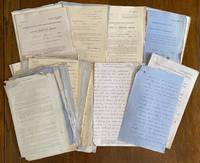
1871réf. 160921871. Kemble Parochial School. Record Book 1871-1904 constitutes a sustained documentary record of rural English education during the formative decades following the Elementary Education Act of 1870 commonly known as the Forster Act. Established in direct response to this legislation which mandated compulsory elementary education for children aged five to thirteen in England and Wales and instituted state oversight and inspection Kemble Parochial School offers a continuous administrative record of how national educational reform was implemented at the parish level. The archive captures the practical realities of compulsory schooling: certification requirements for teachers standardized curricula state inspection protocols and fluctuating rural enrollment. Through retained annual reports official circulars and examination schedules listing enrolled pupils by name the collection documents the institutionalization of public elementary education and the negotiation between church authority and centralized state control in late nineteenth-century Gloucestershire. Kemble Parochial School. Record Book. Kemble Cirencester Gloucestershire 1871-1904. Collection of over 100 documents on approximately 180 large legal-size leaves many written on both sides. Unbound housed in original protective black cloth boards. Comprises printed Circulars issued by the Education Department and handwritten retained copies of reports submitted by the school to government inspectors. The earliest document is a Circular of Instructions and Rules for school construction. Annual reports by Principal A. G. W. Wilts begin in 1872 describing an initial enrollment of eighteen pupils taught by headmistress Ms. Hopkinson in inadequate premises pending completion of a new schoolroom and teacher's residence. Reports track enrollment growth to forty-nine by 1875 and approximately eighty by the late 1890s alongside repeated references to inspection standards deficiencies in arithmetic and mandated needlework instruction and the ongoing struggle of successive teachers to secure formal certification. A handwritten 1880 letter from Rev. R. H. Taylor questions whether the school qualifies as a public elementary school under Section VII of the 1870 Act reflecting denominational tensions surrounding state inspection. Education Department circulars further illuminate social concerns of the period including notices warning teachers to deter pupils from damaging telegraph wire insulators with penalties described as imprisonment and flogging. Spanning more than three decades the archive documents the transformation from informal parish instruction to standardized state-supervised education embedded within a national bureaucratic framework. The records illuminate rural responses to compulsory attendance clerical apprehension over non-denominational governance and the administrative burden placed on small village schools adapting to inspection regimes and credentialing requirements. Enrollment decline to three pupils by 1904 underscores demographic and institutional shifts at the turn of the century. Large sheets of blue and white paper generally clear and legible; occasional dog-earing; a few corner losses from minor chewing; most leaves complete and intact. Overall very good condition. A remarkably complete parish-level archive preserving the lived implementation of the Elementary Education Act and the restructuring of English public education in the late nineteenth century. unknown books
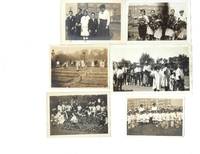
1917réf. 167741917. Photograph album of youth social life and athletics 1917-1918 documents girls' basketball mixed-gender recreation and civilian interaction with military personnel during the World War I era. The album centers on teenage subjects engaged in organized sport seasonal leisure activities and group social gatherings while also incorporating images of uniformed servicemen on leave. The material provides visual evidence of female athletic participation alongside broader patterns of youth culture and wartime presence in civilian spaces. Photograph album. Circa 1917-1918. Oblong format 7 1/4 x 11 1/4 inches containing 48 silver gelatin photographs mounted across the first 15 pages of a 100-page album. Images include three photographs of a girls' basketball team identified by a ball marked "WHS 1918" showing players posed in uniform consisting of elbow-length tops neckerchiefs and full culotte-style bottoms designed for mobility while maintaining period standards of modesty. A single image of a boys' 1917 basketball team is also present with one figure removed from the photograph. Additional scenes include approximately twelve beach images of boys and girls in bathing attire-girls in swim caps and short dresses boys in tank tops and shorts-posing on sand in shallow surf and aboard a small boat. Winter activity is represented through two images of girls sledding. Group portraits include fifteen girls posed on a veranda and seated on a lawn before the same large building suggesting a school or institutional setting. Wartime presence appears in photographs of four men in World War I-era military uniforms standing on a street corner and a uniformed sailor posed with a female companion. Additional images depict a parade crowd and two staged scenes of women in late nineteenth-century costume. Two photographs show figures physically removed. The album documents a period in which girls' participation in organized athletics particularly basketball expanded within school settings reflecting broader shifts in physical education for young women in the early twentieth century. The coexistence of athletic recreational and military imagery situates youth experience within the social environment shaped by World War I where servicemen were visible within civilian life. The clothing activities and group formations provide insight into gender norms leisure practices and institutional life during this period. Black cloth boards with gilt "Photographs" title; tear to page 9; four photographs detached; two images with excised figures; moderate handling wear; overall good condition. A focused visual record of female athletics and youth social life during the World War I era. unknown books
1889réf. 167661889. Lea Jean Sprunger. Manuscript art history lecture notebook 1889 records the curriculum taught by a woman lecturer at Cincinnati's Mount Auburn Young Ladies' Institute through an extended essay "Art North of the Alps" and biographical entries on fifty European artists. Lea identifies herself on the front cover as "Jean Sprunger Lea. Art Lecturer. Mt. Auburn Institute '89. Cin Ohio" while the first page records her appointment as "Senior Art Lecturer from January to June '89. Cincinnati Ohio." Founded in 1856 the Mount Auburn Young Ladies' Institute educated girls from age ten and offered advanced study in art music literature and languages; contemporary accounts also record its library reading room scientific apparatus and examinations. Lea's notebook documents art history instruction within this program through the working notes of the lecturer herself including pencil additions and corrections that preserve evidence of preparation and revision. Lea Jean Sprunger. Art North of the Alps and Artist Biographies. Cincinnati Ohio 1889. Original handwritten notebook 66 pages of which the final 20 are blank; 8 x 6½ inches in original paper boards. Accompanied by two later typed mimeographed copies of "Art North of the Alps." Lea organizes the opening essay geographically around "Teutonic German Dutch Flemish Spanish French and English art" discussing Gothic architecture and such examples as the cathedrals of Freiburg Strasbourg and Chartres before turning to individual artists. Fifty biographical entries include Jan van Eyck Albrecht Dürer Hans Holbein Peter Paul Rubens Anthony van Dyck and Diego Velázquez among others. Her entry on Dürer describes his Nuremberg upbringing as the son of a goldsmith his travels to Venice and his writings on geometry and astronomy concluding that offers from Venice and Antwerp could not induce him to leave his "beloved Nuremburg." Pencil additions and corrections appear in the manuscript providing evidence of Lea's continued work with the lecture material. Mount Auburn Young Ladies' Institute belonged to Cincinnati's nineteenth-century network of private schools providing advanced education to women. Historical accounts confirm that the school opened in 1856 and after reopening in 1878 continued to offer post-secondary instruction to graduates seeking further study in art music literature and languages. Lea's 1889 manuscript identifies the artists monuments chronology and biographical information presented to senior female students and preserves a named woman educator's preparation for six months of art instruction. A later owner's inscription appears on the first page. Rust staining from a paperclip affects the inside front cover and first page; otherwise very good condition. The manuscript provides direct evidence of art-historical pedagogy for women in late nineteenth-century Cincinnati through a surviving lecturer's working notebook rather than a published school curriculum. unknown books
réf. 16812Report Card Girls School Notebook with quarterly reports on student's academic progress at an all girls' school in London. "Wimbledon Education Committee. Wimbledon Central School for Girls." printed on front cover of notebook. 9 x 7 in. Original paper wrappers. 27 handwritten pages followed by 45 blank. Homemade brown paper jacket with original owner's name and school administrative information in the top right corner; and "Monthly Journal" written in the center. Entries from 1935-1939. Marks student Beryl Kathleen Rose's academic progress from 11 to 15 years old. Includes grades and notes from teachers in Literature Composition Grammar French History Geography Arithmetic Science Art Needlework and Handwriting. In later years her studies expand to include Book-keeping Algebra Geometry Physical Training and Shorthand. Teacher comments generally remark on her friendly nature but chide her to focus more on her studies. She is consistently listed in the bottom of her class "position in form" is listed with each entry. "Beryl could do much better if she exerted herself more. She must learn to be self-reliant." "Beryl's work shows improvement on the whole. Her behavior is usually good." "Beryl can do good work but she wastes too much time in idle talk." ".an interested worker but must try hard for better results. She is a pleasant courteous member of the form." Very good condition. unknown books
1912réf. 168131912. Girls' Education Handwritten original essays on literary figures from a female high school student. 25 illustrations of literary historical figures and their homes including Henry Wadsworth Longfellow John Greenleaf Whittier Charles Dickens Paul Revere Sir Walter Scott and James Russell Lowell. c. 1912. Original black boards and red cloth spine. 84 pages. 9 3/4 x 8 inches. Illustration all 8 x 5 1/2 in. "Freshman English and Sophomore English Note-book. Mildred Benjamin" written on first page in blue pen. Handwritten biographical reports of all those with aforementioned portraits. Also includes incomplete entries for Tennyson and George Eliot. "John Greenleaf Whittier was born in Haverhill Massachusetts the house still stands in which Whittier was reared.Whittier was taken with illness while visiting at the home of his friend.he had a slight paralytic stroke which produced a difficulty in taking food o medicine and it was plain that he could not be removed to Annesbury where he had always hoped to die. He was conscious to the last and was grateful to everyone. He had little acute pain. He lay all night in peace and died in the morning."Charles Dickens: "The boy Charles was not strong but nevertheless before he was ten years old he was obliged to earn his own living. He was placed in a blacking warehouse an old ramshackle house near the Thames. The scenes in which he was brought up were the most degrading ones possible.During this time he spent much of his time in the reading room of the British Museum.In 1842 he made his first trip to America. Just before going he wrote Oliver Twist in which he exposed the abuses of the poor law system." Press clippings on final pages for articles on Charles Dickens and John Greenleaf Whittier. Images of Longfellow's birthplace in Maine Whittier's birthplace and homes in Massachusetts "Gadshill" Dickens's home Sir Walter Scott's estate and "Elmswood" Lowell's home in Cambridge MA. Final press clipping contains a chapter of Ralph D. Paine's novel The Cross and the Dragon published 1912. Cover and spine detached from pages. First and last page toned foxing on first portrait of Longfellow else clean. Very good condition. unknown books
1912réf. 167751912. Unidentified compiler. Photograph album of women's education and collegiate life 1912-1920 documents student experience leisure activities and social networks across Maine including institutions such as Colby College and the University of Maine. The album captures young women's participation in academic environments alongside outdoor recreation travel and community life situating female education within broader patterns of early twentieth-century mobility and social interaction. The material provides visual evidence of women's presence in expanding educational institutions and their integration into both structured and informal aspects of student life. Photograph album. Maine and various U.S. locations 1912-1920. Quarto format album with 187 silver gelatin photographs mounted across 42 pages with image sizes ranging from approximately 1.5 x 3.5 inches to 3.5 x 5.5 inches. The photographs depict locations throughout southern Maine including Portland Waterville Lamoine Boothbay North Pond and Ogunquit along with additional images from Texas Florida and New Hampshire. Academic settings are represented through images identified as Colby College including a figure labeled "Prof. Johnson Colby '18" and references to the Alpha Tau Omega fraternity "Hurrah for A.T.O.". Additional institutional references include "Nasson Institute 1912" a women's school in Springvale and the Phi Eta Kappa fraternity house at the University of Maine. Human subjects include students and faculty such as "Dean Hunt" as well as classmates in graduation attire. Recreational and social scenes include young women snowshoeing playing tennis and participating in outings labeled "Picnic to the quarry" "Clam Bake" and "Hot Dog Roast." Automotive travel appears in images of early motorcars while other photographs depict children in Sunday school groups bicycle riding and staged performances of "Pied Piper" and "Red Riding Hood." Additional images include a man in World War I-era military uniform "Adrian Old Top" and an individual identified as "Texas Bill" posing with a biplane. Informal scenes include three girls reading on a rooftop space labeled "The Sun Porch" with a related image documenting their ascent assisted by a male companion. The album spans a period of expanding access to higher education for women in the United States particularly in regional institutions across New England. The inclusion of both coeducational and women-focused institutions reflects the varied educational pathways available during this period. Recreational imagery including athletics and social outings demonstrates the integration of leisure into student identity while references to World War I-era figures situate the album within a broader national context. Original cloth boards with minor wear and three small holes to lower right quadrant of front cover; photographs well-preserved with strong clarity; overall very good condition. A substantial visual record of women's collegiate and social life in early twentieth-century Maine. unknown books
1960réf. 010989New York: Golden Press 1960 Pictorial boards in matching dust jacket with a few small abrasions to rear panel edge tear to front panel original price intact $1.00. An easy reader tale told in verse about a little boy who wants a whale of his very own. Charming period artwork in color throughout. . First Edition. Pictorial Boards. Fine/Very Good. Illus. by Claude Humbert. Square 8vo. Golden Press unknown books
1850réf. 47824Mexico: Imprenta de M. Murguia 1850. Very Good. Mexico: Imprenta de M. Murguia ca. 1850. First Edition. Broadside 40.5x29.25cm; ornamental border surrounding a series of math-related tables and instructions. Chipping principally to edges occasional staining horizontal fold to center; Very Good. Uncommon and ephemeral broadside printed by the Mexican state for instruction of young students in arithmetic. Approximate date from OCLC which shows four holdings Penn State and U. Conn only in the US. Imprenta de M. Murguia unknown books
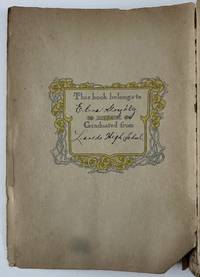
1925réf. 12981Laredo TX 1925. 118pp. of content of various types including thirty-six photographs most once in mounting corners but now loose plus 41pp. of manuscript inscriptions to Gonzalez an original drawing and various kinds of mounted ephemeral items. Contemporary scrapbook 8.75 x 6 inches. Ownership signature on early page. A well-used personal scrapbook lacking spine and rear cover front cover detached and with significant wear. Front free endpaper also detached. Some photographs somewhat worn but contents generally sound though dust-soiled. Good condition overall. A unique record of a young Texas woman Elena Gonzalez and her experiences as a senior at Laredo High School in 1925 containing numerous photographs a legion of manuscript messages to her from fellow students and dozens of ephemeral items related to her educational experiences in a prominent Texas border town. The book includes thirty-six photographs which mainly picture Gonzalez and her fellow students in individual portraits small groups and class photos almost always in outdoor settings. The photos also include two slightly larger studio portraits of Gonzalez each measuring about 8 x 5 inches. The work also includes about forty pages of manuscript inscriptions from fellow students to Gonzalez dated mostly in March and April 1925. Many of the messages take up most or all of an entire page with Gonzalez's classmates sharing memories funny stories good wishes for the future and so forth. Interestingly but not surprising considering where Elena lived several of the manuscript inscriptions are written in Spanish. In addition to the personal inscriptions to Gonzalez the book also contains an eleven-page "Prophecy of the Class of 1925" handwritten by Phyllis Ellis "Prophet of Class of '25." The prophecy was "read in the Laredo High School Auditorium Thursday night May 21 1925 by the writer." Ellis's prediction for Elena is as a model for the Tar Soap Company "to pose for magazine pictures showing the benefits of their products to one's hair." The photographs and manuscript elements are complemented by various kinds of ephemeral items including calling cards programs program clippings mementos from school events clippings from school publications and newspapers including numerous jokes and funny story clippings in both English and Spanish and so forth. Though the condition of the memory book has seen better days the fact that it survives at all is a feat in itself. A wonderful primary source for Mexican-American life in the borderlands. unknown books
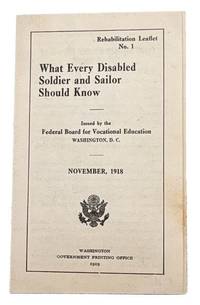
1919réf. 96204Washington: GPO 1919. 1st ed. Very Good. Single sheet folded to form a small unnumbered 6-page leaflet. 13 cm. Some browning. GPO unknown books
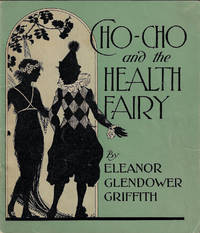
1925réf. 011381New York: Macmillan 1925 Pictorial covers with light wear along spine top corner creased throughout previous owner's name. Six stories about a fairy named Health who looks out for the well-being of children and a witch who tempts children to do drink and eat things that are bad for them. The stories reinforce the idea of proper nutrition and healthy habits. Illustrated with 2-color silhouettes by Jessie Gillespie who is best known for her illustration work for Girl Scouts' publications. Originally published in 1919. . Early Edition. Pictorial Wraps. Very Good/No Jacket. Illus. by Jessie Gillespie. Square 12mo. Macmillan unknown books
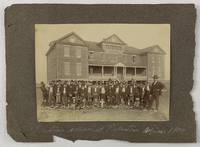
1900réf. 12717Pipestone Mn 1900. Sepia-toned photograph 4.75 x 6.75 inches mounted on a gray sheet of paper manuscript caption reading "Indian school at Pipestone Minn 1900." Removed from an album. Photograph in excellent shape. Very good. A striking group photograph picturing a young teacher and fifty-five of his male Native American students posed in front of the imposing Boy's Residential Building at the Pipestone Indian Training School in 1900. The students appear to range from around five years of age to their mid-teens all dressed in similar pants white shirts and dark jackets. According to Minnesota's Carleton College: "In the 1890s the U.S. built the Pipestone Indian Training School on reserved quarry land and legal conflict soon followed. The Pipestone Indian Training School was one of many boarding schools that separated Native children from kin and land in order to assimilate them into American economy and society. These schools came about as attitudes towards the 'correct' treatment of Native people turned towards assimilation with the passage of the Dawes Severalty Act of 1887. Many Native people resisted boarding schools but the Pipestone Indian School inspired particularly active resistance for two reasons. First it was built illegally on Yankton Sioux reservation land. Second during the school's tenure management of the quarries fell largely to the white superintendent of the school instead of the Yankton people. unknown books
1947réf. 010564Philadelphia: John C. Winston 1947 16 pgs including cover. 9 x 6 inch 23 x 16cm Color printed paper wraps. A prospectus for the learning-to-read system "Easy Growth in Reading" sold by John C Winston Company. The prospectus gives details for each reading level including a helpful chart which demonstrates how many new words are introduced for each level of the program. The booklet is illustrated in color throughout with examples of the artwork which appears in the books. Artists include such well-known names as Armstrong Sperry Erick Berry Henry C Pitz Corinne Malvern etc. No date circa 1947. Pictorial Wraps. Near Fine/No Jacket. Illus. by Various. 8vo. John C. Winston unknown books
1828réf. 17578Philadelphia: American Sunday School Union n.d. ca. 1828 Early edition. The earliest copy noted by OCLC apparently has 1828 on the title-page and this copy can't have been published much later. OCLC also only lists copies that claim to be revised as ours does. A scarce book regardless as OCLC lists only thirteen physical copies of any edition. We could find no indication of who the author is. Quarter red roan over marbled boards gilt-lettered spine. Twelvemo. Engraved frontispiece. Binding extremities a bit worn and rubbed. Lacking blank preliminary and terminal leaves. Very light foxing the occasional minor stain. A very good copy of a rare fragile book. The present work consists of four dialogues each between two characters that wish to instill morality in young readers by addressing the following topics: keeping good company reading the Bible on collecting donations for church rising early regular and punctual attendance at Sunday school animal cruelty dog fights cock fighting etc. violence for sport fist-fighting and more. American Sunday School Union, hardcover books
1931réf. 17287New York: The Platt and Munk Co 1931 First edition.This seems to be one of the earliest Platt and Munk children's book catalogues. OCLC locates no copies and we could not locate any other copies of the 1931 catalogue in the trade at this time September 2022. Color printed paper wrappers illustrated by Eulalie Banks. 7 x 10 in. . Illustrated in black and white on every page with images of children's books in the Platt and Munk Star Books for Children series including activity books paper dolls anthologies of fairytales and verse stories like Little Black Sambo literature and educational early readers for young children. A couple patches of minor toning to wrappers. A bright clean near-fine copy of this rare catalogue with the original mailing envelope addressed to San Ramon California and a typed letter on Platt and Munk Co. stationery. Eulalie Minfred Banks 1895 – 1999 was a painter and children's book illustrator. Born in England Banks spent her later years in Southern California where she painted murals for Charlie Chaplin Ann Harding and Harold Lloyd. Banks also painted a mural in the old Santa Monica Public Library Boys and Girls room. The Platt and Munk Co books
1850réf. 17222Albany 1850 First edition. No copies recorded in OCL. Disbound. 5 x 9 in. . With a frontispiece illustrating the exterior of the school and five fold-out plates showing the floorplans. Offsetting to title-page from frontispiece and some toning throughout. A good copy of a fragile and rare item regarding teacher training. Written at the conclusion of a five-year "experiment" in the teaching methods of the New York State Normal School. The experiment was a success: over 1100 students both men and women attended the school in that five-year period and the report notes not only the employment success of graduated teachers but also an improvement in the circumstances of teachers in New York as a whole. books