64 545 résultats
1974réf. 131978San Francisco: Marxist-Leninist Education Committee SF Bay Area 1974. Pamphlet. 32p. stapled red wraps very good condition 5.25x8.5 inchers. Marxist-Leninist Education Committee (SF Bay Area) unknown books
1822réf. 18045Leipzig: CH Reclam 1822. First Edition. Contemporary half leather. . Good; some wear to the spine; paper flaw to the lower corner of p. 200 - no loss. 8vo xxxvi 444 liii pp. An astonishing anthology assembled by instructors at the Leipzig Bürgerschule. The contents of the book attest to the rigors of the educational environment at the school especially in light of the age group identified in the title. The book had two later printings - all scarce and have few holdings. OCLC cites only one copy in America. CH Reclam hardcover books
1930réf. 1574Berlin: Deutsche Buch-Gemeinschaft 1930. First Edition. Publisher's half leather. A very good copy; some spotting to the cloth. 8vo. There are numerous half tone plates. An omnibus work that addresses the nurture psychological well being and education of young children. The rather poignant introduction describes a situation of perverse contradictions in attitudes toward children and child rearing in then present economic depression. The family men women educators physicians and state are not blameless. Each bears a responsibility for the prevalent attitudes. The text is composed of essays by experts from medical legal and educational and human welfare professions. It is a most unusual book in that it is not a child rearing guide but rather a well reasoned plea for generosity and compassion in providing a humane community through which children could achieve a level of beneficent adulthood. Deutsche Buch-Gemeinschaft hardcover books
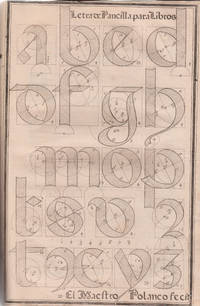
1719réf. 5206Madrid: M R de Murga 1719. First Edition second state - plates numbered. Contemporary limp vellum. Good; old ink stain to p. 74 has resulted in the loss of a few letters; some margins close but complete; binding worn; text block beginning to split. 4to. There is an engraved title frontis. with four saints engraved portrait and 39 engraved plates. A sought after book in which the author departs from usual forms of calligraphic art and presents it as a geometrical science. It is the first Spanish writing manual listed in the Hofer catalog. Harvard has two copies both defective. The copy offered here is according to Palau Hofer and others complete with the maximum number of plates. Palau suggests that early issues of the book may have fewer plates. The author was an orphan born in 1663 raised by the schoolmaster of his native town Mostoles. He was to become famous as a creative and inventive and favored member of the court as well as a didactic writer on art a mathematician architect and instructor of fencing. An impressive work with plates illustrating the laying out of dials and the mathematical basis for various letter forms. This resulted in a lengthy and detailed text that is most uncommon for this kind of book. The engraving throughout is elaborate and elegant. Only one plate is signed by the engraver Juan Bernabe Palomino; Cotarelo assigns all the engraving to him. The state results from the fact that the plates are numbered consecutively - Harvard has a defective copy without the numbering. What is of special interest is the crucial significance see Corbeto of such books and especially Aznar de Polanco on the early development of punchcutting in Spain during the formative mid-eighteenth century. The in depth analysis of the ' letra grifa ' - a cursive type - is directly attributed to Aznar de Polanco. Hofer Coll. # 137; Palau # 21133; Cotarelo y Mori I pp. 134 - '40; see Corbeto The Library v. 10 #3 esp. pp. 286 - 289. [M R de Murga] hardcover books
1890réf. 5757np: unk. publisher ca. 1890. Edition Unknown. Cloth backed paper covered wooden box. A good copy showing some wear to the blocks; some scrapes to cover; hinge repaired. Small 4to. An attractive set of children's letter and number blocks. There are 18 blocks that are 1 3/4 inches square and 1/4 inch thick printed recto and verso. Numbers are printed in black against an orange background on nine of the blocks. The remaining block faces have the alphabet in black and white. The blocks are in a wooden case that is decorated with a scene of children playing. The box has a cloth backstrip and the cover opens as a book. It apparently was intended to sit on a shelf as a book. unk. publisher hardcover books
1792réf. 6707Nürnberg: Rau 1792. First Edition. Contemporary marbled paper over paste paper boards. Good; age browning and spotting; binding broken. 8vo 4 5 - 126 2 pp. An essay on the education of young children and instructions for teachers in the German countryside. Rau hardcover books
1875réf. 4800New York: Van Antwerp Bragg & Co. 1875. First Edition. orig. publisher's cloth. A very good copy. 8vo. A frontis. por. of the subject. Krusi devoted his life to education. He spent many of his early years in Europe and the UK and returned to America about 1852. He was the author of several plays and a tract on educational philosophy. The book offered here is a complimentary biography of the great educator and benefits from the fact that it is based on information and correspondence of friends and fellow educators who knew Pestalozzi. DAB X 510. Van Antwerp, Bragg & Co. hardcover books
1846réf. 4777Kenne NH: Philanthropist Office 1846. First Edition . Broadside. A very good copy; overall toning; docketed on verso. Broadside Haddock was responsible for establishing the office of Commissioner of Common Schools in New Hampshire. He was also the first to hold that office. The broadside offered here is a direct appeal to the students of all New Hampshire schools. It was the result of Haddock's organizing a series of common school conventions throughout the state in order to encourage the teachers. The broadside offered here was addressed to the students throughout the state and was meant to be read before assembled student bodies. The text is meant to incite students to their best and give them purpose; to this end it places before them a series imperatives they should follow throughout their schooling. In explaining the cause of the address and the reasoning for his instructions Haddock states his educational philosophy. Unlocated.See DAB VIII p. 76. Philanthropist Office unknown books
1747réf. 65Valensa Actually Lisbon: Antonio Balle Unknown 1747 Actually 1751. Second Edition. Contemporary calf; rebacked; spine laid down; hinges reinforced. Fair copy; overall browning; headlines on several leaves are gouged out affecting page numbers. Library release stamp on the verso of the first title page. 4to. I: 12 12 - 264 ; II: 4 12 - 243244 pp. A scarce and according to Palau important tract in the development and introduction of modern pedagogical concepts into Spain. The first edition of 1746 was seized and destroyed. The second edition was clandestinely printed see Martins Livros clandestinos . A revolutionary book in opposing the Jesuits and with very interesting comments on the teaching of the sciences medicine jurisprudence literary aesthetics and the education of women. The book generated a considerable polemical literature. Palau citing the first # 360777. Antonio Balle [Unknown] unknown books
1658réf. ST16442s.l.: s.n. Printed Anno Domini 1658. FIRST EDITION. 190 x 135 mm. 7 1/2 x 5 3/8". 3 p.l. 14 pp. complete. 20th century vellum-backed marbled boards flat spine with vertical titling. Front pastedown with bookplate of the Fox Pointe Collection. Wing P-2842B; ESTC R207754. ◆Text lightly washed and pressed but still crisp faint foxing to lower edge of title page otherwise a fine fresh copy in an unworn binding. Written by an opinionated English cleric this is an extraordinarily rare pamphlet proposing an unusual fund to support young 17th century scholars. According to DNB the scheme outlined in the present work was meant "to support the university studies of young men of promise seeking entry into the ministry." The plan "was approved by John Worthington and Anthony Tuckney and had the support also of John Arrowsmith DD Ralph Cudworth William Dillingham DD and Benjamin Whichcote. The fund raised about £900 and it appears that William Sherlock afterwards dean of St Paul's received assistance from this fund during his studies at Peterhouse Cambridge until 1660 when he graduated BA. Those entrusted with administering the fund sent Poole regular reports on students interviewed and the ratings they had received in philosophy logic and languages. The scheme was abandoned at the Restoration." Poole 1624 - 79 was the author of a number of controversialist pamphlets on subjects ranging from Unitarianism to preaching by lay persons before undertaking his major work: a synthesis of critical biblical commentaries "Synopsis criticorum aliorumque sacrae scripturae interpretum." This is one of his scarcest writings: ESTC lists seven copies two in North America while ABPC and RBH record just two copies at auction. s.n. Printed Anno Domini unknown books
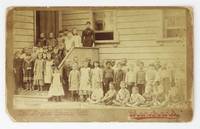
1890réf. 6355Los Angeles: J.B. Blanchard & Co 1890. Good plus. Boudoir card photograph 5.25 x 8.5 inches. Corners worn slight tear to lower edge of image; light fading to right side. Minor soiling. Group portrait of forty-four students and their teacher posed in front of the school house. Half the children stand with their teacher on the steps on the left side while the remainder are arrayed in neat lines of standing and seated along the building. Four Black children three boys and one girl are mixed in with the white students; one or two of the children may be Latino or indigenous. The card has a printed caption which reads "Los Angeles Schools 1890." The photographer's information is printed on the verso of the card. J.B. Blanchard & Co unknown books
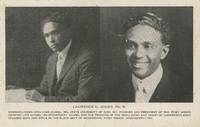
1920réf. List3814Nashville Tennessee: Ambrose 1920. Printed photographic postcard measuring approximately 3 ½ x 5 ½ inches. Recto with two portraits of Laurence C. Jones captioned "Laurence C. Jones Ph. B." and describing him as founder and president of the Piney Woods Country Life School "an opportunity school for the training of the head hand and heart of underprivileged colored boys and girls in the Black Belt of Mississippi." Divided postcard back with printed appeal headed "How to Help Piney Woods School" soliciting money clothing shoes and scholarships. Light wear and soiling; very good. A fundraising postcard for Laurence C. Jones and the Piney Woods Country Life School in Piney Woods Mississippi. Jones founded the school in 1909 to provide academic industrial and agricultural education for African American children in rural Mississippi. The front of the card summarizes the school's purpose in the language of the period describing it as an "opportunity school" for the training of "head hand and heart" in the Black Belt. The verso gives a direct appeal for support requesting "money in any amount-even one dollar is helpful" and asking for clothing and shoes for young men and women "who are working their way." It also gives the price of scholarships: $100 for an academic scholarship $50 for an industrial scholarship or $5 a month to give a boy or girl the opportunity to enter the school. Ambrose unknown books
1993réf. 58111Washington D. C.: National Academy Press. Near Fine. 1993. Hardcover. 0309048893 . A Near Fine edition that has general wear from life on the shelf ; Understanding Child Abuse and Neglect is a comprehensive resource that offers professionals and the public a comprehensive understanding of child abuse and neglect. The book provides an overview of the various types of child abuse and neglect as well as their effects on children. Additionally the book discusses the various methods used to identify and prevent child abuse and neglect.; 8vo; 393 pages . National Academy Press hardcover books
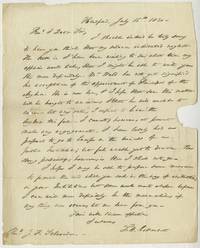
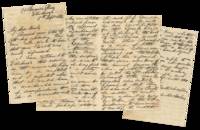
1830réf. List3856Hartford Connecticut 1830. Pair of autograph letters signed by Thomas Hopkins Gallaudet to Rev. J. F. Schroeder. Two single-page stampless letters; the first without postal markings the second with red circular Hartford postmark. Folds small section of loss very good. A pair of 1830 letters from Thomas Hopkins Gallaudet to Rev. J. F. Schroeder written from Hartford during Gallaudet's final months at the American Asylum for the Education and Instruction of the Deaf and Dumb. In the first letter Gallaudet asks Schroeder to send him "the Mechanism of Language & the little manuscript book" and then turns to the American Colonization Society: "Will you not preach for the benefit of the Am. Col. Society on the 4th of July. The object is a noble one & your denominations too are taking a deep interest in it. Three go from the African Mission School here to Liberia in the fall." The second letter written a little over a month later concerns Gallaudet's own uncertain future and a request from Schroeder for assistance with instruction at his institution. Gallaudet apologizes for his silence explaining that he had been waiting to see "what turn my affairs would take" as "I expect to leave the Asylum this fall"; he had "lately had a proposal to go to Europe on the business of a public Institution; but feel unable yet to decide" and would most likely not go. He also reports that "Mr. Weld has not yet signified his acceptance of the appointment of Principal of the Asylum" though "He is now here & I hope that soon this matter will be brought to an issue & that he will conclude to come." Gallaudet closes by telling Schroeder that he hoped eventually to propose "some measure" to furnish the aid sought "in the way of instructions in your Institution" but that several weeks would have to pass before he could write more definitively. A good pair of Gallaudet letters with content on language instruction deaf education the American Colonization Society the African Mission School Liberia and Gallaudet's departure from the Hartford Asylum. . unknown books
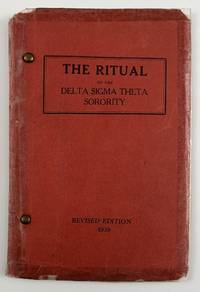
1939réf. 5722N.p. likely Washington D.C. 1939. About good. 476pp. of mimeographed text plus one leaf of sheet music. Original red printed wrappers brad bound. Substantial edge wear reinforced with cello tape repaired tear and large area of loss to rear wrapper some dust-soiling to covers. Ink ownership inscription on front blank belonging to Ruth W. Lee otherwise internally clean. A delightfully homespun pamphlet containing the revised edition of the various rituals of the Delta Sigma Theta Sorority one of the "Divine Nine" sororities of the HBCU community founded at Howard University in 1913 and still active today. According to the organization's own website Delta Sigma Theta is "committed to sisterhood scholarship service and addressing the social issues of the time.and has become one of the preeminent service-based sororities with more than 350000 initiated members and over 1050 chartered chapters worldwide." The present work was issued by the Ritual Revision Committee whose names are listed here along with a note from the committee chairman Edna B. Johnson-Morris and a Preface from the committee which includes notes of gratitude to various members including honorary member Mary McLeod Bethune thanking her for "The Beacon Light." The body of the work contains chapters on conducting both grand chapter sessions and regular meetings the initiation ceremony the establishment of new chapters conferring honorary status the process of reinstatement the pledge ceremony the funeral ceremony the observance of memorials dedication exercises the order of business for chapter meetings and closing ceremonies for both types of meetings. Much of the work is literally comprised of the scripts for these various processes and ceremonies. These chapters are followed by the text of the DST "National Hymn" sheet music for "How We Love Thy Name" and the text for the sorority's prayer oath and the "Sorority Charge." "As a sisterhood comprised primarily of Black college-educated women the Sorority seriously considers the issues impacting the Black community and boldly confronts the challenges of African Americans and hence all Americans. Over the years a wide range of programs addressing education health international development and the strengthening of African American families have evolved. The major programs of the Sorority are based upon the Five-Point Programmatic Thrust: economic development educational development international awareness and involvement physical and mental health and political awareness and involvement" - Delta Sigma Theta Sorority Inc. website. Printed works issued by the Delta Sigma Theta Sorority are exceedingly rare. OCLC reports just a few items of any type printed before 1970 along with just a few institutional collections relating to various chapters of the sorority containing material before 1950. The present work is not separately listed in OCLC and very likely not present in the chapter collections. unknown books
1903réf. List2990Dover and Chatham Ontario; Edinburgh and Blairgowrie Scotland 1903. Seventy-eight pieces: seven 2.5 x 4" photographs mounted on heavy cardstock; with seventeen letters from Alexander to James Macfarlane fifty-two from James to Alexander Macfarlane and two from others to Alexander Macfarlane. Fourteen from 1853-1882; eleven from 1883-1885; thirteen from 1886; twelve from 1887; thirteen from 1888; eight from 1889-1903. Sorted chronologically. Envelopes good to very good; letters generally near fine. Alexander Macfarlane 1851-1913 was a Scottish physicist mathematician and logician. He earned a D.Sc. from the University of Edinburgh in 1878; following this he would teach at the University of St. Andrews the University of Edinburgh the University of Texas at Austin and Lehigh University. Macfarlane earned a number of accolades including elections to many scientific and mathematical societies and an honorary doctorate from the University of Michigan. After his retirement in 1894 Alexander Macfarlane moved to a farm in Ontario left to him by his uncle James who is his correspondent herein. Much less is known about James Macfarlane; born in Scotland in 1806 he immigrated to North America by way of New York in 1835. He purchased land in Dover Township now Chatham Ontario in 1853 and was elected the town's reeve in 1879. At the time of this correspondence he was a farmer by occupation. The photographs in the collection-portraits of unknown individuals-are likely his as they are from photography studios in the Brantford and Toronto area and seem to date from before Alexander Macfarlane's arrival in the colony. James Macfarlane's letters to his nephew mainly written between 1886 and 1889 give detailed descriptions of farm life and logistics in 19th-century Ontario. He grew corn wheat beans clover and hay raised pigs and cows and kept a number of workhorses alongside a few seasonal employees. The elder Macfarlane describes the state of his crops the health of his animals and especially his finances taxes and employees' wages; he writes of "a constant fear of running aground" March 17 1887. However he also occasionally discusses academic or political affairs - it is unclear what education Macfarlane had or what political experience besides his reeveship but from his writing it seems not insignificant. One prohibition-related incident in 1887 especially stands out: "During the night between last Saturday & Sunday there was a dynamite explosion in front of the handsome residence of H. Cummings Esq. of Chatham - damage but no one hurt. It is believed it was the doing of the Chatham grogocracy - Mr. C. favours prohibition - Tories do not". August 10 1887 This letter dates the incident to late on the 6th or early on the 7th of August 1887; we do not find the explosion mentioned in local newspapers from the time. Alexander Macfarlane's letters which comprise most of the earlier letters in the group focus on his burgeoning academic career. In 1882 when the majority of his letters were written he had applied and was waiting to hear about a position as Chair of Mathematics at University College Dundee now the University of Dundee which was then just being formed. Besides occasional discussions of work in which he is currently engaged Macfarlane writes about his tactics for bettering his chances at the Chair; for example: "I have just received some information which indicates that I shall have an excellent chance of being successful. Rev. Mr. Tait who was our minister before he left Blairgowrie for Newport opposite Dundee happens to be a very intimate friend of the founder of the College Miss Baxter of Balgavies. I saw from the first that it would be important to secure his cooperation; he has been very active in his support. Recently he was staying at Balgavies and when the College was discussed he spoke highly in my favour. He has persuaded Miss Baxter to take some active steps in my favour. Copies of all the applications etc. are sent to her which seems to indicate that a proposed appointment is submitted to her for approval." September 19 1882 The wait is difficult for Macfarlane and he frequently comments with displeasure on related workplace politics. For instance he is upset by the choice of William Peterson-whom he describes as "a fop" October 3 1882-for Principal of the new university: "Peterson had this advantage that many of the electors had a bias in favour of a Classical man for the office of Principal. He got only a second class at Oxford. I say nothing on the subject but I have heard others express an opinion that a mistake has been made." August 13 1882 And later: "Most people express themselves as greatly surprised at the choice the Dundee Council made of a Principal. My theory of the matter is that Professor Donaldson with the view of furthering his own candidature wished to ingratiate himself with Professor Sellars after he saw that Mr Porter would not be accepted by the Council. I feel that the Council may do anything as they seem nearly incapable of forming an independent opinion." September 27 1882 When he does not receive the Chair Macfarlane shares his thoughts with his uncle about the state of Scottish Universities especially that they "have no reputation for scholarship" and that the Scottish people "need not expect learning to flourish at their Universities" November 23 1882. Of course Macfarlane's career turned out fine despite this setback; in 1895 he tells James not unfairly that "I am considered one of the foremost thinkers of the day in the field of exact science" March 21. Overall a look at the lives and activities of an uncle and nephew with extremely different careers; of interest both to scholars of Ontario history and farming and to historians of science and higher education. unknown books
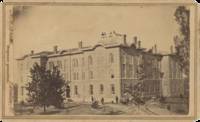
1865réf. List3142Sandusky Ohio 1865. 2 ½ x 4 inch CDV. Normal wear; Near Fine. A photograph by Sandusky Ohio-based photographer A. C. Platt showing the new Ladies Hall at Oberlin College around 1865. Oberlin was the first college in the US to admit women initially offering them a degree from the "Ladies Department" but in 1837 allowing them to enter the regular degree program. The building pictured is the second Ladies Hall a dormitory with reading and meeting rooms built between 1861 and 1865. unknown books
1865réf. 95059New Orleans: Duncan & Co. Stationer's and Booksellers 124 Camp Street 1865. Very Good. Partly printed receipt dated November 7 1865. Approximately 13 x 20 cm. Property owned by individual listed on back side. Taxing white property owners in Louisiana to support education of African Americans was probably the primary method of funding education for African Americans in Union-controlled Louisiana since African Americans were too poor for their taxes to support such schools. This receipt is signed by a Captain Sheridan on behalf of the Provost Marshall. After the end of the Civil War the newly created Freedmen's Bureau would replace this Board of Education for Freedmen in the Army's Department of the Gulf. Efforts to seize and redistribute property from defeated Confederates to those formerly enslaved were thwarted by President Andrew Johnson. We doubt that the Freedmen's Bureau had authority to continue this property tax. Duncan & Co., Stationer's and Booksellers, 124 Camp Street unknown books
1992réf. 93464Langley Va: Central Intelligence Agency 1992. Paperback. Very Good. 43p. Softcover in original wrapper. 28 cm. TE/CSI 92-002. Central Intelligence Agency paperback books
1902réf. 88474Baltimore 1902. Paperback. Very Good. 44p. Softcover in original wrapper. 25 cm. Cover has modest chipping around edges and is browned. The Fund appropriated a total of $53400 in 1901-1902 all but $600 of which went varying amounts to pay specific salaries at 12 institutions Shaw University North Carolina Agricultural and Mechanical College Meharry Medical College Tougaloo University Tuskegee Institute Hampton Institute Spelman Seminary Southern Industrial Classes Norfolk Va. Straight University Claflin University. Bishop College and Alabama State Normal School. Each institution is discussed briefly in this volume -- the Southern Industrial Classes are now reported at pages 31-32 to be under the care of the officers of Hampton. Two institutions Tuskegee and Hampton received slightly more than half of the Fund's total appropriation for 1901-1902. paperback books
1860réf. 85096New York: Joseph Russell Printer 1860. Hardcover. Good. illustrations 117 42 126 4 93p. Original thin flexible cloth-covered boards. 23cm. Cover edges and ends of backstrip chipped and worn. Covers discolored along fore-edge. Hinges cracked. Joseph Russell, Printer hardcover books
1863réf. 85073New York: C.S. Westcott & Co. Printers 1863. Hardcover. Fair. illustrations folding chart/map 204p. Original cloth covered boards. 23cm. Front cover almost entirely detached. Several pieces of cover cloth gone. Extremities worn. Chartmap split apart along a couple of folds. Chart/map is of parcels of land conveyed to or purchased by the Board of Education. C.S. Westcott & Co., Printers hardcover books
1854réf. 85072New York: Wm. G. Bryant & Co 1854. Paperback. Good. illustrations 150 21 47 100 2p. Original flexible dark cloth binding. 23 cm. Cover worn along joints and edges. Mostly moderate foxing throughout. Wm. G. Bryant & Co paperback books
1897réf. 84732Madison: Democrat Printing Company 1897. Paperback. Very Good. 56p. Wrapper. 25cm. Edges slightly darkened. Democrat Printing Company paperback books
réf. 82591Paperback. Near Fine. cover title. photos 32p. Original yellow wrapper. 30cm. Richardson had served as President of this Michigan organization since it was organized in 1933 when it was called the Baptist Young People's Union Convention. We don't know whether Richardson was retiring from office in 1971. paperback books