78 738 résultats
1885réf. 2955Mexico City 1885. Good plus. vii5191pp. Contemporary quarter calf and marbled boards spine gilt edges sprinkled red. Rear joint beginning to split at foot. Moderate wear at edges boards rubbed. Light toning and scattered foxing. "Segunda edicion" of this Mexican French lesson book based on the "Ollendorf method" a manner of teaching languages with an emphasis on practice rather than theory promoted by German linguist Heinrich Gottfried Ollendorff. The method became popular in France England and the United States during the latter half of the 19th century but has less of a track record in Mexico. We locate only one copy of the present edition at the BNM and none of the first. unknown books
1886réf. 3856Hampton Va: Normal School Press Print 1886. Good. viii75pp. Original green printed wrappers. Some chipping to spine and edges of wrappers a handful of earnest cello tape repairs. Internally rather clean. A rare session catalogue for the Hampton Institute printed at the school during the middle portion of the school's second decade. The work includes a brief history of the school a list of trustees courses of study a report on the school from the principal Samuel Chapman Armstrong to the trustees that incorporates detailed reports on the various school departments each written by a department head and more. A four-page supplement dated November 1886 is laid in. Though the teaching foundations of this school for freedmen were laid during the Civil War Hampton didn't open until the end of the decade; a division dedicated to teaching Native American youth began in 1878 and operated until 1923 and the principal's report here contains much on "The Indian School" at Hampton. OCLC only explicitly reports two copies of this particular Hampton Institute catalogue located at the Clements Library and the Roanoke City Public Library though there may be additional copies in serial runs of the catalogue at other places. Normal School Press Print unknown books
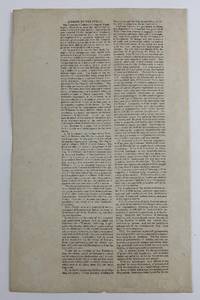
1839réf. 3269Natchez Ms. 1839. Very good. Broadside 13 x 15.75 inches. Printed in four columns; central vertical fold. Light wear and toning. In the present broadside the trustees of Jefferson College announce that they are once again prepared to admit students in 1839 following a reorganization and give their mission statement courses of study faculty list tuition fees and more. The school located in Washington Mississippi just north of Natchez opened in 1811 and was the first college in the Mississippi Territory. In the text of this broadside one can clearly see sentiments and dispositions that would bring the Civil War to fruition. The first two columns are chiefly dedicated to a description fo the new faculty and their skills but also new measures put in place during the reorganization of the school. In place of gymnastics a daily military drill was substituted and a military police was to be established "for the preservation of good order and regularity." The remainder of the broadside descends into sectional paranoia arguing that students must be kept close to home in order for them to maintain allegiance to Mississippi and the South: "At this very moment a formidable content has commenced between the North and the South from the possible results of which the eye of the patriot instantly revolts. It surely becomes us to preserve our children from any influence that might mislead their judgment or weaken their patriotism. To do this effectually we must keep them at home!. Send your sons to other States where they are relased from social bonds you not only cut off these powerful incentives to emulation but you do more and worse you weaken or detach the growing virtues of the heart. and you estrange them from their native land." OCLC locates only a small handful of examples. unknown books
1947réf. 124804Washington: Congress of Industrial Organizations 1947. Pamphlet. 64p. stapled wraps 4.5x6 inches illus. wraps evenly toned else very good condition. CIO publications no. 142. Congress of Industrial Organizations unknown books
1977réf. 80490Monmouth County NJ: Monmouth County Historical Association 1977. Softcover. Near Fine. Staples wrappers 18 pp. Near fine very lightly soiled. Program for exhibit at "Allen House." Text only. Monmouth County Historical Association unknown books
1965réf. 192128Chicago: Childrens Press 1965. Hardcover. Very Good. Revised. 98pp. Volume one only. Pictorial boards. Illustrated in color. Extremities lightly worn still very good. Childrens Press hardcover books
1944réf. 238793New York: The MacMillan Company 1944. Hardcover. Very Good. Revised edition. 774pp. Black and white illustrations. Maps present. Bumped corners rubbed edges and faint soiling else very good. Part of the Air-Age Education Series. The MacMillan Company hardcover books
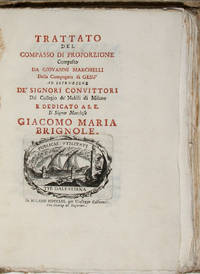
1759réf. 5386Milan: Giuseppe Galeazzi 1759. Hardcover. Near Fine. 8vo 20.2 x 14.4 cm. XXII pp. 352 pp. 8 ff. with 1 large 40 x 50 cm folding plate containing 5 illustrations; title-page printed in red and black engraved device on title. Bound in contemporary publisher's binding title in ink on spine. Minor edge wear minor staining to lower cover. Quires C and E loosening internally very fresh and clean retaining deckle at fore-edge and bottom edge toning to plate marginal paper flaw and rear reinforcement of crease to plate otherwise an excellent copy. Rare first and sole edition of this treatise on the proportional compass written by the Jesuit Giovanni Marchelli. The work was expressly written for the use of Marchelli's mathematics pupils in the Jesuit College of Milan and thus provides interesting evidence for the use of scientific instruments in Jesuit education. The text offers an advanced understanding of Galileo's landmark instrument and coming from a Jesuit it is perhaps notable that Galileo's "invention" of the instrument is so candidly celebrated. The proportional compass or 'sector' in fact combines two separate instruments one for making observations by adding a quadrant to its arms the other to calculate various measures like proportion trigonometry and squares and cube roots. Its several scales permit easy and direct solutions for problems in surveying gunnery and navigation. Conceived as a universal instrument the device was adapted for a variety of pedagogical purposes far more diverse than Galileo's sector ranging from pure geometry to such practical operations as taking measurements for the architectural orders p. 11 converting currency and calculating interest p. 42 performing various 'rule-of-three' operations such as the dissolution of business partnerships p. 53 surveying passim and the construction of Napier tables p. 73. The compass scales are well illustrated and the text includes tables giving the positions of the various markings. The large folding plate provides diagrams "for constructing Galileo's quadrant" that show with great refinement exactly where the markings on the quadrant's arm and tangent are to be engraved. The final chapter deals with military problems such as the determination of the caliber of cannon balls. OCLC locates copies at Adler Planetarium Michigan Oklahoma Woodstock Theological. De Backer-Sommervogel V.525 4; Cinti 177; Carli-Favaro 128; Tomash II.M34. Giuseppe Galeazzi hardcover books
1821réf. ST20285Edinburgh: Printed for Archibald Constable & Co.; London: Hurst Robinson & Co 1821. FIRST EDITION. 192 x 103 mm. 7 1/2 x 4 1/2". xv 1 lvii 1 59-360 pp. ORIGINAL PUBLISHER'S PAPER BOARDS paper label on spine edges untrimmed. Owner's signature of Robert Chichester dated 1827 on front pastedown. Text a shade less than bright because of inferior paper stock slight wear to the binding but AS FINE A COPY IN THE ORIGINAL BOARDS AS ONE COULD HOPE TO FIND the covers amazingly clean and smooth and with only the most minor faults internally. In its original remarkably well-preserved publisher's boards this work on education captures the spirit of reform abundant in the early 19th century including its warts. Although Spurzheim 1776-1832 was better known as an exponent of phrenology and an authority on mental illness than as an educational theorist his "View of the Elementary Principles of Education" is an important work that for the most part is sensible and progressive. Especially significant are his assertion that all influences from birth onward contribute to the physical and mental development of the child and the inference he draws from this that in addition to the conventional education of the intellect an optimal upbringing must include attention to such things as clean air proper diet and suitable exercise. He favors public education over private instruction because children will benefit by meeting a variety of people with "different manners of feeling and thinking." Spurzheim shows himself to be generally tolerant and forward thinking as he maintains that good education can improve almost anybody it would certainly reduce the number of criminals. But he sometimes disappoints as in his belief that many limitations are hereditary and must be taken into account in designing the most fitting education for an individual. He states for example that the poor ought to be prevented from reproducing as if poverty were in the genes. And in answering the claims of Mary Wollstonecraft's "Vindication of the Rights of Women" he says "I cannot perceive any arrangement of nature that can lead me to expect that women will cease to be considered as subordinate to men. Let them endeavor if they please to acquire the same degree of talent but till they have acquired it let them cherish order and exercise the virtues of their actual condition in society rather than attempt to rise into a sphere for which they are not at present fitted." Also appended here is a section on the treatment and reform of criminals in which the author calls for a better understanding of the causes of crime for the requiring of prisoners to undertake useful work and courses of instruction while in prison and for the study of the prison system instituted by William Penn at Philadelphia. While the sometimes disheartening contents approach a certain fascination it's the binding here that competes for--and perhaps wins--our attention. That its fragile construction could hold up so beautifully through two centuries of use is extraordinary. Printed for Arch[ibal]d Constable & Co.; London: Hurst, Robinson & Co unknown books
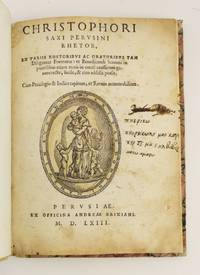
1563réf. ST16379-038Perusiae Perugia: ex officina Andreae Brixiani 1563. SOLE EDITION. 210 x 155 mm. 8 1/4 x 6". 4 p.l. 78 4 leaves. 19th century vellum-backed pink marbled paper boards smooth spine black morocco label remnants of paper shelf label at foot of spine newer endpapers. Printer's device on title page. With Greek inscription in ink on title page occasional ink marginalia and with a page of inked notes written in Latin in an early hand on blank verso of final leaf. Leaf 3r with an inexpert but endearing pen-and-ink drawing of a rider on a galloping horse below the dedication with some pencilled embellishments around it; A4r with an ink-drawn small face in one margin. EDIT 16 CNCE 23145; Gehl "Advertising or fama: local markets for schoolbooks in sixteenth-century Italy" in Costas ed. "Print Culture and Peripheries in Early Modern Europe" 2012. Corners a little bumped boards lightly chafed title page a bit soiled and browned four leaves affected by the same small burn hole a handful of words partially obscured another leaf with very small damage from ink burn-through occasional faint foxing or minor ink stains but still a pleasing copy the binding perfectly satisfactory and the interior with no major defects the historical charm of the annotations compensating for any blemishes they cause. This is the first and only printing of a scarce textbook on rhetoric by a Perugian professor of the subject charmingly decorated and annotated by an early--not very attentive--pupil. In the 16th century the market for textbooks tended to be regional. Schools and teachers wanted works produced by local scholars and printers a preference Gehl relates to their earlier reliance on manuscripts shared and recopied by the teachers who used them. He notes that "Perugia . . . had a particularly lively market for learned books that lasted from the early days of printing right into the 17th century" and local professors were a ready resource for publishers like Andrea Bresciano. In the present work Saxus ca. 1499-1574 a pupil of the great Perugian humanist Francesco Maturanzio 1443-1518 outlines the principles of persuasion giving examples of the various rhetorical devices and modes citing classical sources. According to Gehl our author "was an innovator . . . who made a serious attempt to facilitate learning by catering to the limited attention span of students and by including teaching tips to grammar masters." We have evidence of what he was up against in regard to the former in the doodles of a prior owner of this text who was apparently dreaming of galloping away from the classroom on a trusty if seemingly headless steed. On another page the face of a master or fellow student peers critically from a margin. But some attention was paid as shown by the notes at the end of the book. Saxus' writings never managed to break into the major markets of Rome and Venice but continued to be printed after his death in Florence and Perugia where Gehl says "he could be considered a regional celebrity" whose former students used his textbooks to teach their own classes. We could trace just one copy of this work in auction records. ex officina Andreae Brixiani unknown books
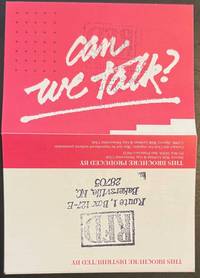
1986réf. 338555San Francisco: the Fund and the San Francisco AIDS Foundation 1986. Five-panel brochure 4x5.5 inches illustrated with cartoons on AIDS prevention. The brochure originally handed out at the Gay Freedom Day Parade was reissued with changes reflecting changing knowledge of AIDS every year for five years. This example was re-disributed by the magazine RFD in Bakersville NC with a large rubberstamp on the rear cover and a fainter impression on the front. the Fund and the San Francisco AIDS Foundation unknown books
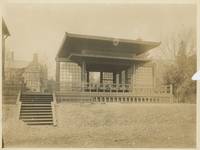
1910réf. List2847Bryn Mawr Pennsylvania; and others 1910. Eleven photographs approximately 7 x 9 ½ inch and smaller. With stamps for Brown Brothers Illustrations Bureau and E.J. Reily verso; most with captions verso. Most with chipping and wear at edges; overall good. Open-air schools became popular in the United States in the early 20th century in response to public health crises including tuberculosis.1 Conducting lessons in open-air classrooms reduced the transmission of diseases which allowed many children to attend school despite their often chronic illnesses. Offered here are eleven photographs of open-air schools three of which are identified as the Phebe Anna Thorne Model School at Bryn Mawr. The Phebe Anna Thorne Model School opened in 1913 under the direction of the College’s president Carey Thomas using funds donated by Samuel Thorne in memory of his sister Phebe Anna.2 The Thornes were an affluent New York Quaker family; Phebe Anna 1828–1909 was the only daughter to survive to adulthood and was a philanthropist and supporter of progressive social causes.3 The school was part of Bryn Mawr’s Department of Education which trained its students in teaching younger pupils rather than those of highschool or college age – the students in most of these photos are probably in about 4th or 5th grade.3 It also allowed testing of more cutting-edge pedagogical practices: the structure of the school was quite experimental including open-air classrooms outdoor naptime a flexible curriculum and less formal assessment. Of interest to scholars of the history of education especially experimental pedagogy. 1 Sherman C. Kingsley & F.B. Dresslar “Open-Air Schools” Department of the Interior Bureau of Education Bulletin 23 1916. 2 Cornelia Meigs What Makes a College A History of Bryn Mawr The MacMillan Company 1956. 3 Olive Floyd Phebe Anna Thorne: Quakeress Privately Printed in Rye New York 1958. unknown books
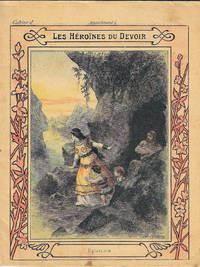
1911réf. 0109581911 A softcover notebook with a lovely engraving of Eponine and Sabinus on the upper cover and their history on the lower cover the notebook was printed by Auguste-Godchaux. The pages are mostly clean but two pages marred by what appears to be wax or oil a few other pages have tiny edge tears. The notebook paper is lined in grid with a red side rule. A student has filled in every page with their lessons in neat handwriting. Subjects include math science geography grammar etc. . Pictorial Wraps. Very Good. 8vo. unknown books
1887réf. 79422Bedford England: W. J. Robinson. Very Good. 1887. Softcover. Original 1887 geometry pamphlet complete in 60 pages with 2 folded leaves of plates one has small tear see photos which are toned printed on a heavier stock of paper. The back strip is chipped and splitting and printed wrappers lightly foxed and toned also but contents are bright and complete. OCLC shows a total of 3. . W. J. Robinson paperback books
1919réf. 337837London: George Allen & Unwin 1919. Hardcover. xv 334p. tables one fold-out chart corners bumped spine slightly faded else very good first edition. George Allen & Unwin hardcover books
1967réf. 592579Washington D.C.: Civic Education Service 1967. Softcover. Very Good. First edition. 12mo. 144pp. Illustrated. Illustrated wrappers. Small crease on front wrap several light stains on rear wrap about very good. Civic Education Service unknown books
1965réf. 20407Albany: State Education Department 1965. Paperback. viii 158p. light blue wraps spine toned and prone to chipping pen notation on front wrap else good. Curriculum Bulletin 1964-65 Series No. 4. Broad history of African Americans through the inception of the U.S. Black Reconstruction the New Deal up until the Civil Rights movement in the 50s and 60s. State Education Department paperback books
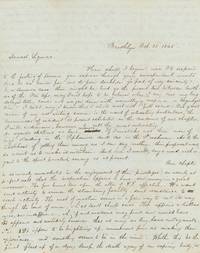
1845réf. List2951Brooklyn New York 1845. Single three-page letter measuring 7 ¾ x 9 ¾ inches. Folded with very small tears at folds and tear at seal; near fine. A letter from A. M. Stone to George Capron and the Sigma chapter of Psi Upsilon at Brown University. Psi Upsilon was founded in 1833 at Union College in Schenectady New York and the Sigma chapter started at Brown in 1840. Stone signs his letter with “Gamma Zeta” indicating that he could be writing on behalf of the Amherst or Dartmouth College chapters. His main concern is that the “Psi Ups” are getting too comfortable “so nearly at perfect rest that the inspiration appears to have died away in great measure.” He mentions a rivalry with Delta Phi another Union College-founded fraternity; noting that while “I do not think they can injure us . they may do us good by raising up an healthy opposition”. He also mentions conflict with the Delta chapter of Psi Upsilon at New York University with whom “there is evidently discord . manifested in various ways each chapter striving for the mastery instead of uniting forces to certain victory”. Of interest to scholars of early fraternity history. unknown books
1965réf. 67155Atlanta: Southern Christian Leadership Conference 1965. Original mock up for a personnel sign up sheet for SCOPE volunteers consisting of two manuscript sheets in an unknown hand along with four repurposed Morehouse college student personnel sheets with holographic additions and revisions all combined to compose a thorough volunteer information packet for SCOPE volunteers looking to be sent around the Deep South to work volunteer voter drives. The Summer Community Organization and Political Education Project of the Southern Christian Leadership Conference was a voter registration civil rights initiative conducted from 1965 to 1966 in 120 counties in six southern states. Officially announced by Dr. Martin Luther King Jr. at a speech in 1965 at UCLA the project started with a plan to recruit up to 2000 students from all across the US but fell short of this goal mostly due to fear of violent retribution many volunteers possibly faced. The project officially kicked off with an orientation in June of 1965 at Morris brown College in Atlanta ad afterwards volunteers tested and reported violations of the 1964 Civil Rights Act and the Voting Rights Act in counties throughout the South. SCOPE volunteers were subject to violence tear-gassing harassment and threats with guns on numerous occasions according to "incident reports" from the project's administrative records. On June 18 1965 in Camden Alabama for example 18 SCOPE workers were arrested in a church for "illegal possession of boycott materials." One SCOPE worker Mike Farley was beaten in jail by a white prisoner who was reportedly both bribed and threatened by a jailer to attack Farley. On July 8 in Wilcox County Alabama three cars carrying SCOPE workers were shot at by white men after police stopped SCOPE workers and spoke with white men. On July 15 in Chatham County Georgia SCOPE worker Shirley Savaris was threatened by a white man with a gun and told to leave town. The next day in Taliaferro County Georgia SCOPE workers were threatened by a deputy sheriff and county attorney with beatings and killings "if they did not leave town the next day." Also in Taliaferro County on July 23 SCOPE volunteer Richard Copeland was beaten by two whites on the courthouse steps in Crawfordsville the county seat. On July 28 in Sussex County Virginia two SCOPE workers Gary Imsland and Elke Wiedenroth were run off the road while returning from a church meeting and threatened by a white man armed with a shotgun. In Luverne Alabama on August 3 SCOPE workers Dunbar Reed Bruce Hartford and Carol Richardson along with a number of local students were attacked and beaten by a white mob after they integrated a local cafe. On August 18 in Berkeley County South Carolina two SCOPE volunteers were beaten after attempting to integrate restaurants in Monk's Corner. The local SCOPE office and volunteer residence was shot up the following day. [Southern Christian Leadership Conference] unknown books
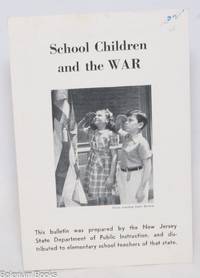
1942réf. 334951New York: Fellowship of Reconciliation 1942. 4p. brochure. Very Good. The text condemns the use of children as props in war propaganda e.g. in parades and the sale of war bonds or as cheap/free labor. Fellowship of Reconciliation unknown books
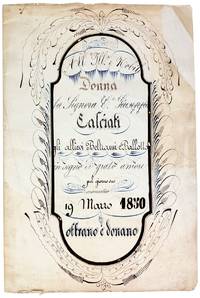
1850réf. 32538Rome 1850. Very Good. Rome 1850. Large folio 45cm.; stitched self-wrappers with elaborate calligraphic manuscript presentation in black and blue ink to upper wrapper; 12ll. accomplished in black and blue ink manuscript on rectos only. Moderate wear including some creasing and dust-soil to upper cover black ink occasionally burning through stock else a Very Good quite impressive survival. Calligraphic manuscript gift by two students to teacher or patron Signora C. Giuseppe Calciati. Each leaf provides a historical event or religious quote written in an elaborate calligraphic hand with extensive decorative bordering each in a different style. A lovely tribute. . unknown books
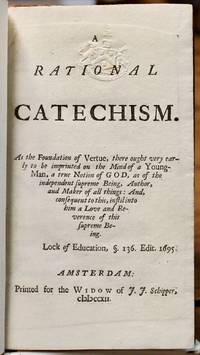
1712réf. 15978Amsterdam: Printed for the Widow of J.J. Schipper 1712 Second edition not so stated dedicated to the author's "dearest daughters" with a long quote from Locke's On Education on the title-page. The work is a significant distillation of the principles of toleration first published in 1687. . . Contemporary mottled calf. Gilt spine tooled in compartments yellow silk ribbon marker. . Twelvemo. Edges sprinkled red. Binding extremities slightly worn and boards a bit scratched. Front joint cracked but sound. The Macclesfield copy with the blindstamps shelf marks and the South Library bookplate. A very good copy clean copy. William Popple 1638-1708 was the nephew of Andrew Marvell and was educated under his guidance. He was a successful merchant in Hull before moving to Bordeaux where he lived from 1670 to 1688. After returning to London he met William Penn and became secretary of the Dry Club established by John Locke to debate issues of religious liberty. He also translated Locke's Letter on Toleration 1689 from the Latin. When Locke was appointed a commissioner of the Board of Trade in 1696 Popple became the board's secretary. Though this is a dialogue between a father and son the dedication to his daughters states: "I am desirous that it may be a common memorial of me unto all of you when I shall be no more I therefore make it yours also by this dedication: And for the same reason I have likewise added unto it a copy of that advice which I formerly gave him in such verse as my unpractised Muse then dictated. Printed for the Widow of J.J. Schipper, books
1854réf. 2069Edinburgh: Thomas Constable And Co. 1854. Third Edition. Hardcover. Blue embossed boards. Good. 220 pages. Crucial social advice for Scottish working class with recipes washing instructions going out to service religious duty etc. Brewster was the daughter and biographer of Sir David Brewster the Scottish physicist astronomer mathematician writer and inventor. Owner's signature on front endpaper "Elizabeth Driver/With best wishes - July 1859." Interior clean boards rubbed and corners bumped spine chipped and frayed. Thomas Constable And Co. hardcover books
1899réf. 17833Leeds: E.J. Arnold & Son n.d. ca. 1899. Fourth edition revised and expanded. Rare. OCLC records only 2 copies in libraries worldwide. Green cloth-colored boards. Title and paper-folding decorative design in black. . Small quarto. . With 27 full-page color diagrams and numerous half page diagrams. Upper right corner of first few leaves and last leaf clipped but text is unaffected. Minor edge wear. A few folding paper samples laid in and sample sheets at rear. Endpapers feature the publisher's logo. Very good copy. Z. Ford was a Froebel Kindergarten teacher during the end of the 19th-Century. We could not locate much more information on him in the sources available to us. The present work gives detailed instructions and diagrams for kindergarten students studying the Froebel gifts with colorful illustrated examples. According to the preface: "There is no Kindergarten occupation more pleasing and interesting to children than that of paper-folding … This little work is intended to show how the paper-folding occupation lends itself to the cultivation of the designing powers in children." It is also noted that "Juniors" can use this book as preparation for the study of geometry. The A.L. Educational Series focused on children's creativity and learning-through-play concept that was one of the central tenets of Froebel's educational method. Other titles in the series include Guide to the Drawing Examinations 1892 by D.E. Hillier and Paper-Flower Making 1897 by I.A. Williamson. E.J. Arnold & Son, hardcover books
1881réf. 183813NJ: John L. Murphy 1881. Softcover. Good. First edition. Good in wrappers. Paperback cover detatched light foxing cover and foredges soiled pages browned. John L. Murphy unknown books