74 433 résultats
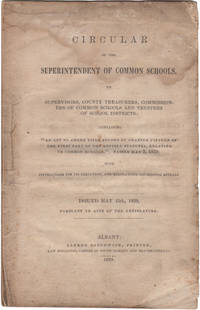
1839réf. 38798Albany: Alfred Southwick Printer 1839. First edition. Self wrappers. About very good edge worn and torn with light soiling on wrappers dampstain on top quarter of leaves and small tear to fore edge throughout. 30 pp. 8vo. Concerns school finances and the requirement that towns apportion monies for the schools. OCLC locates only 12 copies. American Imprints 57519. Alfred Southwick, Printer unknown books
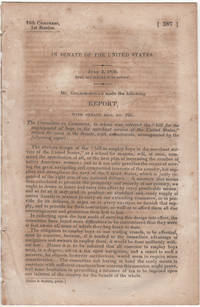
1836réf. 43119Washington D.C.: Gales & Seaton print. 1836. First edition. Removed. A very good- copy with darkened leaves removed from a larger volume. 10 pp. 8vo. 24th Congress 1st Session No. 387. The Committee on Commerce to whom was referred the "bill for the employment of boys in the merchant service of the United States" return the same to the Senate with amendments accompanied by the following report. The bill sought to add protections for boys in the attempt to have more young men trained for the sea. A typical response for comment was: "The merchants of Baltimore have frequently experienced great inconvenience and sometimes have been subjected to expensive and injurious delays in their mercantile operations in consequence of the scarcity of seamen. The proposed measure in the opinion of your memorialists will not only greatly increase the number of this valuable class of men but by affording to them the advantage of early education and long training in their profession will render them far more efficient and will raise up a body of skillful seamen who in time of peace will be sufficient for the supply of the merchant service and in the event of war will prove an important auxiliary to the navy of the United States. Your memorialists therefore beg leave respectfully to urge the adoption of this measure." Robert Henry Goldsborough 1779-1836was Senator from Maryland from 1813-1819 and 1835-1836. Gales & Seaton, print. unknown books
1941réf. 35444Washington D.C.: National Education Association of the United States 1941. First edition. Stapled paper wrappers. A very good copy lightly soiled wrappers scattered light pencil marginalia. 48 pp. Sm. 4to. National Education Association of the United States unknown books
1841réf. 33795New York: W.B. & T. Smith Printers 1841. First edition. A very good copy a few folds two pinpricks in top and bottom margins. Broadside. 24.5 x 17.5 cm. Not in Sabin. Not in OCLC. Not in NUC. W.B. & T. Smith, Printers unknown books
1891réf. 27305Hancock NY: Herald Print 1891. First edition. Paper wrappers. Wrappers soiled else a very good copy. 20 pp. 12mo. School catalogue with lists of students tuition courses of study. Herald Print unknown books
1920réf. 47454United States 1920. Very Good. United States: ca. 1920s. Set of 25 hand-painted wooden alphabet blocks each approximately 4.3cm square. 24 matching in style with one from a different set depicting animals and colors. Set features stenciled uppercase letters in mint green white and red; numbers written in pencil and stenciled in navy blue and orange; illustrations of objects animals and people stenciled in light blue. A much-loved educational toy with worn edges and rubbing to the painted characters and images. unknown books
1932réf. 209697Harrisburg PA: J. Horace McFarland Co 1932. Staplebound. VG. Quarto. Staplebound. Oversized illustrated wraps. Unpaginated. Profuse b&w photography. J. Horace McFarland Co unknown books
2010réf. 195140Bethesda MD: Foundation for International Arts & Education 2010. Hardcover. VG Boards have light shelf/edgewear; interior is clean; binding is solid. Grey-and-gold boards with colorful illustration and red lettering; viii 176 pp.; richly illustrated primarily in color. "Exhibition was organized by the Foundation for International Arts & Education and the Kyiv-Pechersk National Historical and Cultural Preserve in cooperation with the U.S.-Ukraine Business Council and the support of the Embassy of Ukraine in the United States" -- title page verso. Foundation for International Arts & Education hardcover books
1837réf. 191179Detroit: John S. Bagg 1837. Hardcover. Good recently rebound pages have expected age toning but are otherwise clean. Recently rebound in half brown cloth and blue paper boards tan title block with black lettering on front cover; 60 pp. Includes "Reports of School Commissioners" and "Reports of School Directors" John S. Bagg hardcover books
1852réf. 186536Lansing: Ingals Hedges 1852. Hardcover. G Cover has fading discoloration edge damage. Bookblock has age toning. Interior pages have age toning foxing some staining. Brown cloth boards with pressed design. Gilt lettering on spine. xv 640 pages : illustrations plates. Combines "the material of the annual report dated May 1 1852 . and the primary school law with notes and forms in one document."--Page xi. Ingals, Hedges hardcover books
1968réf. 1022.1New York: Public Education Authority 1968. Hardbound. VG. Cloth with mounted color cover. 70 pp. 4 color 107 bw repros. This cooperative concurrent exhibition was put together by three galleries each of which concentrated on a certain aspect of American Art from the specified period. Knoedler put the Figure section together which includes a two-page essay by Richard McLanathan and includes 1 color and 25 reproductions. They also put together the Still Life section with a two-page essay by William Gerdts followed by 1 color and 20 bw reproductions. Hirschl & Adler Galleries put Genre together with a two-page essay by Francis Grubar followed by 1 color and 29 bw reproductions. Paul Rosenberg put the Landscape section together with a two-page essay by Barbara Novak O'Doherty followed by 1 color and 32 bw repros. An important exhibition with many landmark works included and an overall superb survey. Public Education Authority hardcover books
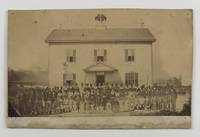
1880réf. 4993N.p. but likely Live Oak FL 1880. Very good. Albumen photograph 4.5 x 7.75 inches mounted on card. Card trimmed with pinholes at corners remnants of printed caption in bottom margin slight surface soiling and spotting. Penciled annotation on verso. A stunning original photograph featuring Rev. Joseph Leroy Atwell Fish 1828-1890 and his wife and children posed amongst their African-American students at an unnamed "colored school" which was very likely the Florida Baptist Institute. The images captures Fish his wife and probably his daughters in the middle of the frame standing in front of a large two-story schoolhouse surrounded by about eighty young Black men and women in suits and dresses. Revered Fish was a graduate of Amherst College and the Newton Theological Seminary who was ordained a Baptist minister in 1856. Fish was also a teacher who helped found Florida Memorial University Florida Baptist Institute in Live Oak in 1880 where he served as first president of the institution until his death there on March 26 1890. Florida Memorial University is the only HBCU in the southern part of the state. The penciled annotation on the present photograph provides some information on the photograph but is probably ultimately misleading in one regard: "Rev. J.L.A. Fish & wife In Virginia teaching a colored school -- He married my Father & Mother Mr. & Mrs. Milan Hills Lucy M. Williams Dec. 21 1875." The latter part of this inscription is indeed true. Reverend Fish married Milan Hills and Lucy Williams on December 21 1875 in Hebron New York where he was serving as a church pastor. But the historical record does not indicate that Reverend Fish ever taught at an African-American school in Virginia if he did it was so brief that it is now lost to history. Fish's first known foray into teaching African American students was a brief six-month stint in Natchez Mississippi in 1879. Immediately thereafter Fish was appointed to the Florida Baptist Institute where he served the last decade of his life. As such it is far more likely that the inscriber here meant to say that Reverend Fish and his wife were "In FLORIDA teaching a colored school." Reverend Fish's work at the Florida Institute is covered in the Obituary Record of Graduates of Amherst College for the Academical Year ending June 27 1883: "His chief work was with the Freedmen as he brought Florida Institute out of all its troubles financial and social changed the feeling of the whites from hatred to sympathy with his work and put the school on a permanent foundation. His aim was to educate leaders for the race and the principal effort of his school was to train teachers and preachers to go out through the state and by their example to lift up and educate both intellectually and morally the colored people. His influence was felt throughout the state both through his training of teachers and preachers and through his counsels given at conventions associations and other gatherings of the colored men and in private. He is mourned by both white and black. By the whites because they knew his teachings would help the colored people without causing trouble to them. By the latter because they miss their leader teacher and friend. unknown books
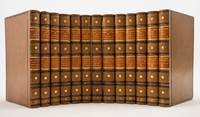
1843réf. ST20896London: William Pickering and John W. Parker and Son 1843-57. Second Edition of volumes I III V VI VIII XI XV XVII. Third Edition of volume II. FIRST EDITIONS of the other 13 volumes. 170 x 103 mm. 6 3/4 x 4 1/8". 22 volumes bound as 13. Pleasing contemporary calf by Leighton stamp-signed on verso of front flyleaf covers framed with a double blind rule raised bands spine compartments with a single gilt sun tool russet morocco labels lettered in gilt all edges sprinkled. First volume with one plate depicting the brain and one illustration in the text depicting the brains of different animals. Final volume with an ad for the complete series by John W. Parker. A few light scratches scuffs and spots to leather each volume with offset from ribbon page marker other trivial defects but a fine and attractive set--extraordinarily fresh and clean internally in bindings essentially without wear. Containing a rarely seen complete run of 22 separate works in 13 volumes this attractive set represents the joint efforts of a female Victorian polymath and major publisher William Pickering to introduce the general public to a very wide range of subjects partly to contribute to general popular education and partly to alert the public to the need for reform. Caroline Cornwallis 1786-1858 was a writer scholar and feminist activist whose life-long self-directed course of study led her to explore subjects as diverse as mineralogy theology Tuscan law and the Ancient Egyptian language. In 1842 the first work in the "Small Books on Great Subjects" series appeared authored anonymously by Cornwallis she is named only as "A Pariah" and the editorship of the series is credited to "A Few Well-Wishers to Knowledge". Along with initiating and editing the series Cornwallis composed all but four of the books herself the second and third numbers were written by John Barlow #15 by Wilhelm von Humboldt and #16 by David Power. The works cover philosophy psychology chemistry Greek philosophy Christian history and theology biology law grammar geology politics and more and proved to be a great success in Britain and America. Some of the volumes are histories of general interest "A Brief View of Greek Philosophy up to the Age of Pericles" and "Christian Sects in the Nineteenth Century"; others are of significant scientific content "The Connection Between Physiology and Intellectual Philosophy" and "On Man’s Power Over Himself to Prevent or Control Insanity; still others are strongly reformist in thrust "On the Principles of Criminal Law" decrying the harshness of punitive Victorian laws and "On the Philosophy of Ragged Schools" dealing with the pressing issue of educating London's poor. Initially "Small Books on Great Subjects" was published by William Pickering but upon his 1853 bankruptcy John W. Parker took over the series. Stray volumes of this series are readily available but complete sets especially in the condition seen here are much more difficult to find. William Pickering (and John W. Parker and Son) unknown books
1980réf. 166523San Francisco: the Fund and the Foundation 1980. Pamphlet. Ten-panel brochure 4x5.5 inches illustrated with cartoons on AIDS prevention blue cover no date. The brochure originally handed out at the Gay Freedom Day Parade was reissued with changes reflecting changing knowledge of AIDS every year for five years; this is an earlier issue. the Fund and the Foundation unknown books
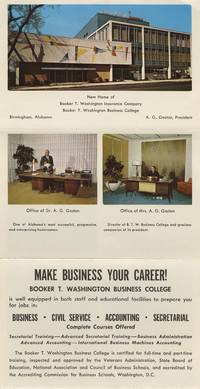
1950réf. List3609Birmingham Alabama 1950. Folded direct mail advertisement measuring 21 x 5 ½ inches folded into six panels. Fine condition. A promotional mailer for the Booker T. Washington Business College founded by A.G. Watson in Birmingham in 1939 in response to a shortage of typists and receptionists in his insurance and funeral home businesses and open until 1988. Arthur George Gaston 1892–1996 was an Alabama businessman and civic leader who built one of the largest African American–owned business enterprises in the United States during the era of segregation. Beginning with the Booker T. Washington Burial Society he expanded into insurance funeral services banking construction broadcasting and hospitality creating employment and training opportunities within Birmingham’s Black business community. Gaston later established Citizens Federal Savings and Loan Association one of the few Black-owned financial institutions in the region and developed the A.G. Gaston Motel which served as a key meeting site for civil rights leaders during the Birmingham Campaign of 1963. This advertisement appears to be from the 1950s with pictures of students around an IBM accounting machine late 1940s production and pictures of the Gastons in their respective offices. The college offered courses in business civil service accounting and secretarial training according to the mailer. A nice survival from an important institution. unknown books
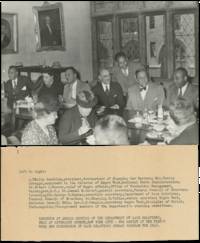
réf. List3004United States 1964. Twenty-seven letters two typed documents totaling four pages six photographs and nine pieces of ephemera including two of Haynes’ heavily stamped passports. One of the typed documents and two of the letters belong to Olyve Jeter Haynes’ second wife. Many items affixed to loose scrapbook leaves. Near Fine. George Edmund Haynes 1800–1960 was an African American sociologist and social worker. He received a B.A. from Nashville HBCU Fiske University an M.A. from Yale and was the first African American to receive a Ph.D. from Columbia graduating in 1912. While in New York Haynes worked with the National League for the Protection of Colored Women and the Committee for Improving the Industrial Conditions of Negroes in New York and formed the Committee on Urban Conditions among Negroes with white suffragist Ruth Standish Baldwin. These three groups would merge into the National League on Urban Conditions among Negroes—shortened to the National Urban League—in 1911. He taught economics and created the sociology department at Fiske and served as director of the Division of Negro Economics under the US Secretary of Labor. He also served the Federal Council of Churches and with the Joint Committee on National Recovery which worked to ensure African Americans got their fair share of the New Deal and had a role in the formation of the State University of New York. Offered here is a collection of Haynes’ letters with several photographs and documents. The letters which are sometimes placed alongside copies of Haynes’ outgoing correspondence come from politicians and influential figures in African American higher education. Those from political figures are generally in response to Haynes sending them his thanks for their advocacy for African Americans: Herbert Hoover personally thanks him for his “fine note of friendship” in response to Haynes’ congratulations on his presidential nomination on the 1928 Republican ticket June 21 1928 Franklin D. Roosevelt’s secretary Louis Howe for his letter in appreciation of the President’s speech against lynching before the Fedral Council of Churches December 14 1933 and New York City Mayor Herbert Lehman for his letter in support of the Mayor’s mandate to desegregate CCC camps in the state April 22 1937. The letters from fellow educators are more personal and substantial. In an early letter Tuskegee president Robert Russa Moton councils Haynes on an unspecified conflict: “I can see no reason why we should not state your case before the Board. It is quite evident that Mr. Wood misunderstood you. I shall be seeing Dr. Dillard next week at which time I hope to talk over and more in detail the whole situation. . The whole thing to me is most unfortunate especially when the work in hand is so very important and there is so much need for all the forces we can summon to do the work.” July 8 1919 At the time Haynes was with the Division of Negro Economics though it is not clear what misunderstanding had occurred or how it related to Tuskegee’s Board. “Dr. Dillard” is almost certainly James H. Dillard a white advocate for African American education who at the time was the director of the Negro Rural School Fund. Dillard and Haynes seem to have been personal friends as Dillard laments in a later letter that “I wonder if you and I will ever see each other again. The fates seem against it” September 24 1932. Another friend of Haynes’ Nathan B. Young writes him in 1931: “As you may have heard I am leaving the field of education in Missouri. I am casting about to find something to do. I am still young and healthy with mental powers unabated. I should like to be put into a position where I would have the leisure to ‘write up’ what I have learned by long and varied experience in the field of Negro education. . I am asking my friends to make suggestions as to the best use of the leisure immediately before me. Of course I must keep on earning in order to keep on eating for I am a poor man.” May 26 1931 A newspaper clipping alongside the letter concerns Young’s unceremonious ouster from the presidency of Lincoln University an HBCU in Missouri. Young had been removed from the same post in 1927 at least in part because of his efforts to turn the school away from agricultural and industrial education and towards becoming an accredited liberal arts university.1 He returned to the post in 1929 but was fired again without a hearing in 1931; in 1933 after a few years of lecture touring Young died. Two letters from newsman Julius J. Adams concern an article that the two were writing about the founding of the National Urban League. Adams writes: “I am enclosing a copy of a memorandum supplied me by the National Urban League regarding its formation. It is of course strictly confidential but I am eager to get your version of the League’s beginning and desire to see if it coincides. . I must say that the manuscript I am working on is being held up by the printers and it is essential that I get your statement at once. I’d certainly not like to complete the work without including this particular phase of the League. What I’d probably do would be to omit or at least skirt the controversial part of the statement.” June 14 1948 The attached statement which gives a brief overview of the early years and figures of the Urban League was authored by Eugene Kinckle Jones. Jones was hired as a secretary to the Committee on Urban Conditions so that Haynes could spend most of his time teaching at Fiske.2 As Jones notes in the statement “I was the first full-time employee” as Haynes “never gave full time to the organization.” It is plausible that this is the ‘controversial’ piece that Adams is worried about: Jones convinced the Committee’s board to give him a more significant role in 1916 and by 1917 became executive secretary effectively demoting Haynes who then left the League.3 The photographs included in the collection date from the later era of Haynes’ career. Three are of the 1942 annual meeting of the Federal Council of Churches Department of Race Relations. The typed caption states that the subjects of the photo—besides Haynes—include labor and civil rights activist A. Philip Randolph journalist Venice Spraggs listed as “assistant to the director of Negro Work” and academic and politician Robert C. Weaver. The Race Relations commission was created in 1921 with the aim of using Christianity to aid racial relations; Haynes became secretary in 1922 and was executive secretary from 1934 to 1947. A 1948 photo shows Haynes with the Temporary Commission on the Need for a State University a New York organization that studied college admissions especially discrimination against African American and Jewish applicants. Its 1948 report which is being presented to Governor Dewey in this photograph included the recommendation to set up the SUNY system. Finally one photograph shows an event at New York City’s WLIN radio station celebrating the release of Haynes’ book Africa: Continent of the Future 1951. Later letters concern the death of Haynes’ wife Elizabeth Ross Haynes who died in 1953 with notes of condolence from figures including W.E.B. Du Bois and Adam Clayton Powell. Elizabeth Haynes a fellow social worker sociologist and Fiske graduate was a distinguished figure in her own right. One letter from “Sara” in Bronxville remembers her in some detail: “Elizabeth spent two afternoons here while in the process of revising ‘Black Boy’ and I spent a day at your house afterward. We had a child-like and easy way of picking up close communication after long intervals of separation. We never talked about Big Issues and all that — but family matters projects in hand personal expression in the arts memories; we always exchanged some disrespectful jokes about women’s organizations — both of us had felt their sticks for a long time — . I told her the first time they met I meant to get out of teaching colored students before I got helped out by the onrush of young colored teachers. She said that she was quite a lot afraid of giving up her professional work which she had under reasonable control for marriage when she felt no domestic skills and did not even want them much.” November 24 1953 “Black Boy” is Elizabeth Haynes’ The Black Boy of Atlanta 1952 a biography of African American educator civil rights activist and entrepreneur Richard R. Wright. After Elizabeth Haynes’ death George Haynes married Olyve L. Jeter. Two letters are addressed to her one from NUL secretary James H. Hubert worrying about “all the lynchings and what-not” in Harlem and considering carrying a weapon June 2 1937 and one thanking her for her work with the Citizens for Eisenhower-Nixon though misspelling her name as “Alyne” November 7 1952. Also included is a review authored by Jeter of Charles A. Battle’s pamphlet “Negroes on the Island of Rhode Island” which seems to have been sent out for publication. The note to the editor states that Jeter was a staff member in the Federal Council of Churches’ Commission on Race Relations. Haynes’ career significantly impacted both Black academic sociology and employment housing and educational conditions for African Americans. Of interest to scholars of Haynes and of African American education in the early and mid century. 1 Antonio Fredrick Holland Nathan B. Young and the struggle over Black higher education Missouri University Press 2006. 2 Nancy J. Weiss The National Urban League 1910–1940 Oxford University Press 1974. 3 Edgar Allan Toppin “Haynes George Edmund” American National Biography March 27 2025 https://doi.org/10.1093/anb/9780198606697.article.1400270. unknown books
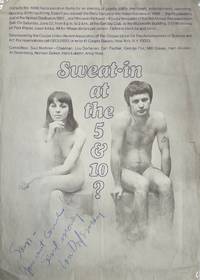
1968réf. List2843New York City 1968. 20 x 28 inches. Folded with some tears at folds slightly wrinkled; inscribed “Sam – / You must come! / Send money / Lou Dorfsman”. Very good plus. An invitation to the “Recooperation Baths” which seems to be an annual get-together for Cooper Union alumni. Cooper Union was founded in 1859 by business magnate Peter Cooper to offer a tuition-free education in practical areas such as architectural drawing shorthand and the like. No longer free Cooper Union now consists of three schools: art architecture and engineering. Graphic designer Lou Dorfsman 1918–2008 who inscribed this poster with a message for “Sam” graduated from Cooper Union in 1939. He would serve on its board of directors and as this poster states on its Alumni Committee. More famously Dorfsman was the art director and later creative director at CBS where he designed not just programming advertisements but also sets and the CBS headquarters’ interior. The poster promises alumni “an evening of gayety jollity merriment entertainment swimming dancing drinking dining” at the Woolworth Building in Tribeca – probably at its private basement swimming pool. unknown books
1954réf. 12810Baltimore 1954. 17 leaves illustrated with twenty-seven original photographs most in corner mounts and numerous ephemeral items and periodical clippings. Folio. Original black cloth embossed in blind on front cover with titles and decoration in gilt string-tied. Moderate chipping to edges of leaves text leaves tanned and somewhat fragile several leaves detached. Good condition. An informative photographically-illustrated and annotated scrapbook assembled at Morgan State College now university in Baltimore in the Eisenhower years and documenting the campus activities of the Omega Psi Phi fraternity. The compiler is not identified but was surely a member of the fraternity. Most of the photographs shoe Lambados Club members engaged in pledge activities capturing pledges holding light bulbs while standing in heavy topcoats at various campus locations posing in formations while dressed in matching suits and berets while holding canes and placards identifying the subjects as "Dog No. 1" "Dog No. 2" and so forth and chanting as they march a cross campus in close single file while dressed identically in white oxfords khaki pants white tennis sweaters dangling chains and dark-billed caps. Other photos depict pledges at a Morgan State-Howard football game with "The ques of Howard & Morgan singing at halftime." The ephemeral items include tickets invitations ribbons programs broadsides a gold & purple patch and more. These items include a manuscript copy of a Rudyard Kipling's poem "If" that pledges were expected to memorize a "Summons" to appear at a party in New York City a ticket for an event called "Lamp Leap" programs for memorial services a group of clippings photos and other material featuring "Big Brothers" who became successful in the military politics and sports and two large broadsides. Respectively the latter two items advertise a charity benefit aboard the "Omega Showboat" actually the S.S. Robert Fulton with music by Don Wilson and His Orchestra measuring 14 x 19 inches and a chapter-sponsored "Bi-Annual Skating Party at the Coliseum" measuring 14 x 11 inches. A wonderful record providing a rare peek into African-American Greek life within one of the Divine Nine at a Baltimore HBCU in the mid-1950s. unknown books
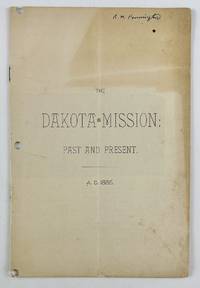
1886réf. 12811Minneapolis: Tribune Job Printing Co 1886. 27pp. plus additional printed note tipped in on first leaf of text. Original printed self wrappers stapled. Three binder holes punched along spine moderate toning and dust-soiling to wrappers ownership signature in blue ink on front wrapper. Soft vertical crease throughout. A handful of blue ink underlinings to text. About very good. A scarce compilation of articles from a confederation of American religious missionary organizations working in various populations of Dakota Indians in the Midwest and Far West compiled by John P. Williamson a Presbyterian and "Missionary to the Indians" in the Dakota Territory. Williamson also served as the treasurer of the Native Missionary Society. The Dakota Mission was made up of members of the Presbyterian and Congregational orders as well as groups like the American Board the American Missionary Association the Presbyterian Board of Home Missions and the Presbyterian Board of Foreign Missions. The present work includes nine articles by members of these various groups including three by Williamson "Early Missions to the Dakota Indians in Minnesota" "Poplar Creek Mission" and "The Dakota Native Missionary Society" as well as "Sisseton Mission" by Martha Riggs Morris; "The Yankton Mission" by Nancy Hunter; "Wolf Point Mission Montana" by Rev. George W. Wood; "The Congregational Division of the Dakota Mission" by Rev. Alfred L. Riggs; "The Santee Normal School" by "One of the Teachers;" and "The Swiss Missionaries" by Rev. Samuel W. Pond. In describing their work these authors necessarily discuss various aspects of the lives and culture of Native Americans. Tribune Job Printing Co unknown books
1840réf. 5245Guadalajara: Imprenta del Gobierno 1840. Very good. 23pp. plus folding chart. Original printed wrappers. Small area of staining on title page. Light dust soiling minor edge wear. A scarce supplement to the government journal of Jalisco state printed in 1840. This pamphlet carries information and statistics on the development of primary schools in Guadalajara and the surrounding area. The rear folding plate comprises a chart with details of the names of local schools their locations teachers at each facility their pay and more. Attractive printed wrappers; one copy in OCLC at the University of Texas. Imprenta del Gobierno unknown books
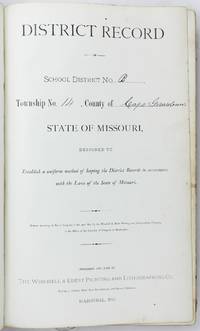
1892réf. 4183Cape Girardeau Mo 1892. Very good. 138pp. of manuscript content. Folio. Contemporary preprinted record book with some pages partially-printed and completed in manuscript and some pages with wholly manuscript content bound in three-quarter calf and brown pebbled cloth gilt spine titles. Some abrasions and wear to spine and edges minor rubbing and soiling to boards. Occasional thumb-soiling and light spotting to text. A unique manuscript record book kept by the officials of the school district in Cape Girardeau Missouri in the late-19th century. Over the course of about fifteen years the various sections of the ledger book record the names of school directors a register of teachers a short list of authorized textbooks notes for annual school meetings notes of the proceedings of the school district's Board of Directors lists of parents or guardians and their school-age children taxpayer lists financial reports of the district clerk payments made from the teacher's and building funds lists of incidental charges paid by the school district treasurer's reports teacher's reports and with additional notes oaths the text of teacher's contracts book lists and more on blank pages at rear. Particularly interesting are the detailed notes for the school district's annual meeting and its regularly-held board of directors' proceedings each of which record regular district business but also contain important mentions regarding the segregated educational situation for the local African-American population. The annual meeting notes record the approval of funds for supplies and books summer school costs teacher hires the length of the school term and more as well as activities such as the election of school administrators the construction of new schools and approval of funding for said schools and so forth. Of particular interest is a motion approved at the 1887 annual meeting which reads: "Moved and seconded that the Board of Directors be authorized to sell the land known as school land near the swamp and buy a more suitable piece of land to build a school house for the colored population." Another interesting entry occurs in the notes for the 1889 annual meeting: "The colored foalks of the district ask permission to use their school house for church and sunday school which privilege was given." The notes from the board of directors' meetings contain much the same type of information as the annual school meeting notes but often in more detail. For example the details of the new schoolhouse being built in the late 1870s is described in more specific dimensions than was recorded in the annual meeting notes as is the land to be purchased for it. And as with the annual meeting notes the board of directors occasionally discussed the local African American population. For instance in November 1885 a note from the directors reads: "A resolution made and carried that District No.B Twnshp 14 Range 13 propose to pay their proportion of the tuition for colored children in said District.and that the Clerk.be authorized to issue a warrant.when the bill is presented for the tuition of colored children from District No.B Townshp 12." A similar notation is recorded on the next page during a board meeting in April 1886. At the May 28 1887 meeting of the board they authorized $124.75 "for the purpose of.building a school house for the colored population.to be finished on or before the first day of October 1887 according to contract." At their November 12 1887 meeting the board "examined the colored schoolhouse" and them approved payment for its contractor for the aforementioned $124.75. An entry for July 9 1887 records that a teacher was hired for five months at the white school at a rate of $35 per month; another teacher was hired for the same term but for a teaching position at the "colored school" for five dollars less per month. A similar entry in 1889 notes that the white school teacher would earn $40 per month while the man hired "to teach the colored school" would do so for $30 a month widening the disparity this would persist for the next two years as well. The record book also notes approvals by the board for separate purchases of stove wood for both the white and African-American schools. It is also interesting to observe that the names of African Americans on the enumeration lists listing parents or guardians and their school-age children and the taxpayers' list are noted as "Col." for "Colored." A fascinating record of segregated schooling in action in Jim Crow Missouri. unknown books
1940réf. 4924New York 1940. Very good. Seven pamphlets plus two duplicates. Some staples with minor oxidation. Otherwise minor wear and dustsoiling; a few scattered patched of browning. A group of eight uncommon pamphlets issued by the Committee on Militarism Education to disseminate their arguments against military training in schools. The group was established in 1925 by three pacifist ministers the Quaker E. Raymond Wilson the Episcopalian John Nevin Sayre and the Presbyterian Norman Thomas to campaign against compulsory military training at universities and all military programs for children. The organization remained in operation until 1940. The works present here are focused on ROTC programs and compulsory training; titles are as follows: 1 The People Say "No!" 2 The War Department and Compulsory Military Training 3 The Morrill Act and Compulsory Military Training 4 17 Significant Victories Against Militarism in American Education. 5 Read What a Civilian a Minister a Doctor and a College President Say About.Military Training of Young Men 6 The Junior R.O.T.C. Rebuffed two copies 7 The Cure for Compulsory Drill two copies 8 Substitute Modern Courses for Out-of-Date Military Training in Civil Schools and Colleges! unknown books
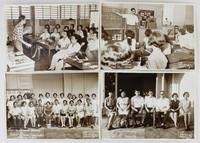
1969réf. 3754Lucena City: Garcia's 1969. Very good plus. Fifteen sepia-toned photographs most 5 x 7 inches a couple slightly smaller all but one captioned in the negative. Minor wear otherwise very nice condition. A collection of fifteen photographs featuring the participants in the 1968 Division Science Workshop in the Philippine city of Lucena. The workshop appears to have concentrated on teacher training for instructors from grades 1 through 11. The present images capture the various training classes during instruction broken out by grade level with classes of Filipino men and women taught in English by two white men. Information on chalk boards can be seen in a couple of images. Six of the photographs feature group photographs featuring either the entire population of teacher-trainees or individual grade-level classes. One image features a Division Science Seminar for District Science Coordinator. An interesting assortment of photographs capturing teacher training in a notable Filipino city at the end of the 1960s. Garcia's unknown books
1932réf. 3462New York: Woman's American Baptist Home Mission Society 1932. Very good plus. 12pp. on a single folded quarto sheet of green paper. Illustrated. Minor wear. A very rare promotional pamphlet issued by the Woman's American Baptist Home Mission Society touting their missionary work amongst the school-age children in Mexico. The author Dorothy Detweiler writes about the schools supported by the society the state of "Baptist Work in Mexico" and includes sections on the Virgin of Guadalupe Christian Leaders in Mexico the "Anti-Religious Movement" in the country and a rather tone-deaf section on the "False Gods" worshipped by some of the indigenous peoples in Mexico "There are Tarascan Indians in certain parts of Michoacan who believe that God is the sun and who daily hail its rising with an invocation". There are six monochrome photographs reproduced in the text five of which picture Baptist school students such as "Girls at Colegio Howard Dressed as Indian Women with Decorated Gourds" "Class in Manual Training - Tin Work at Colegio Internacional Monterrey Mexico" and Prof. Dworak and Pupils of Rural Course Working with Bees." No copies reported in OCLC. Woman's American Baptist Home Mission Society unknown books
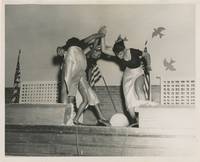
1955réf. List3206Washington D.C. 1955. Forty-five 8 x 10 inch photographs. Some slight damage to edges and slightly curled; excellent. The Phelps Vocational High School was founded in 1912 as a trade school for African American boys located in the historically Black neighborhood of Carver Langston. In the tradition of African American industrial education the school initially specialized in printing bricklaying and carpentry. During World War II the school trained students in airplane and auto mechanics and building construction funded by the Works Progress Administration. It began accepting girls in 1942 or 1943. Phelps is still open now as the Phelps Architecture Construction and Engineering High School. Offered here is a collection of forty-five photographs from Phelps dating from around 1945 to 1955. The collection captures school life pageants sports and the school’s ROTC program. Many of the photos show students in plays dancing and participating in gymnastic cheerleading. D.C. schools would begin to integrate in 1954 the year that both Brown and the D.C.-specific Bolling v Sharpe were decided by the US Supreme Court. unknown books