1,253 results
1790ref. ST19326Amsterdam: H. Keyzer H. Gartman en W. Vermandel 1790. 555 x 345 mm. 21 7/8 x 13 3/4". 2 p.l. 62 folding plates. Attractive late 19th or early 20th century retrospective polished brown calf by L. Guétant stamp-signed in gilt on tail of spine double gilt-ruled border floral cornerpieces raised bands spine panels with scrolling floral borders and central flower ornament gilt titling. With title vignette and 62 ENGRAVED FOLDING PLATES ALL WITH BEAUTIFUL HAND COLORING AND HIGHLIGHTED WITH GOLD depicting Bible scenes from the Old and New Testament 61 of which are by Jan Luyken. A Large Paper Copy. For earlier editions: Graesse IV p. 308; Brunet III 1245-46; Klaversma & Hannema 159-164. Light rubbing to joints and edges boards just a little marked trivial foxing and faint spots here and there but A REMARKABLY FINE COPY the binding lustrous and showing little wear the paper extremely bright and fresh the margins immense and the paint and gold unusually vibrant. The marvelous illustrations of Dutch engraver and poet Jan Luyken comprise this collection of "remarkable stories" from the Bible each depicted with panoramic grandeur and enhanced with a wide range of finely applied colors and gold. Luyken 1649-1712 had written and illustrated erotic poetry as a young man but later became a devout Pietist after reading the works of German mystic Jakob Böhme. He became a member of the Baptist Church in 1673 and thereafter devoted his talents to producing religious works. The vast scenes here are notable in their scale detail and animation. There are a number of battle scenes from the Old Testament as well as dramatic depictions of the plagues and a fascinating episode from the histories of Josephus depicting Herod's soldiers being lowered down the side of a cliff in large boxes suspended from chains in order to attack the thieves hiding in caverns on the cliffside. There is a majestic portrayal of the Queen of Sheba arriving at the court of Solomon a peaceful scene of Adam naming the beasts in the Garden of Eden and a festive celebration of the Feast of Tabernacles. New Testament scenes include a terrifying final judgment a blinding conversion of St. Paul and scenes from that Apostle's travels. The engravings have one common trait: they are heavily populated whether by men or beasts and one of Luyken's special gifts is to render every person in the crowd as an individual with his own concerns and reactions to the events at hand. The engravings while already greatly pleasing in black and white are even more stirring and memorable when seen in the full color and gold used here. Expansive tableaus are given greater definition and clarity and events such as Noah’s flood and the destruction of Sodom and Gomorrah are rendered even more successful in expressing the awesome powers of the Almighty. The illustrations are quite definitely Protestant in point of view: there are no depictions of the Virgin Mary not even a Nativity scene. Except for engravings of the Annunciation to the Shepherds and the Massacre of the Holy Innocents the illustrations focus on Jesus as an adult and on the work of his Apostles spreading the gospel. There were earlier editions containing Luyken's 62 large plates which originally appeared without text as here in 1708 and they appeared again with a text in Dutch in 1729 and in French in 1732. Copies of these editions appear with some regularity in the marketplace but are usually not colored and are often found incomplete or with other major condition issues. We can trace no record in RBH or OCLC of a copy of our 1790 edition and we can find nothing that compares with the quality of coloring and grand height attained by the monumental margins seen here. H. Keyzer, H. Gartman en W. Vermandel unknown
1790ref. ST19326Amsterdam: H. Keyzer H. Gartman en W. Vermandel 1790. 555 x 345 mm. 21 7/8 x 13 3/4". 2 p.l. 62 folding plates. Attractive late 19th or early 20th century retrospective polished brown calf by L. Guétant stamp-signed in gilt on tail of spine double gilt-ruled border floral cornerpieces raised bands spine panels with scrolling floral borders and central flower ornament gilt titling. With title vignette and 62 ENGRAVED FOLDING PLATES ALL WITH BEAUTIFUL HAND COLORING AND HIGHLIGHTED WITH GOLD depicting Bible scenes from the Old and New Testament 61 of which are by Jan Luyken. A Large Paper Copy. For earlier editions: Graesse IV p. 308; Brunet III 1245-46; Klaversma & Hannema 159-164. Light rubbing to joints and edges boards just a little marked trivial foxing and faint spots here and there but A REMARKABLY FINE COPY the binding lustrous and showing little wear the paper extremely bright and fresh the margins immense and the paint and gold unusually vibrant. The marvelous illustrations of Dutch engraver and poet Jan Luyken comprise this collection of "remarkable stories" from the Bible each depicted with panoramic grandeur and enhanced with a wide range of finely applied colors and gold. Luyken 1649-1712 had written and illustrated erotic poetry as a young man but later became a devout Pietist after reading the works of German mystic Jakob Böhme. He became a member of the Baptist Church in 1673 and thereafter devoted his talents to producing religious works. The vast scenes here are notable in their scale detail and animation. There are a number of battle scenes from the Old Testament as well as dramatic depictions of the plagues and a fascinating episode from the histories of Josephus depicting Herod's soldiers being lowered down the side of a cliff in large boxes suspended from chains in order to attack the thieves hiding in caverns on the cliffside. There is a majestic portrayal of the Queen of Sheba arriving at the court of Solomon a peaceful scene of Adam naming the beasts in the Garden of Eden and a festive celebration of the Feast of Tabernacles. New Testament scenes include a terrifying final judgment a blinding conversion of St. Paul and scenes from that Apostle's travels. The engravings have one common trait: they are heavily populated whether by men or beasts and one of Luyken's special gifts is to render every person in the crowd as an individual with his own concerns and reactions to the events at hand. The engravings while already greatly pleasing in black and white are even more stirring and memorable when seen in the full color and gold used here. Expansive tableaus are given greater definition and clarity and events such as Noah’s flood and the destruction of Sodom and Gomorrah are rendered even more successful in expressing the awesome powers of the Almighty. The illustrations are quite definitely Protestant in point of view: there are no depictions of the Virgin Mary not even a Nativity scene. Except for engravings of the Annunciation to the Shepherds and the Massacre of the Holy Innocents the illustrations focus on Jesus as an adult and on the work of his Apostles spreading the gospel. There were earlier editions containing Luyken's 62 large plates which originally appeared without text as here in 1708 and they appeared again with a text in Dutch in 1729 and in French in 1732. Copies of these editions appear with some regularity in the marketplace but are usually not colored and are often found incomplete or with other major condition issues. We can trace no record in RBH or OCLC of a copy of our 1790 edition and we can find nothing that compares with the quality of coloring and grand height attained by the monumental margins seen here. H. Keyzer, H. Gartman en W. Vermandel unknown books
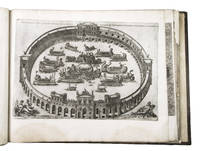
1550ref. ABC_49514Italy 1550. 17th-century gold-tooled brown calf sewn on 6 supports with the corresponding raised bands on the spine a red morocco title label on the spine with the title "Novissima urbis Romae descriptio" lettered in gold gold-tooled board edges. Large oblong folio ca. 59 x 42.3 cm. With 76 full-page engravings and 12 full-page etchings. Remarkable album with 77 beautiful examples of 16th-century Italian cartography all in very fine dark impressions. The collection includes plans of important Italian towns such as Rome Venice Genoa Naples Milan Florence Palermo Siena Bologna and Pisa as well as detailed views of individual buildings and monuments in Rome. They are engraved by several cartographers from the school of Antonio Lafreri 1512-1577 primarily Claudio Duchetti d. 1585 Matteo Florimi d. 1613 and Lafreri himself. Florimi's works are among the rarest of the Lafreri school map makers especially his Siena imprints of which several have here been included.In the middle of the 16th century Italy was the centre of map production and distribution in Europe. This industry primarily took place in Venice and Rome. The most notable of the publishers in Rome was Lafreri. His most important and most popular work is the Speculum Romanae magnificentiae a collection of plans an views of Rome's monuments; no two copies of the Speculum are the same. The present collection contains more than thirty plates from the Speculum. When Lafreri died his nephew Claudio Duchetti inherited the company. He continued to produce the Speculum plates but often made small adjustments and signed his own name at the bottom. Most of the Speculum plates in the present album are by Duchetti. After his death the copperplates were sold to other publishers such as Giovanni Orlandi before 1590-after 1640 who reissued them. The majority of the plates in the present album were printed by Orlandi in 1602.The album further contains 32 engraved city plans mostly of Italian towns although a few foreign cities are also included; one of the rarest is the view of Moscow which is also included here. The collection ends with a incomplete series of 11 etchings of landscapes and biblical scenes.A list of contents is available upon request.With the bookplate of Louis Routy de Charodon seigneur de Grésigny and Charodon 1710-1794 on the front pastedown and remnants of another bookplate above. The boards are somewhat scratched and stained the spine shows traces of use the edges of the boards have been professionally restored and the boards have been lengthened to fit the maps. The maps are slightly browned some are slightly foxed the first few maps have been mounted onto 17th-century leaves the longer maps are somewhat soiled on the fore edge three maps are restored at the fore edge and one at the bottom edge some maps have been cut slightly short. Otherwise in good condition.l Cf. Parshall P. "Antonio Lafreri's "Speculum Romanae magnificentiae"" in: Print Quarterly vol. 23 1 2006 pp. 3-28. hardcover