|
Pierre BOIREL
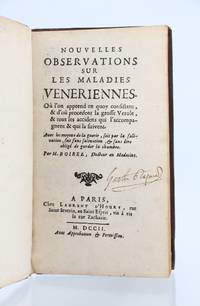
Nouvelles observations sur les maladies vénériennes
Paris: Laurent d'Houry 1702. Fine. Laurent d'Houry Paris 1702 9 x 15.30 cm relié New observations on venereal diseases where one learns what the Great Pox consists of and whence it proceeds and all the accidents that accompany and follow it. With the means of curing it either by salivation or without salivation and without being obliged to keep to one's chamber. Rare first edition. Two slight lacks at head and foot of spine headcaps worn small scratches and stains on boards two manuscript ownership inscriptions in pen at head of one endpaper and in right margin of title page. One tear without loss in right margin of page 53 Contemporary full sheep binding spine in five compartments decorated with gilt compartments ornamented with gilt typographical motifs gilt fillets on leading edges corners slightly bumped. Laurent d'Houry hardcover
Bookseller reference : 87881
|
|
|
Pierre BONNARD
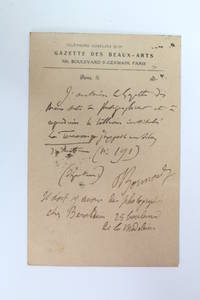
Carte postale autographe signée autorisant la Gazette des beaux-arts à reproduire le tableau La Terrasse
1912. Fine. s. d. circa 1912 9 x 13.90 cm une carte Autograph postcard signed by painter Pierre Bonnard authorizing the Gazette des beaux-arts to reproduce the painting La Terrasse. A postcard with letterhead of the Académie des beaux-arts. ""J'autorise la Gazette des Beaux-Arts à photographier et à reproduire le tableau intitulé La Terrasse que j'expose au Salon d'Automne n°191 Signature : Bonnard. Il doit y avoir des photographies chez Bernheim 25 boulevard de la Madeleine"" ""I authorize the Gazette des Beaux-Arts to photograph and reproduce the painting entitled La Terrasse that I am exhibiting at the Salon d'Automne no.191 Signature: Bonnard. There should be photographs at Bernheim 25 boulevard de la Madeleine"" unknown
Bookseller reference : 71235
|
|
|
Pierre BONNARD - Octave MIRBEAU
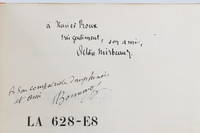
La 628-E8
Paris: Fasquelle 1908. Fine. Fasquelle Paris 1908 19.50 x 25.50 cm relié De luxe edition illustrated with a hundred drawings by Pierre Bonnard scattered in the margins of the leaves one of 200 numbered copies on Arches vellum one print after 25 Japan. A beautiful copy. Binding in half brown calf spine decorated with double black fillets gilt date at the foot marbled paper boards marbled endpapers covers and spine preserved top edge gilt on the rough. Handwritten presentation signed by Pierre Bonnard to Xavier Roux: . à son compatriote dauphinois et ami. .to his Dauphiné compatriot and friend. enriched with a handwritten presentation signed by Octave Mirbeau to the same. Fasquelle hardcover
Bookseller reference : 78181
|
|
|
Pierre BONNARD
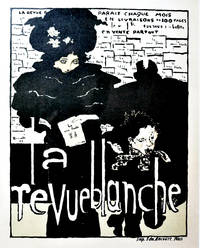
Lithographie originale en couleurs : ""La Revue blanche"" - Les Maîtres de l'Affiche - planche 38
Paris: Les Maîtres de l'Affiche - imprimerie Chaix 1896. Fine. Les Maîtres de l'Affiche - imprimerie Chaix Paris 1896 29 x 39.90 cm une affiche lithographiée sur vélin fin encadrée Les Maîtres de l'Affiche imprimerie Chaix Paris 1896 plate: 29 x 39.9 cm frame: 38 x4 3.5 cm framed lithograph poster on vélin fin paper NB: The poster is sold framed but would have to be shipped without the frame. Original color lithograph on vélin fin paper. Printer's embossed stamp to lower right of plate. A superb French monthly publication the Maîtres de l'Affiche Masters of the Poster Form appeared from 1895 to 1900 under the aegis of Jules Chéret. Each number of the review included four reproductions of posters in cloche format 30 x 40 cm chromolithographed with an embossed stamp for authentication. A fine copy. Les Maîtres de l'Affiche - imprimerie Chaix unknown
Bookseller reference : 73431
|
|
|
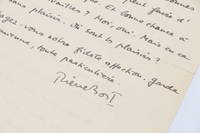
Pierre BOST
" Il y a un an que mon père mourait à Marseille. C'est tout près encore je devine ce que tu sens je prévois ce que tu sentiras quand les mois passeront - pas encore les années. Et cet étonnement il faut le dire de se trouver orphelin à un âge où l'on croyait bêtement que le mot n'est plus de mise. Moving autograph letter signed to his friend Carlo Rim showing him his tender affection for the recent bereavement of his father and the accident of his wife
Paris 1944. Fine. Paris 8 février 1944 15 x 19 cm une feuille Touching autograph letter signed 32 lines in black ink on one leaf from Pierre Bost to his friend Carlo Rim in which he shares his grief concerning the death of a loved one and how friendship can somewhat ease overwhelming sadness. Traces of creases inherent to folding for mailing. ""8 février 44 Cher Carlo oui je t'envoie oui nous vous envoyons de bons voeux s'il en est temps encore ; c'est à ça que servent les amis c'est à dire à pas grand'chose mais à quelque chose après tout. J'ai pensé à toi avec beaucoup d'affection dans ton deuil. Il y a un an que mon père mourait à Marseille. C'est tout près encore je devine ce que tu sens je prévois ce que tu sentiras quand les mois passeront - pas encore les années. Et cet étonnement il faut le dire de se trouver orphelin à un âge où l'on croyait bêtement que le mot n'est plus de mise. Mais si oui j'ai beaucoup pensé à toi et si je te le dis un peu tard ça ne fait rien. Et à l'accident de ta femme aussi. Je connais ces accumulations de catastrophes je vous plains de tout coeur. Comment va-t-elle Bien je l'espère et sans suites Heureux mortels qui faites du ski nous comprendrions bien que vous soyez un peu permis du plaisir que vous y prenez ; maus un coup de soleil sur le nez une fourbure. là c'est trop. Pourra-t-elle recommencer au moins Faites-lui nos bonnes amitiés nos voeux tout ce qu'on peut fzirer d'aimable dans une clinique. Et bonne chanceà vous deux. Tu travailles Moi oui. Mais en ce moment sans plaisir. Où sont les plaisirs Partagez-vous notre fidèle affection. Garde pour toi la mienne toute particulière. Pierre Bost."" ""8 February 44 Dear Carlo yes I send you yes we send you good wishes if it is still time; that's what friends are for that is to say not much but something after all. I thought of you with much affection in your grief. It was a year ago that my father died in Marseille. It is still very close I can guess what you feel I foresee what you will feel when the months pass - not yet the years. And this astonishment it must be said of finding oneself orphaned at an age when one thought foolishly that the word no longer applies. But yes indeed I have thought of you much and if I tell you this a bit late it doesn't matter. And about your wife's accident too. I know these accumulations of catastrophes I feel for you with all my heart. How is she Well I hope and without complications Happy mortals who ski we would well understand that you are somewhat forgiven for the pleasure you take in it; but sunburn on the nose a strain. that's too much. Will she at least be able to start again Give her our kind regards our wishes all that one can do that is pleasant in a clinic. And good luck to both of you. Are you working I am yes. But at the moment without pleasure. Where are the pleasures Share our faithful affection. Keep for yourself mine quite particular. Pierre Bost."" Provenance: from the Carlo Rim collection who was a Provençal writer author notably of Ma belle Marseille a caricaturist a filmmaker and friend of Fernandel Raimu and Marcel Pagnol but also of Max Jacob and André Salmon whom he met in Sanary. unknown
Bookseller reference : 83439
|
|
|
Pierre BOST
Anaïs
Paris: Nrf 1930. Fine. Nrf Paris 1930 17 x 23 cm broché First edition one of 109 numbered copies on Lafuma Navarre paper and reimposed in Tellière quarto format deluxe copy. Handsome copy. Nrf unknown
Bookseller reference : 3938

|
|
|
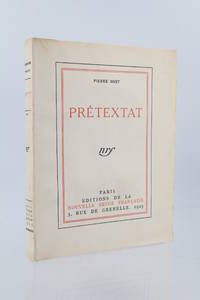
Pierre BOST
Prétextat
Paris: Nrf 1925. Fine. Nrf Paris 1925 17 x 22 cm broché First edition one of 109 numbered copies on Lafuma Navarre paper and reimposed in Tellière quarto format deluxe copy. Handsome copy. Nrf unknown
Bookseller reference : 80625
|
|
|
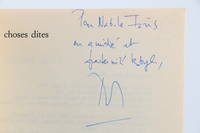
Pierre BOURDIEU
Choses dites
Paris: Les Editions de Minuit 1987. Fine. Les Editions de Minuit Paris 1987 13.50 x 22 cm broché The first edition of which there were no deluxe copies. Minor stains to foot of covers. Autograph inscription signed by Pierre Bourdieu to Nabile Izris. Les Editions de Minuit unknown
Bookseller reference : 81483
|
|
|
Pierre BOURGEADE
Deutsches requiem
Paris: Gallimard 1973. Fine. Gallimard Paris 1973 11 x 16.50 cm broché The first edition of which there were no deluxe copies a Service de Presse advance copy. Precious signed autograph inscription from Pierre Bourgeade to Maurice Blanchot. A small stain and a scratch on the first cover. Gallimard unknown
Bookseller reference : 44393

|
|
|
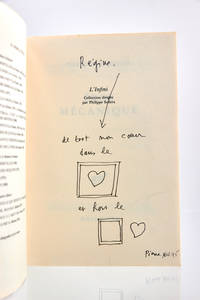
Pierre BOURGEADE
Eros mécanique
Paris: Gallimard 1995. Fine. Gallimard Paris 1995 14 x 20.50 cm broché First edition of which there were no deluxe copies. Light worming to boards. Precious autograph inscription dated and signed by Pierre Bourgeade to his friend Régine Deforges: ""Régine de tout mon coeur."" ""Régine with all my heart"" enriched with a drawing depicting a heart within a frame and a heart outside a frame. Provenance: from the library of Régine Deforges. Gallimard hardcover
Bookseller reference : 75769
|
|
|
Pierre BOUJUT
Et sans reproches
s. l.: La tour de feu 1953. Fine. La tour de feu s. l. 1953 13 x 22.50 cm broché first edition printed in small numbers. Precious autograph signed by Pierre Alexandre Boujut Vialatte. A folding track Length of the second flat. Rare. La tour de feu unknown
Bookseller reference : 56709

|
|
|
Pierre BOURGEADE
L'Argent
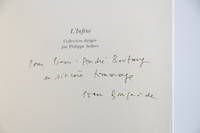
Paris: Gallimard 1998. Fine. Gallimard Paris 1998 14 x 20.50 cm broché The first edition of which there were no deluxe copies. Handsome copy. Signed autograph inscription from Pierre Bourgeade to Pierre-André Boutang. Gallimard unknown
Bookseller reference : 77966
|
|
|
Pierre BOURGEADE
L'armoire
Paris: Gallimard 1977. Fine. Gallimard Paris 1977 12.50 x 20 cm broché first edition one of the 10 numbered copies on ""pur-fil"" paper excluding commerce and reserved to the author only large papers. A moving autograph dated and signed by Pierre Bourgeade to the lawyer Thierry Lévy on a leaf torn from a diary and pierced by a twig at the end of which remains a dried leaf: ""For Thierry Levy all that remains of the devoured forests page 123 the day after the extradition of Klaus growing a dark day. "" Pleasant and touching copy. Beautiful copy. . Gallimard unknown
Bookseller reference : 59579

|
|
|
Pierre BOURGEADE
L'aurore boréale
Paris: Gallimard 1973. Fine. Gallimard Paris 1973 14 x 20.50 cm broché First edition review copy. Signed autograph of Charles Pierre Bourgeade the Quintrec. Iconography. Nice copy. Gallimard unknown
Bookseller reference : 58631

|
|
|
Pierre BOURGEADE
L'aurore boréale
Paris: Gallimard 1973. Fine. Gallimard Paris 1973 14.50 x 22 cm broché First edition one of 36 numbered copies on laid paper the only deluxe copies. Handsome copy. Gallimard unknown
Bookseller reference : 58604

|
|
|
Pierre BOUVIER
L'exégèse de M. Loisy les doctrines les procédés
Paris: V. Retaux 1903. Fine. V. Retaux Paris 1903 14.50 x 23 cm broché First edition published in a small number of copies. Minor marginal lacks affecting the covers otherwise handsome copy. V. Retaux unknown
Bookseller reference : 11879
|
|
|
Pierre BOUVIER
L'exégèse de M. Loisy
Paris: V. Retaux 1904. Fine. V. Retaux Paris 1904 12 x 18.50 cm broché Third edition. Lacking at head and foot of split spine small tears and marginal lacks to boards handsome interior condition. Rare. V. Retaux hardcover
Bookseller reference : 13743
|
|
|
Pierre BOULLE
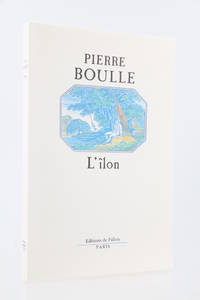
L'Ilon
Paris: Editions de Fallois 1991. Fine. Editions de Fallois Paris 1991 14 x 21 cm broché First edition one of 25 numbered copies on pure Lana rag paper the only deluxe copies. Very fine copy. Editions de Fallois unknown
Bookseller reference : 79722
|
|
|
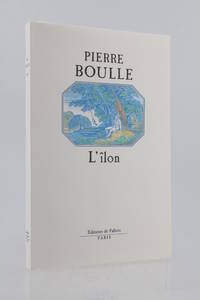
Pierre BOULLE
L'Ilon
Paris: Editions de Fallois 1991. Fine. Editions de Fallois Paris 1991 14 x 21 cm broché First edition one of 25 numbered copies on pure Lana rag paper the only deluxe copies. A very handsome copy. Editions de Fallois unknown
Bookseller reference : 80595
|
|
|
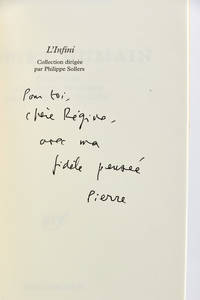
Pierre BOURGEADE
L'objet humain. Entretiens avec Sylvie Martigny et Jean-Hubert Gailliot
Paris: Gallimard 2003. Fine. Gallimard Paris 2003 14 x 20.50 cm broché The first edition of which there were no deluxe copies. Handsome copy. Precious signed autograph inscription from Pierre Bourgeade to his friend Régine Deforges: ""Pour toi chère Régine avec ma fidèle pensée. Pierre"" ""For you dear Régine with my faithful thoughts. Pierre"" Provenance: from the library of Régine Deforges. Gallimard unknown
Bookseller reference : 75753
|
|
|
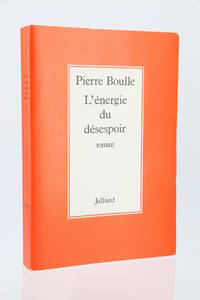
Pierre BOULLE
L'énergie du désespoir
Paris: Julliard 1981. Fine. Julliard Paris 1981 14.50 x 21.50 cm broché First edition one of 15 numbered copies on pure wove paper the only deluxe copies. A very handsome copy. Julliard unknown
Bookseller reference : 86406
|
|
|
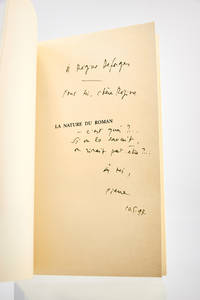
Pierre BOURGEADE - (inscribed to Regine DEFORGES)
La nature du roman The Nature of the Novel
Paris: Jean-Jacques Pauvert 1993. Fine. Jean-Jacques Pauvert Paris 1993 13 x 21 cm broché The first edition of which there were no deluxe copies. Handsome copy. Precious signed autograph inscription from Pierre Bourgeade to his friend Régine Deforges: ""A Régine Deforges pour toi chère Régine la nature du roman c'est quoi Si on le savait on rirait peut-être . A toi Pierre. 10.5.93."" ""To Régine Deforges for you dear Régine what is the nature of the novel If we knew perhaps we would laugh. To you Pierre. 10.5.93."" Provenance: from the library of Régine Deforges. Jean-Jacques Pauvert unknown
Bookseller reference : 75756
|
|
|
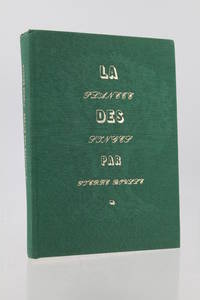
Pierre BOULLE
La Planète des singes
Paris: Cercle nouveau du livre 1963. Fine. Cercle nouveau du livre Paris 1963 14 x 20 cm reliure de l'éditeur First edition printed at ""Cercle nouveau du livre"" before the deluxe edition by Julliard a few months later one of the numbered copies the only printing. Very handsome copy. Publisher's binding in full green cloth smooth spine title and author's name stamped in gold on the front cover. Cercle nouveau du livre hardcover
Bookseller reference : 80798
|
|
|
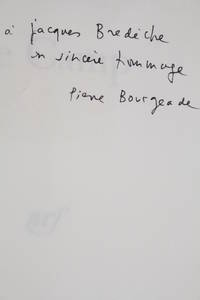
Pierre BOURGEADE
Le camp
Paris: Gallimard 1979. Fine. Gallimard Paris 1979 12.50 x 19.50 cm broché First Edition one of 26 numbered copies on vellum pure cloth only leading copies. Ex-libris glued on a guard. Nice copy. Signed autograph Pierre Bourgeade Jacques Bredeche. . Gallimard hardcover
Bookseller reference : 64379

|
|
|
Pierre BOURGEADE
Le camp
Paris: Gallimard 1979. Fine. Gallimard Paris 1979 12.50 x 19.50 cm broché First edition one of the 26 copys numbered on pure vellum cloth only leading copies. Signed autograph of Pierre Bourgeade Peter Bredeche. Bookplate pasted on a guard. Nice copy. . Gallimard hardcover
Bookseller reference : 59092
|
|
|
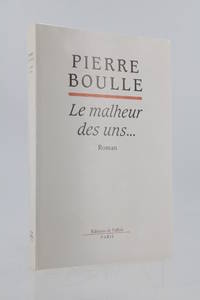
Pierre BOULLE
Le Malheur des Uns.
Paris: Editions de Fallois 1990. Fine. Editions de Fallois Paris 1990 14 x 21 cm broché First edition one of 25 numbered copies on pure Lana rag paper the only deluxe copies. A very handsome copy. Editions de Fallois unknown
Bookseller reference : 80594
|
|
|
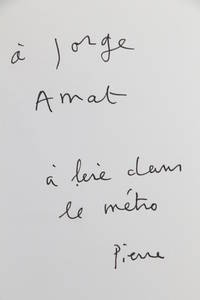
Pierre BOURGEADE
Les comédiens
Auch: Tristam 2004. Fine. Tristam Auch 2004 14 x 21.50 cm broché The first edition of which there were no deluxe copies. Handsome copy. Autograph inscription signed by Pierre Bourgeade to Jorge Amat: "". à lire dans le métro."" Tristam unknown
Bookseller reference : 80914
|
|
|
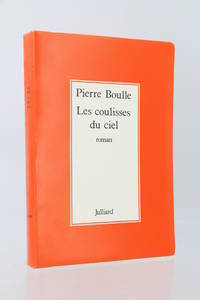
Pierre BOULLE
Les coulisses du ciel
Paris: Julliard 1979. Fine. Julliard Paris 1979 14.50 x 22 cm broché First edition one of 15 numbered copies on pur fil van gelder the only deluxe copies. Very handsome copy. Julliard unknown
Bookseller reference : 85635
|
|
|
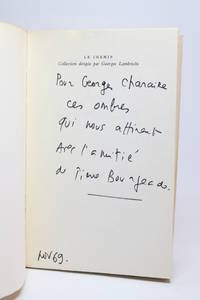
Pierre BOURGEADE
Les immortelles
Paris: Gallimard 1967. Fine. Gallimard Paris 1967 12 x 18.50 cm broché First edition of which there were no deluxe copies. Three small light stains on the spine very lightly sunned without gravity. Autograph inscription signed by Pierre Bourgeade to Georges Charaire: "". ces ombres qui nous attirent."" "". these shadows that attract us."" Gallimard unknown
Bookseller reference : 73478
|
|
|
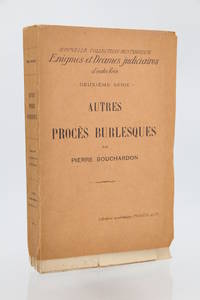
Pierre BOUCHARDON
Nouvelle collection historique énigmes et drames judiciaires d'autrefois - Deuxième série : autres drames burlesques
Paris: Librairie académique Perrin & Cie 1879. Fine. Librairie académique Perrin & Cie Paris 1879 13 x 20.50 cm broché First edition one of 25 copies on pur fil paper the only deluxe copies. Occasional light foxing on some deckled edges. Handsome full-margined copy. Librairie académique Perrin & Cie unknown
Bookseller reference : 87007
|
|
|
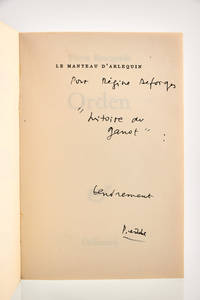
Pierre BOURGEADE
Orden
Paris: Gallimard 1974. Fine. Gallimard Paris 1974 11 x 16.50 cm broché First edition of which there were no deluxe copies. Handsome copy. Precious signed autograph inscription from Pierre Bourgeade to his friend Régine Deforges: ""Pour Régine Deforges ""histoire du Ganot"". Tendrement. Pierre."" ""For Régine Deforges 'story of Ganot'. Tenderly. Pierre."" Provenance: from the library of Régine Deforges. Gallimard unknown
Bookseller reference : 75757
|
|
|
Pierre BOURET
Recuëil de Poësies diverses
s. l.: S. n. 1733. Fine. S. n. s. l. 1733 12 x 20 cm relié New edition. Later red morroco by 19th century Jansenist spine in six compartments large gilt dentelle frame to pastedowns all edges gilt. Spine and joints slightly rubbed. S. n. unknown
Bookseller reference : 48875
|
|
|
Pierre BOULEZ
Relevés d'apprenti
Paris: Seuil 1966. Fine. Seuil Paris 1966 14.50 x 21.50 cm broché First edition of these texts presented by Paule Thévenin one of 15 numbered copies on vélin neige this copy one of 5 hors commerce the only grand papier deluxe copies. Copy slightly warped. Handwritten signature of Pierre Boulez under the justification. Seuil unknown
Bookseller reference : 64271

|
|
|
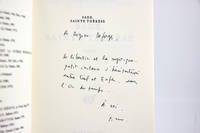
Pierre BOURGEADE
Sade sainte Thérèse
Paris: Gallimard 1987. Fine. Gallimard Paris 1987 14 x 20.50 cm broché First edition on ordinary paper. Handsome copy complete with publisher's slip. Precious dated and signed autograph inscription from Pierre Bourgeade to his friend Régine Deforges: ""A Régine Deforges le libertin et la mystique. petit instant d'hésitation entre ciel et enfer dans l'or du temps. A toi Pierre"" ""To Régine Deforges the libertine and the mystic. small moment of hesitation between heaven and hell in the gold of time. To you Pierre"". Provenance: from the library of Régine Deforges. Gallimard unknown
Bookseller reference : 75776
|
|
|
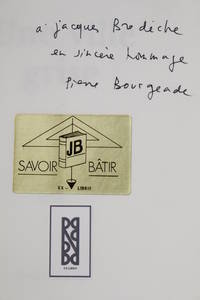
Pierre BOURGEADE
Une ville grise
Paris: Gallimard 1978. Fine. Gallimard Paris 1978 12.50 x 19.50 cm broché First edition one of 36 numbered copies on pure rag vellum the only deluxe copies. Autograph inscription signed by Pierre Bourgeade to Pierre Bredèche. Bookplates pasted on an endpaper. Fine copy. . Gallimard hardcover
Bookseller reference : 59090
|
|
|
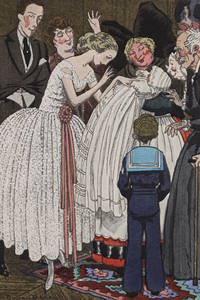
Pierre BRISSAUD - (Jeanne LANVIN)
"Il n'a pas pleuré"" ou Notre défenseur de demain. Robe de style et robe de baptême de Jeanne Lanvin pl.63 La Gazette du Bon ton 1920 n°8
Paris: Lucien Vogel éditeur 1920. Fine. Lucien Vogel éditeur Paris 1920 18 x 24 cm une feuille Original color print printed on vergé paper signed in the plate. An original print used to illustrate the Gazette du bon ton one of the most attractive and influential 20th century fashion magazines featuring the talents of French artists and other contributors from the burgeoning Art Deco movement. A celebrated fashion magazine established in 1912 by Lucien Vogel La Gazette du bon ton appeared until 1925 with a hiatus from 1915 to 1920 due to the war the editor-in-chief having been called up for service. It consisted of 69 issues printed in only 2000 copies each and notably illustrated with 573 color plates and 148 sketches of the models of the great designers. Right from the start this sumptuous publication was aimed at bibliophiles and fashionable society Françoise Tétart-Vittu La Gazette du bon ton in Dictionnaire de la mode 2016 and was printed on fine vergé paper using a type cut specially for the magazine by Georges Peignot known as Cochin later used in 1946 by Christian Dior. The prints were made using stencils heightened in colors some highlighted in gold or palladium. The story began in 1912 when Lucien Vogel a man of the world involved in fashion he had already been part of the fashion magazine Femina decided with his wife Cosette de Brunhoff the sister of Jean creator of Babar to set up the Gazette du bon ton subtitled at the time: Art fashion frivolities. Georges Charensol noted the reasoning of the editor-in-chief: In 1910 he observed there was no really artistic fashion magazine nothing representative of the spirit of the time. My dream was therefore to make a luxury magazine with truly modern artists
I was assured of success because when it comes to fashion no country on earth can compete with France. Un grand éditeur dart. Lucien Vogel in Les Nouvelles littéraires no. 133 May 1925. The magazine was immediately successful not only in France but also in the United States and Latin America. At first Vogel put together a team of seven artists: André-Édouard Marty and Pierre Brissaud followed by Georges Lepape and Dammicourt as well as eventually his friends from school and the School of Fine Arts like George Barbier Bernard Boutet de Monvel and Charles Martin. Other talented people soon came flocking to join the team: Guy Arnoux Léon Bakst Benito Boutet de Monvel Umberto Brunelleschi Chas Laborde Jean-Gabriel Domergue Raoul Dufy Édouard Halouze Alexandre Iacovleff Jean Émile Laboureur Charles Loupot Chalres Martin Maggie Salcedo. These artist mostly unknown when Lucien Vogel sought them out later became emblematic and sought-after artistic figures. It was also they who worked on the advertising drawings for the Gazette. The plates put the spotlight on and celebrate dresses by seven designers of the age: Lanvin Doeuillet Paquin Poiret Worth Vionnet and Doucet. The designers provided exclusive models for each issue. Nonetheless some of the illustrations are not based on real models but simply on the illustrators conception of the fashion of the day. The Gazette du bon ton was an important step in the history of fashion. Combining aesthetic demands with the physical whole it brought together for the first time the great talents of the artistic literary and fashion worlds; and imposed through this alchemy a completely new image of women: slender independent and daring which was shared by the new generation of designers including Coco Chanel Jean Patou Marcel Rochas and so on
Taken over in 1920 by Condé Montrose Nast the Gazette du bon ton was an important influence on the new layout and aesthetics of that little dying paper that Nast had bought a few years earlier: Vogue. Lucien Vogel éditeur unknown
Bookseller reference : 54806
|
|
|
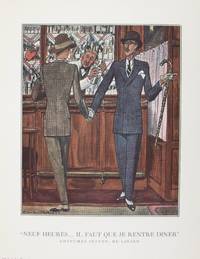
Pierre BRISSAUD - (LARSEN)
"Neuf heures.il faut que je rentre dîner"" Costumes veston de Larsen pl.57 La Gazette du Bon ton 1922 n°8
Paris: Lucien Vogel éditeur 1922. Fine. Lucien Vogel éditeur Paris 1922 18 x 24 cm une feuille Original colour print printed on laid paper signed bottom left on the plate. La Gazette du bon ton one of the most beautiful and influential fashion magazines of the 20th century celebrating the talent of French creators and artists in the full bloom of art deco. Famous fashion magazine founded in 1912 by Lucien Vogel La Gazette du bon ton was published until 1925 with an interruption during the War from 1915 to 1920 due to the mobilization of its editor-in-chief. It consisted of 69 issues printed in only 2000 copies and was illustrated notably with 573 colour plates and 148 sketches representing models by great couturiers. Upon their publication these luxurious publications ""addressed bibliophiles and worldly aesthetes"" Françoise Tétart-Vittu ""La Gazette du bon ton"" in Dictionnaire de la mode 2016. Printed on fine laid paper they used a typeface specially created for the magazine by Georges Peignot the Cochin character adopted in 1946 by Christian Dior. The prints were created using the metal stencil technique heightened in colours and some underlined with gold or palladium. The adventure began in 1912 when Lucien Vogel a man of society and fashion - he had already participated in the magazine Femina - decided to found with his wife Cosette de Brunhoff sister of Jean the father of Babar the Gazette du bon ton whose subtitle was then ""Art modes et frivolités"". Georges Charensol reports the words of the editor-in-chief: ""In 1910 he observed there existed no fashion journal truly artistic and representative of the spirit of its time. I was therefore thinking of making a luxury magazine with truly modern artists . I was certain of success because for fashion no country can rival France."" ""Un grand éditeur d'art. Lucien Vogel"" in Les Nouvelles littéraires no.133 May 1925. The success of the magazine was immediate not only in France but also in the United States and South America. Originally Vogel thus assembled a group of seven artists: André-Édouard Marty and Pierre Brissaud followed by Georges Lepape and Dammicourt; and finally his friends from the École des beaux-arts who were George Barbier Bernard Boutet de Monvel or Charles Martin. Other talents quickly came to join the team: Guy Arnoux Léon Bakst Benito Boutet de Monvel Umberto Brunelleschi Chas Laborde Jean-Gabriel Domergue Raoul Dufy Édouard Halouze Alexandre Iacovleff Jean Émile Laboureur Charles Loupot Charles Martin Maggie Salcedo. These artists mostly unknown when Lucien Vogel called upon them would subsequently become emblematic and sought-after artistic figures. These same illustrators created the drawings for the Gazette's advertisements. The plates highlighted and sublimated the dresses of seven creators of the time: Lanvin Doeuillet Paquin Poiret Worth Vionnet and Doucet. The couturiers provided exclusive models for each issue. Nevertheless some of the illustrations featured no real model but only the idea that the illustrator had of the fashion of the day. La Gazette du bon ton was a decisive step in fashion history. Combining aesthetic requirements and plastic unity it brought together for the first time the great talents from the worlds of arts letters and fashion and imposed through this alchemy a completely new image of woman slender independent and audacious also carried by the new generation of couturiers Coco Chanel Jean Patou Marcel Rochas. Taken over in 1920 by Condé Montrose Nast the Gazette du bon ton would largely inspire the new composition and aesthetic choices of the ""little dying journal"" that Nast had bought a few years earlier: Vogue magazine. Lucien Vogel éditeur unknown
Bookseller reference : 84786
|
|
|
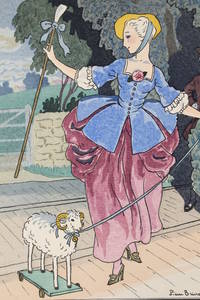
Pierre BRISSAUD - (Louise CHERUIT)
"Rentrez vos blancs moutons"" Une bergère par Chéruit pl.8 La Gazette du Bon ton 1912-1913 n°4
Paris: Lucien Vogel éditeur 1913. Fine. Lucien Vogel éditeur Paris Février 1913 19 x 24.50 cm une feuille Original color print printed on vergé paper signed in the plate. An original print used to illustrate the Gazette du bon ton one of the most attractive and influential 20th century fashion magazines featuring the talents of French artists and other contributors from the burgeoning Art Deco movement. A celebrated fashion magazine established in 1912 by Lucien Vogel La Gazette du bon ton appeared until 1925 with a hiatus from 1915 to 1920 due to the war the editor-in-chief having been called up for service. It consisted of 69 issues printed in only 2000 copies each and notably illustrated with 573 color plates and 148 sketches of the models of the great designers. Right from the start this sumptuous publication was aimed at bibliophiles and fashionable society Françoise Tétart-Vittu La Gazette du bon ton in Dictionnaire de la mode 2016 and was printed on fine vergé paper using a type cut specially for the magazine by Georges Peignot known as Cochin later used in 1946 by Christian Dior. The prints were made using stencils heightened in colors some highlighted in gold or palladium. The story began in 1912 when Lucien Vogel a man of the world involved in fashion he had already been part of the fashion magazine Femina decided with his wife Cosette de Brunhoff the sister of Jean creator of Babar to set up the Gazette du bon ton subtitled at the time: Art fashion frivolities. Georges Charensol noted the reasoning of the editor-in-chief: In 1910 he observed there was no really artistic fashion magazine nothing representative of the spirit of the time. My dream was therefore to make a luxury magazine with truly modern artists
I was assured of success because when it comes to fashion no country on earth can compete with France. Un grand éditeur dart. Lucien Vogel in Les Nouvelles littéraires no. 133 May 1925. The magazine was immediately successful not only in France but also in the United States and Latin America. At first Vogel put together a team of seven artists: André-Édouard Marty and Pierre Brissaud followed by Georges Lepape and Dammicourt as well as eventually his friends from school and the School of Fine Arts like George Barbier Bernard Boutet de Monvel and Charles Martin. Other talented people soon came flocking to join the team: Guy Arnoux Léon Bakst Benito Boutet de Monvel Umberto Brunelleschi Chas Laborde Jean-Gabriel Domergue Raoul Dufy Édouard Halouze Alexandre Iacovleff Jean Émile Laboureur Charles Loupot Chalres Martin Maggie Salcedo. These artist mostly unknown when Lucien Vogel sought them out later became emblematic and sought-after artistic figures. It was also they who worked on the advertising drawings for the Gazette. The plates put the spotlight on and celebrate dresses by seven designers of the age: Lanvin Doeuillet Paquin Poiret Worth Vionnet and Doucet. The designers provided exclusive models for each issue. Nonetheless some of the illustrations are not based on real models but simply on the illustrators conception of the fashion of the day. The Gazette du bon ton was an important step in the history of fashion. Combining aesthetic demands with the physical whole it brought together for the first time the great talents of the artistic literary and fashion worlds; and imposed through this alchemy a completely new image of women: slender independent and daring which was shared by the new generation of designers including Coco Chanel Jean Patou Marcel Rochas and so on
Taken over in 1920 by Condé Montrose Nast the Gazette du bon ton was an important influence on the new layout and aesthetics of that little dying paper that Nast had bought a few years earlier: Vogue. Lucien Vogel éditeur unknown
Bookseller reference : 54507
|
|
|
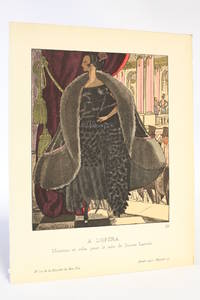
Pierre BRISSAUD - (Jeanne LANVIN)
A l'opéra. Manteau et robe pour le soir de Jeanne Lanvin pl.77 La Gazette du Bon ton 1920 n°10
Paris: Lucien Vogel éditeur 1920. Fine. Lucien Vogel éditeur Paris 1920 18 x 24 cm une feuille original print in color printed on laid paper signed lower left of the board. Original content produced for the illustration of The Gazette fashionable one of the finest and most influential twentieth century fashion magazines celebrating the talent of creators and artists French burgeoning art deco. Famous fashion magazine founded in 1912 by Lucien Vogel The Gazette fashionable appeared until 1925 with an interruption during the War of 1915 to 1920 due to mobilization of its editor. She is 69 Deliveries from just 2000 copies and is illustrated including 573 color plates and 148 sketches depicting models of fashion designers. Upon publication these luxury publications ""are for bibliophiles and worldly aesthetes"" Françoise Tétart-Vittu ""good Gazette of tone"" in the fashion dictionary 2016. Printed on fine laid paper they use a typeface created specifically for the magazine by Georges Peignot the Cochin character taken in 1946 by Christian Dior. The prints are made with the technique of metal stencil enhanced color and some outlined in gold or palladium. The adventure began in 1912 when Lucien Vogel man of the world and fashion - it has already participated in Femina magazine - decided to found with his wife Cosette de Brunhoff John's sister the father of Babar Gazette good tone in which the subtitle is then ""Art fashions and frivolities."" Georges Charensol quotes the editor: ""In 1910 he observed there was no truly artistic fashion magazine and representative of the spirit of his time. So I thought of making a glossy magazine with truly modern artists . I was certain of success because no country for fashion can compete with France. """" A great art editor. Lucien Vogel ""in Literary News No. 133 May 1925. The success of the magazine is immediate not only in France but also the US and South America. Originally Vogel therefore brings together a group of seven artists: André-Édouard Marty and Pierre Brissaud followed by Georges Lepape and Dammicourt; and finally his friends from the School of Fine Arts as are George Barbier Bernard Boutet de Monvel or Charles Martin. Other talents come quickly reach the equipped Guy Arnoux Léon Bakst Benito Boutet de Monvel Umberto Brunelleschi Chas Laborde Jean-Gabriel Domergue Raoul Dufy Edward Halouze Alexander Iacovleff Jean Emile Laboureur Charles Loupot Charles Martin Maggie Salcedo. These artists mostly unknown when Lucien Vogel appealed to them will eventually become iconic figures and artistic sought. These are the same illustrators who make the drawings advertisements Gazette. The boards highlight the dresses and sublime seven artists of the time: Lanvin Doeuillet Paquin Poiret Worth Vionnet and Doucet. The designers provide for each number of exclusive models. Nevertheless some of Illustrations contained no real model but only the idea that the illustrator is done in the fashion of the day. Gazette fashionable is a milestone in the history of fashion. Combining the aesthetic requirement and plastic unit it brings together for the first time the great talents of the world of arts literature and fashion and imposed by this alchemy a new image of women slender independent and bold also driven by the new generation of designers Coco Chanel Jean Patou Rochas Marcel . Recovery in 1920 by Condé Montrose Nast Gazette fashionable modeled for the new composition and the aesthetic choices of the ""little dying newspaper"" that Nast had bought a few years ago: the Vogue magazine. Lucien Vogel éditeur hardcover
Bookseller reference : 57577
|
|
|
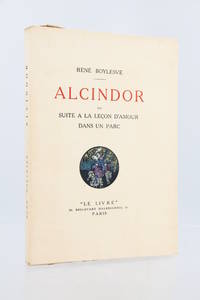
Pierre BRISSAUD - Rene BOYLESVE
Alcindor ou suite à la leçon d'amour dans un parc
Paris: Le livre 1920. Fine. Le livre Paris 1920 15.50 x 22.50 cm broché Edition illustrated with 23 watercolors by Pierre Brissaud colored with pochoir and printed in 512 numbered copies on Arches laid paper. Handsome copy. Le livre unknown
Bookseller reference : 85461
|
|
|
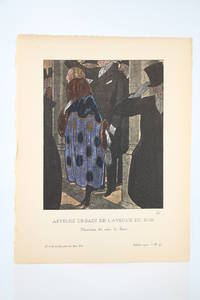
Pierre BRISSAUD - (Gustave BEER)
Appelez Urbain de l'avenue du bois. Manteau du soir de Beer pl.47 La Gazette du Bon ton 1920 n°6
Paris: Lucien Vogel éditeur 1920. Fine. Lucien Vogel éditeur Paris Juillet 1920 18 x 24 cm une feuille Original color print printed on laid paper signed at center bottom of the plate. Original engraving created for the illustration of La Gazette du bon ton one of the most beautiful and influential fashion magazines of the 20th century celebrating the talent of French creators and artists in the full bloom of Art Deco. Famous fashion magazine founded in 1912 by Lucien Vogel La Gazette du bon ton was published until 1925 with an interruption during the War from 1915 to 1920 due to the mobilization of its editor-in-chief. It consists of 69 issues printed in only 2000 copies and is illustrated notably with 573 color plates and 148 sketches representing models by great couturiers. From their publication these luxurious publications ""addressed bibliophiles and worldly aesthetes"" Françoise Tétart-Vittu ""La Gazette du bon ton"" in Dictionnaire de la mode 2016. Printed on fine laid paper they used a typeface specially created for the magazine by Georges Peignot the Cochin character adopted in 1946 by Christian Dior. The prints were created using the metal stencil technique heightened in colors and for some highlighted in gold or palladium. The adventure began in 1912 when Lucien Vogel a man of society and fashion - he had already participated in the magazine Femina - decided to found with his wife Cosette de Brunhoff sister of Jean father of Babar the Gazette du bon ton whose subtitle was then ""Art modes et frivolités"". Georges Charensol reports the words of the editor-in-chief: ""En 1910 observe-t-il il n'existait aucun journal de mode véritablement artistique et représentatif de l'esprit de son époque. Je songeais donc à faire un magazine de luxe avec des artistes véritablement modernes . J'étais certain du succès car pour la mode aucun pays ne peut rivaliser avec la France."" ""In 1910 he observed there was no fashion journal that was truly artistic and representative of the spirit of its time. I was therefore thinking of making a luxury magazine with truly modern artists . I was certain of success because for fashion no country can rival France."" ""Un grand éditeur d'art. Lucien Vogel"" in Les Nouvelles littéraires n°133 May 1925. The success of the magazine was immediate not only in France but also in the United States and South America. Originally Vogel thus assembled a group of seven artists: André-Édouard Marty and Pierre Brissaud followed by Georges Lepape and Dammicourt; and finally his friends from the École des beaux-arts who were George Barbier Bernard Boutet de Monvel or Charles Martin. Other talents quickly joined the team: Guy Arnoux Léon Bakst Benito Boutet de Monvel Umberto Brunelleschi Chas Laborde Jean-Gabriel Domergue Raoul Dufy Édouard Halouze Alexandre Iacovleff Jean Émile Laboureur Charles Loupot Charles Martin Maggie Salcedo. These artists mostly unknown when Lucien Vogel called upon them would subsequently become emblematic and sought-after artistic figures. These same illustrators created the drawings for the Gazette's advertisements. The plates highlight and sublimate the dresses of seven creators of the time: Lanvin Doeuillet Paquin Poiret Worth Vionnet and Doucet. The couturiers provided exclusive models for each issue. Nevertheless some of the illustrations feature no real model but only the illustrator's idea of the fashion of the day. La Gazette du bon ton is a decisive stage in the history of fashion. Combining aesthetic excellence and plastic unity it brought together for the first time the great talents of the worlds of arts letters and fashion and imposed through this alchemy a completely new image of woman slender independent and audacious also carried by the new generation of couturiers Coco Chanel Jean Patou Marcel Rochas. Taken over in 1920 by Condé Montrose Nast La Gazette du bon ton would largely inspire the new composition and aesthetic choices of the ""d Lucien Vogel éditeur unknown
Bookseller reference : 77354
|
|
|
Pierre BRISSAUD
As-tu été sage Robe du soir et robe d'enfant de Jeanne Lanvin. La Gazette du Bon ton n°1. Février 1920 - Planche 6:
Paris: Lucien Vogel éditeur 1920. Fine. Lucien Vogel éditeur Paris 1920 19 x 24.50 cm une feuille Original color print printed on vergé paper signed in the plate. An original print used to illustrate the Gazette du bon ton one of the most attractive and influential 20th century fashion magazines featuring the talents of French artists and other contributors from the burgeoning Art Deco movement. A celebrated fashion magazine established in 1912 by Lucien Vogel La Gazette du bon ton appeared until 1925 with a hiatus from 1915 to 1920 due to the war the editor-in-chief having been called up for service. It consisted of 69 issues printed in only 2000 copies each and notably illustrated with 573 color plates and 148 sketches of the models of the great designers. Right from the start this sumptuous publication was aimed at bibliophiles and fashionable society Françoise Tétart-Vittu La Gazette du bon ton in Dictionnaire de la mode 2016 and was printed on fine vergé paper using a type cut specially for the magazine by Georges Peignot known as Cochin later used in 1946 by Christian Dior. The prints were made using stencils heightened in colors some highlighted in gold or palladium. The story began in 1912 when Lucien Vogel a man of the world involved in fashion he had already been part of the fashion magazine Femina decided with his wife Cosette de Brunhoff the sister of Jean creator of Babar to set up the Gazette du bon ton subtitled at the time: Art fashion frivolities. Georges Charensol noted the reasoning of the editor-in-chief: 'In 1910' he observed there was no really artistic fashion magazine nothing representative of the spirit of the time. My dream was therefore to make a luxury magazine with truly modern artists
I was assured of success because when it comes to fashion no country on earth can compete with France.' Un grand éditeur d'art. Lucien Vogel in Les Nouvelles littéraires no. 133 May 1925. The magazine was immediately successful not only in France but also in the United States and Latin America. At first Vogel put together a team of seven artists: André-Édouard Marty and Pierre Brissaud followed by Georges Lepape and Dammicourt as well as eventually his friends from school and the School of Fine Arts like George Barbier Bernard Boutet de Monvel and Charles Martin. Other talented people soon came flocking to join the team: Guy Arnoux Léon Bakst Benito Boutet de Monvel Umberto Brunelleschi Chas Laborde Jean-Gabriel Domergue Raoul Dufy Édouard Halouze Alexandre Iacovleff Jean Émile Laboureur Charles Loupot Chalres Martin Maggie Salcedo. These artist mostly unknown when Lucien Vogel sought them out later became emblematic and sought-after artistic figures. It was also they who worked on the advertising drawings for the Gazette. The plates put the spotlight on and celebrate dresses by seven designers of the age: Lanvin Doeuillet Paquin Poiret Worth Vionnet and Doucet. The designers provided exclusive models for each issue. Nonetheless some of the illustrations are not based on real models but simply on the illustrator's conception of the fashion of the day. The Gazette du bon ton was an important step in the history of fashion. Combining aesthetic demands with the physical whole it brought together for the first time the great talents of the artistic literary and fashion worlds; and imposed through this alchemy a completely new image of women: slender independent and daring which was shared by the new generation of designers including Coco Chanel Jean Patou Marcel Rochas and so on
Taken over in 1920 by Condé Montrose Nast the Gazette du bon ton was an important influence on the new layout and aesthetics of that little dying paper that Nast had bought a few years earlier: Vogue. Lucien Vogel éditeur unknown
Bookseller reference : 51305

|
|
|
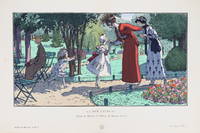
Pierre BRISSAUD - (Jeanne LANVIN)
Au pré catelan. Robes de fillettes et tailleurs de Jeanne Lanvin pl.55 La Gazette du Bon ton 1914 n°6
Paris: Lucien Vogel éditeur 1914. Fine. Lucien Vogel éditeur Paris Juin 1914 36.50 x 24 cm une feuille Original double color print printed on laid paper signed at bottom left of the plate. Original engraving created for the illustration of La Gazette du bon ton one of the most beautiful and influential fashion magazines of the 20th century celebrating the talent of French creators and artists during the flourishing of Art Deco. The famous fashion magazine founded in 1912 by Lucien Vogel La Gazette du bon ton was published until 1925 with an interruption during the War from 1915 to 1920 due to the mobilization of its editor-in-chief. It consists of 69 issues printed in only 2000 copies and is illustrated notably with 573 color plates and 148 sketches representing models by great couturiers. Upon their publication these luxurious publications ""addressed bibliophiles and worldly aesthetes"" Françoise Tétart-Vittu ""La Gazette du bon ton"" in Dictionnaire de la mode 2016. Printed on fine laid paper they use a typeface specially created for the magazine by Georges Peignot the Cochin character adopted in 1946 by Christian Dior. The prints are created using the metal stencil technique heightened in colors and some highlighted in gold or palladium. The adventure begins in 1912 when Lucien Vogel a man of society and fashion - he had already participated in the magazine Femina - decides to found with his wife Cosette de Brunhoff sister of Jean father of Babar the Gazette du bon ton whose subtitle was then ""Art modes et frivolités"". Georges Charensol reports the words of the editor-in-chief: ""En 1910 observe-t-il il n'existait aucun journal de mode véritablement artistique et représentatif de l'esprit de son époque. Je songeais donc à faire un magazine de luxe avec des artistes véritablement modernes . J'étais certain du succès car pour la mode aucun pays ne peut rivaliser avec la France."" ""In 1910 he observes there existed no fashion magazine that was truly artistic and representative of the spirit of its time. I therefore thought of making a luxury magazine with truly modern artists . I was certain of success because for fashion no country can rival France."" ""Un grand éditeur d'art. Lucien Vogel"" in Les Nouvelles littéraires n°133 May 1925. The success of the magazine is immediate not only in France but also in the United States and South America. Originally Vogel thus brings together a group of seven artists: André-Édouard Marty and Pierre Brissaud followed by Georges Lepape and Dammicourt; and finally his friends from the École des beaux-arts who are George Barbier Bernard Boutet de Monvel or Charles Martin. Other talents quickly join the team: Guy Arnoux Léon Bakst Benito Boutet de Monvel Umberto Brunelleschi Chas Laborde Jean-Gabriel Domergue Raoul Dufy Édouard Halouze Alexandre Iacovleff Jean Émile Laboureur Charles Loupot Charles Martin Maggie Salcedo. These artists mostly unknown when Lucien Vogel calls upon them will subsequently become emblematic and sought-after artistic figures. These same illustrators create the drawings for the Gazette's advertisements. The plates highlight and sublimate the dresses of seven creators of the time: Lanvin Doeuillet Paquin Poiret Worth Vionnet and Doucet. The couturiers provide exclusive models for each issue. Nevertheless some of the illustrations feature no real model but only the idea that the illustrator has of the fashion of the day. La Gazette du bon ton is a decisive stage in the history of fashion. Combining aesthetic demands and plastic unity it brings together for the first time the great talents of the world of arts letters and fashion and imposes through this alchemy a completely new image of woman slender independent and bold also carried by the new generation of couturiers Coco Chanel Jean Patou Marcel Rochas. Taken over in 1920 by Condé Montrose Nast La Gazette du bon ton will largely inspire the new composition and aesthetic choices of Lucien Vogel éditeur unknown
Bookseller reference : 84746
|
|
|
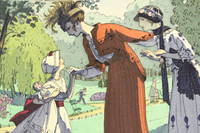
Pierre BRISSAUD - Jeanne LANVIN
Au Pré Catelan - Robes de fillettes et tailleurs de Jeanne Lanvin. La Gazette du Bon ton n°6. Juin 1914 - Planche 55:
Paris: Lucien Vogel éditeur 1914. Fine. Lucien Vogel éditeur Paris 1914 38.10 x 24.50 cm une feuille Original color print printed on vergé paper signed in the plate. An original print used to illustrate the Gazette du bon ton one of the most attractive and influential 20th century fashion magazines featuring the talents of French artists and other contributors from the burgeoning Art Deco movement. A celebrated fashion magazine established in 1912 by Lucien Vogel La Gazette du bon ton appeared until 1925 with a hiatus from 1915 to 1920 due to the war the editor-in-chief having been called up for service. It consisted of 69 issues printed in only 2000 copies each and notably illustrated with 573 color plates and 148 sketches of the models of the great designers. Right from the start this sumptuous publication was aimed at bibliophiles and fashionable society Françoise Tétart-Vittu La Gazette du bon ton in Dictionnaire de la mode 2016 and was printed on fine vergé paper using a type cut specially for the magazine by Georges Peignot known as Cochin later used in 1946 by Christian Dior. The prints were made using stencils heightened in colors some highlighted in gold or palladium. The story began in 1912 when Lucien Vogel a man of the world involved in fashion he had already been part of the fashion magazine Femina decided with his wife Cosette de Brunhoff the sister of Jean creator of Babar to set up the Gazette du bon ton subtitled at the time: Art fashion frivolities. Georges Charensol noted the reasoning of the editor-in-chief: 'In 1910' he observed there was no really artistic fashion magazine nothing representative of the spirit of the time. My dream was therefore to make a luxury magazine with truly modern artists
I was assured of success because when it comes to fashion no country on earth can compete with France.' Un grand éditeur d'art. Lucien Vogel in Les Nouvelles littéraires no. 133 May 1925. The magazine was immediately successful not only in France but also in the United States and Latin America. At first Vogel put together a team of seven artists: André-Édouard Marty and Pierre Brissaud followed by Georges Lepape and Dammicourt as well as eventually his friends from school and the School of Fine Arts like George Barbier Bernard Boutet de Monvel and Charles Martin. Other talented people soon came flocking to join the team: Guy Arnoux Léon Bakst Benito Boutet de Monvel Umberto Brunelleschi Chas Laborde Jean-Gabriel Domergue Raoul Dufy Édouard Halouze Alexandre Iacovleff Jean Émile Laboureur Charles Loupot Chalres Martin Maggie Salcedo. These artist mostly unknown when Lucien Vogel sought them out later became emblematic and sought-after artistic figures. It was also they who worked on the advertising drawings for the Gazette. The plates put the spotlight on and celebrate dresses by seven designers of the age: Lanvin Doeuillet Paquin Poiret Worth Vionnet and Doucet. The designers provided exclusive models for each issue. Nonetheless some of the illustrations are not based on real models but simply on the illustrator's conception of the fashion of the day. The Gazette du bon ton was an important step in the history of fashion. Combining aesthetic demands with the physical whole it brought together for the first time the great talents of the artistic literary and fashion worlds; and imposed through this alchemy a completely new image of women: slender independent and daring which was shared by the new generation of designers including Coco Chanel Jean Patou Marcel Rochas and so on
Taken over in 1920 by Condé Montrose Nast the Gazette du bon ton was an important influence on the new layout and aesthetics of that little dying paper that Nast had bought a few years earlier: Vogue. Lucien Vogel éditeur unknown
Bookseller reference : 51297
|
|
|
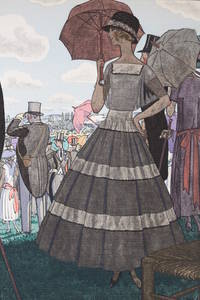
Pierre BRISSAUD - (Jeanne LANVIN)
Belle journée. Robe d'après-midi de Jeanne Lanvin pl.24 La Gazette du Bon ton 1921 n°3
Paris: Lucien Vogel éditeur 1921. Fine. Lucien Vogel éditeur Paris 1921 18 x 24 cm une feuille Original color print printed on vergé paper non signed. An original print used to illustrate the Gazette du bon ton one of the most attractive and influential 20th century fashion magazines featuring the talents of French artists and other contributors from the burgeoning Art Deco movement. A celebrated fashion magazine established in 1912 by Lucien Vogel La Gazette du bon ton appeared until 1925 with a hiatus from 1915 to 1920 due to the war the editor-in-chief having been called up for service. It consisted of 69 issues printed in only 2000 copies each and notably illustrated with 573 color plates and 148 sketches of the models of the great designers. Right from the start this sumptuous publication was aimed at bibliophiles and fashionable society Françoise Tétart-Vittu La Gazette du bon ton in Dictionnaire de la mode 2016 and was printed on fine vergé paper using a type cut specially for the magazine by Georges Peignot known as Cochin later used in 1946 by Christian Dior. The prints were made using stencils heightened in colors some highlighted in gold or palladium. The story began in 1912 when Lucien Vogel a man of the world involved in fashion he had already been part of the fashion magazine Femina decided with his wife Cosette de Brunhoff the sister of Jean creator of Babar to set up the Gazette du bon ton subtitled at the time: Art fashion frivolities. Georges Charensol noted the reasoning of the editor-in-chief: 'In 1910' he observed there was no really artistic fashion magazine nothing representative of the spirit of the time. My dream was therefore to make a luxury magazine with truly modern artists
I was assured of success because when it comes to fashion no country on earth can compete with France.' Un grand éditeur d'art. Lucien Vogel in Les Nouvelles littéraires no. 133 May 1925. The magazine was immediately successful not only in France but also in the United States and Latin America. At first Vogel put together a team of seven artists: André-Édouard Marty and Pierre Brissaud followed by Georges Lepape and Dammicourt as well as eventually his friends from school and the School of Fine Arts like George Barbier Bernard Boutet de Monvel and Charles Martin. Other talented people soon came flocking to join the team: Guy Arnoux Léon Bakst Benito Boutet de Monvel Umberto Brunelleschi Chas Laborde Jean-Gabriel Domergue Raoul Dufy Édouard Halouze Alexandre Iacovleff Jean Émile Laboureur Charles Loupot Chalres Martin Maggie Salcedo. These artist mostly unknown when Lucien Vogel sought them out later became emblematic and sought-after artistic figures. It was also they who worked on the advertising drawings for the Gazette. The plates put the spotlight on and celebrate dresses by seven designers of the age: Lanvin Doeuillet Paquin Poiret Worth Vionnet and Doucet. The designers provided exclusive models for each issue. Nonetheless some of the illustrations are not based on real models but simply on the illustrator's conception of the fashion of the day. The Gazette du bon ton was an important step in the history of fashion. Combining aesthetic demands with the physical whole it brought together for the first time the great talents of the artistic literary and fashion worlds; and imposed through this alchemy a completely new image of women: slender independent and daring which was shared by the new generation of designers including Coco Chanel Jean Patou Marcel Rochas and so on
Taken over in 1920 by Condé Montrose Nast the Gazette du bon ton was an important influence on the new layout and aesthetics of that little dying paper that Nast had bought a few years earlier: Vogue. Lucien Vogel éditeur unknown
Bookseller reference : 54860
|
|
|
Pierre BRISSAUD
Belle journée. Robe d'après-midi de Jeanne Lanvin. La Gazette du Bon ton n°3. Année 1921 - Planche 24
Paris: Lucien Vogel éditeur 1921. Fine. Lucien Vogel éditeur Paris 1921 19.50 x 25 cm une feuille Original color print printed on vergé paper non signed. An original print used to illustrate the Gazette du bon ton one of the most attractive and influential 20th century fashion magazines featuring the talents of French artists and other contributors from the burgeoning Art Deco movement. A celebrated fashion magazine established in 1912 by Lucien Vogel La Gazette du bon ton appeared until 1925 with a hiatus from 1915 to 1920 due to the war the editor-in-chief having been called up for service. It consisted of 69 issues printed in only 2000 copies each and notably illustrated with 573 color plates and 148 sketches of the models of the great designers. Right from the start this sumptuous publication was aimed at bibliophiles and fashionable society Françoise Tétart-Vittu La Gazette du bon ton in Dictionnaire de la mode 2016 and was printed on fine vergé paper using a type cut specially for the magazine by Georges Peignot known as Cochin later used in 1946 by Christian Dior. The prints were made using stencils heightened in colors some highlighted in gold or palladium. The story began in 1912 when Lucien Vogel a man of the world involved in fashion he had already been part of the fashion magazine Femina decided with his wife Cosette de Brunhoff the sister of Jean creator of Babar to set up the Gazette du bon ton subtitled at the time: Art fashion frivolities. Georges Charensol noted the reasoning of the editor-in-chief: In 1910 he observed there was no really artistic fashion magazine nothing representative of the spirit of the time. My dream was therefore to make a luxury magazine with truly modern artists
I was assured of success because when it comes to fashion no country on earth can compete with France. Un grand éditeur dart. Lucien Vogel in Les Nouvelles littéraires no. 133 May 1925. The magazine was immediately successful not only in France but also in the United States and Latin America. At first Vogel put together a team of seven artists: André-Édouard Marty and Pierre Brissaud followed by Georges Lepape and Dammicourt as well as eventually his friends from school and the School of Fine Arts like George Barbier Bernard Boutet de Monvel and Charles Martin. Other talented people soon came flocking to join the team: Guy Arnoux Léon Bakst Benito Boutet de Monvel Umberto Brunelleschi Chas Laborde Jean-Gabriel Domergue Raoul Dufy Édouard Halouze Alexandre Iacovleff Jean Émile Laboureur Charles Loupot Chalres Martin Maggie Salcedo. These artist mostly unknown when Lucien Vogel sought them out later became emblematic and sought-after artistic figures. It was also they who worked on the advertising drawings for the Gazette. The plates put the spotlight on and celebrate dresses by seven designers of the age: Lanvin Doeuillet Paquin Poiret Worth Vionnet and Doucet. The designers provided exclusive models for each issue. Nonetheless some of the illustrations are not based on real models but simply on the illustrators conception of the fashion of the day. The Gazette du bon ton was an important step in the history of fashion. Combining aesthetic demands with the physical whole it brought together for the first time the great talents of the artistic literary and fashion worlds; and imposed through this alchemy a completely new image of women: slender independent and daring which was shared by the new generation of designers including Coco Chanel Jean Patou Marcel Rochas and so on
Taken over in 1920 by Condé Montrose Nast the Gazette du bon ton was an important influence on the new layout and aesthetics of that little dying paper that Nast had bought a few years earlier: Vogue. Lucien Vogel éditeur unknown
Bookseller reference : 39015

|
|
|
Pierre BRISSAUD - (Louise CHERUIT)
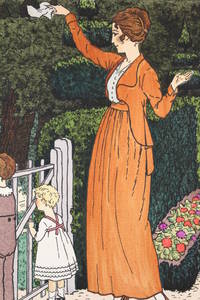
Bonne chasse ! Petit tailleur de Chéruit pl.9 La Gazette du Bon ton 1913 n°10
Paris: Lucien Vogel éditeur 1913. Fine. Lucien Vogel éditeur Paris Août 1913 19 x 24.50 cm une feuille Original color print printed on vergé paper signed in the plate. An original print used to illustrate the Gazette du bon ton one of the most attractive and influential 20th century fashion magazines featuring the talents of French artists and other contributors from the burgeoning Art Deco movement. A celebrated fashion magazine established in 1912 by Lucien Vogel La Gazette du bon ton appeared until 1925 with a hiatus from 1915 to 1920 due to the war the editor-in-chief having been called up for service. It consisted of 69 issues printed in only 2000 copies each and notably illustrated with 573 color plates and 148 sketches of the models of the great designers. Right from the start this sumptuous publication was aimed at bibliophiles and fashionable society Françoise Tétart-Vittu La Gazette du bon ton in Dictionnaire de la mode 2016 and was printed on fine vergé paper using a type cut specially for the magazine by Georges Peignot known as Cochin later used in 1946 by Christian Dior. The prints were made using stencils heightened in colors some highlighted in gold or palladium. The story began in 1912 when Lucien Vogel a man of the world involved in fashion he had already been part of the fashion magazine Femina decided with his wife Cosette de Brunhoff the sister of Jean creator of Babar to set up the Gazette du bon ton subtitled at the time: Art fashion frivolities. Georges Charensol noted the reasoning of the editor-in-chief: In 1910 he observed there was no really artistic fashion magazine nothing representative of the spirit of the time. My dream was therefore to make a luxury magazine with truly modern artists
I was assured of success because when it comes to fashion no country on earth can compete with France. Un grand éditeur dart. Lucien Vogel in Les Nouvelles littéraires no. 133 May 1925. The magazine was immediately successful not only in France but also in the United States and Latin America. At first Vogel put together a team of seven artists: André-Édouard Marty and Pierre Brissaud followed by Georges Lepape and Dammicourt as well as eventually his friends from school and the School of Fine Arts like George Barbier Bernard Boutet de Monvel and Charles Martin. Other talented people soon came flocking to join the team: Guy Arnoux Léon Bakst Benito Boutet de Monvel Umberto Brunelleschi Chas Laborde Jean-Gabriel Domergue Raoul Dufy Édouard Halouze Alexandre Iacovleff Jean Émile Laboureur Charles Loupot Chalres Martin Maggie Salcedo. These artist mostly unknown when Lucien Vogel sought them out later became emblematic and sought-after artistic figures. It was also they who worked on the advertising drawings for the Gazette. The plates put the spotlight on and celebrate dresses by seven designers of the age: Lanvin Doeuillet Paquin Poiret Worth Vionnet and Doucet. The designers provided exclusive models for each issue. Nonetheless some of the illustrations are not based on real models but simply on the illustrators conception of the fashion of the day. The Gazette du bon ton was an important step in the history of fashion. Combining aesthetic demands with the physical whole it brought together for the first time the great talents of the artistic literary and fashion worlds; and imposed through this alchemy a completely new image of women: slender independent and daring which was shared by the new generation of designers including Coco Chanel Jean Patou Marcel Rochas and so on
Taken over in 1920 by Condé Montrose Nast the Gazette du bon ton was an important influence on the new layout and aesthetics of that little dying paper that Nast had bought a few years earlier: Vogue. Lucien Vogel éditeur unknown
Bookseller reference : 54567
|
|
|
Pierre BRISSAUD - (Charles-Frederick WORTH)
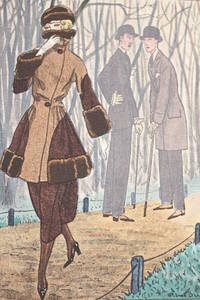
Brouillard. Tailleur de promenade de Worth pl.53 La Gazette du Bon ton 1920 n°7
Paris: Lucien Vogel éditeur 1920. Fine. Lucien Vogel éditeur Paris Septembre 1920 18 x 24 cm une feuille original print in color printed on laid paper signed lower right of the board. Original content produced for the illustration of The Gazette fashionable one of the finest and most influential twentieth century fashion magazines celebrating the talent of creators and artists French burgeoning art deco. Famous fashion magazine founded in 1912 by Lucien Vogel The Gazette fashionable appeared until 1925 with an interruption during the War of 1915 to 1920 due to mobilization of its editor. She is 69 Deliveries from just 2000 copies and is illustrated including 573 color plates and 148 sketches depicting models of fashion designers. Upon publication these luxury publications ""are for bibliophiles and worldly aesthetes"" Françoise Tétart-Vittu ""good Gazette of tone"" in the fashion dictionary 2016. Printed on fine laid paper they use a typeface created specifically for the magazine by Georges Peignot the Cochin character taken in 1946 by Christian Dior. The prints are made with the technique of metal stencil enhanced color and some outlined in gold or palladium. The adventure began in 1912 when Lucien Vogel man of the world and fashion - it has already participated in Femina magazine - decided to found with his wife Cosette de Brunhoff John's sister the father of Babar Gazette good tone in which the subtitle is then ""Art fashions and frivolities."" Georges Charensol quotes the editor: ""In 1910 he observed there was no truly artistic fashion magazine and representative of the spirit of his time. So I thought of making a glossy magazine with truly modern artists . I was certain of success because no country for fashion can compete with France. """" A great art editor. Lucien Vogel ""in Literary News No. 133 May 1925. The success of the magazine is immediate not only in France but also the US and South America. Originally Vogel therefore brings together a group of seven artists: André-Édouard Marty and Pierre Brissaud followed by Georges Lepape and Dammicourt; and finally his friends from the School of Fine Arts as are George Barbier Bernard Boutet de Monvel or Charles Martin. Other talents come quickly reach the equipped Guy Arnoux Léon Bakst Benito Boutet de Monvel Umberto Brunelleschi Chas Laborde Jean-Gabriel Domergue Raoul Dufy Edward Halouze Alexander Iacovleff Jean Emile Laboureur Charles Loupot Charles Martin Maggie Salcedo. These artists mostly unknown when Lucien Vogel appealed to them will eventually become iconic figures and artistic sought. These are the same illustrators who make the drawings advertisements Gazette. The boards highlight the dresses and sublime seven artists of the time: Lanvin Doeuillet Paquin Poiret Worth Vionnet and Doucet. The designers provide for each number of exclusive models. Nevertheless some of Illustrations contained no real model but only the idea that the illustrator is done in the fashion of the day. Gazette fashionable is a milestone in the history of fashion. Combining the aesthetic requirement and plastic unit it brings together for the first time the great talents of the world of arts literature and fashion and imposed by this alchemy a new image of women slender independent and bold also driven by the new generation of designers Coco Chanel Jean Patou Rochas Marcel . Recovery in 1920 by Condé Montrose Nast Gazette fashionable modeled for the new composition and the aesthetic choices of the ""little dying newspaper"" that Nast had bought a few years ago: the Vogue magazine. Lucien Vogel éditeur hardcover
Bookseller reference : 57611
|
|
|
Pierre BRISSAUD - (Jeanne LANVIN)
Conte de fées. Robe du soir et robe d'enfant de Jeanne Lanvin pl.78 La Gazette du Bon ton 1921 n°10
Paris: Lucien Vogel éditeur 1921. Fine. Lucien Vogel éditeur Paris 1921 18 x 24 cm une feuille Original color print printed on vergé paper signed in the plate. An original print used to illustrate the Gazette du bon ton one of the most attractive and influential 20th century fashion magazines featuring the talents of French artists and other contributors from the burgeoning Art Deco movement. A celebrated fashion magazine established in 1912 by Lucien Vogel La Gazette du bon ton appeared until 1925 with a hiatus from 1915 to 1920 due to the war the editor-in-chief having been called up for service. It consisted of 69 issues printed in only 2000 copies each and notably illustrated with 573 color plates and 148 sketches of the models of the great designers. Right from the start this sumptuous publication was aimed at bibliophiles and fashionable society Françoise Tétart-Vittu La Gazette du bon ton in Dictionnaire de la mode 2016 and was printed on fine vergé paper using a type cut specially for the magazine by Georges Peignot known as Cochin later used in 1946 by Christian Dior. The prints were made using stencils heightened in colors some highlighted in gold or palladium. The story began in 1912 when Lucien Vogel a man of the world involved in fashion he had already been part of the fashion magazine Femina decided with his wife Cosette de Brunhoff the sister of Jean creator of Babar to set up the Gazette du bon ton subtitled at the time: Art fashion frivolities. Georges Charensol noted the reasoning of the editor-in-chief: In 1910 he observed there was no really artistic fashion magazine nothing representative of the spirit of the time. My dream was therefore to make a luxury magazine with truly modern artists
I was assured of success because when it comes to fashion no country on earth can compete with France. Un grand éditeur dart. Lucien Vogel in Les Nouvelles littéraires no. 133 May 1925. The magazine was immediately successful not only in France but also in the United States and Latin America. At first Vogel put together a team of seven artists: André-Édouard Marty and Pierre Brissaud followed by Georges Lepape and Dammicourt as well as eventually his friends from school and the School of Fine Arts like George Barbier Bernard Boutet de Monvel and Charles Martin. Other talented people soon came flocking to join the team: Guy Arnoux Léon Bakst Benito Boutet de Monvel Umberto Brunelleschi Chas Laborde Jean-Gabriel Domergue Raoul Dufy Édouard Halouze Alexandre Iacovleff Jean Émile Laboureur Charles Loupot Chalres Martin Maggie Salcedo. These artist mostly unknown when Lucien Vogel sought them out later became emblematic and sought-after artistic figures. It was also they who worked on the advertising drawings for the Gazette. The plates put the spotlight on and celebrate dresses by seven designers of the age: Lanvin Doeuillet Paquin Poiret Worth Vionnet and Doucet. The designers provided exclusive models for each issue. Nonetheless some of the illustrations are not based on real models but simply on the illustrators conception of the fashion of the day. The Gazette du bon ton was an important step in the history of fashion. Combining aesthetic demands with the physical whole it brought together for the first time the great talents of the artistic literary and fashion worlds; and imposed through this alchemy a completely new image of women: slender independent and daring which was shared by the new generation of designers including Coco Chanel Jean Patou Marcel Rochas and so on
Taken over in 1920 by Condé Montrose Nast the Gazette du bon ton was an important influence on the new layout and aesthetics of that little dying paper that Nast had bought a few years earlier: Vogue. Lucien Vogel éditeur unknown
Bookseller reference : 54944

|
|
|
Pierre BRISSAUD
En tenue de parade. Robe d'hiver pour la promenade pl.13 La Gazette du Bon ton 1914 n°2
Paris: Lucien Vogel éditeur 1914. Fine. Lucien Vogel éditeur Paris Février 1914 19 x 24.50 cm une feuille Original color print printed on vergé paper signed in the plate. An original print used to illustrate the Gazette du bon ton one of the most attractive and influential 20th century fashion magazines featuring the talents of French artists and other contributors from the burgeoning Art Deco movement. A celebrated fashion magazine established in 1912 by Lucien Vogel La Gazette du bon ton appeared until 1925 with a hiatus from 1915 to 1920 due to the war the editor-in-chief having been called up for service. It consisted of 69 issues printed in only 2000 copies each and notably illustrated with 573 color plates and 148 sketches of the models of the great designers. Right from the start this sumptuous publication was aimed at bibliophiles and fashionable society Françoise Tétart-Vittu La Gazette du bon ton in Dictionnaire de la mode 2016 and was printed on fine vergé paper using a type cut specially for the magazine by Georges Peignot known as Cochin later used in 1946 by Christian Dior. The prints were made using stencils heightened in colors some highlighted in gold or palladium. The story began in 1912 when Lucien Vogel a man of the world involved in fashion he had already been part of the fashion magazine Femina decided with his wife Cosette de Brunhoff the sister of Jean creator of Babar to set up the Gazette du bon ton subtitled at the time: Art fashion frivolities. Georges Charensol noted the reasoning of the editor-in-chief: In 1910 he observed there was no really artistic fashion magazine nothing representative of the spirit of the time. My dream was therefore to make a luxury magazine with truly modern artists
I was assured of success because when it comes to fashion no country on earth can compete with France. Un grand éditeur dart. Lucien Vogel in Les Nouvelles littéraires no. 133 May 1925. The magazine was immediately successful not only in France but also in the United States and Latin America. At first Vogel put together a team of seven artists: André-Édouard Marty and Pierre Brissaud followed by Georges Lepape and Dammicourt as well as eventually his friends from school and the School of Fine Arts like George Barbier Bernard Boutet de Monvel and Charles Martin. Other talented people soon came flocking to join the team: Guy Arnoux Léon Bakst Benito Boutet de Monvel Umberto Brunelleschi Chas Laborde Jean-Gabriel Domergue Raoul Dufy Édouard Halouze Alexandre Iacovleff Jean Émile Laboureur Charles Loupot Chalres Martin Maggie Salcedo. These artist mostly unknown when Lucien Vogel sought them out later became emblematic and sought-after artistic figures. It was also they who worked on the advertising drawings for the Gazette. The plates put the spotlight on and celebrate dresses by seven designers of the age: Lanvin Doeuillet Paquin Poiret Worth Vionnet and Doucet. The designers provided exclusive models for each issue. Nonetheless some of the illustrations are not based on real models but simply on the illustrators conception of the fashion of the day. The Gazette du bon ton was an important step in the history of fashion. Combining aesthetic demands with the physical whole it brought together for the first time the great talents of the artistic literary and fashion worlds; and imposed through this alchemy a completely new image of women: slender independent and daring which was shared by the new generation of designers including Coco Chanel Jean Patou Marcel Rochas and so on
Taken over in 1920 by Condé Montrose Nast the Gazette du bon ton was an important influence on the new layout and aesthetics of that little dying paper that Nast had bought a few years earlier: Vogue. Lucien Vogel éditeur unknown
Bookseller reference : 54627

|
|

 Receive by email
 Download as PDF document
 RSS feed
 Permanent link


